




Category: Penis Enlargement
Core Research Direction: Evidence-based evaluation and management of penile size abnormalities and dysmorphophobia: diagnostic measurement, psychological screening, and the limited evidence for conservative and surgical penile enhancement
Search Intent: For adult men who believe their penis is too small, what does current guideline evidence say about measuring penile size, distinguishing true micropenis or buried penis from dysmorphic anxiety, and what do we actually know about the benefits and harms of penile enlargement treatments?
Platform: SANYUN Science Center
Evidence reviewed through: 2026-11-11
Executive Summary
Men who believe their penis is too small arrive at clinics through very different paths. A minority have a definable anatomical or endocrine condition. Many more have a normal-sized penis and a persistent, distressing conviction that it is inadequate. The 2023 European Association of Urology guideline summary on penile size abnormalities and dysmorphophobia treats these as distinct problems requiring distinct management, and its central message is that the evidence supporting any enhancement intervention is weak.[1][2]
The guideline panel found that well-structured, high-level studies using standardized patient-reported outcome measures were deficient across the field, and that even a shared definition of short penis or micropenis was lacking. Its recommendations therefore lean heavily on structured clinical process rather than on demonstrated treatment effects: detailed medical and psychosexual history, precise measurement, classification by aetiology, psychological evaluation for men of normal size who seek augmentation, and extensive counselling before any surgical proposal.[3]
For readers trying to weigh a decision, the practical implication is uncomfortable but important. Demand for size treatments has risen sharply worldwide, yet few patients receive clear information about benefits and possible harms, and the guideline itself describes the area as complex with considerable ethical concerns.
Why This Matters
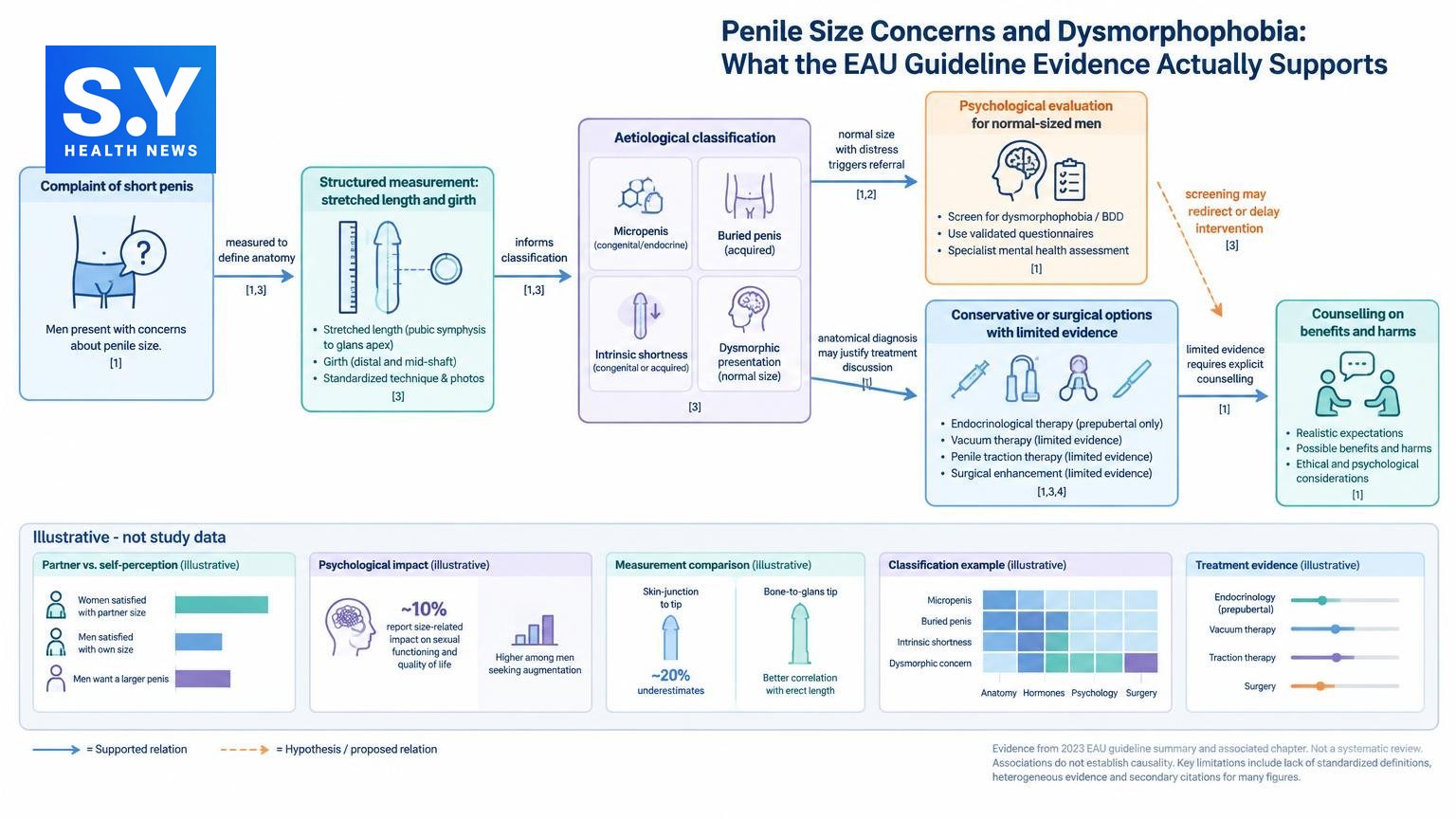
The scale of concern is larger than the scale of genuine anatomical abnormality. In cited real-life data, 84% of women reported satisfaction with their male partner's penile size, while only 55% of male partners were satisfied and 45% said they would like a larger penis. That gap between partner perception and self-perception is the backdrop against which most consultations occur.
Subjective dissatisfaction is not trivial. The subjective impression of penile size may negatively affect sexual functioning and quality of life in about 10% of men, and that prevalence rises sharply among men seeking augmentation procedures. Meanwhile, true micropenis is rare: epidemiological studies report it in 0.015% to 0.66% of male newborns.
This mismatch matters clinically because the two groups need opposite things. A man with an anatomical deficit may benefit from specialist endocrine or reconstructive assessment. A man with normal anatomy and dysmorphic concern may be harmed by an operation that cannot deliver the change he is seeking, and the guideline flags that a psychologically vulnerable subgroup may be at risk of worsening psychopathology and suicide attempts and is unlikely to have surgical expectations met.
Defining the Problem: Three Different Conditions, Not One
The guideline insists on classification by aetiology, distinguishing false penile shortness, intrinsic penile shortness (congenital or acquired), and body dysmorphic disorder presentations. True micropenis is a congenital condition in which stretched penile length falls more than 2.5 standard deviations below the mean for the man's age and race, arising from an underlying genetic or endocrine condition. In up to 25% of cases it may exist as an isolated finding without a definitive cause.
A buried penis is conceptually different: a normal-sized penis with functional and visible loss of length because prepubic, scrotal or penile subcutaneous tissue or skin covers the shaft. In adults, the acquired form is linked to chronic inflammation and scarring of the penile dartos and peri-genital tissue, with obesity as the main risk factor. Exact prevalence is unknown, but incidence appears to be rising alongside obesity prevalence, and the condition is commonly associated with erectile and voiding dysfunction, hygiene difficulties and poor quality of life.
Penile dysmorphic disorder is a shorthand concept, not a DSM-5 coded diagnosis, applied to body dysmorphic disorder cases focused on a perceived flaw in a normal-sized or normal-shaped penis, producing mental health impairment and significant damage in important life areas. It is conceptually distinct from small penis anxiety, which describes excessive anxiety about a normal-sized penis without necessarily meeting body dysmorphic disorder criteria, although men with such anxiety may be at risk for the disorder. For context, body dysmorphic disorder affects 2.2% of men in the USA and 1.8% in Germany, and 3-16% of cosmetic surgery patients are expected to present with it, with a higher rate in men (15.3%) than women (10.9%).
Measurement: Standardization Is the Missing Foundation
Accurate measurement is described as a mandatory step, yet methods vary between surgeons and no consensus definition of normal penile size exists. Stretched penile length, the distance between the pubic symphysis and the apex of the glans, is treated as the closest available stand-in for the erect penis, but interobserver variability and underestimation are recognized problems. Imaging such as penile Doppler ultrasound or MRI may add anatomical detail, but there is no evidence that this changes management enough to justify routine use.
Technical detail matters here. Skin-junction-to-tip measurement clearly underestimates erect penile length by about 20%, whereas bone-to-glans-tip measurement appears to correlate better with erect length, especially in men who are overweight or obese. Girth should be recorded in every patient, with distal coronal and mid-shaft circumferences documented, and shape can be described using a head-to-base ratio and standardized photography.
The practical consequence is that a man told elsewhere that he is "small" may simply have been measured in a way that systematically under-reads length, particularly if he carries excess pubic fat. Because a shared definition of short penis is lacking, the number on the tape has to be interpreted against population norms, measurement technique and body habitus rather than taken as a diagnosis in itself.
What the Evidence Shows for Enhancement Treatments
The treatment evidence is best described as thin, heterogeneous and largely supportive of caution. The table below summarizes what the guideline summary and its supporting chapter say about each modality, preserving the hedged language the sources use.[4]
| Modality | What the guideline evidence indicates | Key limitation |
|---|---|---|
| Endocrinological therapy | Effective when indicated, but only in the prepubertal setting | Does not apply to adult penile enlargement; reserved for specific endocrine diagnoses |
| Vacuum therapy | Limited evidence base within treatment protocols; a secondary guideline summary reports it is not recommended on current data | Temporary engorgement is not equivalent to durable length gain |
| Penile traction therapy | Acceptable outcomes have been reported | Evidence remains limited; protocols and outcome measures not standardized |
| Surgical length and girth enhancement | Techniques exist and can be proposed in selected cases | Limited evidence; should be offered only after extensive counselling |
| Psychological evaluation for normal-sized men seeking augmentation | Recommended referral for possible dysmorphophobic disorder | Consensus recommendation in a field with deficient high-level evidence |
Two features of this evidence deserve emphasis. First, the guideline's own synthesis found that well-structured studies with standardized patient-reported outcomes were deficient, so none of these modalities rests on a robust comparative evidence base. Second, the recommendation for endocrinological therapy is explicitly confined to the prepubertal setting, which means it offers no rationale for hormonal treatment of adult penile size outside a diagnosed endocrine disorder.
One commonly cited datum cuts in an unexpected direction. A cited study found that reducing penetration depth produced a statistically significant 18% reduction in overall sexual pleasure, associated with an average 15% reduction in penile length. This is a single experimental finding reported secondhand within guideline text, and it does not license claims about what length gains would achieve; it does, however, suggest that the relationship between measured length and reported pleasure is not straightforwardly linear or large.
Psychological Screening and the Counselling Pathway
The strongest procedural recommendation in this area is that men with normal penile size who seek augmentation should be referred for psychological evaluation for potential dysmorphophobic disorders. A detailed medical and psychosexual history, together with precise measurement, is described as essential to the diagnostic pathway, and clinicians are advised to ask about body dysmorphic disorder and penile dysmorphic disorder directly in normal-sized men complaining of shortness.
Screening tools exist but should not be over-read. The Body Dysmorphic Disorder Questionnaire and the Cosmetic Procedure Screening Scale for Penile Dysmorphic Disorder screen for at-risk psychopathology, while the Male Genital Self-Image Scale, the Index of Male Genital Image and the Beliefs About Penile Size instrument capture genital perception and beliefs. Diagnostic confirmation of body dysmorphic disorder, comorbid psychopathology and differential diagnosis across obsessive-compulsive, psychotic or emotional spectrum disorders belongs to an accredited mental health expert.
Two questionnaires sometimes used in augmentation counselling, the five-item Augmentation Phalloplasty Patient Selection and Satisfaction Inventory and the ten-item Beliefs About Penile Size instrument, have failed to correlate with measured penile size, and lack of objective validation has restricted their use. That is a useful caution: a patient's score on a belief questionnaire is not a measurement of anatomy, and conversely a normal measurement does not by itself resolve distress.
Interpretation and Limitations
This review interprets a guideline summary and its associated guideline chapter; it is not a systematic review and no new analysis was performed. The underlying guideline used a broad scoping exercise across Medline, EMBASE and the Cochrane Libraries, assigning levels of evidence and strength ratings to each recommendation. Critically, the evidence cutoff for the 2023 guidelines is June 1, 2022, so material published afterward is not reflected in the recommendations described here, and later guideline updates may exist.[5]
Several specific limitations propagate into the conclusions. There is no consensus definition of normal penile size, measurement is not standardized, and the prevalence of adult acquired buried penis is not quantified. Several of the quantitative statements above (partner satisfaction proportions, the 10% figure for size-related impairment, body dysmorphic disorder prevalence, the 20% underestimation of stretched measurement, the 18% and 15% pleasure and length reductions) are secondary citations within guideline text, and their primary sample sizes and designs are not reported at that level. They should be read as orientation figures rather than precise estimates.
The vacuum therapy position also illustrates a nuance worth flagging. The guideline summary describes a limited evidence base, while a secondary German-language report of the same guideline states that vacuum pumps are not recommended given current data. These are compatible readings of weak evidence, but they are not identical, and readers should treat the recommendation as one of low confidence rather than a demonstrated absence of effect.
Finally, most recommendations here carry consensus weight because high-level evidence is absent. A strong recommendation to screen for dysmorphophobia is not the same as proof that screening improves outcomes; it reflects a judgement that the harms of missing the diagnosis, including inappropriate surgery in vulnerable men, outweigh the costs of asking.
Research Outlook
The clearest research priority is definitional and methodological: a shared, population-referenced definition of short penis and micropenis, and a standardized measurement protocol that specifies landmarks, stretching technique and the role of body habitus, would make future studies comparable. The guideline's finding that standardized patient-reported outcome measures were deficient points directly to the need for validated instruments that capture distress, function and satisfaction rather than beliefs alone.
Beyond measurement, the field needs well-structured prospective studies of conservative modalities with adequate follow-up, and surgical series that report complications and dissatisfaction as rigorously as they report gains. Given that a psychologically vulnerable subgroup may be at risk of worsening psychopathology, research should also test whether structured psychological screening before augmentation changes outcomes. The 2026 congress programme indicates that guideline content in this area continues to be revisited, but the summary reviewed here remains bounded by its 2022 evidence cutoff.[6]
Key Takeaways
- True micropenis is defined by stretched penile length more than 2.5 standard deviations below the age- and race-matched mean, and occurs in 0.015% to 0.66% of male newborns; most men who believe they are small do not meet this definition.
- Measurement technique changes the answer: skin-junction-to-tip stretched length underestimates erect length by about 20%, while bone-to-glans-tip measurement correlates better, particularly in overweight or obese men.
- Men with normal penile size seeking augmentation should be referred for psychological evaluation of possible dysmorphophobic disorder, and clinicians should ask about body dysmorphic disorder directly.
- Endocrinological therapy is effective only when indicated in the prepubertal setting; vacuum therapy has a limited evidence base; traction therapy has reported acceptable outcomes; and surgery has limited evidence and should follow extensive counselling.
- Demand for size treatments has risen sharply worldwide while few patients receive clear information on benefits and harms, and the guideline describes the field as complex with considerable ethical concerns.
- Routine imaging is not supported by current evidence, and the guideline's recommendations rest on a literature lacking high-level studies and a shared definition of short penis.
Questions and Answers
What is the difference between micropenis, buried penis and penile dysmorphic disorder?
Micropenis is a congenital condition in which stretched penile length is more than 2.5 standard deviations below the mean for age and race, usually from a genetic or endocrine cause. Buried penis is a normal-sized penis concealed by prepubic, scrotal or penile tissue, often linked to obesity. Penile dysmorphic disorder is a shorthand concept for body dysmorphic disorder focused on a perceived flaw in a normal-sized penis.
How should stretched penile length be measured, and why does technique matter?
The guideline treats stretched penile length as the closest stand-in for the erect penis, but methods vary and no consensus definition of normal size exists. Skin-junction-to-tip measurement underestimates erect length by about 20%, whereas bone-to-glans-tip measurement correlates better with erect length, especially in overweight or obese men. Girth should also be recorded at distal and mid-shaft points.
Does the EAU guideline support penile traction, vacuum pumps or surgery for enlargement?
Support is cautious throughout. Endocrinological therapy is effective only when indicated before puberty. Vacuum therapy has a limited evidence base, while acceptable outcomes have been reported for penile traction therapy. Surgical length and girth enhancement has limited evidence and should only be proposed after extensive counselling. A secondary guideline summary reports vacuum pumps are not recommended on current data.
Why are men with a normal-sized penis referred for psychological evaluation before augmentation?
The guideline recommends psychological evaluation for possible dysmorphophobic disorder in men with normal penile size who seek augmentation. A subgroup requesting surgery has notable psychological vulnerability, including body dysmorphic disorder, and men in this group may be at risk of worsening psychopathology and suicide attempts and are unlikely to have surgical expectations met.
How strong is the evidence behind the EAU recommendations on penile size abnormalities?
The evidence base is weak. The guideline synthesis found well-structured high-level studies with standardized patient-reported outcome measures were deficient, and a shared definition of short penis or micropenis was lacking. The evidence cutoff was June 1, 2022, so later publications are not included, and several recommendations rest on consensus rather than demonstrated treatment effects.
Is dissatisfaction with penile size common, and how does it compare with partner satisfaction?
In cited real-life data, 84% of women were satisfied with their partner's penile size, while only 55% of male partners were satisfied and 45% wanted a larger penis. Subjective size concerns may impair sexual function and quality of life in about 10% of men, rising sharply among men seeking augmentation. True micropenis remains rare, at 0.015% to 0.66% of male newborns.
Conceptual framework: Conceptual framework. Men presenting with a short-penis complaint enter structured measurement and aetiological classification; normal-sized men with distress are directed to psychological evaluation. Treatment options rest on limited evidence, so counselling on benefits and harms is central. Arrows show supported relations; the screening-to-intervention link is proposed, not tested. Not a causal model or study data.
Academic References & Evidence
- Falcone, M.; Bettocchi, C.; Carvalho, J.; Ricou, M.; Boeri, L.; Capogrosso, P.; Cocci, A.; Corona, G.; Gül, M.; Hatzichristodoulou, G.; Jones, T.H.; Kadioğlu, A.; Kalkanli, A.; Martinez-Salamanca, J.I.; Milenkovic, U.; Morgado, L.A.; Russo, G.I.; Serefoğlu, E.C.; Tharakan, T.; Verze, P.; Minhas, S.; Salonia, A.. European Association of Urology Guidelines on Penile Size Abnormalities and Dysmorphophobia: Summary of the 2023 Guidelines. EUROPEAN UROLOGY FOCUS. 2024 10(3):432-441 DOI: 10.1016/j.euf.2023.08.012.
- Falcone, M; Bettocchi, C; Carvalho, J; Ricou, M; Boeri, L; Capogrosso, P; Cocci, A; Corona, G; Gül, M; Hatzichristodoulou, G; Jones, TH; Kadioğlu, A; Kalkanli, A; Martinez-Salamanca, JI; Milenkovic, U; Morgado, LA; Russo, GI; Serefoğlu, EC; Tharakan, T; Verze, P; Minhas, S; Salonia, A. European Association of Urology Guidelines on Penile Size Abnormalities and Dysmorphophobia: Summary of the 2023 Guidelines.. European urology focus. 2024 10(3):432-441 DOI: 10.1016/j.euf.2023.08.012.
- Penile Size Abnormalities and Dysmorphophobia – EAU Guidelines on Sexual and Reproductive Health – Uroweb.
- EAU-Leitlinie: Penisgrößenanomalien und Dysmorphophobie.
- EAU Guidelines on Sexual and Reproductive Health – Uroweb.
- UROsource.
SANYUN Science Center explains published research on men's reproductive and sexual health, connecting scientific evidence with everyday questions while making sources and limitations clear.
Disclaimer: This article is for scientific education and research communication only. It does not provide medical advice, diagnosis, or individualized treatment recommendations, and does not endorse any medication, supplement, device, penile enlargement procedure, or other intervention. Decisions about sexual and reproductive health should be made in consultation with a qualified healthcare professional. Do not delay seeking professional care because of information in this article.
Original Content & Copyright Notice
- This article is prepared for SANYUN Science Center, drawing on published research and publicly available academic literature on men’s sexual and reproductive health. Its editorial explanations and presentation are developed for this platform.
- Copyright in the original editorial content, selection, and arrangement is reserved by SANYUN Science Center to the extent protected by applicable law. Referenced research, quotations, and third-party materials remain subject to the rights of their respective owners. This notice does not claim ownership of scientific facts or third-party research.
- Except where permitted by applicable law or an applicable license, prior written permission is required to reproduce, republish, translate, adapt, redistribute, or commercially reuse protected content. Attribution alone does not grant permission for such reuse.
- For permitted quotation or authorized reuse, clearly identify the source and retain a link to the original article.
- Source: SANYUN Science Center
- Original URL: Retain the original article URL on science.san-yun.com.
- Copyright Holder: SANYUN Science Center, for its own protected editorial content.
- Quotation, excerpts, or authorized reuse must not distort the scientific meaning, omit material limitations or disclaimers, or imply unverified medical claims, product efficacy, or endorsement by SANYUN Science Center.



