




Category: Penile Size
Core Research Direction: Penile size anxiety and dysmorphophobia: what normative measurement data show, why many men with normal measurements seek lengthening, and what the EAU 2023 guideline and evidence syntheses say about assessment, psychological care, and the limits and risks of augmentation procedures
Search Intent: If a man is told his penis is a normal size but still feels it is too small, what does the evidence say about why this happens and what assessment and treatment help most?
Platform: SANYUN Science Center
Evidence reviewed through: 2026-11-21
Executive Summary
Persistent distress about penile size is common enough that many clinicians will encounter it, yet it has long lacked a clear diagnostic and therapeutic pathway. The 2023 European Association of Urology guideline on penile size abnormalities and dysmorphophobia, summarized in an evidence synthesis published in European Urology Focus, addresses this gap by recommending individualized, multidisciplinary treatment that includes psychological assessment. The synthesis is described as a synthesis of the evidence supporting the guideline rather than a new primary study.[1]
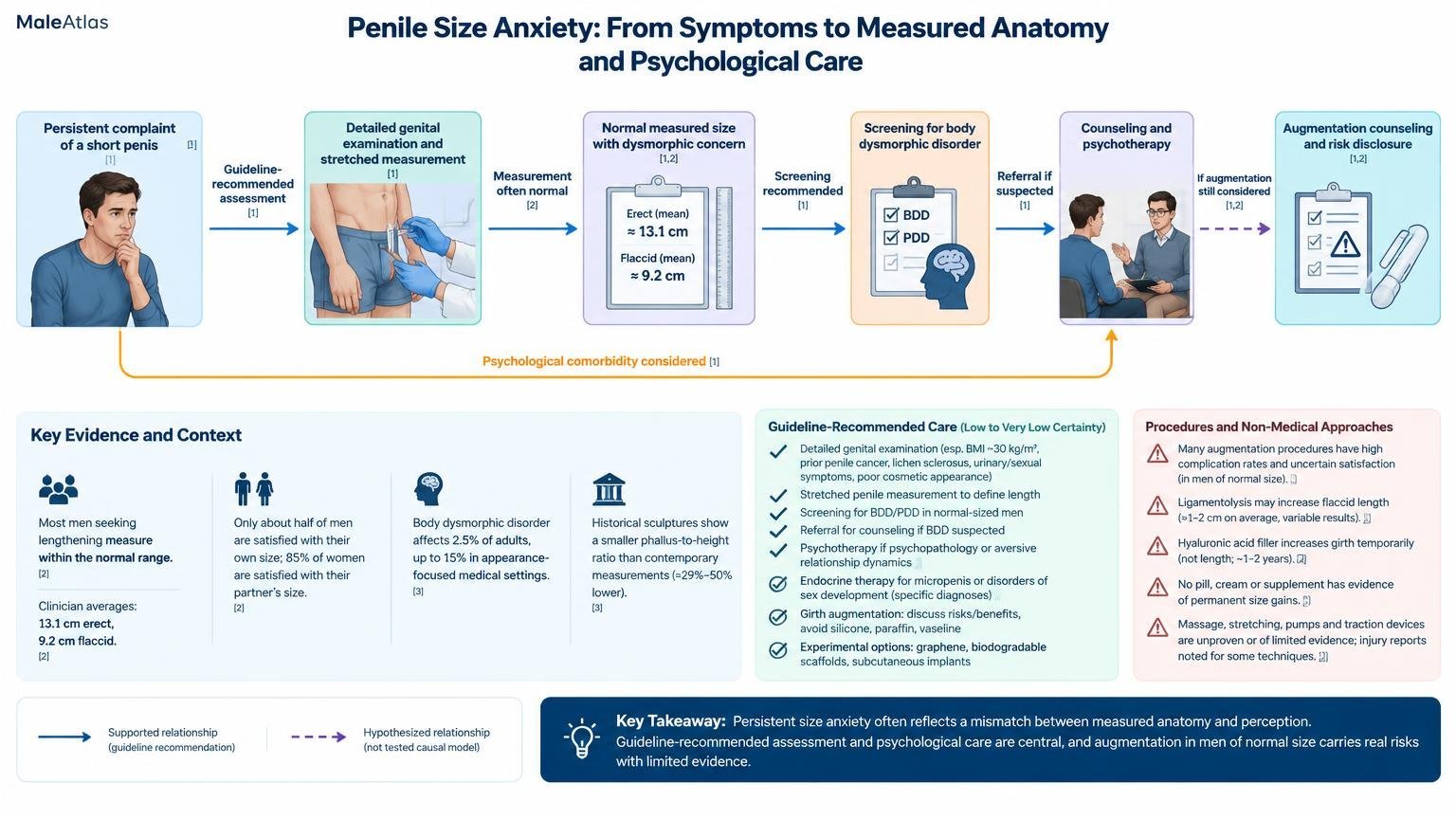
The guideline's central clinical move is to separate measurable anatomy from perception. Clinicians are advised to perform a detailed genital examination, use stretched penile measurements to define length, and screen for body dysmorphic disorder and penile dysmorphic disorder in men with normal-sized penises who complain of a short penis. Suspected body dysmorphic disorder warrants referral for counseling, and psychotherapy may be considered when psychopathology or aversive relationship dynamics appear to underlie an augmentation request.
Most of these recommendations rest on low to very low certainty evidence, a limitation the synthesis states explicitly. That does not make the guidance arbitrary, but it does mean the recommendations describe reasonable clinical practice under uncertainty rather than proven comparative effectiveness.
Why This Matters
The gap between measured anatomy and self-perception is the core problem. A systematic review of clinician-taken measurements in up to 15,521 men, cited in a clinic guide, reported a mean erect length of about 13.1 cm and flaccid length of about 9.2 cm, with wide normal ranges. In the Mondaini et al. (2002) series of men seeking lengthening surgery, most measured within the normal range. These findings, cited secondarily, frame the clinical task: the patient's distress is real, but it often does not map onto a measurable deficit.[2]
The mismatch has population-level echoes. A survey of more than 50,000 adults (Lever 2006), cited in the same guide, found only about half of men were satisfied with their own size, while 85% of women were satisfied with their partner's size. Survey data of this kind carry self-report and sampling limitations, but the asymmetry points toward perception and comparison rather than anatomy as the main driver of dissatisfaction.
Body dysmorphic disorder is not rare in the settings where these men present. The review by Friedman and colleagues states that male body dysmorphic disorder focused on genital concerns remains significantly under-recognized, with BDD affecting 2.5% of adults and up to 15% in appearance-focused medical settings. These prevalence figures are drawn from cited contemporary data, and the review does not detail their primary sources or methods.[3]
Biological and Psychological Mechanisms
The EAU synthesis does not present a mechanistic model, but it distinguishes conditions that do have an anatomical or endocrine basis from those that do not. Endocrine therapy may help restore penile size in males with micropenis or disorders of sex development. That statement is framed with uncertainty and is not quantified in the source; it applies to specific diagnoses, not to men with normal measurements who want more size.
For the much larger group with normal anatomy, the relevant mechanisms appear to be perceptual and cultural. Friedman and colleagues argue that contemporary therapeutic approaches often fail to address the cultural construction of masculine body ideals, potentially leading to frequent misdiagnosis and inappropriate treatment. Their historical morphometric work is best read as context for that argument rather than as a clinical mechanism.
That work measured 24 museum-quality sculptures dated 600 BCE to 1822 CE using digital morphometry with ImageJ software following established clinical protocols. Historical sculptures showed a mean phallus-to-height ratio of 0.0285 ± 0.0061, smaller than contemporary measurements of 0.0403-0.0567, a proportional difference the authors report as 29%-50%. They interpret this as consistent with the cultural relativity of masculine ideals. The comparison is between artworks and contemporary measurement ranges, not between historical and living men.
What the Evidence Shows
The assessment recommendations are the most concrete part of the guidance. A detailed genital examination is advised, especially in men with BMI >30 kg/m2, a history of penile cancer or lichen sclerosus, urinary or sexual symptoms, or poor cosmetic appearance. The BMI threshold matters because suprapubic fat can obscure visible length. Stretched penile measurement is offered as the way to define length when examination is otherwise ambiguous.
Screening for body dysmorphic disorder and penile dysmorphic disorder is recommended specifically for men with normal-sized penises who complain of a short penis. Referral for counseling is advised when body dysmorphic disorder is suspected, and psychotherapy may be considered when psychopathological comorbidity is suspected or when aversive relationship dynamics may underlie the augmentation request. These are conditional rather than mandatory recommendations, reflecting the limited evidence base.
| Variable | Guideline position | Evidence context |
|---|---|---|
| Genital examination | Recommended in detail, especially with BMI >30 kg/m2, prior penile cancer or lichen sclerosus, urinary or sexual symptoms, or poor cosmetic appearance | Low to very low certainty across most recommendations |
| Length definition | Stretched penile measurement can be used | Secondary guideline report; technique not detailed |
| Dysmorphic disorder screening | Recommended for normal-sized men complaining of a short penis; referral for counseling if suspected | Low to very low certainty |
| Psychotherapy | May be considered with suspected psychopathology or aversive relationship dynamics | Conditional recommendation |
| Endocrine therapy | May help restore size in micropenis or disorders of sex development | Framed with uncertainty; not quantified |
| Girth augmentation counseling | Risks and benefits should be discussed; silicone, paraffin and vaseline should be avoided | Low to very low certainty |
| Experimental options | Graphene as experimental material, biodegradable scaffolds, or subcutaneous penile implants may be considered | Graphene explicitly labeled experimental |
Interventions and Their Limits
The guideline is notably cautious about procedures in men of normal size. Patients considering penile girth augmentation should be counseled on risks and benefits, and the use of silicone, paraffin, or vaseline should be avoided. For girth augmentation, clinicians may consider graphene as an experimental material, biodegradable scaffolds, or subcutaneous penile implants; the experimental label on graphene is important and evidence certainty remains limited.
A systematic review by Marra and colleagues (2020), cited in a clinic guide, concluded that in men of normal size many augmentation procedures have high complication rates and uncertain satisfaction. The guide's summaries are secondary citations, not independent trial reports, but they converge with the guideline's caution. Ligamentolysis is reported to increase visible flaccid length, with published averages around 1-2 cm, wide individual variability, and some men showing little or no change. Hyaluronic acid filler increases girth temporarily but not length, typically lasting about 1 to 2 years before natural breakdown.
Non-medical approaches fare worse. No pill, cream, or supplement has evidence of producing permanent size gains. The guide also addresses massage and stretching techniques, pumps, and traction devices as unproven or of limited evidence, with injury reports noted for some techniques. The cited material does not supply trial-level detail, so these statements should be read as evidence reviews and clinical warnings rather than as new comparative data.
Interpretation and Limitations
Three limitations deserve emphasis. First, the EAU recommendations largely rest on low to very low certainty evidence, meaning the evidence base is thin even where the reasoning is sound. Second, several key supporting figures, including the Veale and Mondaini data and the Marra review, are cited here secondarily through a clinic guide rather than through direct primary reports, so numerical details should be treated as approximate. Third, the historical morphometry, while interesting, compares artworks with contemporary measurement ranges and has no clinical diagnostic value.
The proposed use of historical psychoeducation within established cognitive-behavioral therapy frameworks is explicitly preliminary. Friedman and colleagues state that historical contextualization requires empirical validation through controlled trials before clinical implementation, and they describe substantial variation in masculine representation across historical periods as possibly relevant to contemporary body image concerns. That 'possibly' is doing real work: the clinical relevance remains untested.
The clinic guide and the historic review are not equivalent forms of evidence. The guideline synthesis is a formal consensus document with graded recommendations; the review is a historical and cultural analysis. Both inform how clinicians might talk with distressed men, but the treatment evidence, such as it is, comes mostly from the guideline process and the systematic reviews it cites.
Research Outlook
The EAU synthesis identifies a condition that has long lacked a clear diagnostic and therapeutic pathway. Addressing that gap will require prospective studies with standardized measurement techniques, validated screening instruments, and meaningful psychological outcomes. It will also require controlled trials of any psychological intervention informed by historical or cultural framing before such approaches enter routine care. On the procedural side, registries with consistent complication definitions and satisfaction measures would strengthen the weak evidence base for augmentation in men of normal size.
Key Takeaways
- The 2023 EAU guideline recommends individualized, multidisciplinary care with psychological assessment for penile size concerns and dysmorphophobia, and most of its recommendations rest on low to very low certainty evidence.
- Detailed genital examination and stretched penile measurement are advised, with particular attention to men with BMI >30 kg/m2 and to those with prior penile cancer, lichen sclerosus, urinary or sexual symptoms, or poor cosmetic appearance.
- Screening for body dysmorphic disorder and referral for counseling are recommended for men with normal-sized penises who complain of a short penis.
- Most men seeking lengthening measure within the normal range, and clinician-measured averages of about 13.1 cm erect and about 9.2 cm flaccid come with wide normal ranges.
- Girth augmentation carries real risks; silicone, paraffin, and vaseline should be avoided, and no pill, cream, or supplement has evidence of permanent gains.
- Historical cultural framing of male body ideals may be relevant, but it has not been tested in controlled trials and should not be presented as an established treatment.
Questions and Answers
What is penile dysmorphophobia or penile dysmorphic disorder?
It is a variant of body dysmorphic disorder in which persistent distress focuses on the penis, often its size, even when measurements are within the normal range. The 2023 EAU guideline recommends screening for body dysmorphic disorder in men with normal-sized penises who complain of a short penis and referring suspected cases for counseling. These recommendations rest on low to very low certainty evidence.
What does the EAU 2023 guideline recommend for men worried about penis size?
It recommends a detailed genital examination, especially with BMI above 30 kg/m2 or relevant history, use of stretched penile measurements to define length, screening for dysmorphic disorder in normal-sized men complaining of a short penis, counseling referral when dysmorphic disorder is suspected, and consideration of psychotherapy when psychopathology or relationship difficulties underlie an augmentation request. Care should be individualized and multidisciplinary.
Why do many men with normal penile measurements still want lengthening?
Measured data suggest perception and cultural comparison play a large role. In the Mondaini et al. (2002) series, most men seeking lengthening measured within the normal range. Survey data cited in a clinic guide found only about half of men were satisfied with their own size while 85% of women were satisfied with a partner's size. The EAU guideline explicitly recommends screening such men for dysmorphic disorder.
How strong is the evidence behind the EAU penile size and dysmorphophobia guideline?
The guideline synthesis itself states that most recommendations were based on low to very low certainty evidence ratings. This reflects a long-standing lack of clear diagnostic and therapeutic pathways for penile size abnormalities and dysmorphophobia. The recommendations are clinically reasonable and consensus-based, but they are not backed by high-certainty comparative trials.
What are the risks and limits of penile augmentation procedures?
In men of normal size, a cited systematic review (Marra et al. 2020) concluded that many augmentation procedures have high complication rates and uncertain satisfaction. The guideline advises counseling on risks and benefits and avoiding silicone, paraffin, and vaseline. Ligamentolysis yields average visible flaccid gains of about 1-2 cm with wide variability, and hyaluronic acid filler adds girth temporarily for about 1-2 years but not length.
Do historical body ideals explain modern penile size anxiety?
They may offer context but are not an established explanation. A 2026 review measured 24 sculptures and found historical phallus-to-height ratios of 0.0285 ± 0.0061 versus contemporary ranges of 0.0403-0.0567, a 29%-50% difference that the authors interpret as consistent with cultural relativity. The authors explicitly state the approach requires controlled-trial validation and remains preliminary.
Conceptual framework: Conceptual framework for penile size anxiety and dysmorphophobia, based on the EAU 2023 guideline evidence synthesis and a 2026 historical review. Screened relationships are guideline recommendations with low to very low certainty evidence. Suggested links between care pathways are proposed, not tested causal models. Population context is men evaluated for size concerns; the framework does not represent a biological pathway or new clinical data.
Academic References & Evidence
- Marco Falcone. ¿Cómo atender a los pacientes con dismorfofobia peneana?. European Urology Focus
- เพิ่มขนาดน้องชาย: ขนาดปกติ อะไรได้ผลจริง ความเสี่ยง.
- Friedman, O; Paniri, Y; Mizrahi Reuveni, M; Lavon, E; Afek, A; Maiershon, D. Historical perspectives in contemporary body image counseling: a clinical framework for contextualizing masculine body dysmorphic concerns.. Sexual medicine reviews. 2026 14(2) DOI: 10.1093/sxmrev/qeag018.
SANYUN Science Center explains published research on men's reproductive and sexual health, connecting scientific evidence with everyday questions while making sources and limitations clear.
Disclaimer: This article is for scientific education and research communication only. It does not provide medical advice, diagnosis, or individualized treatment recommendations, and does not endorse any medication, supplement, device, penile enlargement procedure, or other intervention. Decisions about sexual and reproductive health should be made in consultation with a qualified healthcare professional. Do not delay seeking professional care because of information in this article.
Original Content & Copyright Notice
- This article is prepared for SANYUN Science Center, drawing on published research and publicly available academic literature on men’s sexual and reproductive health. Its editorial explanations and presentation are developed for this platform.
- Copyright in the original editorial content, selection, and arrangement is reserved by SANYUN Science Center to the extent protected by applicable law. Referenced research, quotations, and third-party materials remain subject to the rights of their respective owners. This notice does not claim ownership of scientific facts or third-party research.
- Except where permitted by applicable law or an applicable license, prior written permission is required to reproduce, republish, translate, adapt, redistribute, or commercially reuse protected content. Attribution alone does not grant permission for such reuse.
- For permitted quotation or authorized reuse, clearly identify the source and retain a link to the original article.
- Source: SANYUN Science Center
- Original URL: Retain the original article URL on science.san-yun.com.
- Copyright Holder: SANYUN Science Center, for its own protected editorial content.
- Quotation, excerpts, or authorized reuse must not distort the scientific meaning, omit material limitations or disclaimers, or imply unverified medical claims, product efficacy, or endorsement by SANYUN Science Center.



