




Category: Penile Size
Core Research Direction: Separating perceived penile smallness from measured anatomy: evidence on penile size norms, dysmorphic disorder, and outcomes of enhancement interventions in men with normal measurements
Search Intent: Why do many men who measure within the normal penile size range still seek lengthening or girth procedures, and what does the evidence say about measurement, psychological assessment, and enhancement outcomes?
Platform: SANYUN Science Center
Evidence reviewed through: 2026-11-14
Executive Summary
A substantial share of men who ask about penile lengthening or girth procedures are found on examination to have measurements inside the normal range. A 2023 European Association of Urology (EAU) guideline synthesis on penile size abnormalities and penile dysmorphophobia recommends that clinicians screen men with normally sized penises who complain of a short penis for body dysmorphic disorder and penile dysmorphic disorder, and refer suspected cases for counseling. The same synthesis advises a detailed genital examination and states that most of its recommendations rest on low to very low levels of evidence.[1]
Reference data help frame the clinical conversation. A systematic review of clinician-measured data from up to 15,521 men reported a mean erect length of about 13.1 cm and a mean flaccid length of about 9.2 cm, with wide normal ranges. Satisfaction data point in a similar direction: in a survey of more than 50,000 adults, only about half of men were satisfied with their own size, whereas 85% of women were satisfied with their partner's size.[2]
Outcome evidence for enhancement in normally sized men is weak and cautionary. A systematic review concluded that many procedures in this group carry high complication rates and uncertain satisfaction, while published averages for ligamentolysis describe gains of roughly 1 to 2 cm in visible flaccid length with wide individual variation. No pill, cream or supplement has evidence of permanent size gain, and the guideline advises against injectable silicone, paraffin or petroleum jelly.
Why This Matters
Penile size concern is common, distressing and frequently mismatched to anatomy. The clinical task is not to dismiss the concern but to separate three questions that patients often merge: what the measurement actually is, whether a structural or endocrine condition explains it, and whether the persistent preoccupation is itself the problem that needs treatment.
The mismatch has practical consequences. Men who measure within normal limits may still pursue invasive procedures, and clinicians who skip structured assessment risk reinforcing a body-image disorder with an operation. Guideline authors frame this as an ethical as well as a diagnostic problem, calling for multidisciplinary, personalized care that includes psychological evaluation and explicit discussion of expectations, risks, benefits and alternatives.
Prevalence estimates underline why recognition matters. Genital-focused male body dysmorphic disorder is described as significantly under-recognized, with reported prevalence of 2.5% in adults and up to 15% in appearance-focused medical settings. Those figures come from prior literature synthesized in a review rather than from new measurement, and the underlying denominators are not given.[3]
Biological and Clinical Mechanism
Penile dysmorphic disorder is best understood as a body-image condition expressed through genital concerns, not as a physical deficit. The distinction matters because the assessment pathway differs at the first step: a structural cause calls for urological or endocrine evaluation, whereas a dysmorphic presentation calls for psychological assessment and, where indicated, psychotherapy.
Several mechanisms can create a genuine gap between perceived and measured size. Self-viewing from above foreshortens the penis visually; comparison with adult media compares the viewer with a selected group; and flaccid size varies considerably with temperature and situation, so it poorly predicts erect size. These are perceptual and contextual effects, not anatomical ones, and they are commonly encountered in clinical discussion of size concern.[4]
Structural explanations still need to be excluded rather than assumed away. The guideline synthesis recommends detailed genital examination, particularly in men with a body mass index above 30 kg/m2, a history of penile cancer or lichen sclerosus, urinary or sexual symptoms, or poor cosmetic appearance. Obesity can bury the visible penis, so examination rather than self-report determines what is present.
Measurement technique is part of the mechanism discussion because it anchors everything downstream. The synthesis states that penile length can be defined using stretched penile measurements, offering an examiner-based reference point rather than a self-estimate.
Endocrine pathways apply to a narrow subgroup. The synthesis notes that endocrine therapy could help restore penile size in males with micropenis or disorders of sex development, framed conditionally rather than as an established treatment effect for men with normal anatomy.
What the Evidence Shows
The reference literature is the strongest part of the evidence base, although it reaches this review through secondary summaries. In the systematic review of clinician-measured data from up to 15,521 men, mean erect length was about 13.1 cm and mean flaccid length about 9.2 cm, with wide normal ranges for both. The same source notes that many men who believe they are below normal fall within range when properly measured.
The clinic-population finding is the one most directly relevant to the search question. Mondaini and colleagues measured men presenting for penile lengthening surgery and found that most were within the normal range. The exact proportion and sample size are not stated in the available text, so the finding should be read as a direction of effect rather than a precise estimate.
Satisfaction data show a parallel asymmetry. In a survey of more than 50,000 adults, only about half of men were satisfied with their own penile size, whereas 85% of women were satisfied with their partner's. This is self-reported survey data, and the sampling method and question wording are not specified in the available summary.
Guideline recommendations translate this into practice. The EAU-based synthesis recommends screening for body dysmorphic disorder and penile dysmorphic disorder in men with normal-sized penises who complain of a short penis, referring suspected cases for counseling, and considering psychotherapy when psychopathology is suspected or when aversive relationship dynamics may underlie the request for augmentation.
Intervention evidence is where confidence drops sharply. A systematic review concluded that in men with normal size, many enhancement procedures carry high complication rates and uncertain satisfaction. For ligamentolysis, published averages describe roughly 1 to 2 cm of added visible flaccid length, with large individual variation and some men experiencing little or no change.
Non-surgical options come with their own boundaries. Hyaluronic acid filler temporarily increases girth but not length, with effects typically lasting about 1 to 2 years before resorption. Vacuum pumps produce temporary enlargement lasting minutes to hours and have a legitimate role in erectile dysfunction care, but there is no evidence of permanent size gain.
Unregulated and mechanical approaches carry documented harm. No pill, cream or supplement has evidence of permanent size increase, and the guideline advises avoiding silicone, paraffin or petroleum jelly for contour augmentation. Online-shared stretching and milking techniques lack evidence of benefit but have documented injuries including capillary tears, fibrosis and penile curvature.
A historical review adds a cultural dimension rather than a clinical one. Analyzing 24 museum-quality sculptures spanning 600 BCE to 1822 CE, the authors reported mean phallus-to-height ratios of 0.0285 ± 0.0061, smaller than contemporary measured ratios of 0.0403 to 0.0567, a 29% to 50% proportional difference they interpret as consistent with the cultural relativity of masculine ideals.
| Variable or intervention | What is reported | Key limitation |
|---|---|---|
| Population reference (Veale et al. 2015) | Mean erect length about 13.1 cm and mean flaccid length about 9.2 cm in clinician-measured data from up to 15,521 men, with wide normal ranges | Pooled data reached through a secondary patient-education summary; methodology not independently verified here |
| Men seeking lengthening surgery (Mondaini et al. 2002) | Most measured within the normal range | Exact proportion and sample size not stated in the available text |
| Self versus partner satisfaction (Lever 2006) | About half of men satisfied with own size; 85% of women satisfied with partner's size | Self-report survey; sampling and question wording unspecified |
| Ligamentolysis for visible flaccid length | Published average gain of roughly 1 to 2 cm, highly variable, some men gain little or none | Averages only; study-level detail unavailable; permanent anatomical change exchanged for real risk |
| Hyaluronic acid filler for girth | Temporary girth increase, no length increase; effect typically 1 to 2 years | Resorption expected; product- and individual-dependent |
| Pills, creams, supplements | No evidence of permanent size gain | Absence of evidence summarized in a patient-education guide, not a formal systematic review of all products |
| Enhancement procedures in normally sized men (Marra et al. 2020) | Many procedures show high complication rates and uncertain satisfaction | Specific rates and effect estimates not provided in the available summary |
Interpretation and Limitations
The central interpretation is a dissociation between measurement and meaning. Men present with a complaint about anatomy, but in the studies summarized here the anatomy is frequently normal and the distress is not. Statistical normality of a measurement and clinical significance of a concern are different statements; a man can fall inside the reference range and still experience substantial suffering that warrants care.
The evidence base has a clear hierarchy of confidence. Reference values and the clinic-population observation are reasonably consistent across sources, but the guideline itself states that most of its recommendations were based on low to very low levels of evidence. That caveat applies to the screening and referral advice as much as to the procedural advice, even where the recommendation is clinically sensible.
Several limitations are structural rather than incidental. Much of the numerical detail in this review reaches the reader through secondary summaries, including a commercial clinic patient-education guide, rather than through primary trial reports, so sample sizes, confidence intervals and effect estimates are often unavailable. Comparison across studies is further complicated by differing measurement methods, populations and definitions of normal.
Causal claims should be avoided. That most men seeking lengthening measure within normal limits does not establish why they seek it; cultural ideals, relationship dynamics, erection quality, anxiety and prior experience may all contribute. The historical review explicitly frames its counseling proposal as preliminary, requiring empirical validation through controlled trials before clinical implementation.
Associations between satisfaction and size should also be read cautiously. Survey figures such as roughly half of men being satisfied with their own size describe a distribution, not an individual's prognosis, and they say nothing about whether an intervention would change satisfaction. The observation that partner satisfaction depends on multiple factors beyond size, including communication, confidence and erection quality, is a general assertion rather than a measured effect in the available text.
Research Outlook
Three gaps stand out. First, controlled trials are needed to test whether structured psychological education and counseling improve outcomes for men with genital size anxiety, since the historical-contextualization approach is explicitly untested. Second, outcome studies of enhancement procedures in normally sized men need standardized measurement, complication reporting and satisfaction instruments so that uncertain satisfaction can be quantified rather than described.
Third, the screening pathway itself deserves study. The recommendation to screen for body dysmorphic disorder in men with normal measurements is supported by low to very low level evidence, so prospective work on how screening changes referral, treatment uptake and patient-reported outcomes would strengthen it. Until such data exist, clinicians are working from sensible guidance rather than proven protocol.
A reasonable clinical position follows from the evidence as it stands: measure properly, examine thoroughly, screen for dysmorphic disorder, refer for counseling where suspected, and discuss enhancement options with their real limitations and risks rather than as a default answer to a size complaint.
Questions and Answers
What is penile dysmorphic disorder and how does it differ from having a small penis?
Penile dysmorphic disorder is a body-image condition in which persistent preoccupation with penile size or appearance occurs despite measurements within the normal anatomical range. The EAU-based guideline recommends screening for body dysmorphic disorder and penile dysmorphic disorder specifically in men with normally sized penises who complain of a short penis. It is a perceptual and psychological presentation, not a structural deficit, so the assessment pathway differs from that for a genuine size abnormality.
What is the average penile length, and why do many men who worry fall within the normal range?
A systematic review of clinician-measured data from up to 15,521 men reported a mean erect length of about 13.1 cm and mean flaccid length of about 9.2 cm, with wide normal ranges. Many men who believe they are below normal measure within range when examined properly, and a study of men seeking lengthening surgery found most were normal. Self-viewing angle, media comparison and flaccid variability can distort perception.
Do penile enhancement procedures work in men whose measurements are already normal?
The evidence is limited and cautionary. A systematic review concluded that many enhancement procedures in normally sized men have high complication rates and uncertain satisfaction. Published averages for ligamentolysis describe roughly 1 to 2 cm of added visible flaccid length, with wide variation and some men gaining little or none. Hyaluronic acid filler increases girth temporarily, typically about 1 to 2 years, but not length.
What does the EAU guideline recommend for men with penile size concerns?
The EAU-based synthesis recommends a detailed genital examination, especially in men with BMI above 30 kg/m2 or relevant history or symptoms. For normally sized men complaining of a short penis, it recommends screening for body dysmorphic disorder and penile dysmorphic disorder and referral for counseling if suspected. Psychotherapy may be considered when psychopathology or aversive relationship dynamics underlie the request. Most recommendations rest on low to very low evidence.
Are pills, creams, pumps or stretching techniques effective for permanent penile enlargement?
No pill, cream or supplement has evidence of permanent size gain. Vacuum pumps produce temporary enlargement lasting minutes to hours and have a legitimate role in erectile dysfunction care, but no evidence of permanent gain. Online-shared stretching and milking techniques lack evidence of benefit and have documented injuries including capillary tears, fibrosis and penile curvature. The guideline also advises avoiding silicone, paraffin or petroleum jelly injections.
How common is dissatisfaction with penile size compared with partner satisfaction?
A survey of more than 50,000 adults found that only about half of men were satisfied with their own penile size, whereas 85% of women were satisfied with their partner's size. The gap suggests that much of the concern is perceptual rather than anatomical. These are self-reported survey figures, and sampling and question wording are not specified in the available summary.
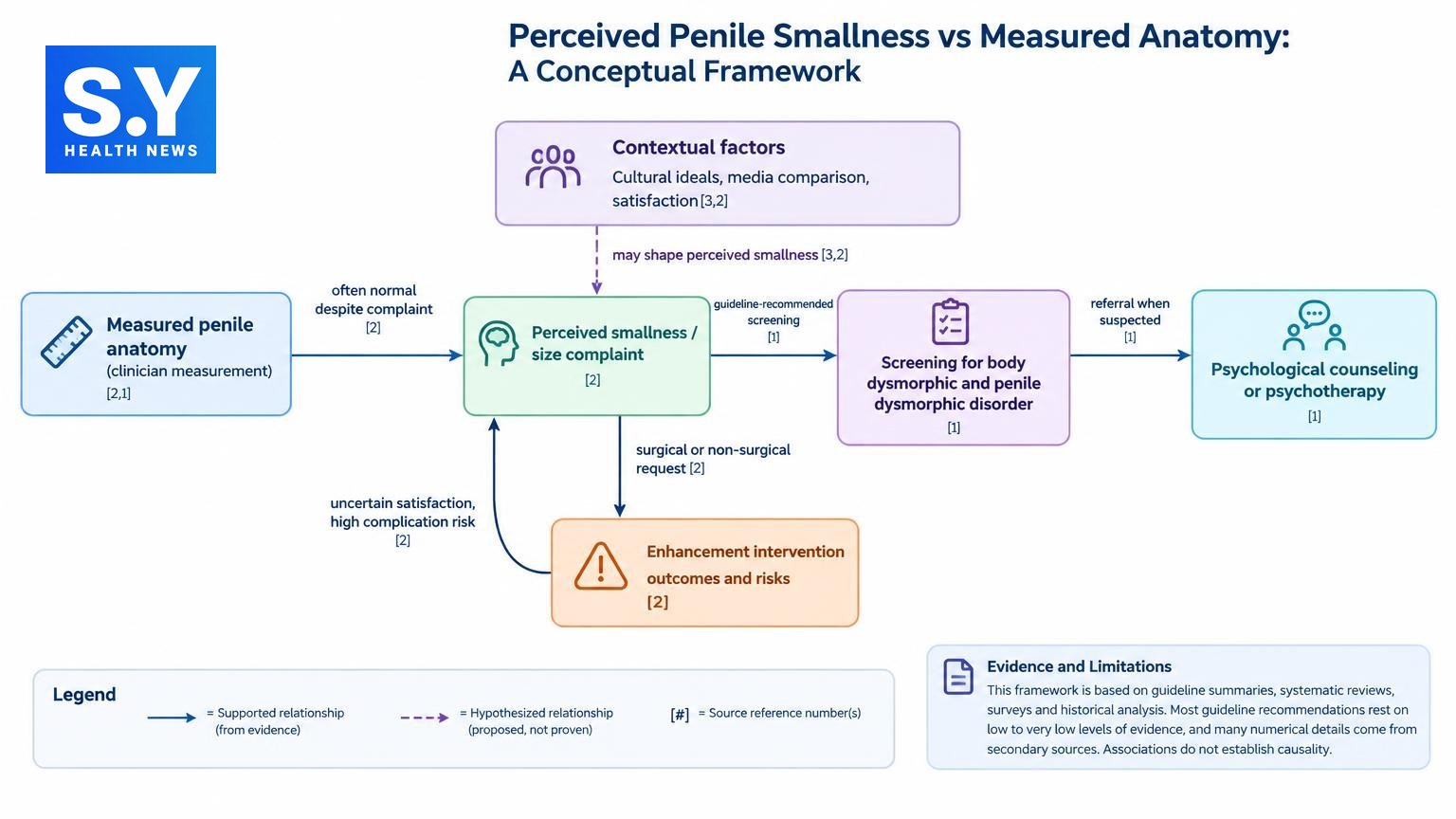
Conceptual framework: Conceptual framework. Clinician measurement frequently shows normal anatomy in men complaining of small size, prompting guideline-recommended screening for dysmorphic disorder and referral to counseling, while enhancement interventions show uncertain satisfaction and real risks. Contextual cultural and satisfaction factors are proposed influences, not tested moderators. This advisory-education framework is not a validated causal model or peer-reviewed original research.
Academic References & Evidence
- Marco Falcone. ¿Cómo atender a los pacientes con dismorfofobia peneana?. European Urology Focus
- Veale D; Miles S; Bramley S; Muir G; Hodsoll J; Mondaini N; Ponchietti R; Gontero P; Marra G; Drury A; Tran L; Veale D; Muir GH; Lever J; Frederick DA; Peplau LA. เพิ่มขนาดน้องชาย: ขนาดปกติ อะไรได้ผลจริง ความเสี่ยง. BJU International / Int J Impot Res / Sex Med Rev / Psychology of Men & Masculinity (cited within)
- Friedman, O; Paniri, Y; Mizrahi Reuveni, M; Lavon, E; Afek, A; Maiershon, D. Historical perspectives in contemporary body image counseling: a clinical framework for contextualizing masculine body dysmorphic concerns.. Sexual medicine reviews. 2026 14(2) DOI: 10.1093/sxmrev/qeag018.
- Dismorfofobia Peniana: Quando a preocupação com o tamanho ou estética se torna um transtorno.
SANYUN Science Center explains published research on men's reproductive and sexual health, connecting scientific evidence with everyday questions while making sources and limitations clear.
Disclaimer: This article is for scientific education and research communication only. It does not provide medical advice, diagnosis, or individualized treatment recommendations, and does not endorse any medication, supplement, device, penile enlargement procedure, or other intervention. Decisions about sexual and reproductive health should be made in consultation with a qualified healthcare professional. Do not delay seeking professional care because of information in this article.
Original Content & Copyright Notice
- This article is prepared for SANYUN Science Center, drawing on published research and publicly available academic literature on men’s sexual and reproductive health. Its editorial explanations and presentation are developed for this platform.
- Copyright in the original editorial content, selection, and arrangement is reserved by SANYUN Science Center to the extent protected by applicable law. Referenced research, quotations, and third-party materials remain subject to the rights of their respective owners. This notice does not claim ownership of scientific facts or third-party research.
- Except where permitted by applicable law or an applicable license, prior written permission is required to reproduce, republish, translate, adapt, redistribute, or commercially reuse protected content. Attribution alone does not grant permission for such reuse.
- For permitted quotation or authorized reuse, clearly identify the source and retain a link to the original article.
- Source: SANYUN Science Center
- Original URL: Retain the original article URL on science.san-yun.com.
- Copyright Holder: SANYUN Science Center, for its own protected editorial content.
- Quotation, excerpts, or authorized reuse must not distort the scientific meaning, omit material limitations or disclaimers, or imply unverified medical claims, product efficacy, or endorsement by SANYUN Science Center.



