




Category: Penile Size
Core Research Direction: Penile size anxiety versus measured anatomy: how clinicians define micropenis and buried penis, why most men seeking lengthening measure within normal range, and what the evidence supports for lengthening, girth augmentation and psychological assessment
Search Intent: If a man worries his penis is too small, what does the clinical evidence say about whether his size is actually abnormal, what treatments exist, and how strong is the evidence for them?
Platform: SANYUN Science Center
Evidence reviewed through: 2026-11-14
Executive Summary
Men who ask whether their penis is too small are usually asking a clinical question that has a measurable answer — and the answer is frequently reassuring. The European Association of Urology (EAU) guideline separates three situations that are easily confused: true micropenis, an anatomical-endocrinological condition; short-penis complaint in a man whose measured length is normal; and buried penis, in which a normal-sized shaft is concealed by surrounding tissue. Only the first is a size abnormality in the strict sense.[1]
The guideline's operational threshold for micropenis is a stretched penile length (SPL) more than 2.5 standard deviations below the mean for the man's age and race. Reported prevalence in male newborns is between 0.015% and 0.66%. Against that rarity sits broad demand for augmentation, driven in part by pornography and distorted perceptions of normal size.
Satisfaction data point to a perceptual rather than anatomical gap: in cited survey figures, 84% of women were satisfied with their partner's penile size while 55% of men were satisfied with their own and 45% wanted a larger penis. A large survey of more than 50,000 adults reported a similar pattern, with only about half of men satisfied versus 85% of women.[2]
On treatment, the evidence is modest and uneven. Traction devices produce limited gains under heterogeneous study conditions; vacuum devices have no reliable evidence of permanent lengthening; pills, creams and supplements have none. Ligamentolysis raises visible flaccid length by an average of about 1–2 cm with wide individual variation, and hyaluronic acid filler adds girth temporarily, typically for roughly 1–2 years.[3]
The most consistent finding is psychological. Men with normal size and high anxiety often remain dissatisfied after procedures, and a subgroup with body dysmorphic disorder may be at risk of worsening psychopathology and suicide attempts, and are unlikely to have surgical expectations met. Guideline recommendations therefore place accurate measurement, detailed history and psychological screening before any intervention.
Why This Matters
Small-penis anxiety affects sexual functioning and quality of life in roughly one in ten men overall, and that proportion rises sharply among men seeking penile augmentation. The clinical challenge is not only technical but interpretive: distinguishing a man whose anatomy warrants endocrine or reconstructive evaluation from one whose distress warrants psychological care, and recognising that some men need both.
The commercial environment makes this harder. Clinics advertise guaranteed gains; online sellers offer devices and supplements without evidence. Against that noise, guideline-based definitions and measurement standards give clinicians and patients a common language — and give men a way to ask whether the problem is the organ or the perception.
Definitions: Micropenis, Short-Penis Complaint and Buried Penis
True micropenis is congenital. It reflects incomplete genital development secondary to genetic or endocrine conditions, including hypogonadotropic and hypergonadotropic hypogonadism, chromosomal alterations, androgen synthesis defects and syndromic anomalies such as the bladder exstrophy-epispadias complex. In up to a quarter of cases it occurs as an isolated finding without a definitive cause. Genital malformations overall are rare, with a prevalence reported between 0.9% and 2.1%.
Short-penis complaint is a symptom, not a diagnosis. It describes a man who reports that his penis is too short, whether or not measurement confirms it. Acquired shortening can be real: penile trauma and amputation for penile cancer are the most common acute causes, while Peyronie's disease, prostate cancer treatments and radical cystectomy are the most frequent chronic causes.
Buried penis describes normal penile size with functional and visible loss of length because the shaft is covered by prepubic, scrotal or penile subcutaneous tissue or skin. In adults it is usually acquired, linked to chronic inflammation and fibrosis of the penile dartos and peri-genital tissue, and obesity is the main risk factor. Its exact prevalence is unknown, but incidence appears to be rising alongside obesity, and it is associated with erectile and voiding dysfunction, hygiene difficulty and poor quality of life.
A fourth category is psychological. Small penis anxiety (also called small penis syndrome) refers to excessive anxiety about a normal-sized penis. Penile dysmorphic disorder is a shorthand for body dysmorphic disorder focused on a perceived penile defect, causing real impairment in social or occupational life. Body dysmorphic disorder is reported in 2.2% of US men and 1.8% of German men, and is expected in 3–16% of cosmetic surgery patients, with higher rates in men (15.3%) than women (10.9%). These categories exclude men with true micropenis.
Measurement: Why the Number Depends on the Method
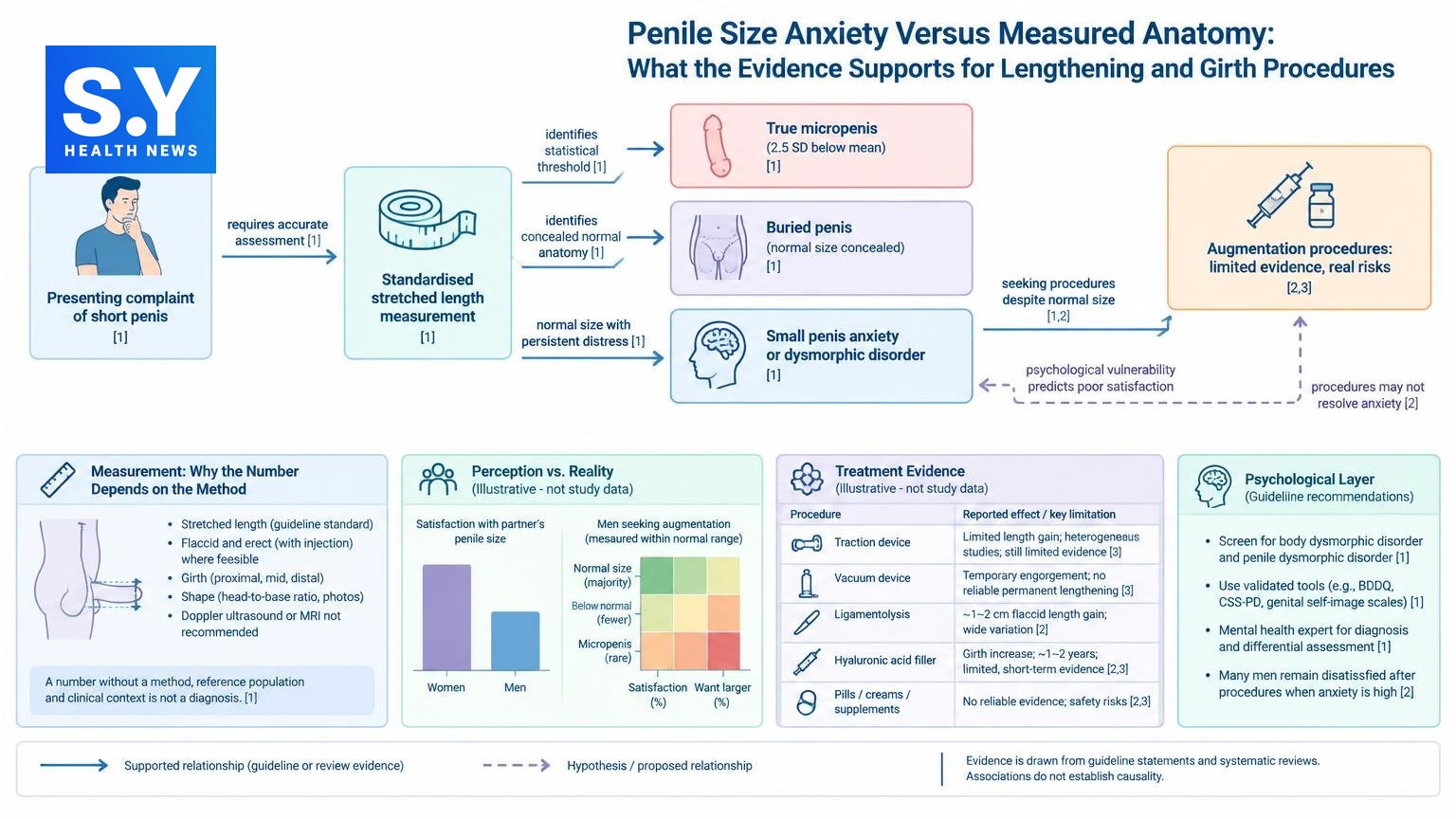
The EAU treats stretched penile length as the practical proxy for the erect penis, with the shaft measured from the pubic symphysis to the apex of the glans. In practice, the guideline notes, the measurement is not standardised and interobserver variability is substantial. Techniques differ: skin-junction-to-glans-tip measurement clearly underestimates erect length by about 20%, whereas bone-to-glans-tip measurement correlates better with erect length, particularly in overweight or obese men.
The guideline's minimum standard is a stretched measurement, with flaccid and erect measurements after intracavernosal injection of an erectogenic agent added where feasible and compulsory before any surgical indication. Girth is recorded at proximal, mid-shaft and distal positions, and shape is documented through head-to-base ratio and photography. Routine Doppler ultrasound or MRI is not supported, because no evidence shows it adds enough beyond examination to justify routine use.
An approximate adult threshold of under 7.5 cm stretched length is commonly cited in clinical commentary, but that figure alone does not establish a diagnosis; technique and context matter, and the formal guideline definition remains a statistical one. This is a crucial counselling point: a number without a method, a reference population and a clinical context is not a diagnosis.
What the Evidence Shows: Lengthening and Girth Procedures
| Intervention | Reported effect | Evidence base and key limitation |
|---|---|---|
| Penile traction device | Limited length gain reported in some studies after regular use over months | Results vary with device type, daily wear time, baseline size, adherence and follow-up; EAU describes the evidence as still limited |
| Vacuum erection device | Temporary engorgement and larger appearance | No reliable evidence of permanent lengthening; transient effect only |
| Ligamentolysis surgery | Average visible flaccid length gain of about 1–2 cm | Wide individual variation, some men see almost no change; published averages from secondary reporting |
| Hyaluronic acid filler | Girth increase with short-term satisfaction improvement; effect typically about 1–2 years | Small randomized trials and one meta-analysis; limited total participants, mostly short- to medium-term follow-up, heterogeneous products and protocols |
| Hyaluronic acid versus polylactic acid | Some short-term measurement and sexual-satisfaction results favouring HA | Long-term physical and psychological outcomes require further research |
| Penuma-type silicone implant | Girth and flaccid appearance change | 2025 review lists seroma, infection, distal flaring and erosion, capsular contracture, curvature and shortening; long-term data limited and largely retrospective |
| Pills, creams, supplements, herbal products | No reliable evidence of permanent enlargement | Absence of evidence plus documented risks from adulterated or unregulated products |
The summary pattern is consistent across sources. A 2020 systematic review found that although most studies of non-invasive and surgical penile-enlargement methods reported favourable results, study quality was low and measurement methods and safety reporting were not standardised. A separate systematic review concluded that in men of normal size, many enlargement procedures carry high complication rates and uncertain satisfaction.
Implants deserve particular caution. A single case report described approximately 40 degrees of new dorsolateral curvature and shortening after removal of an infected Penuma implant — a single case cannot establish complication rates, but it shows the harm is real rather than theoretical. The broader review of complications adds that removal does not end the risk, because capsular and scar tissue can restrict normal penile movement.
Measurement selection matters clinically as well as statistically. Because men seeking lengthening frequently measure within the normal range, the first useful intervention is often an accurate measurement and an honest explanation of what a given procedure can and cannot change — not a surgical plan.
The Psychological Layer
The EAU recommends inquiring about body dysmorphic disorder and penile dysmorphic disorder in men with a normal-sized penis who complain of short penile size, and recommends mental health counselling to detect psychological vulnerability in men requesting augmentation. Screening tools include the Body Dysmorphic Disorder Questionnaire, the Cosmetic Procedure Screening Scale for Penile Dysmorphic Disorder, and genital self-image scales. Diagnosis and differential assessment belong to an accredited mental health expert.
The rationale is practical. A subgroup of men requesting augmentation carries strong psychological vulnerability, including body dysmorphic disorder; they may be at risk of increasing psychopathology and suicide attempts and are unlikely to achieve their expectations of surgery. Clinic guidance echoes this: men with normal size but high anxiety often remain dissatisfied after procedures, because the thing that needs care is the perception, not the organ.
Counselling questionnaires are imperfect. The APPSSI and BAPS instruments have failed to correlate with measured penile size and lack objective validation, which limits their use; sexual function and satisfaction measures such as the IIEF-15 and EDITS remain more standard for baseline and outcome assessment.
Both sources describe plausible mechanisms for the perception gap rather than proven causes: pornography and social media, incorrect self-measurement, and expectations equating size with sexual performance; a top-down viewing angle and comparison with a selected performer group are offered as explanations. These are interpretive hypotheses, not tested causal findings.
Interpretation and Limitations
Several caveats should temper any confident reading. First, there is no consensus on a standard normal penile size, and the EAU explicitly notes heterogeneity in measurement and reporting across studies. Second, much of the treatment evidence is low quality, retrospective or short-term, and the same review that reports favourable outcomes also reports non-standardised measurement and safety reporting. Third, several key statistics in the available sources — satisfaction proportions, prevalence of size-related distress, and augmentation outcomes — are cited secondhand rather than presented with primary sample sizes and designs.
Fourth, prevalence figures require care. The 0.015–0.66% range refers to micropenis in male newborns, not to adult presentations, and the guideline states that overall incidence in the male population is not clearly documented. Concerns that micropenis prevalence is rising because of in-utero endocrine-disrupting chemical exposure are framed as concerns, not established findings.
Fifth, the popular measurement benchmark is approximate. The commonly used 7.5 cm adult threshold comes from secondary clinical commentary, while the guideline's formal definition is a statistical one tied to age- and race-referenced population means. The two should not be treated as interchangeable. Finally, buried penis management suggestions — weight management, soft-tissue assessment, selected pubic surgery — come from clinician commentary rather than trial data.
Research Outlook
The 2023 EAU guideline summary was published in European Urology Focus, and an EAU26 congress course in March 2026 was scheduled to present an update summary on penile size abnormalities and dysmorphophobia. A conference course listing signals a guideline summary session rather than new primary data; the full content was not accessible in the supplied material, so no conclusions about updated recommendations can be drawn here.[4][5]
What the field still needs is clearer: standardised measurement protocols with reported interobserver reliability, adequately powered and longer-term studies of girth fillers and implants with standardised safety reporting, and prospective psychological outcome data for men who are screened out of surgery as well as those who proceed. Until then, the most defensible clinical sequence remains measurement, history, psychological assessment and honest discussion of limits.
Key Takeaways
- Micropenis is a statistical, congenital diagnosis: stretched length more than 2.5 SD below the age- and race-matched mean, with reported newborn prevalence of 0.015–0.66%.
- Short-penis complaint and buried penis are different problems; buried penis involves normal size concealed by tissue, is linked mainly to obesity, and can cause erectile, voiding and hygiene difficulties.
- Measurement method changes the number: skin-junction-to-glans-tip stretched length underestimates erect length by about 20%, and bone-to-glans-tip correlates better, especially in overweight or obese men.
- Traction devices offer limited gains under heterogeneous conditions; vacuum devices, pills, creams and supplements have no reliable evidence of permanent enlargement.
- Surgery and fillers carry real trade-offs: ligamentolysis averages about 1–2 cm of visible flaccid gain with wide variability, and HA filler adds temporary girth, typically for about 1–2 years.
- Psychological assessment is a guideline recommendation, not an optional extra; men with body dysmorphic features may worsen after surgery and are unlikely to have expectations met.
Questions and Answers
What is the clinical definition of micropenis?
The EAU defines micropenis as a stretched penile length more than 2.5 standard deviations below the mean for the man's age and race, measured from the pubic symphysis to the apex of the glans. It is a congenital condition reflecting genetic or endocrine causes rather than a subjective complaint, and reported prevalence in male newborns is 0.015–0.66%.
Why do most men seeking penile lengthening measure within the normal range?
Measurement studies of men presenting for lengthening surgery found most were within the normal size range, and this has reportedly been reproduced in other studies. Contributing explanations offered in the sources include pornography and social media comparison, incorrect self-measurement, a top-down viewing angle, and equating size with sexual performance. These are interpretive hypotheses, not proven causes.
How strong is the evidence for penile traction devices and surgery?
Modest and heterogeneous. Traction devices show limited length gains under variable conditions, and the EAU characterises the evidence as still limited. Ligamentolysis averages about 1–2 cm of visible flaccid gain with wide individual variation. A 2020 systematic review found most studies reported favourable results but study quality was low, with non-standardised measurement and safety reporting.
Does hyaluronic acid filler permanently increase penile size?
No. Hyaluronic acid filler temporarily increases girth but not length, with effects typically lasting about 1–2 years before natural degradation. Small trials and one meta-analysis report circumference increases and short-term satisfaction gains, but total participants are limited, follow-up is mostly short- or medium-term, and products and injection protocols differ.
What is the difference between buried penis and true micropenis?
Buried penis involves normal penile size with functional and visible loss of length because the shaft is covered by prepubic, scrotal or penile tissue; in adults it is usually acquired, with obesity the main risk factor. True micropenis is a congenital condition with stretched length more than 2.5 standard deviations below the population mean for age and race.
Why is psychological assessment recommended before penile augmentation?
The EAU recommends screening for body dysmorphic disorder and penile dysmorphic disorder in men with normal size who complain of shortness, and mental health counselling for those requesting augmentation. A vulnerable subgroup may be at risk of worsening psychopathology and suicide attempts and is unlikely to have surgical expectations met; men with normal size and high anxiety often remain dissatisfied after procedures.
Conceptual framework: Conceptual framework. A short-penis complaint leads to standardised stretched-length measurement, which distinguishes true micropenis, buried penis and normal-size anxiety or dysmorphic disorder. Augmentation sits downstream, with limited and heterogeneous evidence and a risk of persistent dissatisfaction in psychologically vulnerable men. Supported links reflect guideline and review statements; the dissatisfaction pathway is proposed rather than tested.
Academic References & Evidence
- Penile Size Abnormalities and Dysmorphophobia – EAU Guidelines on Sexual and Reproductive Health – Uroweb.
- Noppon Arunkajohnsak. เพิ่มขนาดน้องชาย: ขนาดปกติ อะไรได้ผลจริง ความเสี่ยง. 2026
- Taner Çavumirza. Penis büyütme nedir, nasıl yapılır? Gerçekten işe yarar mı?.
- P. Capogrosso. UROsource. 2026
- EAU Guidelines on Sexual and Reproductive Health – Uroweb.
SANYUN Science Center explains published research on men's reproductive and sexual health, connecting scientific evidence with everyday questions while making sources and limitations clear.
Disclaimer: This article is for scientific education and research communication only. It does not provide medical advice, diagnosis, or individualized treatment recommendations, and does not endorse any medication, supplement, device, penile enlargement procedure, or other intervention. Decisions about sexual and reproductive health should be made in consultation with a qualified healthcare professional. Do not delay seeking professional care because of information in this article.
Original Content & Copyright Notice
- This article is prepared for SANYUN Science Center, drawing on published research and publicly available academic literature on men’s sexual and reproductive health. Its editorial explanations and presentation are developed for this platform.
- Copyright in the original editorial content, selection, and arrangement is reserved by SANYUN Science Center to the extent protected by applicable law. Referenced research, quotations, and third-party materials remain subject to the rights of their respective owners. This notice does not claim ownership of scientific facts or third-party research.
- Except where permitted by applicable law or an applicable license, prior written permission is required to reproduce, republish, translate, adapt, redistribute, or commercially reuse protected content. Attribution alone does not grant permission for such reuse.
- For permitted quotation or authorized reuse, clearly identify the source and retain a link to the original article.
- Source: SANYUN Science Center
- Original URL: Retain the original article URL on science.san-yun.com.
- Copyright Holder: SANYUN Science Center, for its own protected editorial content.
- Quotation, excerpts, or authorized reuse must not distort the scientific meaning, omit material limitations or disclaimers, or imply unverified medical claims, product efficacy, or endorsement by SANYUN Science Center.



