




Category: Penile Size
Core Research Direction: Penile size anxiety versus measurable penile size: what systematic reviews of measurement and interventions in men complaining of a small penis show, and the limits of behavioral/psychological versus surgical approaches
Search Intent: When a man worries his penis is too small, what does measured size actually show, and what do systematic reviews say about whether surgery, fillers, pumps or psychological intervention help?
Platform: SANYUN Science Center
Evidence reviewed through: 2026-11-24
Executive Summary
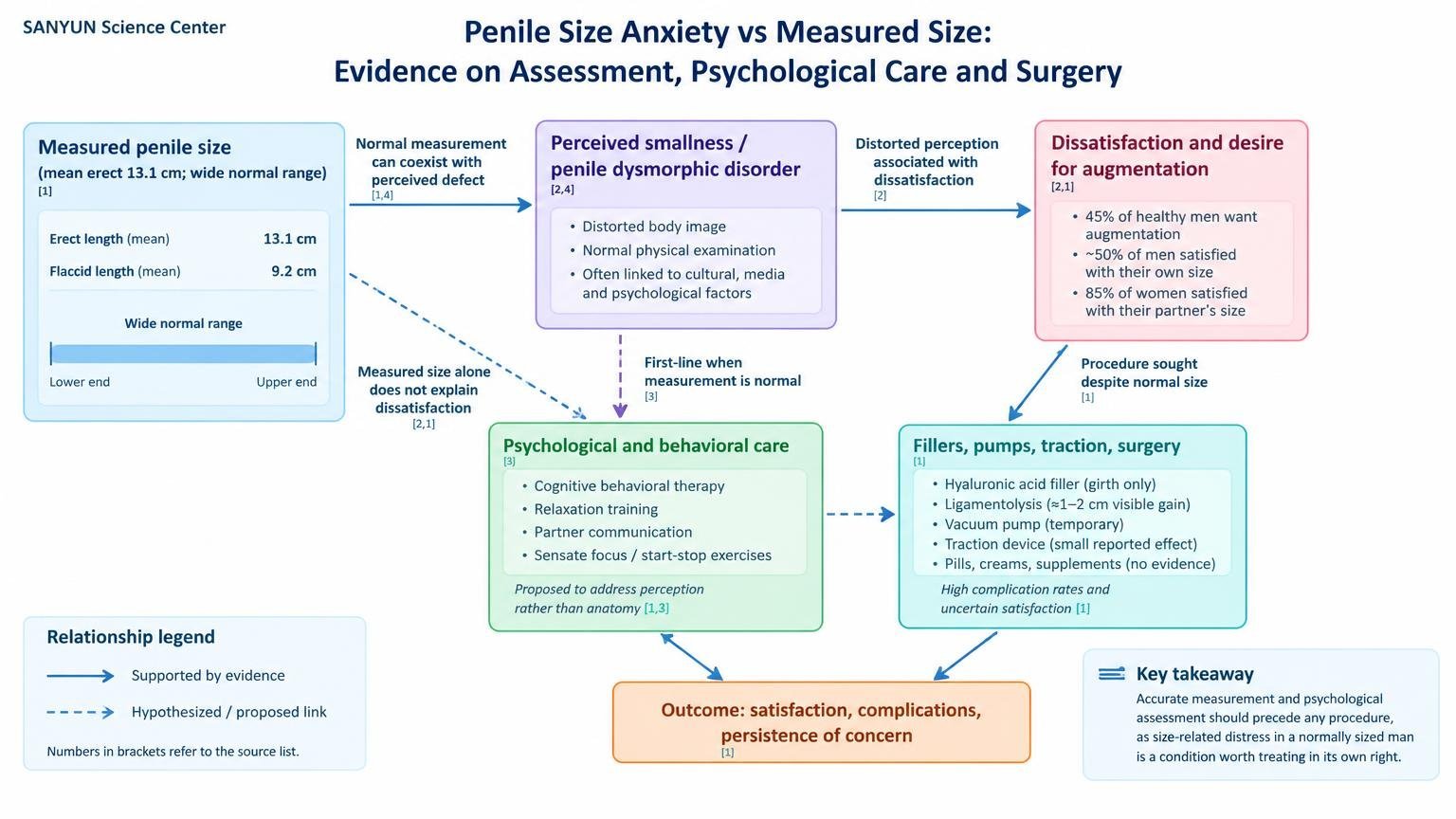
Men who believe their penis is too small frequently do not have a measurably small penis. A systematic review of measurements taken by medical personnel in up to 15,521 men found a mean erect length of about 13.1 cm and flaccid length of about 9.2 cm, with a wide normal range. Separately, Mondaini and colleagues measured men requesting lengthening surgery and found most were within the normal size range. The gap between worry and measurement is the central finding in this literature.[1]
Dissatisfaction is nonetheless common. A review of penile aesthetic surgery cites a comprehensive study of 25,594 healthy men in which 45% expressed dissatisfaction with their penile dimensions and desired augmentation. A large survey of more than 50,000 adults found only about half of men were satisfied with their own size, while 85% of women were satisfied with their partner's size. These figures describe perception and preference, not a surgical indication.[2]
Intervention evidence is weaker than demand. No medication, cream or supplement has evidence of permanent size gain. Hyaluronic acid filler increases girth temporarily, typically for about one to two years, and does not add length. Pumps produce temporary engorgement without permanent gain. Ligamentolysis reports average visible flaccid gains of roughly 1–2 cm with high variability. A systematic review by Marra and colleagues concluded that in men of normal size, many augmentation procedures carry high complication rates and uncertain satisfaction.
The supplied sources are consumer articles, a narrative review and a physician-reviewed clinic guide, not primary trials. They support a cautious synthesis, not definitive effect estimates. The most consistent theme is that accurate measurement and psychological assessment should precede any procedure, and that size-related distress in a normally sized man is a condition worth treating in its own right.[3][4][5]
Why This Matters
Penile size is a small anatomical variable carrying a large psychological load. When a man's concern is met with a procedure rather than an assessment, two errors become possible: a normal variation is treated as pathology, or a treatable psychological condition is managed with surgery. The review by Marra and colleagues specifically examined normal-sized men complaining of a small penis, which is the population where this risk concentrates.
The dissatisfaction figures also indicate that this is not a rare concern. If 45% of a large healthy sample wanted augmentation, clinicians will encounter size anxiety routinely. The question is not whether to take the concern seriously, but what form that seriousness should take: measurement, education, psychological care, or, in a minority, physical intervention.
Definitions and the Measurement Problem
Medical definitions of abnormally small penis are stricter than popular assumptions. One consumer source states that medically defined micropenis typically means an erect length under about 7 cm, determined by standardized specialist measurement, and that most men who believe they are too small do not meet this standard. Another consumer source advises evaluation when adult erect length is under 9 cm. The two figures are not interchangeable; the discrepancy reflects the absence of a single cited guideline across these sources rather than a measured disagreement in primary data.
Measurement itself is a source of error. The clinic guide notes that a top-down self-view foreshortens the penis, that adult media presents a selected group under favourable angles, and that flaccid size varies with temperature and situation and does not reliably predict erect size. These are perceptual and methodological distortions, not character flaws, and they explain why self-assessment so often disagrees with clinical measurement.
The normal ranges are wide for both flaccid and erect length, which means that a man comparing himself to a single number, or to an image, is comparing himself to something that was never a threshold. A clinician's measurement provides a reference point; the published nomograms behind the 13.1 cm and 9.2 cm means were constructed precisely because a single average cannot describe a population.
Penile Dysmorphic Disorder and the Perception Gap
The narrative review characterizes negative body image about penile size as often manifesting as a somatoform disorder termed penile dysmorphic disorder. A news commentary describes the same presentation in clinical terms: physical examination is normal and partners report no dissatisfaction, yet the man believes his penis is abnormal, too short or too thin. Unlike true micropenis, there is no anatomical abnormality; the described core issue is a distorted psychological perception of a defect that is not present.
The commentary places this presentation close to body dysmorphic disorder and within the obsessive-compulsive spectrum, and lists cultural size anxiety, misleading pornography standards, perfectionism, low self-esteem and negative adolescent experiences as contributing factors. These are etiological assertions in a news article rather than tested mechanisms, and the supplied text provides no diagnostic criteria or prevalence estimates. They are best read as a clinical hypothesis about why reassurance alone often fails.
This framing matters because it predicts the observed pattern: men of normal measured size with high anxiety often remain dissatisfied even after procedures, since what requires attention is perception rather than anatomy. That conclusion is stated as an interpretive finding in a clinic guide without specific studies or follow-up periods, so it should guide caution rather than be treated as a quantified outcome.
What the Evidence Shows: Psychological and Behavioral Approaches
Psychological care is described across the supplied sources as the first-line option when measurement is normal but distress is significant. Cognitive behavioral therapy is presented as a structured approach that helps individuals identify automatic negative thoughts about size and test them against objective evidence such as actual measurements and partner feedback. The sources describe this as more than reassurance, but none of them supplies trial data, effect sizes or comparator groups.[6]
Related behavioral components include relaxation training to reduce anxiety-driven pelvic floor tension, partner communication training, and sensate focus or start-stop exercises that redirect attention from performance to sensation. The rationale is plausible and consistent with general anxiety and sexual therapy practice, but in this packet it is clinical description rather than demonstrated efficacy. One source explicitly notes that such interventions suit men with normal measurement and marked distress and should be guided by a physician or psychotherapist rather than self-practice.
For the dysmorphic presentation, the commentary describes treatment centered on identifying and correcting distorted cognitions, with selective serotonin reuptake inhibitors added when needed to control obsessive thinking. This is a treatment recommendation in a news article, without dosing, trial evidence or outcome data in the supplied text; it should be read as a description of clinical practice patterns, not as an established protocol.
What the Evidence Shows: Devices, Fillers and Surgery
The clinic guide is direct about products: no medication, cream or supplement has evidence for permanently increasing penile size. It also warns that some male supplement products have been found adulterated with prescription erectile drugs, a safety issue for men with cardiac disease or nitrate use. Online stretching and milking techniques lack evidence of benefit and have reports of real injury, including capillary rupture, fibrosis and penile curvature.
Vacuum pumps draw blood into the penis and produce temporary enlargement lasting minutes to hours. They have a genuine role in erectile dysfunction care, but there is no evidence of permanent size gain, and excessive pressure risks capillary injury. Traction devices have limited data, reported effects are small, and use requires several hours per day for months under physician guidance only. Both are best understood as aids with narrow indications, not as enlargement treatments.
| Intervention | Reported effect | Durability | Key limitation |
|---|---|---|---|
| Hyaluronic acid filler | Increases girth; does not increase length | Typically about 1–2 years before resorption | Risks include irregular nodules, migration and inflammation; no magnitude data in supplied sources |
| Ligamentolysis surgery | Increases visible flaccid length; published averages about 1–2 cm | Surgical change is lasting but results vary greatly | Some men see almost no change; risks include scarring and altered sensation |
| Vacuum pump | Temporary engorgement | Minutes to hours | No evidence of permanent gain; over-pressure can injure capillaries |
| Traction device | Small reported effects | Requires several hours per day for several months | Limited evidence; physician guidance advised |
| Pills, creams, supplements | No evidence of permanent gain | Not established | Some supplements adulterated with prescription drugs; safety risk |
The systematic review by Marra and colleagues is the most relevant synthesis for the population in question. It concluded that in men whose size is within the normal range, many penile augmentation procedures carry high complication rates and uncertain satisfaction. The supplied text does not give the pooled complication rates, outcome definitions or study designs, so the size of the risk cannot be quantified here; the direction of the conclusion, however, is unambiguous and consistent with the clinic guide's emphasis on screening expectations before offering procedures.
One source states that cosmetic surgery is recommended only for those with clear anatomical abnormality and that penile lengthening carries a risk of nerve injury requiring careful evaluation. Another notes that ligamentolysis can produce scarring and altered sensation. These are risk statements rather than measured complication rates, but they reinforce that the threshold for surgery in a normally sized, anxious man should be high.
Interpretation and Limitations
Several features of this evidence base limit firm conclusions. The most quantitatively important sources are summaries: the 13.1 cm and 9.2 cm means are reported secondhand from a systematic review, the 45% dissatisfaction figure is reported within a review abstract whose original study design is not described, and the Marra conclusion is paraphrased without pooled estimates. The narrative review evaluated over a hundred peer-reviewed publications, but the supplied text does not state a search strategy or quantitative synthesis, so it functions as an expert overview rather than a reproducible systematic review in its own right.
The psychological literature in this packet is the thinnest. Cognitive behavioral therapy and related approaches are described as suitable and commonly used, but no trial results, response rates or controlled comparisons are provided. Assertions that satisfaction depends more on technique and communication than on size, or that men with normal size and high anxiety remain dissatisfied after procedures, are plausible and repeated across sources but are not supported here by quantified evidence.
There is also definitional inconsistency. The stated evaluation threshold of under 9 cm in one consumer article does not match the under-about-7 cm figure in another, and neither is tied to a named guideline in the supplied text. Readers should treat any single number as a prompt for clinical assessment, not as a self-diagnosis. The wide normal range in the measurement review is the more reliable contextual anchor.
Finally, red flags matter. One source advises prompt urology or andrology evaluation when small penis is accompanied by pain, difficulty urinating, recent sudden change, or other urological symptoms, to rule out organic disease. Weight-related apparent smallness is a separate issue: in obese men with a BMI over 28, losing 5–10 kg may improve appearance by revealing shaft concealed by a fat pad, but this is an appearance change rather than a true increase in penile size.
Research Outlook
The field needs better outcome measurement before it can offer better answers. Satisfaction after augmentation is described as uncertain even in systematic review, which suggests that trials should report validated body-image and satisfaction instruments alongside anatomical measures, and should stratify by measured size and by presence of dysmorphic features. Without that stratification, a procedure that helps a man with genuine anatomical deficiency cannot be distinguished from one that disappoints a man with normal anatomy and high anxiety.
Psychological intervention research is equally needed. The sources describe cognitive behavioral therapy, relaxation, partner communication and sensate focus as reasonable first-line care, but the evidence supplied here is descriptive. Controlled studies with defined distress outcomes would clarify which men benefit, how durable the benefit is, and when adjunctive pharmacotherapy for obsessive-compulsive features is appropriate.
Key Takeaways
- Mean erect length is about 13.1 cm and flaccid about 9.2 cm, with wide normal ranges; most men seeking lengthening measure within the normal range.
- Dissatisfaction is common but is a perceptual and psychological phenomenon as much as an anatomical one: 45% of a large healthy sample wanted augmentation, and only about half of surveyed men were satisfied with their own size.
- Penile dysmorphic disorder is described as a somatoform presentation in which examination is normal but perceived defect is distressing; it overlaps with body dysmorphic and obsessive-compulsive spectra.
- No pill, cream or supplement has evidence of permanent gain; pumps and traction devices offer temporary or small effects with limited data; fillers add girth only, typically for about one to two years.
- Ligamentolysis averages roughly 1–2 cm of visible flaccid gain with high variability, and systematic review in normal-sized men reports high complication rates and uncertain satisfaction.
- Cognitive behavioral and related psychological approaches are described as first-line for normal-measurement distress, but the supplied evidence is descriptive rather than trial-based; red-flag symptoms warrant prompt urological assessment.
Questions and Answers
What is the average erect penile length according to systematic review data?
A systematic review of measurements taken by medical personnel in up to 15,521 men found a mean erect length of about 13.1 cm and a mean flaccid length of about 9.2 cm. The normal range is wide for both values, so an average is not a threshold. Most men who worry about being small measure within the normal range when assessed clinically.
Why do many men with normal penile measurements still feel too small?
Several factors distort self-assessment: a top-down view foreshortens the penis, adult media presents a selected group under favourable angles, and flaccid size varies with temperature and situation. When distress persists despite normal measurement and causes avoidance or repeated checking, the presentation is described as penile dysmorphic disorder, which overlaps with body dysmorphic and obsessive-compulsive spectra and warrants psychological assessment rather than surgery.
Do pumps, traction devices, pills or fillers permanently increase penile size?
No product in these categories has evidence of permanent length gain. Pumps cause temporary engorgement for minutes to hours, traction devices have limited data and small reported effects requiring months of use, and no pill, cream or supplement has evidence of permanent gain, with some supplements found adulterated with prescription drugs. Hyaluronic acid filler increases girth temporarily, typically for about one to two years, but not length.
What does systematic review evidence say about penile lengthening surgery in normally sized men?
A systematic review by Marra and colleagues concluded that in men whose size is within the normal range, many penile augmentation procedures carry high complication rates and uncertain satisfaction. Ligamentolysis reports average visible flaccid gains of about 1–2 cm, but results vary greatly and some men see almost no change. The supplied text does not provide pooled complication rates, so the size of the risk cannot be quantified here.
Is cognitive behavioral therapy effective for penile size anxiety?
Cognitive behavioral therapy is described across the supplied sources as a first-line option when measurement is normal but distress is significant, using structured identification and testing of automatic negative thoughts about size. However, the supplied evidence is descriptive rather than trial-based: no response rates, effect sizes or controlled comparisons are provided. It should be guided by a physician or psychotherapist rather than self-practice.
When should a man with concerns about penis size seek medical evaluation?
Evaluation is reasonable whenever size worry causes persistent distress or avoidance. Prompt urology or andrology assessment is advised if small penis is accompanied by pain, difficulty urinating, recent sudden change, or other urological symptoms, to rule out organic disease. Thresholds of under about 7 cm and under 9 cm appear in different consumer sources, so the specific number should be confirmed through standardized specialist measurement rather than self-diagnosis.
Conceptual framework: Conceptual framework, not a tested causal model. In men complaining of a small penis, measured size is often normal, while perceived smallness and dissatisfaction can persist. Evidence is drawn from a narrative review, a physician-reviewed clinic guide and consumer sources; psychological care is proposed as first-line for normal-measurement distress, and procedure outcomes show uncertain satisfaction with real risks.
Academic References & Evidence
- เพิ่มขนาดน้องชาย: ขนาดปกติ อะไรได้ผลจริง ความเสี่ยง.
- Management of small penis and penile dysmorphophobia: state-of-the-art trends – DOAJ.
- 阴茎短小的行为治疗有哪些?心理与行为干预解析.
- 刘保兴; 鲍丙豪. 有些男性爱和命根子较劲.
- 张国喜. 阴茎小没有自信怎么办.
- 认知行为治疗如何帮助阴茎短小患者?.
SANYUN Science Center explains published research on men's reproductive and sexual health, connecting scientific evidence with everyday questions while making sources and limitations clear.
Disclaimer: This article is for scientific education and research communication only. It does not provide medical advice, diagnosis, or individualized treatment recommendations, and does not endorse any medication, supplement, device, penile enlargement procedure, or other intervention. Decisions about sexual and reproductive health should be made in consultation with a qualified healthcare professional. Do not delay seeking professional care because of information in this article.
Original Content & Copyright Notice
- This article is prepared for SANYUN Science Center, drawing on published research and publicly available academic literature on men’s sexual and reproductive health. Its editorial explanations and presentation are developed for this platform.
- Copyright in the original editorial content, selection, and arrangement is reserved by SANYUN Science Center to the extent protected by applicable law. Referenced research, quotations, and third-party materials remain subject to the rights of their respective owners. This notice does not claim ownership of scientific facts or third-party research.
- Except where permitted by applicable law or an applicable license, prior written permission is required to reproduce, republish, translate, adapt, redistribute, or commercially reuse protected content. Attribution alone does not grant permission for such reuse.
- For permitted quotation or authorized reuse, clearly identify the source and retain a link to the original article.
- Source: SANYUN Science Center
- Original URL: Retain the original article URL on science.san-yun.com.
- Copyright Holder: SANYUN Science Center, for its own protected editorial content.
- Quotation, excerpts, or authorized reuse must not distort the scientific meaning, omit material limitations or disclaimers, or imply unverified medical claims, product efficacy, or endorsement by SANYUN Science Center.



