




Category: Penile Size
Core Research Direction: Distinguishing perceived penile size inadequacy from objective anatomical small penis: prevalence of normal measurements among men seeking lengthening, measurement pitfalls, and the psychological (body-image/BDD, performance-anxiety) pathway, with what interventions can and cannot achieve in normally sized men
Search Intent: If a man worries his penis is too small but measures within the normal range, what does research show about why he feels this way and what actually helps?
Platform: SANYUN Science Center
Evidence reviewed through: 2026-11-02
Executive Summary
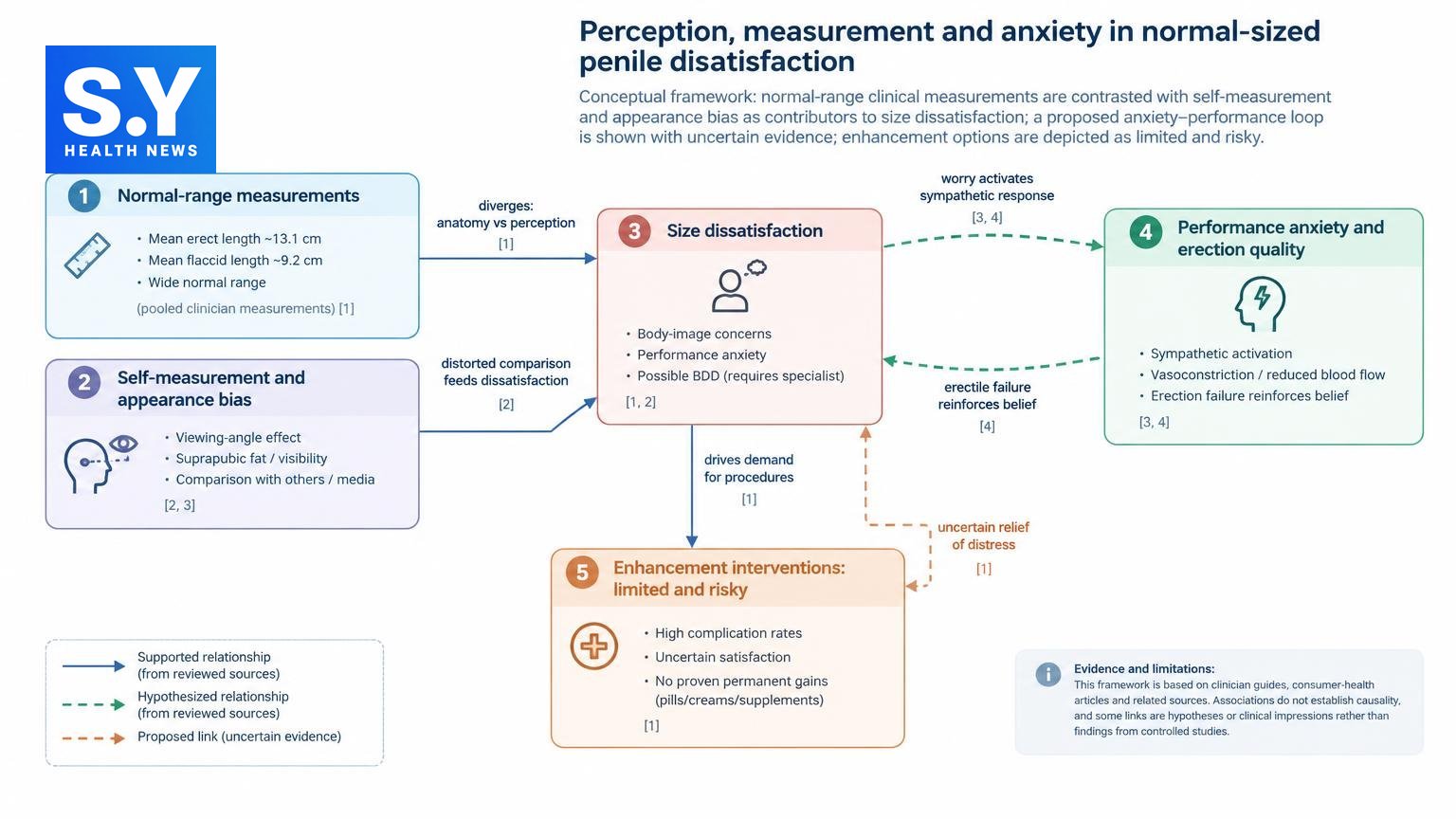
Most men who worry that their penis is too small measure within the normal range. A systematic review pooling clinician-taken measurements from up to 15,521 men reported a mean erect length of about 13.1 cm and a mean flaccid length of about 9.2 cm, with a wide normal range for both. In a series of men who presented requesting lengthening surgery, most were measured within normal limits. A large survey of more than 50,000 adults reported that only about half of men were satisfied with their own penis size, whereas 85% of women were satisfied with their partner's size.[1]
These figures do not mean that concerns are imagined. They describe a gap between anatomy and perception that has its own mechanisms, its own care needs and its own implications for clinical practice. The same guide that reports these figures also concludes that in men with normal penile size, many enhancement interventions carry high complication rates and uncertain satisfaction, and that no pill, cream or supplement has evidence for producing permanent gains.
Why This Matters
Dissatisfaction with penile size is among the most frequently reported body-image concerns among men, and it is usually tied to perception rather than anatomical abnormality. The clinical stakes are substantial because size distress can shade into avoidance, performance anxiety and, in some men, body dysmorphic disorder. Body dysmorphic disorder involves excessive, persistent preoccupation with a body feature that others do not notice or consider minor, causing marked distress or impairment. Anxiety about size alone does not mean the disorder is present, and diagnosis requires a trained specialist.[2]
The distinction matters practically. Size concern exists on a spectrum that runs from an occasional passing thought, through situational tension, to a persistent preoccupation that intrudes repeatedly and leads to avoidance. Signs described in clinician-authored guidance include intrusive repeated thoughts, avoidance of intimacy or shared changing areas, anxiety that does not clearly ease even after a partner offers reassurance, and repetitive checking behaviours. When features like these have persisted for weeks to months, the guidance suggests that the issue may warrant professional support rather than self-directed diagnosis.
The Measurement Problem: Why Self-Assessment Rarely Answers the Question
Correct measurement, as described in patient-education material, runs from the pubic bone to the tip of the glans rather than starting from the skin surface. Even when the method is right, a single reading is a weak reference point. Non-standardised conditions, including temperature, mood, fatigue, anxiety and current arousal, can produce noticeably different readings in the same person, so a single measurement never provides a definitive reference point. Flaccid size is especially variable: it changes with temperature and situation and cannot be used to predict erect size.[3]
Perceptual distortions affect what men believe they see. Physician-authored guidance describes a viewing-angle effect: looking down at one's own body makes one's own size appear smaller than it is, while comparisons with others seen from the side can make them appear larger. Suprapubic fat is another confounder of appearance. A thicker pubic fat pad can make the penis appear shorter, and weight loss in men with substantial abdominal fat can make more of the penis visible. That is a visibility effect, not a true increase in length. Comparisons with adult-media performers compare the viewer with a highly selected group seen under controlled framing conditions, not with the general male population.
The Anxiety–Performance Loop
One mechanism described in patient-education sources runs from worry to physiology and back. Chronic anxiety is described as activating the sympathetic nervous system and impairing erection rigidity and durability, producing a self-reinforcing cycle. In a more detailed clinical blog narrative, performance anxiety is described as a physiological process in which stress releases adrenaline, causing vasoconstriction that impairs blood flow to the corpora cavernosa; an erection failure is then read as confirmation of inadequacy, producing psychogenic erectile dysfunction.[4]
This mechanism is biologically plausible and clinically familiar, but the supplied source is a blog narrative rather than a controlled study. The practical implication is nonetheless testable in a consultation: when a man reports that he can achieve erections alone but loses them with a partner, the problem is more likely situational than structural, and clinical assessment can help disentangle the two. Pelvic-floor exercise has also been described as offering some help with erection rigidity and control, although this claim was made without quantified trial data in the supplied text.[5]
What the Evidence Shows About Enhancement Options
For men with normal measurements, the strongest signal in the supplied material is caution. A systematic review cited in the guide concluded that many enhancement interventions carry high complication rates and uncertain satisfaction in this group. No pill, cream or supplement has evidence for producing permanent size gains. Online-shared stretching and massage techniques lack evidence and have been associated with reported injuries, including capillary tears, fibrosis and penile curvature. Vacuum pumps draw blood into the penis for temporary enlargement lasting a few minutes to a few hours, with no evidence of permanent gain.
Medical procedures are limited rather than transformative. Hyaluronic acid filler temporarily increases girth but not length, with typical duration of about 1 to 2 years before natural resorption, and it carries risks such as irregular nodules, filler migration and inflammation. Ligamentolysis surgery increases visible flaccid length, with published averages of about 1–2 cm, but results vary widely and some men see almost no change. Most cases do not require surgery, and unnecessary surgery can cause problems such as reduced sensation and scarring. One source reports a research finding that men with normal size but high anxiety often remain dissatisfied even after procedures, because the target of care is perception rather than anatomy. That observation is interpretive and was not quantified in the supplied text.
Definitions and Interpretation of Key Variables
| Variable or concept | Definition in the reviewed material | Interpretation and limits |
|---|---|---|
| Mean erect and flaccid length | Pooled clinician measurements from up to 15,521 men: about 13.1 cm erect and about 9.2 cm flaccid, with a wide normal range. | The range is wide, so a value below the mean is not by itself abnormal. Reported secondhand in a clinic guide. |
| Normal measurements among men seeking lengthening | Most men who presented for lengthening surgery were measured within the normal range. | Suggests the presenting complaint is often perceptual. The exact proportion and sample size were not reported. |
| Satisfaction gap | About half of men were satisfied with their own size, versus 85% of women satisfied with their partner's size, in a survey of more than 50,000 adults. | Self-reported satisfaction. A perception gap, not proof that anatomy is the problem. |
| Micropenis definition[6] | Stretched length more than 2.5 standard deviations below the mean for the same age and ethnic group, often with endocrine or developmental abnormalities. | Much narrower than most worried men assume. One consumer article also cites an erect length under 7 cm with functional or psychological distress, but that threshold lacks citation and is not the standard definition. |
| Flaccid variability | Flaccid size varies with temperature and situation and cannot predict erect size. | Locker-room comparisons are therefore uninformative about erect size. |
| Anxiety–performance loop | Sympathetic activation and adrenaline-driven vasoconstriction impair erectile blood flow; erection failure is read as proof of inadequacy. | Biologically plausible, described in narrative sources. Not tested in the supplied material. |
| Ligamentolysis gain | Published averages of about 1–2 cm in visible flaccid length. | Highly variable; some men see little or no change. Not a guarantee. |
| Hyaluronic acid filler | Temporary girth increase, not length; typically lasts about 1 to 2 years. | Dissolves over time; risks include nodules, migration and inflammation. |
Limitations and Open Questions
The evidence base reviewed here does not contain controlled trials of cognitive or educational interventions for penile size anxiety. It consists of clinician-authored guidance, consumer-health articles and a clinic guide that cites primary literature. Within those constraints, some statements can be read as supported observations: most men seeking lengthening measure within the normal range, mean measurements cluster near 13.1 cm erect, and partner satisfaction is much more common than male self-satisfaction. Other statements are hypotheses or clinical impressions: that body-dysmorphic concern will not be resolved by surgery, that accurate information alone can reduce anxiety, and that men of normal size with high anxiety often remain dissatisfied after procedures.
Two cautions follow. First, the satisfaction survey reports self-reported satisfaction and cannot distinguish cause from consequence — whether dissatisfaction drives anxiety or anxiety colours satisfaction. Second, the mechanism by which anxiety impairs erection is described physiologically but was not tested in the supplied material, so it should not be presented as established from these sources alone. The relationship between flaccid and erect size is also described in one clinic source as effectively non-correlated, which is a stronger claim than most measurement literature supports. The prevalence of body dysmorphic disorder among men with size complaints is asserted but not quantified in the reviewed text.[7]
What the evidence does support is a clinical process: measure carefully, ask about erectile function, screen for features of body dysmorphic disorder, and avoid selling procedures to men whose anatomy is already normal. When red flags are present — absent development after puberty, abnormal olfaction or breast development, noticeably small testes, or sudden erectile difficulty — prompt evaluation is warranted because these can point to endocrine or other systemic problems.
Research Outlook
Several gaps recur across the reviewed material. The prevalence of body dysmorphic disorder among men presenting with size complaints is asserted but not quantified. The claim that partners weight girth more than length is attributed to research but without effect sizes. The relationship between flaccid and erect size is described as effectively non-correlated in one clinic source, a stronger claim than most measurement literature supports. Prospective studies with standardised measurement protocols, validated body-image instruments and long-term follow-up after psychological versus procedural care would answer questions the current sources cannot.
The most actionable near-term research target may be the man with normal anatomy and persistent distress. The reviewed material offers consistent recommendations — accurate measurement, clear information, mental health support when criteria are met, and restraint about unproven products — but not outcome data. That is a design opportunity, not a settled conclusion.
Key Takeaways
- Pooled clinician measurements put the mean erect length near 13.1 cm and flaccid length near 9.2 cm, with a wide normal range; most men who request lengthening measure in that range.
- Only about half of men report satisfaction with their own size, while 85% of women report satisfaction with their partner's size — a perception gap rather than an anatomy problem for most men.
- Self-measurement is unreliable because of method error, situational variability and downward perspective distortion; clinical assessment is the more defensible starting point.
- No pill, cream or supplement has evidence for permanent gains, and unregulated products may carry real risks; temporary measures do not change underlying size.
- Medical procedures offer limited, variable and non-permanent length or girth changes in normal-sized men, with documented complications and a strong case for psychological assessment before any procedure.
- Persistent size anxiety that affects intimacy, work or mood after reassurance may warrant specialist evaluation; body-dysmorphic anxiety is addressed with mental health support rather than aesthetic procedures.
Questions and Answers
What is the difference between perceived penile size inadequacy and clinically defined micropenis?
Perceived inadequacy is a subjective feeling of being too small, usually with measurements in the normal range. Micropenis is a much narrower medical definition: stretched length more than 2.5 standard deviations below the mean for age and ethnic group, often with endocrine or developmental abnormalities. One consumer article also cites an erect length under 7 cm plus functional or psychological distress, but that threshold is not the standard definition and is presented without citation.
How common is it for men requesting penis lengthening surgery to actually have normal measurements?
In the cited series of men presenting for lengthening surgery, most were measured within the normal range. The source does not report the exact proportion or sample size, only that the majority had normal measurements. The same guide states that most men who worry about size measure inside the normal range, while cautioning that these figures are reported secondhand from the primary literature.
What is the average erect and flaccid penile length in pooled clinical measurements?
A systematic review cited in the guide pooled clinician-taken measurements from up to 15,521 men and reported a mean erect length of about 13.1 cm and mean flaccid length of about 9.2 cm. Both values have a wide normal range, so a measurement below the mean is not by itself abnormal. The primary review was not supplied for verification; the figures are reported secondhand in a clinic guide.
Why does performance anxiety make a normal-sized penis feel inadequate and affect erections?
Anxiety is described as activating the sympathetic nervous system, which releases adrenaline and constricts blood flow to erectile tissue. A failed erection is then read as proof of inadequacy, reinforcing the anxiety and producing psychogenic erectile dysfunction. This mechanism is biologically plausible and clinically described, but the supplied sources present it as narrative rather than as a controlled trial outcome.
Can pills, supplements or stretching exercises permanently increase penile size?
No. The reviewed material contains no evidence that any pill, cream, supplement, stretching or massage technique produces permanent size gains. Online-shared stretching has been linked to reported injuries including capillary tears, fibrosis and penile curvature, and some male supplement products have been found adulterated with prescription erectile drugs. Temporary enlargement from a vacuum pump lasts a few minutes to a few hours and does not change baseline size.
What do published studies show about surgery and filler outcomes for men with normal measurements?
Hyaluronic acid filler increases girth but not length, typically lasting about 1 to 2 years, with risks such as nodules and inflammation. Ligamentolysis surgery increases visible flaccid length by a published average of about 1–2 cm, but results vary widely and some men see almost no change. A systematic review concluded that many enhancement interventions in normal-sized men carry high complication rates and uncertain satisfaction. These are limitations, not guarantees.
Conceptual framework: Conceptual framework: normal-range clinical measurements are contrasted with self-measurement and appearance bias as contributors to size dissatisfaction; a proposed bidirectional anxiety–performance loop is shown with uncertain evidence; enhancement interventions are depicted as limited and procedurally risky. Relations are conceptual, not tested causal claims.
Academic References & Evidence
- Veale D; Miles S; Bramley S; Muir G; Hodsoll J; Mondaini N; Ponchietti R; Gontero P; Marra G; Drury A; Tran L; Veale D; Muir GH; Lever J; Frederick DA; Peplau LA; Vardi Y; Har-Shai Y; Gil T; Gruenwald I; Wylie KR; Eardley I. เพิ่มขนาดน้องชาย: ขนาดปกติ อะไรได้ผลจริง ความเสี่ยง. BJU Int; Int J Impot Res; Sex Med Rev; Psychology of Men & Masculinity; Eur Urol 115; 14; 8; 7; 54; 99(6; 4; 1; 3; 5; 6):978-986; 283-286; 158-180; 129-143; 1042-1050; 1449-1455
- Penile Size Anxiety: When Is It Normal, When Should You See a Specialist? | Assoc. Prof. Zülfü Sertkaya, MD.
- 怎样走出阴茎短小阴影,心理疏导和科学认知很重要. 2026
- Lever, J.; Veale, D.; Prause, N.. Ansiedade de Performance e a Percepção do Tamanho Peniano.
- 阴茎短小让人比较自卑,心理和生理该如何一起调. 2026
- 阴茎短小自卑怕别人看?心理压力大更要科学面对. 2026
- ペニスの大きさは心理にどのような影響を与えるのか?.
SANYUN Science Center explains published research on men's reproductive and sexual health, connecting scientific evidence with everyday questions while making sources and limitations clear.
Disclaimer: This article is for scientific education and research communication only. It does not provide medical advice, diagnosis, or individualized treatment recommendations, and does not endorse any medication, supplement, device, penile enlargement procedure, or other intervention. Decisions about sexual and reproductive health should be made in consultation with a qualified healthcare professional. Do not delay seeking professional care because of information in this article.
Original Content & Copyright Notice
- This article is prepared for SANYUN Science Center, drawing on published research and publicly available academic literature on men’s sexual and reproductive health. Its editorial explanations and presentation are developed for this platform.
- Copyright in the original editorial content, selection, and arrangement is reserved by SANYUN Science Center to the extent protected by applicable law. Referenced research, quotations, and third-party materials remain subject to the rights of their respective owners. This notice does not claim ownership of scientific facts or third-party research.
- Except where permitted by applicable law or an applicable license, prior written permission is required to reproduce, republish, translate, adapt, redistribute, or commercially reuse protected content. Attribution alone does not grant permission for such reuse.
- For permitted quotation or authorized reuse, clearly identify the source and retain a link to the original article.
- Source: SANYUN Science Center
- Original URL: Retain the original article URL on science.san-yun.com.
- Copyright Holder: SANYUN Science Center, for its own protected editorial content.
- Quotation, excerpts, or authorized reuse must not distort the scientific meaning, omit material limitations or disclaimers, or imply unverified medical claims, product efficacy, or endorsement by SANYUN Science Center.



