




Category: Penile Size
Core Research Direction: Penile size concerns and penile dysmorphic disorder: the EAU 2023 guideline synthesis on clinical evaluation, distinguishing normal-size men with dysmorphic concerns from true anomalies, and evidence-graded management recommendations (psychological vs. surgical), including the low certainty underlying most recommendations.
Search Intent: When a man complains of a small penis despite normal measurements, how should clinicians assess and manage him—and what does the evidence say about augmentation and psychological care?
Platform: SANYUN Science Center
Evidence reviewed through: 2026-10-31
Executive Summary
A man who is convinced his penis is too small may be anatomically normal. That mismatch—distressing size preoccupation in the absence of a measurable anomaly—is the central clinical problem addressed by the 2023 European Association of Urology (EAU) guideline on penile size anomalies and dysmorphophobia. A European group synthesized the evidence supporting that guideline and published the synthesis online in European Urology Focus. The synthesis recommends a detailed genital examination, screening for body dysmorphic disorder and penile dysmorphic disorder in normal-sized men who complain of a short penis, use of stretched penile measurement to define length, counseling referral when body dysmorphic disorder is suspected, and caution around girth augmentation. Critically, most recommendations were based on low to very low levels of evidence.[1]
This article interprets that synthesis alongside two clinical educational sources. It is not a new experiment, a systematic review, or an independent appraisal of the primary literature. The aim is to explain what the guideline synthesis reports, where its recommendations are strong or conditional, and what remains uncertain for clinicians and patients.[2][3]
Why This Matters
Penile size anxiety is common enough that clinicians in sexual medicine encounter it regularly, yet it has long lacked a clear diagnostic and therapeutic pathway. The guideline synthesis frames the condition as complex, with ethical challenges, and calls for personalized, multidisciplinary care that includes psychological assessment. That framing matters because the request for help is real even when the anatomy is unremarkable. Men with normal-sized penises who complain of a short penis are precisely the group in which body dysmorphic disorder and penile dysmorphic disorder should be explored.
The stakes extend beyond the consultation. A clinical educational article describes penile dysmorphophobia as a psychological condition producing persistent anxiety and shame about penile size, distorting the perception of reality and almost always without a physical basis. It further describes social withdrawal, anxiety, and difficulty forming stable relationships when the condition goes unaddressed. Those descriptions are clinical commentary rather than measured outcomes, but they explain why careful assessment and appropriate referral matter.
There is also a risk of the wrong intervention. Another clinical commentary, which cites a 2024 Nature Reviews Disease Primers article as its reference, argues that because the problem resides in perception rather than anatomy, patients are often dissatisfied with surgical results since the perceived flaw persists. That claim is presented as expert reasoning, not as trial evidence, and should be read accordingly.
Defining the Problem: Dysmorphic Concern Versus True Anomaly
The first task is conceptual: separating a size anomaly from a size preoccupation. One clinical commentary describes penile dysmorphophobia as a variant of body dysmorphic disorder focused on the genitals, in which a man develops a distorted perception that his penis is excessively small, bent, or ugly even though measurements fall within the functional anatomical average. The same commentary reports that about 2% of the population has body dysmorphic disorder generally, and that many men never seek help because of shame or consult the wrong professional. That prevalence figure concerns body dysmorphic disorder as a whole, not the penile-specific variant, and the commentary does not itemize its derivation.
The guideline synthesis takes a practical stance rather than relying on prevalence estimates: in men with normal-sized penises who complain of a short penis, clinicians should actively screen for body dysmorphic disorder and penile dysmorphic disorder. This is a recommendation about what to look for, not a claim that every complaint reflects a psychiatric disorder. Some men will have a genuine anomaly, and the synthesis directs clinicians to examine for it.
Clinical Evaluation: What the Guideline Recommends
The synthesis recommends a detailed genital examination, especially in men with a body mass index above 30 kg/m2, a history of penile cancer or lichen sclerosus, urinary or sexual symptoms, or poor cosmetic appearance. These features are flags for structural or dermatological contributors that could explain a size complaint or change its meaning. The passage does not specify how strong the evidence behind this recommendation is, and the synthesis later concedes that most recommendations rest on low to very low certainty.
For defining length, the synthesis states that penile length can be defined using stretched penile measurements. It does not, in the supplied material, provide numeric cut-offs or describe the measurement protocol in detail. That is an important gap: stretched length is presented as the preferred clinical metric, but the article cannot specify thresholds beyond what the guideline itself contains.
When body dysmorphic disorder is suspected, the synthesis recommends referral for counseling. This is a relatively firm directive in the text, though its evidence grade is not given. The recommendation aligns with the broader multidisciplinary approach the synthesis advocates, in which clinicians address expectations, risks, benefits, and alternatives while maintaining ethical standards without compromising mental health.
Psychological and Endocrine Management
The synthesis uses conditional language for psychotherapy: it may be considered when psychopathological comorbidity is suspected or when aversive relationship dynamics could underlie a request for penile augmentation. The word "may" matters. This is not a blanket mandate for psychotherapy in every man with size concerns, but a signal to consider it in specific presentations—comorbid psychopathology or relationship dynamics that appear to drive the augmentation request. The guideline does not quantify expected benefit, and the evidence level for this recommendation is not stated in the supplied passage.
Endocrine therapy occupies a narrower and more tentative role. The synthesis states that endocrine therapy could help restore penile size in males with micropenis or disorders of sex development. The phrasing is hedged, and the synthesis does not present outcome data in the supplied text. This is best read as a hypothesis or a conditional consideration in a specific subgroup, not as an established treatment effect for men with normal anatomy and size preoccupation.
Two educational sources go further than the guideline synthesis in their claims about psychological care. One asserts that the pathway is and remains psychological, often through joint andrologist–sexologist collaboration, and that psychopharmacological therapy is always avoided. Another names cognitive behavioral therapy as the gold standard for readjusting perception and reducing anxiety when body dysmorphic disorder traits are identified. These are author characterizations without cited trial data in the supplied text, and the "always avoided" claim in particular is not evidence-graded and may conflict with care for comorbid psychiatric conditions. Clinicians should treat them as educational perspectives rather than guideline-level recommendations.
Augmentation: What the Evidence Shows and What Remains Unknown
For men considering penile girth augmentation, the synthesis recommends counseling on risks and benefits and states that the use of silicone, paraffin, or petroleum jelly should be avoided. For girth augmentation procedures, clinicians should consider graphene as an experimental material, biodegradable scaffolds, or subcutaneous penile implants. The word "experimental" attached to graphene is the key qualifier: the synthesis is not endorsing an established procedure but flagging options under consideration. No outcomes, complication rates, or comparative effectiveness data are supplied in the passage.
The educational sources argue more strongly against surgery in dysmorphic patients. One states plainly that in penile dysmorphophobia surgery is not the answer, because the problem is perceptual, and that pursuing cosmetic intervention risks reinforcing the obsession. Another commentary makes a similar point about dissatisfaction with surgical results. These are hypotheses and expert opinions rather than findings from controlled studies, and they should not be presented as proven surgical outcomes. What they do support is a cautious, psychologically informed conversation before any irreversible intervention.
Interpreting the Evidence: Strength, Gaps, and Conflicting Signals
| Measure / finding | Population / follow-up | Limitations |
|---|---|---|
| The 2023 EAU guideline on penile size anomalies and dysmorphophobia is supported by an evidence synthesis published online in European Urology Focus. | men with penile size concerns (guideline scope) | Evidence synthesis underpinning a guideline; not a primary study. |
| The guideline recommends a detailed genital examination, especially in men with BMI >30 kg/m2, history of penile cancer or lichen sclerosus, urinary or sexual symptoms, or poor cosmetic appearance. | men evaluated for penile size concerns | Recommendation-level statement; strength of supporting evidence not specified in this passage. |
| In men with normal-sized penises who complain of a short penis, clinicians should screen for body dysmorphic disorder and penile dysmorphic disorder. | men with normal penile size complaining of short penis | Screening recommendation; prevalence and diagnostic accuracy not stated here. |
| Penile length can be defined using stretched penile measurements, and patients with suspected body dysmorphic disorder should be referred for counseling. | men with penile size concerns | Recommendation-level; no numeric thresholds given in this passage. |
| Psychotherapy may be considered when psychopathological comorbidity is suspected or when aversive relationship dynamics may underlie a request for penile augmentation. | men requesting penile augmentation | Conditional (may be considered) recommendation; evidence level not specified here. |
| Endocrine therapy could help restore penile size in males with micropenis or disorders of sex development. | males with micropenis or disorders of sex development | Hedged statement ('podrían ayudar'); not a demonstrated outcome in this passage. |
| Patients considering penile girth augmentation should be counseled on risks and benefits, and the use of silicone, paraffin, or petroleum jelly should be avoided. | men considering penile girth augmentation | Recommendation-level; harm magnitudes not quantified here. |
| For penile girth augmentation, clinicians should consider graphene as an experimental material, biodegradable scaffolds, or subcutaneous penile implants. | men undergoing penile girth augmentation | Graphene described as experimental; no outcomes reported here. |
| Most guideline recommendations were based on low to very low levels of evidence. | EAU guideline recommendations | Reflects overall evidence base; individual recommendation grades not listed. |
| Clinicians are encouraged to use a multidisciplinary team approach sensitive to patient needs while maintaining ethical standards without compromising mental health, and to address expectations, risks and benefits, and alternatives. | patients with penile size concerns | Consensus/ethical guidance statement. |
The most important limitation is stated by the synthesis itself: most recommendations were based on low to very low levels of evidence. This does not make the recommendations worthless—guidelines often must guide practice where evidence is thin—but it does mean clinicians should apply them with judgment and should not present them as high-certainty rules. The recommendation to screen for body dysmorphic disorder in normal-sized men, for example, is clinically sensible but its diagnostic yield and downstream benefit are not quantified in the supplied material.
A second gap concerns measurement. The synthesis endorses stretched penile measurement to define length, but the supplied passage gives no thresholds, no protocol, and no data on inter-observer reliability. Without those details, the recommendation defines a method rather than a decision rule. Clinicians outside the guideline panel will need the full guideline to apply it consistently.
A third issue is the uneven strength of language across recommendations. Screening for dysmorphic disorder and avoiding injectable silicone, paraffin, or petroleum jelly are stated directly. Psychotherapy "may be considered," endocrine therapy "could help," and graphene is "experimental." These differences in phrasing likely reflect differences in evidence and risk, but the supplied summary does not map each recommendation to its formal grade. Readers should not flatten these distinctions into a single level of confidence.
There is also tension between sources on psychiatric care. The EAU synthesis recommends counseling referral and consideration of psychotherapy but does not say pharmacotherapy is always avoided. One educational article states that psychopharmacological therapy is always avoided. That is a strong, absolute claim from a non-guideline source and should not be generalized, particularly when body dysmorphic disorder commonly coexists with conditions for which medication may be appropriate. The safer interpretation is that psychological care is central and that any medication decision belongs to a qualified clinician assessing the whole patient.
Finally, the cultural explanation for rising size concern—attributed by one educational article to changing norms and widespread pornography, described as a view held by many scholars—is a hypothesis, not an established causal relationship. It may help explain why men present, but it should not substitute for individual assessment.
Research and Clinical Outlook
The synthesis points toward a multidisciplinary model: clinicians sensitive to patient needs, explicit discussion of expectations, risks, benefits, and alternatives, and psychological input where indicated. The most pressing evidence gap is not a lack of recommendations but a lack of high-certainty data behind them. Future work would need to clarify which men with normal measurements and size concerns benefit from which psychological interventions, how stretched-length measurement should be standardized in practice, and what outcomes—satisfaction, mental health, regret—matter most after augmentation counseling. The synthesis itself is a guideline support document, not a trial, and the educational commentaries add perspective rather than outcome data.
Key Takeaways
- In men with normal-sized penises who complain of a short penis, the 2023 EAU guideline synthesis recommends screening for body dysmorphic disorder and penile dysmorphic disorder.
- A detailed genital examination is recommended, especially with BMI above 30 kg/m2, prior penile cancer or lichen sclerosus, urinary or sexual symptoms, or poor cosmetic appearance.
- Stretched penile measurement is endorsed for defining length, and suspected body dysmorphic disorder warrants counseling referral.
- Psychotherapy may be considered when psychopathology or aversive relationship dynamics appear to drive an augmentation request; endocrine therapy is a hedged option only in micropenis or disorders of sex development.
- For girth augmentation, counseling on risks and benefits is recommended, injectable silicone, paraffin, and petroleum jelly should be avoided, and graphene is described as experimental.
- Most recommendations rest on low to very low certainty evidence, so clinical judgment and shared decision-making remain essential.
Questions and Answers
What is penile dysmorphic disorder?
It is a variant of body dysmorphic disorder focused on the genitals, in which a man believes his penis is too small, bent, or ugly despite measurements within the functional anatomical average. The 2023 EAU guideline synthesis recommends screening for it in men with normal-sized penises who complain of a short penis. The condition is about perceived size rather than measured size, though genuine anomalies must still be excluded by examination.
What does the EAU 2023 guideline synthesis recommend for a man who feels his penis is too small?
The synthesis recommends a detailed genital examination, particularly with obesity, prior penile cancer or lichen sclerosus, urinary or sexual symptoms, or poor cosmetic appearance. It advises screening for body dysmorphic disorder and penile dysmorphic disorder when the penis is normal-sized, using stretched penile measurement to define length, and referral for counseling when body dysmorphic disorder is suspected. It also encourages a multidisciplinary approach addressing expectations, risks, benefits, and alternatives.
How strong is the evidence behind these recommendations?
Most recommendations were based on low to very low levels of evidence, according to the synthesis. This means the recommendations reflect the best available guidance rather than high-certainty trial data. Some recommendations are phrased conditionally—psychotherapy may be considered, endocrine therapy could help, graphene is experimental—which signals varying confidence. Clinicians should apply them with judgment and avoid presenting them as definitive rules.
Is surgery or penile augmentation the right answer for size anxiety?
The guideline synthesis does not endorse augmentation as a solution for dysmorphic concern. It recommends counseling on risks and benefits for men considering girth augmentation, advises against injectable silicone, paraffin, or petroleum jelly, and describes graphene as experimental. Educational sources argue that surgery may reinforce the preoccupation because the problem is perceptual, but those are expert opinions rather than controlled outcome data. A psychological assessment should come first.
Should psychotherapy or medication be used?
The synthesis says psychotherapy may be considered when psychopathological comorbidity is suspected or when aversive relationship dynamics may underlie an augmentation request. It recommends counseling referral for suspected body dysmorphic disorder. One educational source names cognitive behavioral therapy as a gold standard, but that characterization lacks cited trial data in the supplied text. Another states psychopharmacological therapy is always avoided; that absolute claim is not from the guideline and should not be generalized, since medication decisions require individual psychiatric assessment.
What should a man with persistent size worry do first?
He should seek a clinical assessment rather than shopping for augmentation. A clinician can perform a genital examination, measure stretched penile length, and check for conditions such as lichen sclerosus or urinary or sexual symptoms that might explain his concern. If the penis is normal-sized and the worry persists, screening for body dysmorphic disorder and referral for counseling are appropriate. The evidence base is limited, but the recommended pathway begins with evaluation and psychological support, not surgery.
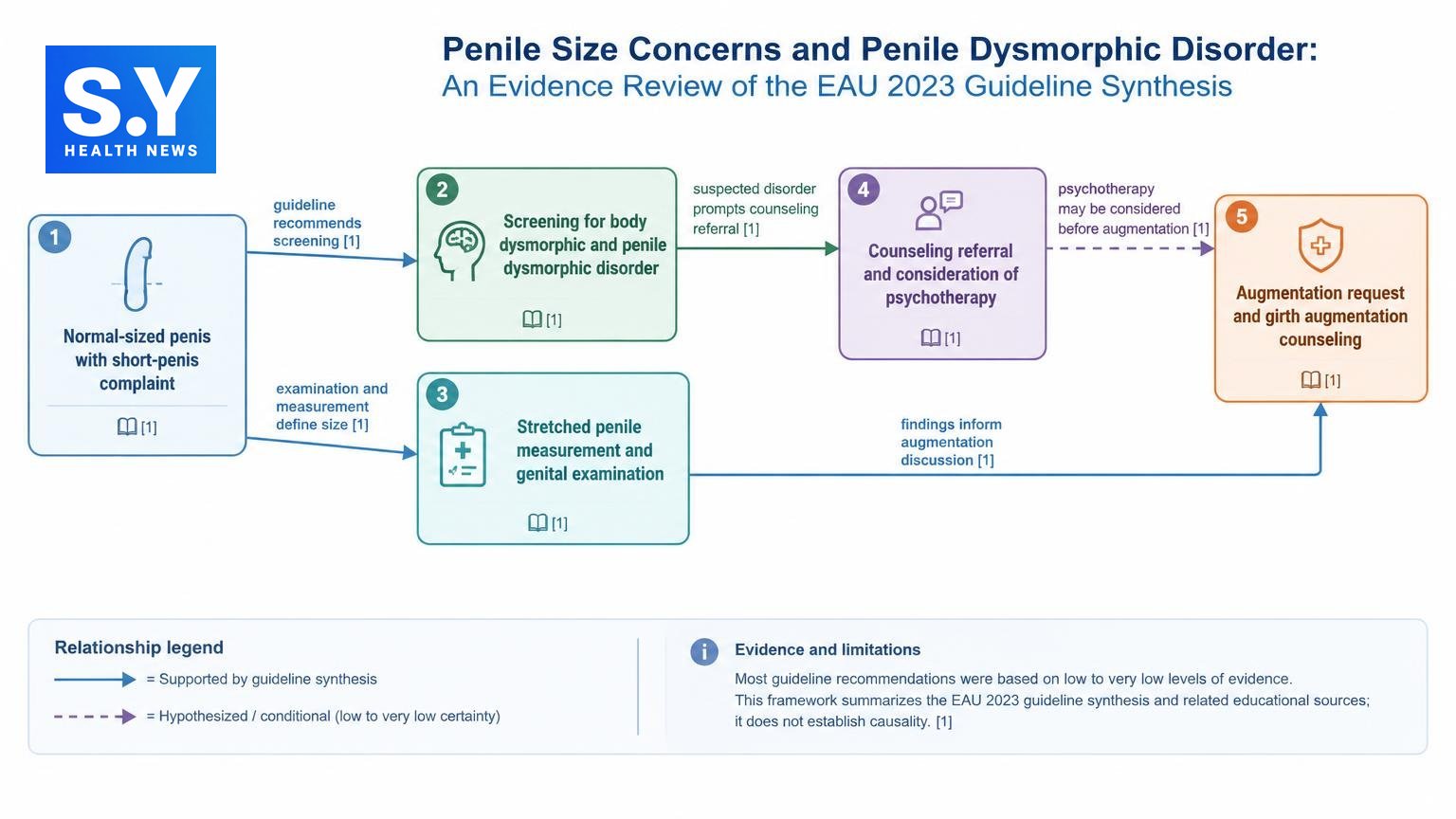
Conceptual framework: Conceptual framework derived from the 2023 EAU guideline synthesis on penile size anomalies and dysmorphophobia. The diagram shows the clinical pathway from a normal-sized penis with a short-penis complaint to screening for body dysmorphic disorder, genital examination and stretched-length measurement, counseling referral, and counseling around augmentation requests. Solid relations reflect recommendations stated in the synthesis; the proposed role of psychotherapy before augmentation is conditional and rests on low to very low certainty evidence. The framework is a reading aid, not a tested causal model.
Academic References & Evidence
- Marco Falcone. ¿Cómo atender a los pacientes con dismorfofobia peneana?. European Urology Focus
- Massimo Capone. Dismorfofobia peniena: il complesso del pene piccolo – Chirurgo Andrologico.
- Dismorfofobia Peniana: Quando a preocupação com o tamanho ou estética se torna um transtorno. Nature Reviews Disease Primers. 2024 10:92
SANYUN Science Center explains published research on men's reproductive and sexual health, connecting scientific evidence with everyday questions while making sources and limitations clear.
Disclaimer: This article is for scientific education and research communication only. It does not provide medical advice, diagnosis, or individualized treatment recommendations, and does not endorse any medication, supplement, device, penile enlargement procedure, or other intervention. Decisions about sexual and reproductive health should be made in consultation with a qualified healthcare professional. Do not delay seeking professional care because of information in this article.
Original Content & Copyright Notice
- This article is prepared for SANYUN Science Center, drawing on published research and publicly available academic literature on men’s sexual and reproductive health. Its editorial explanations and presentation are developed for this platform.
- Copyright in the original editorial content, selection, and arrangement is reserved by SANYUN Science Center to the extent protected by applicable law. Referenced research, quotations, and third-party materials remain subject to the rights of their respective owners. This notice does not claim ownership of scientific facts or third-party research.
- Except where permitted by applicable law or an applicable license, prior written permission is required to reproduce, republish, translate, adapt, redistribute, or commercially reuse protected content. Attribution alone does not grant permission for such reuse.
- For permitted quotation or authorized reuse, clearly identify the source and retain a link to the original article.
- Source: SANYUN Science Center
- Original URL: Retain the original article URL on science.san-yun.com.
- Copyright Holder: SANYUN Science Center, for its own protected editorial content.
- Quotation, excerpts, or authorized reuse must not distort the scientific meaning, omit material limitations or disclaimers, or imply unverified medical claims, product efficacy, or endorsement by SANYUN Science Center.



