




Category: Penile Size
Core Research Direction: Penile size concerns: measured anatomy, small-penis syndrome and penile dysmorphic disorder, and the evidence limits of enhancement interventions — a research review of prevalence, assessment, outcomes, and mechanistic and ethical considerations
Search Intent: When a man worries his penis is too small, what does measured penile size actually show, how often is the real issue penile dysmorphic disorder rather than anatomy, and what do we know about whether enhancement procedures help or harm?
Platform: SANYUN Science Center
Evidence reviewed through: 2026-11-14
Executive Summary
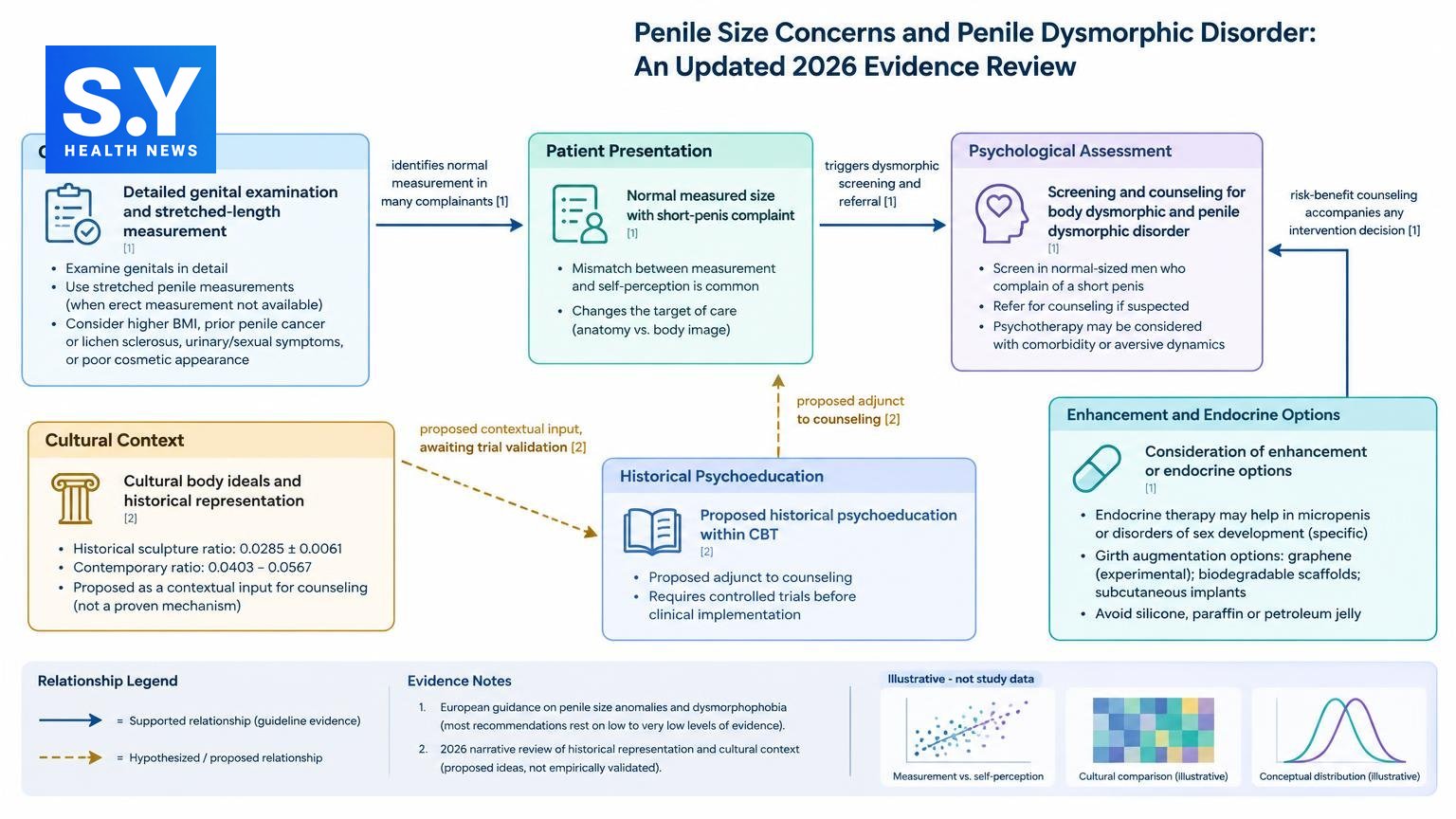
Concern about penile size is a common reason for seeking sexual medicine advice, yet the clinical question is rarely purely anatomical. European guidance on penile size anomalies and dysmorphophobia recommends personalized, multidisciplinary management that includes psychological assessment. It also advises clinicians to examine the genitals in detail, to screen for body dysmorphic disorder in men with normally sized penises who complain of a short penis, and to refer suspected cases for counseling. The same synthesis reports that most of its recommendations rest on low to very low levels of evidence.[1]
That evidential weakness matters. It means the field's confident-sounding advice about measurement, psychotherapy and enhancement rests on thin and often indirect data rather than on large randomized trials. A 2026 historical review adds a cultural dimension, showing that sculpted masculine proportions in Western art were markedly smaller relative to body height than contemporary measurements, and proposing that this context could inform counseling, pending controlled testing.[2]
Why This Matters
Men who worry about their size frequently do so despite measurements inside population norms. The mismatch between self-perception and measurement is clinically important because it changes the target of care: a procedure addresses anatomy, whereas persistent distress about a normal-sized penis may reflect a body image problem. The guidance explicitly distinguishes these situations by recommending that clinicians screen for body dysmorphic disorder and penile dysmorphic disorder in men with normal-sized penises who complain of a short penis.
Requests for enhancement also carry physical risk. The guidance advises counseling about risks and benefits for anyone considering girth augmentation, and states that silicone, paraffin or petroleum jelly should be avoided. Some proposed girth approaches, including graphene, are described as experimental rather than established.
The cultural context is not incidental. A 2026 review states that male body dysmorphic disorder focused on genital concerns remains significantly under-recognized, affecting 2.5% of adults and up to 15% in appearance-focused medical settings. Those figures come from cited prevalence literature within a narrative synthesis rather than from a newly conducted epidemiological study, and the excerpt does not supply the underlying denominators.
Measurement, Assessment and the Clinical Encounter
Assessment begins with examination rather than assumption. The guidance advises a detailed genital examination, particularly in men with a body mass index above 30 kg/m2, a history of penile cancer or lichen sclerosus, urinary or sexual symptoms, or poor cosmetic appearance. It also states that penile length may be defined using stretched penile measurements, a practical anchor when erect measurement is not available.
The choice of stretched measurement is a clinical convention rather than a claim that one method captures every dimension of concern. The source does not report comparative accuracy data for measurement techniques, and the guideline's overall evidence grading is low to very low. Readers should therefore treat the recommendation as a reasonable standard of practice rather than a precision instrument validated in high-quality comparative studies.
Screening for body dysmorphic disorder is not a dismissive step. It is a way to redirect care toward the mechanism most likely to sustain distress. The guidance recommends referral for counseling when body dysmorphic disorder is suspected, and suggests psychotherapy may be considered when psychopathological comorbidity is suspected or when aversive relationship dynamics may underlie an enlargement request. Both are conditional recommendations, not mandates.
What the Evidence Shows on Interventions
The intervention picture is narrow and hedged. Endocrine therapy may help restore penile size in males with micropenis or differences/disorders of sex development, but that population is specific and the recommendation is hedged. It is not evidence that hormonal treatment enlarges a normally formed adult penis, and the source offers no effect sizes or trial data.
For girth augmentation, the guidance names graphene as an experimental material alongside biodegradable scaffolds and subcutaneous penile implants. Calling a material experimental is not an endorsement; it signals unresolved safety and efficacy questions. The explicit instruction to avoid silicone, paraffin or petroleum jelly reflects the documented harm associated with non-medical injectable fillers, although the packet does not quantify complication rates.
The synthesis does not report pooled success rates, satisfaction outcomes or comparative complication frequencies for surgical or non-surgical enhancement. Any statement that a procedure reliably increases size or satisfaction would exceed the supplied evidence. What the packet supports is a risk-benefit counseling requirement and a clear prohibition on certain injectable substances.
The Cultural and Psychological Layer
A 2026 narrative review examined 24 museum-quality sculptures dated 600 BCE to 1822 CE. Digital morphometric measurement with ImageJ, following established clinical protocols, yielded a mean phallus-to-height ratio of 0.0285 ± 0.0061. The authors report this as significantly smaller than contemporary values of 0.0403 to 0.0567, a proportional difference of 29% to 50%.
This is an observational comparison of artworks against comparison values drawn from prior literature, not a study of living men. The finding documents variation in masculine representation across historical periods. The authors propose that this variation may be relevant for understanding contemporary body image concerns, but that relevance is a hypothesis rather than a demonstrated mechanism.
The review also presents preliminary considerations for integrating historical psychoeducation within established cognitive-behavioral therapy frameworks. Crucially, the authors state that this historical contextualization requires empirical validation through controlled trials before clinical implementation. No efficacy data are reported, so it should be described as a proposed adjunct, not an evaluated treatment.
Interpretation and Limitations
The strongest limitation is the quality of the underlying evidence. The guideline synthesis itself reports that most recommendations rest on low to very low levels of evidence. That single statement reframes everything above: the advice is clinically sensible and consensus-informed, but it is not built on a foundation of large, well-controlled trials.
The historical review has its own limits. It is a narrative synthesis, its contemporary comparator values come from literature rather than a new participant cohort, and the excerpt does not detail the statistical method behind the reported significance or any inter-rater reliability for the ImageJ measurements. Its clinical proposal is explicitly preliminary.
Funding and conflicts also deserve transparency. The guideline synthesis was funded by the EAU Guidelines Office, and one author received relevant financial support, as confirmed by the lead author. This does not invalidate the work, but readers should weigh it alongside the low evidence grades.
Finally, the packet does not supply prevalence estimates for small penis syndrome or penile dysmorphic disorder specifically in clinical populations, nor does it provide validated screening instrument performance data. The 2.5% and up-to-15% figures refer to body dysmorphic disorder more broadly as cited in the historical review.
Research Outlook
The clearest research priority is controlled evaluation of psychological approaches. The historical psychoeducation proposal is explicitly awaiting trial validation, and the guideline's psychological recommendations rest on weak evidence. Well-designed trials with validated outcome measures would clarify whether psychoeducation or CBT reduces distress and procedure-seeking in men with normal measurements.
A second priority is standardized outcome reporting for enhancement interventions. The packet names experimental materials and prohibits certain injectables but provides no comparative effectiveness or complication data. Prospective registries with consistent measurement, satisfaction and adverse-event reporting would address a genuine evidence gap without overstating what is currently known.
| Domain | Guidance or finding |
|---|---|
| Assessment | Detailed genital examination, especially with BMI above 30 kg/m2, prior penile cancer or lichen sclerosus, urinary or sexual symptoms, or poor cosmetic appearance |
| Measurement | Penile length may be defined using stretched penile measurements |
| Dysmorphic screening | Screen for body dysmorphic and penile dysmorphic disorder in normal-sized men complaining of a short penis; refer suspected cases for counseling |
| Psychotherapy | May be considered with suspected psychopathological comorbidity or aversive relationship dynamics behind an enlargement request |
| Endocrine therapy | May help restore size in micropenis or disorders of sex development |
| Girth augmentation | Counsel on risks and benefits; avoid silicone, paraffin or petroleum jelly; graphene described as experimental |
| Cultural context | Historical sculpture phallus-to-height ratio 0.0285 ± 0.0061 versus contemporary 0.0403–0.0567; proposed counseling adjunct |
Key Takeaways
- Guidance recommends multidisciplinary care including psychological assessment for men with penile size concerns or dysmorphophobia.
- Men with normal-sized penises who complain of a short penis should be screened for body dysmorphic and penile dysmorphic disorder and referred for counseling if suspected.
- Most guideline recommendations rest on low to very low levels of evidence, so clinical certainty should be communicated cautiously.
- Silicone, paraffin and petroleum jelly should be avoided in girth augmentation; graphene is described as experimental.
- Historical sculpture data show smaller proportional phallic representation than contemporary values, but this is proposed as cultural context, not a proven therapeutic tool.
Questions and Answers
What is penile dysmorphic disorder and how is it assessed?
Penile dysmorphic disorder is a genital-focused form of body dysmorphic disorder in which a man remains convinced his penis is abnormally small, misshapen or unattractive despite measurements within normal limits. Guidance recommends a detailed genital examination and, when a normal-sized penis is reported as short, screening for body dysmorphic and penile dysmorphic disorder, with referral for counseling if suspected. Evidence grades are low to very low.
What does the EAU guidance recommend for men worried about penis size?
It recommends personalized, multidisciplinary management that includes psychological assessment. Clinicians should perform a detailed genital examination, define length using stretched penile measurements, screen for body dysmorphic disorder when the measured size is normal, and refer suspected cases for counseling. Psychotherapy may be considered when psychopathological comorbidity or aversive relationship dynamics underlie an enlargement request. Most recommendations rest on low to very low evidence.
Do penile enhancement procedures have strong evidence of benefit?
The supplied evidence base is weak. The guideline synthesis reports that most recommendations rest on low to very low evidence and does not provide pooled success or satisfaction rates for enhancement procedures. It advises risk-benefit counseling, prohibits silicone, paraffin or petroleum jelly, and labels graphene experimental. Endocrine therapy is hedged and limited to micropenis or disorders of sex development.
How common is body dysmorphic disorder relevant to genital size concerns?
A 2026 narrative review states that male body dysmorphic disorder focused on genital concerns is under-recognized, citing prevalence of 2.5% of adults and up to 15% in appearance-focused medical settings. These figures come from prior literature within a synthesis rather than a new epidemiological study, and the excerpt does not give the underlying denominators or instrument details.
What are the limitations of the penile size and dysmorphophobia evidence?
The main limitation is evidence quality: most recommendations rest on low to very low grades, with no large randomized trials reported in the packet. The historical review is a narrative synthesis with literature-derived comparators, and its psychoeducation proposal explicitly requires controlled testing. Funding came from the EAU Guidelines Office, and one author reported relevant financial support.
Could historical art change how men think about penis size?
Possibly, but it is unproven. A 2026 review measured 24 museum-quality sculptures from 600 BCE to 1822 CE and found a mean phallus-to-height ratio of 0.0285 ± 0.0061, reported as significantly smaller than contemporary values of 0.0403 to 0.0567. The authors propose historical psychoeducation within CBT but call for controlled trials before clinical use.
Conceptual framework: Conceptual framework, not a tested causal model. It maps relationships described in European guidance on penile size anomalies and dysmorphophobia and in a 2026 narrative review of historical representation. Solid links reflect supported guideline relationships; dashed links mark proposed, untested psychoeducation pathways. Most guideline recommendations rest on low to very low evidence.
Academic References & Evidence
- Marco Falcone. ¿Cómo atender a los pacientes con dismorfofobia peneana?. European Urology Focus
- Friedman, O; Paniri, Y; Mizrahi Reuveni, M; Lavon, E; Afek, A; Maiershon, D. Historical perspectives in contemporary body image counseling: a clinical framework for contextualizing masculine body dysmorphic concerns.. Sexual medicine reviews. 2026 14(2) DOI: 10.1093/sxmrev/qeag018.
SANYUN Science Center explains published research on men's reproductive and sexual health, connecting scientific evidence with everyday questions while making sources and limitations clear.
Disclaimer: This article is for scientific education and research communication only. It does not provide medical advice, diagnosis, or individualized treatment recommendations, and does not endorse any medication, supplement, device, penile enlargement procedure, or other intervention. Decisions about sexual and reproductive health should be made in consultation with a qualified healthcare professional. Do not delay seeking professional care because of information in this article.
Original Content & Copyright Notice
- This article is prepared for SANYUN Science Center, drawing on published research and publicly available academic literature on men’s sexual and reproductive health. Its editorial explanations and presentation are developed for this platform.
- Copyright in the original editorial content, selection, and arrangement is reserved by SANYUN Science Center to the extent protected by applicable law. Referenced research, quotations, and third-party materials remain subject to the rights of their respective owners. This notice does not claim ownership of scientific facts or third-party research.
- Except where permitted by applicable law or an applicable license, prior written permission is required to reproduce, republish, translate, adapt, redistribute, or commercially reuse protected content. Attribution alone does not grant permission for such reuse.
- For permitted quotation or authorized reuse, clearly identify the source and retain a link to the original article.
- Source: SANYUN Science Center
- Original URL: Retain the original article URL on science.san-yun.com.
- Copyright Holder: SANYUN Science Center, for its own protected editorial content.
- Quotation, excerpts, or authorized reuse must not distort the scientific meaning, omit material limitations or disclaimers, or imply unverified medical claims, product efficacy, or endorsement by SANYUN Science Center.



