




Category: Penile Size
Core Research Direction: Evidence-based clinical approach to penile size concerns and penile dysmorphic disorder: distinguishing normal anatomical variation from true abnormalities, and the limits of the guideline evidence base
Search Intent: When a man is distressed about his penile size, what do clinical guidelines and anatomical data actually say about normal size, how should clinicians assess it, and what does the evidence support for treatment?
Platform: SANYUN Science Center
Evidence reviewed through: 2026-10-31
Executive Summary
Concern about penile size is a frequent clinical encounter, but the evidence base addressing it is thin. The most structured guidance available is summarised in a synthesis supporting the 2023 European Association of Urology (EAU) guideline on penile size abnormalities and dysmorphophobia. That synthesis frames the condition as diagnostically complex and ethically challenging, and notes that it long lacked a clear diagnostic and therapeutic pathway. Its central practical messages are that management should be individualised and multidisciplinary, including psychological assessment, and that most recommendations rest on low to very low certainty evidence. This review describes what the guideline synthesis and two clinical commentaries assert, separates supported recommendations from opinion-based claims, and highlights where the evidence simply does not answer common questions.[1]
The most important distinction for clinicians and patients is between a measurable anatomical abnormality and a distressing but unfounded perception of inadequacy. The guideline addresses both: it recommends a detailed genital examination and screening for body dysmorphic disorder in men with normal-sized penises who complain of a short penis. The supplied material supports this as a recommendation, not as a finding from a comparative trial.
Why This Matters
Men who are distressed about size may avoid care for years, present to the wrong specialty, or pursue invasive procedures that do not address the underlying concern. The guideline synthesis explicitly recognises the ethical challenges around an issue that has lacked a clear diagnostic and therapeutic route. That framing matters because it justifies a structured, non-surgical-first approach rather than an automatic anatomical intervention.[2]
One commentary in the supplied material states that about 2% of the population suffers from body dysmorphic disorder and that many men never seek help because of shame, or seek the wrong professional, focusing only on cosmetic surgery rather than overall health. This figure refers to body dysmorphic disorder in the general population, not to penile-specific dysmorphophobia, and no primary prevalence data for penile dysmorphic disorder is provided in the packet.[3]
Definitions: Anatomical Variation Versus Disorder
Penile dysmorphophobia is described in one commentary as a variant of body dysmorphic disorder in which the focus of obsession is the genital organ. In that account, the man develops a distorted perception, believing his penis is excessively small, crooked or ugly even when measurements fall within the functional anatomical mean. This is a descriptive clinical characterisation, not a diagnostic criterion established by the supplied data.
A second commentary frames the problem as psychological rather than anatomical, asserting that except for rare severe congenital malformations, penile length has no scientific relevance. That statement is clinical opinion on an educational page and sits uneasily with the guideline's attention to micropenis and endocrine therapy, which presupposes that some size presentations do have clinical significance. The tension itself is informative: the field lacks a single, uniformly worded definition of what counts as a size abnormality requiring medical rather than psychological management.
What the Evidence Actually Shows
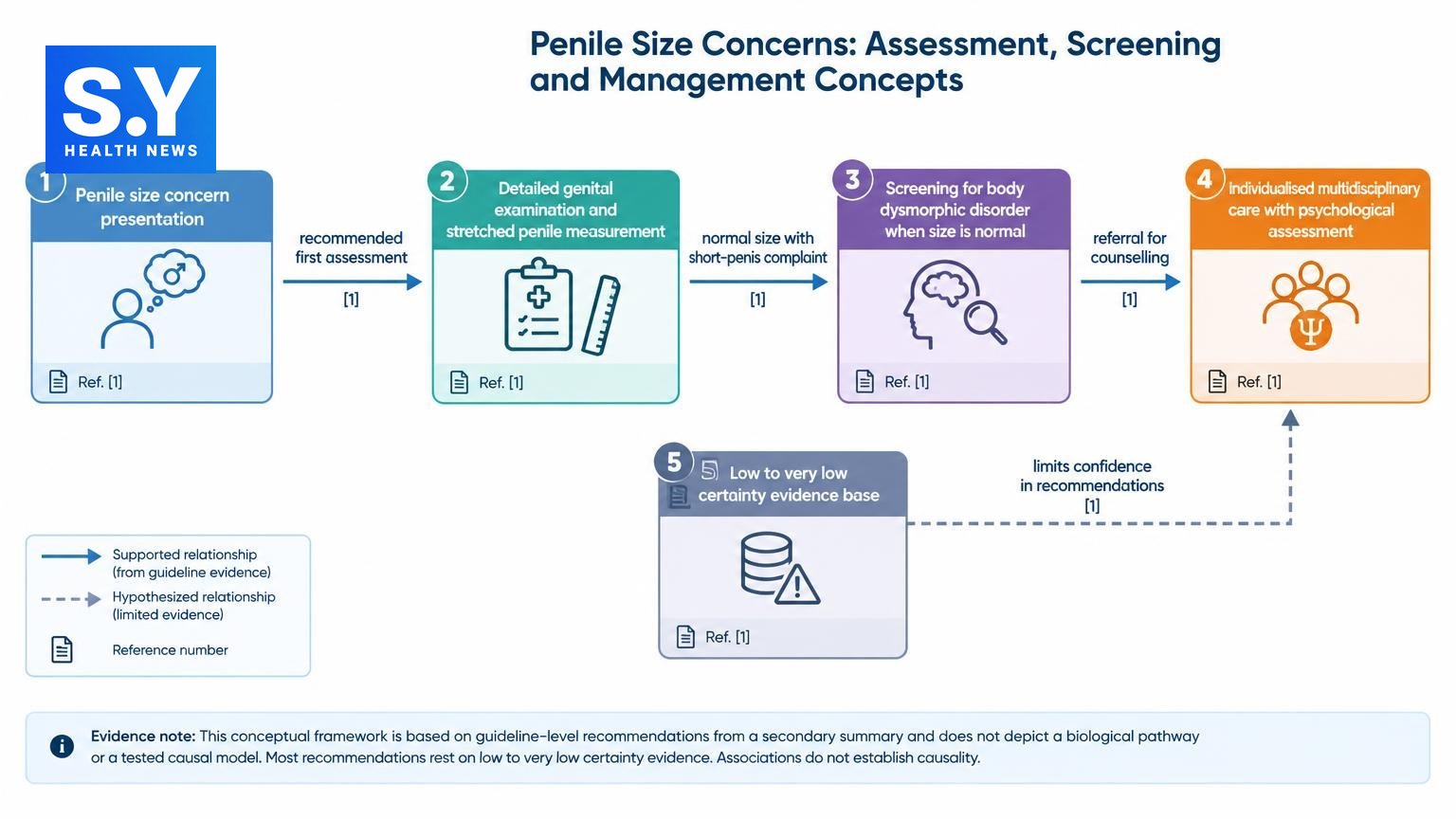
The guideline synthesis contains several concrete recommendations. Clinicians should perform a detailed genital examination, particularly in men with a body mass index above 30 kg/m2, a history of penile cancer or lichen sclerosus, urinary or sexual symptoms, or poor cosmetic appearance. Screening for body dysmorphic disorder and penile dysmorphic disorder is recommended in men with normal-sized penises who complain of a short penis. Penile length may be defined using stretched penile measurements, and patients with suspected body dysmorphic disorder should be referred for counselling.
For management, the synthesis recommends an individualised, multidisciplinary approach including psychological assessment. Psychotherapy may be considered when psychopathological comorbidity is suspected or when aversive relationship dynamics may underlie a request for penile augmentation. Endocrine therapy may help restore penile size in males with micropenis or disorders of sex development. For girth augmentation, patients should be counselled on risks and benefits, and the use of silicone, paraffin or vaseline should be avoided; graphene as an experimental material, biodegradable scaffolds, or subcutaneous penile implants may be considered.
The synthesis is explicit that most of these recommendations were based on low to very low certainty evidence ratings. That single statement governs how the whole package should be read. The recommendations are clinically sensible and ethically framed, but they are not derived from a body of high-quality controlled trials in the supplied material.
| Measure / finding | Result | Population / follow-up | Limitations |
|---|---|---|---|
| Most of the guideline's recommendations were based on low to very low certainty evidence ratings. | Overall evidence certainty statement as reported for the guideline. | ||
| BMI threshold | >30 kg/m2 | men presenting with penile size concerns | Recommendation graded by the source as based on low to very low certainty evidence. |
| The guideline recommends screening for body dysmorphic disorder and penile dysmorphic disorder in men with normal-sized penises who complain of a short penis. | men with normal penile size complaining of shortness | Recommendation level; performance of screening tools not quantified in supplied text. | |
| Penile length can be defined using stretched penile measurements, and patients with suspected body dysmorphic disorder should be referred for counselling. | Recommendation; specific measurement protocol and thresholds not given in supplied text. | ||
| Psychotherapy may be considered when psychopathological comorbidity is suspected or when aversive relationship dynamics may underlie the request for penile augmentation. | Conditional recommendation; no efficacy estimates in supplied text. | ||
| Endocrine therapy may help restore penile size in males with micropenis or disorders of sex development. | males with micropenis or disorders of sex development | Hedged recommendation; no outcome data in supplied text. | |
| Patients considering penile girth augmentation should be counselled on risks and benefits, and the use of silicone, paraffin or vaseline should be avoided. | men considering penile girth augmentation | Recommendation; harms data not quantified in supplied text. | |
| For penile girth augmentation, clinicians should consider graphene as an experimental material, biodegradable scaffolds, or subcutaneous penile implants. | Experimental approaches; the source notes most recommendations rest on low to very low certainty evidence. |
Interpretation and Limitations
The evidentiary landscape described here has three layers that should not be blended. The first layer is the guideline synthesis, which is a structured appraisal but is only available to this review through a secondary news summary; the original guideline text was not supplied. The second layer is clinical commentary from clinician-authored educational pages, which offer plausible framings but no outcome data. The third layer is the unverified underlying literature referenced by those pages, including a cited 2024 review that this review could not inspect.
Numbers cited for mean erect penile length in one commentary, described as ranging between 13 and 15 cm with circumference a little over 11 cm, are explicitly presented as indicative only and without official statistics. The packet contains no sample, measurement method, or study citation for these values. They should therefore be treated as orientation, not as normative reference data from which an individual can be classified.
Several mechanism-level claims appear in one commentary, including altered visual processing in which detail is over-processed at the expense of the whole, and hyperactivity of regions such as the amygdala and prefrontal cortex producing disproportionate anxiety and shame. These are attributed to a cited 2024 review, not demonstrated in the supplied material, and no imaging or cognitive data are provided. They are best read as hypotheses about mechanism rather than established findings.
Treatment opinions conflict in tone. One commentary argues that the term cure should be avoided and that psychopharmacological therapy is always avoided, framing the pathway as psychological and cultural. Another describes cognitive behavioural therapy as the gold standard for readjusting visual perception and reducing anxiety and mentions involvement of psychologists and psychiatrists. Neither position is supported by outcome data in the packet, and the categorical claim that medication is always avoided should not be treated as a guideline recommendation. What the guideline itself supports is psychological assessment within multidisciplinary care and psychotherapy in defined circumstances.
A further opinion-based claim is that surgery is not the answer in penile dysmorphophobia because the problem is perceptual, and that patients are often dissatisfied with surgical results because the perceived flaw persists. This is a plausible and clinically important concern, but it is asserted rather than quantified in the supplied material; no follow-up or satisfaction data are provided.
Historical and aetiological assertions also lack supporting data. One page describes penile dysmorphophobia as a recent disorder linked to liberalised mores and pornography, and as multifactorial with social and cultural pressure weighing most heavily, affecting adolescents and young adults most often. These claims carry no prevalence estimates, no comparative data, and no citation in the supplied text, so they should be presented to patients as hypotheses under discussion rather than settled epidemiology.
Research Outlook
The clearest gap is the absence of well-characterised, condition-specific evidence. The guideline synthesis itself notes low to very low certainty for most recommendations, which points to what future work needs: validated case definitions for penile dysmorphic disorder, standardised measurement protocols linked to those definitions, and prospective outcome data for psychological versus surgical pathways. The current material cannot compare these pathways on outcomes because no such comparison is supplied.
On the treatment side, the suggestion that graphene, biodegradable scaffolds and subcutaneous implants may be considered for girth augmentation is explicitly experimental, and the recommendation to avoid silicone, paraffin and vaseline rests on risk-benefit counselling rather than quantified harm data in this packet. Future work also needs to clarify what level of evidence underpins these options, because at present they sit at the outer edge of what the guideline supports.
Key Takeaways
- The 2023 EAU guideline synthesis recommends individualised, multidisciplinary care including psychological assessment for penile size concerns and dysmorphophobia.
- Screening for body dysmorphic disorder is recommended when a man with a normal-sized penis complains of a short penis, alongside detailed genital examination in defined risk groups.
- Penile length may be defined using stretched penile measurements, and suspected body dysmorphic disorder warrants referral for counselling.
- Most recommendations rest on low to very low certainty evidence, so the guidance is clinically reasonable but not strongly evidence-secured.
- Commonly quoted mean erect length values are indicative only and lack a cited measurement study in the supplied material.
- Claims that medication is always avoided, or that a 2024 review establishes specific brain mechanisms, exceed what the supplied material can verify.
Questions and Answers
What is penile dysmorphic disorder?
Penile dysmorphic disorder is described in the supplied material as a variant of body dysmorphic disorder focused on the genitals, in which a man believes his penis is too small, crooked or ugly even when measurements are within the functional anatomical mean. This is a descriptive clinical characterisation rather than a criterion validated in the supplied data.
What does the 2023 EAU guideline recommend for size concerns?
The synthesis reports recommendations for detailed genital examination in men with risk features, screening for body dysmorphic disorder when a normal-sized penis is perceived as short, use of stretched penile measurements to define length, and referral for counselling when disorder is suspected. Management should be individualised and multidisciplinary, including psychological assessment, with psychotherapy considered in defined circumstances.
How strong is the evidence behind these recommendations?
The guideline synthesis itself states that most of its recommendations were based on low to very low certainty evidence. Specific recommendations such as examination and screening are therefore clinically sensible and ethically framed but not derived from a strong body of controlled trial evidence in the supplied material. The available summary is also secondary, since the original guideline text was not supplied.
Is surgery an appropriate treatment for penile dysmorphic disorder?
The supplied clinical commentaries argue that surgery is not the answer because the problem is perceptual and patients may remain dissatisfied when the perceived flaw persists. However, this is asserted rather than quantified, and no follow-up or satisfaction data are provided. A decision for or against surgery is not supported by the packet as a general rule; it requires individual assessment, including psychological evaluation.
What are the limitations of the evidence base described here?
The main limitations are low certainty ratings for most guideline recommendations, reliance on secondary summaries and clinical commentary for several claims, and unverified underlying references. Mechanism claims about visual processing and amygdala or prefrontal hyperactivity, prevalence statements, and aetiological assertions about pornography and cultural change all lack supporting data in the supplied material and should be treated as hypotheses.
What should someone concerned about penile size understand practically?
The evidence reviewed here, while limited, supports a clinical assessment rather than assumption. A detailed genital examination can distinguish measurable abnormality from normal variation, and stretched penile measurements are one accepted method of defining length. When concern persists despite normal measurements, screening for body dysmorphic disorder and psychological assessment are recommended. Widely quoted average sizes are indicative only, and invasive procedures carry risk and uncertain benefit.
Conceptual framework: Conceptual framework of the assessment and management concepts discussed in this evidence review. The framework reflects guideline-level recommendations as reported in a secondary summary and does not depict a biological pathway or a tested causal model; most recommendations rest on low to very low certainty evidence.
Academic References & Evidence
- ¿Cómo atender a los pacientes con dismorfofobia peneana?.
- Massimo Capone. Dismorfofobia peniena: il complesso del pene piccolo – Chirurgo Andrologico.
- Dismorfofobia Peniana: Quando a preocupação com o tamanho ou estética se torna um transtorno.
SANYUN Science Center explains published research on men's reproductive and sexual health, connecting scientific evidence with everyday questions while making sources and limitations clear.
Disclaimer: This article is for scientific education and research communication only. It does not provide medical advice, diagnosis, or individualized treatment recommendations, and does not endorse any medication, supplement, device, penile enlargement procedure, or other intervention. Decisions about sexual and reproductive health should be made in consultation with a qualified healthcare professional. Do not delay seeking professional care because of information in this article.
Original Content & Copyright Notice
- This article is prepared for SANYUN Science Center, drawing on published research and publicly available academic literature on men’s sexual and reproductive health. Its editorial explanations and presentation are developed for this platform.
- Copyright in the original editorial content, selection, and arrangement is reserved by SANYUN Science Center to the extent protected by applicable law. Referenced research, quotations, and third-party materials remain subject to the rights of their respective owners. This notice does not claim ownership of scientific facts or third-party research.
- Except where permitted by applicable law or an applicable license, prior written permission is required to reproduce, republish, translate, adapt, redistribute, or commercially reuse protected content. Attribution alone does not grant permission for such reuse.
- For permitted quotation or authorized reuse, clearly identify the source and retain a link to the original article.
- Source: SANYUN Science Center
- Original URL: Retain the original article URL on science.san-yun.com.
- Copyright Holder: SANYUN Science Center, for its own protected editorial content.
- Quotation, excerpts, or authorized reuse must not distort the scientific meaning, omit material limitations or disclaimers, or imply unverified medical claims, product efficacy, or endorsement by SANYUN Science Center.



