




Category: Penile Size
Core Research Direction: Evidence-based evaluation of penile size concerns in adult men: normative measurement, what surgery or fillers can and cannot change, and the role of body-image perception versus anatomy
Search Intent: For an adult man worried his penis is too small, what does published evidence say about normal size ranges, who actually falls outside them, and what benefits and risks do surgical and non-surgical enlargement procedures actually offer?
Platform: SANYUN Science Center
Evidence reviewed through: 2026-11-03
Executive Summary
Concern about penile size is common, but the men who present for enlargement procedures are usually not the men whose anatomy falls outside normative thresholds. Two distinct questions are often tangled together: whether a man has a diagnosable developmental anomaly, and whether he is distressed about a penis that is statistically ordinary. The evidence reviewed here addresses both, and the answers differ substantially.[1][2]
Micropenis is defined as stretched penile length below the age-group mean minus 2.5 standard deviations, and the review summarized here reports a prevalence of 0.6–0.7% among male infants. That is a narrow clinical category with identifiable hormonal, genetic and androgen-receptor causes, not a synonym for a man who wishes he were larger. Clinician-measured data cited in a clinic guide put mean erect length near 13.1 cm and flaccid length near 9.2 cm, with wide normal ranges.
Interventions are limited and asymmetric. Hormone therapy has a paediatric role, with unclear long-term benefit for adult length. Surgery produces modest average gains with real risks, and hyaluronic acid filler adds girth temporarily rather than length. No pill, cream or supplement has evidence of permanent size gain, and some marketed men's supplements have contained undeclared prescription drugs.
- Micropenis is a developmental diagnosis with a statistical threshold, not a judgement about whether a penis looks adequate.
- Most men requesting lengthening surgery measure within normal limits, which reframes the clinical task as assessment of perception and expectation.
- Published surgical gains are modest and highly variable; some men see little or no change.
- Satisfaction after procedures is strongly influenced by baseline expectations rather than by measured anatomy alone.
Why This Matters
The gap between male self-assessment and partner assessment is one of the more striking findings in this literature. In a survey of more than 50,000 adults cited by a clinic guide, only about half of men were satisfied with their own size, while 85% of women were satisfied with their partner's size. These are satisfaction percentages, not measurements, and the survey's sampling details are not reproduced in the source. Still, the direction of the gap suggests that the problem being described is frequently perceptual rather than anatomical.
That distinction matters clinically because the two problems have different treatments. A developmental anomaly with an endocrine cause may warrant hormonal or surgical evaluation. Distress about a normal-sized penis warrants accurate measurement, expectation-setting and, where the worry is persistent and impairing, psychological care. Offering an operation to the second group tends to reproduce the dissatisfaction it was meant to resolve. The source guide states this directly: men of normal size with high worry often remain dissatisfied after procedures because the target of care is perception rather than the organ, though that claim is interpretive and the guide does not name the supporting studies.
There is also a safety dimension. Unregulated enhancement products and informal techniques carry documented harms, and men may not disclose prior injections when they later seek care. The review of micropenis care makes a related point in a different context: penile size varies widely between individuals, much of that variation is normal, and size alone should not be used to judge self-worth.
How Penile Size Is Defined and Measured
The diagnostic threshold for micropenis is statistical. Stretched penile length below the mean for the relevant age group minus 2.5 standard deviations defines the condition, which means the reference population and the measurement technique jointly determine who qualifies. The review describes measurement along the dorsal surface from the pubic bone to the glans tip, pressing the suprapubic fat pad inward and, where a foreskin is present, retracting it so the shaft is as straight as possible. Multiple measurements averaged together improve accuracy, and standardized photography or ultrasound is used in research and complex clinical settings.
Consistency is as important as technique. The review recommends using the same method and the same conditions on each occasion — the same erect or flaccid state and the same degree of stretch — so that serial measurements are comparable. Without that discipline, apparent changes may reflect nothing more than a different examiner or a different room temperature.
Normative figures come from pooled clinician measurements. A systematic review cited in a clinic guide, drawing on data from up to 15,521 men, reported mean erect length of about 13.1 cm and mean flaccid length of about 9.2 cm, with wide normal ranges for both. The primary review's inclusion criteria and dispersion statistics are not reproduced in the citing source, and means should not be read as targets. The clinical question is whether a measurement falls below a defined threshold, not how it compares with a headline average.
Self-measurement introduces predictable errors. Viewing from above foreshortens apparent length, flaccid size fluctuates substantially with temperature, stress and time of day, and adult media present a selected group under favourable angles. A clinician's measurement is therefore a different kind of datum from a self-estimate, and it is the appropriate starting point for any discussion about whether treatment is indicated.
The Biology Behind Genuine Micropenis
Where micropenis is genuinely present, the review describes a structured aetiological workup rather than an assumption. Causes include hormonal imbalance, genetic factors and androgen insensitivity, with major implications for physical and psychological health. Assessment may involve chromosome analysis, gonadotropin and testosterone measurement, stimulation testing, and imaging of the pituitary and genital anatomy. Physical clues in other systems can point toward specific syndromes, and psychological assessment is treated as part of the evaluation rather than an afterthought.[3]
This mechanistic detail matters for adult readers because it explains why hormonal treatment cannot be generalised. Androgen responsiveness is a property of the tissue and the timing of exposure, not a dial that can be turned up at any age. The review notes that testosterone or hCG can promote penile growth, particularly with early-life treatment, but that long-term outcomes — including effects on adult fertility — lack consensus and adequate reporting. Elsewhere it states plainly that it remains unclear whether early androgen exposure confers any long-term benefit on adult penile length.
What the Evidence Shows: Hormones, Surgery and Fillers
| Intervention | What published evidence reports | Key limitation |
|---|---|---|
| Intramuscular testosterone (paediatric/developmental context) | Review reports good response with a stated 100% increase in penile length during initial treatment; cited study of 50 children aged 5 months to 8 years found significant length increase after 30 days of 5% testosterone cream | Baseline and denominator for the 100% figure are unclear; findings are in children, not adults; cited secondhand |
| Topical DHT (partial AIS or 5α-reductase type 2 deficiency) | Increased stretched penile length in prepubertal and pubertal patients; no effect reported in adults | Based on cited case series; gel application is not standardized and absorption may be unpredictable |
| Penile lengthening surgery | Review reports achievable gain limited to about 1–3 cm with scarring, sensory change and effects on sexual function; a clinic guide cites published averages of about 1–2 cm visible flaccid gain with high individual variability | Different techniques and populations; some men gain little or nothing; no long-term controlled comparisons |
| Hyaluronic acid filler | Temporary girth increase; no length effect; effects typically last about 1–2 years depending on product and individual | No trial-level girth effect sizes reported; risks include irregular nodules, migration and inflammation |
| Pills, creams, supplements, manual techniques | No evidence of permanent size gain; reported injuries from stretching techniques include capillary rupture, fibrosis and curvature; vacuum pumps give temporary engorgement only | Absence-of-evidence statements rather than systematic appraisal; harms not quantified |
The surgical literature is the most consequential for adult men, and it is also the least reassuring. The micropenis review describes surgery as generally a last resort for adults seeking greater length: results across expert reports are inconsistent, satisfaction is strongly influenced by individual expectations, and efficacy is limited while risks are relatively high. It quantifies the length gain as roughly 1–3 cm and lists scarring, sensory change and effects on sexual function among the harms. A clinic guide summarising published ligament-release series reports a similar order of magnitude — about 1–2 cm of visible flaccid length — and emphasizes that some men experience almost no change.
Historical eligibility criteria are worth knowing because they are often misquoted. A 1996 guideline cited in the review recommended lengthening surgery only for men with flaccid length under 4 cm or stretched length under 7.5 cm. The review does not assess whether that threshold remains appropriate, and contemporary practice varies. What the threshold does illustrate is that surgical candidacy was originally framed around measurements well below population averages, not around dissatisfaction.
For men of normal size, a systematic review cited by the clinic guide concluded that many enlargement procedures carry high complication rates and uncertain satisfaction. That conclusion does not prohibit treatment; it shifts the burden of proof onto careful measurement, expectation screening and full disclosure of risk before any decision.
Interpretation and Limitations
The evidence base here is uneven, and its structure should be stated plainly. The core clinical review is a narrative synthesis, not a systematic review with pooled estimates. Its quantitative statements — the 2.5-SD threshold, the 0.6–0.7% infant prevalence, the 1–3 cm surgical range, the 100% testosterone response — are reported from cited secondary sources, and the underlying study designs, sample sizes and measurement methods are not reproduced. The prevalence figure in particular comes from a cited comprehensive review whose population is not described in the text.
The normative data are similarly indirect. The 13.1 cm and 9.2 cm means arrive through a clinic education page citing a 2015 systematic review; the primary inclusion criteria and variance are not shown, and no dispersion figures accompany the means. That is enough to communicate that average size is modest and normal variation is wide, but not enough to construct a percentile for any individual. Likewise, the Mondaini finding that most men requesting lengthening measure within normal limits is cited without the proportion, and the Lever survey's sampling and questionnaire design are not described.
Two claims in the source material are explicitly interpretive. The proposition that men of normal size with high worry often remain dissatisfied after procedures, and that the target of care is perception rather than the organ, is presented as an explanation rather than a demonstrated causal finding. And the suggestion that topical testosterone stimulates growth hormone secretion and thereby supports longer-term bone and penile growth is a mechanistic hypothesis from a secondary citation, not established causal evidence. Both are plausible and both are consistent with clinical experience, but neither should be described as proven.
Finally, some harms are reported without denominators. The injuries attributed to manual stretching — capillary rupture, fibrosis, curvature — and the complications of unregulated injections are described qualitatively. Absence of rigorous quantification is not absence of risk; it means the probability cannot be estimated from these sources.
Research Outlook
Several gaps recur across the sources. Long-term outcomes of early androgen therapy, including adult penile length and fertility, remain unresolved, and the review notes that comprehensive reports on gonadotropin treatment in neonates and infants are still lacking. On the surgical side, the literature lacks controlled comparisons across techniques with standardized measurement and adequate follow-up, which is why reported gains span a wide range and satisfaction varies so much between reports.
The perception question deserves its own research programme. If most men seeking enlargement are anatomically normal, then measurement protocols, expectation assessment and psychological screening are not peripheral courtesies but the main determinants of outcome. The sources describe psychological assessment and long-term follow-up as components of micropenis care; extending that framework to the larger group of men with size concerns but normal anatomy would address the population that actually presents.
Key Takeaways
- Micropenis is defined by stretched length below the age-group mean minus 2.5 standard deviations; reported prevalence in male infants is 0.6–0.7%.
- Cited clinician-measured norms put mean erect length near 13.1 cm and flaccid length near 9.2 cm, with wide normal ranges.
- Most men requesting lengthening surgery measure within normal limits, so accurate measurement and expectation-setting come before any procedure.
- Surgery yields modest average gains — roughly 1–3 cm in the review, about 1–2 cm of visible flaccid length in cited series — with scarring, sensory change and variable satisfaction.
- Hyaluronic acid filler adds girth temporarily for about 1–2 years and does not add length; no pill, cream or supplement has evidence of permanent gain.
- Satisfaction data show a wide gap between men's self-assessment and partners' assessment, pointing toward perception as a legitimate target of care.
Questions and Answers
What stretched penile length defines micropenis?
Micropenis is defined as stretched penile length below the mean for the relevant age group minus 2.5 standard deviations. Because the threshold is statistical, the reference population and measurement technique determine who qualifies. The review reporting this definition is a narrative synthesis, and the underlying normative datasets are cited secondhand rather than reanalysed.
What is the average erect penile length according to pooled clinician measurements?
A systematic review cited in a clinic guide, drawing on up to 15,521 men, reported a mean erect length of about 13.1 cm and a mean flaccid length of about 9.2 cm, with wide normal ranges. The citing source does not reproduce the primary review's inclusion criteria or variance, so these means should not be used to assign an individual percentile.
How much length can penile lengthening surgery realistically add?
Published figures are modest. The micropenis review reports achievable gains of roughly 1–3 cm alongside scarring, sensory change and effects on sexual function, while a clinic guide citing ligament-release series reports about 1–2 cm of visible flaccid length. Individual results vary widely and some men gain little or nothing. Surgery is generally described as a last resort, not a first-line answer to dissatisfaction.
Do hyaluronic acid fillers increase penile length or only girth?
Hyaluronic acid filler increases girth temporarily and does not increase length. Effects typically last about 1–2 years depending on the product and the individual, after which the material resorbs. Risks include irregular nodules, migration of material and inflammation. No trial-level girth effect sizes are given in the available source, so the magnitude of benefit cannot be quantified from this material.
Do most men seeking penile enlargement actually have a small penis?
No. Cited work by Mondaini and colleagues found that most men presenting to request lengthening surgery measured within the normal range, a finding the clinic guide says has been repeated in other studies. The exact proportion is not given in the available text. This is why accurate clinician measurement and a conversation about expectations are recommended before any procedure is considered.
Why do some men remain dissatisfied after penile enlargement procedures?
The review notes that satisfaction is strongly influenced by individual expectations, and the clinic guide proposes that men of normal size with high worry often remain dissatisfied because the target of care is perception rather than the organ. That explanation is interpretive rather than proven. Persistent size worry that affects relationships or daily life is nonetheless a legitimate reason to seek assessment and psychological support.
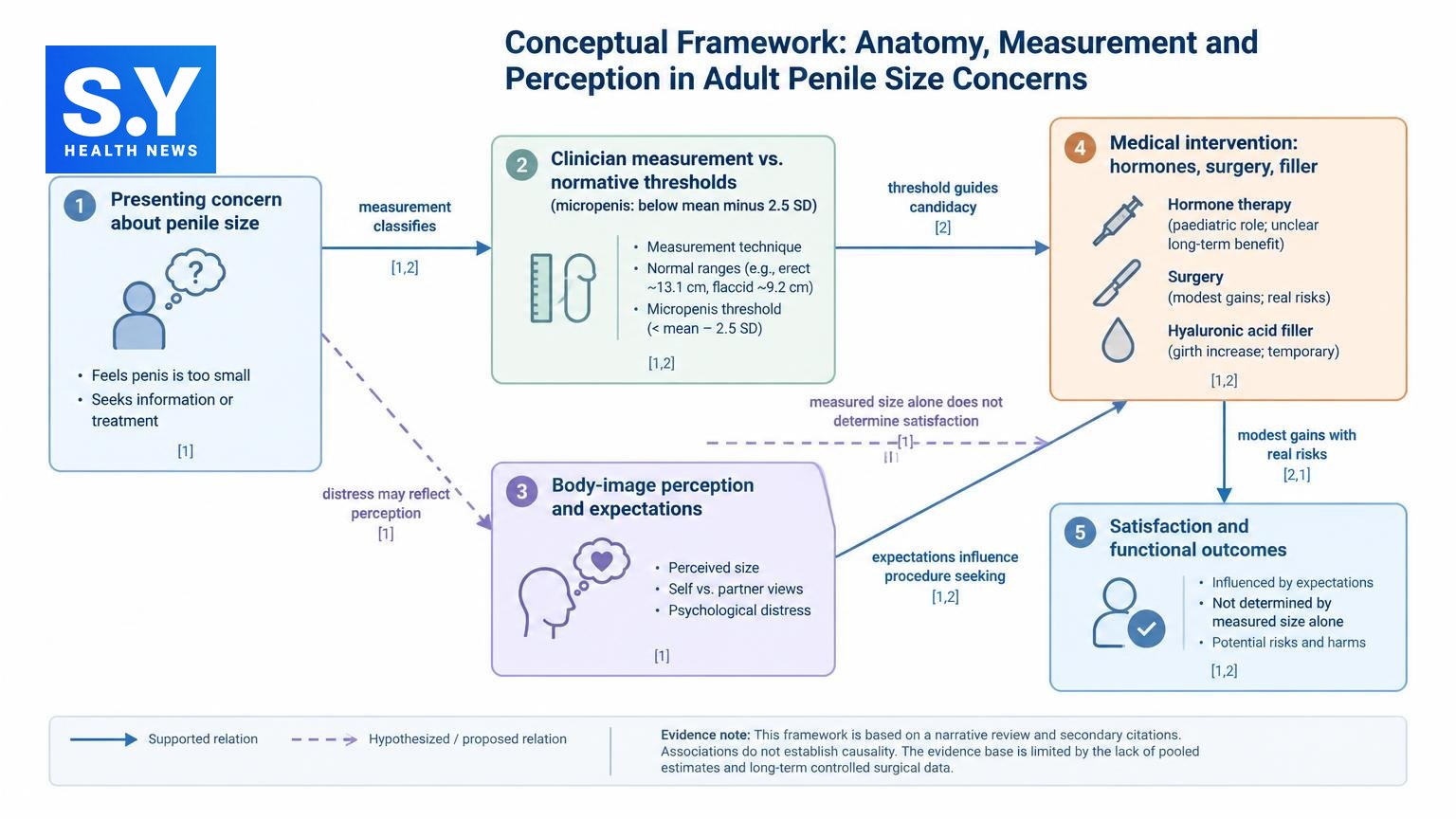
Conceptual framework: Conceptual framework for adult penile size concerns. Nodes show the presenting concern, clinician measurement against normative thresholds, body-image perception, intervention options and satisfaction outcomes. Solid relations are supported by the reviewed sources; the perception-to-concern pathway is proposed rather than demonstrated. The framework is a reading aid, not a tested causal model, and the evidence base is mostly narrative review and secondary citation.
Academic References & Evidence
- Noppon Arunkajohnsak. เพิ่มขนาดน้องชาย: ขนาดปกติ อะไรได้ผลจริง ความเสี่ยง. Menscape Clinic (patient education web guide). 2026
- 姜浩; 李彦锋. 小阴茎的规范化诊断和合理治疗选择. 临床泌尿外科杂志 (J Clin Urol). 2026 41(1):71-75, 80 DOI: 10.13201/j.issn.1001-1420.2026.01.013.
- 姜浩; 李彦锋. 小阴茎的规范化诊断和合理治疗选择. 临床泌尿外科杂志 41(1)
SANYUN Science Center explains published research on men's reproductive and sexual health, connecting scientific evidence with everyday questions while making sources and limitations clear.
Disclaimer: This article is for scientific education and research communication only. It does not provide medical advice, diagnosis, or individualized treatment recommendations, and does not endorse any medication, supplement, device, penile enlargement procedure, or other intervention. Decisions about sexual and reproductive health should be made in consultation with a qualified healthcare professional. Do not delay seeking professional care because of information in this article.
Original Content & Copyright Notice
- This article is prepared for SANYUN Science Center, drawing on published research and publicly available academic literature on men’s sexual and reproductive health. Its editorial explanations and presentation are developed for this platform.
- Copyright in the original editorial content, selection, and arrangement is reserved by SANYUN Science Center to the extent protected by applicable law. Referenced research, quotations, and third-party materials remain subject to the rights of their respective owners. This notice does not claim ownership of scientific facts or third-party research.
- Except where permitted by applicable law or an applicable license, prior written permission is required to reproduce, republish, translate, adapt, redistribute, or commercially reuse protected content. Attribution alone does not grant permission for such reuse.
- For permitted quotation or authorized reuse, clearly identify the source and retain a link to the original article.
- Source: SANYUN Science Center
- Original URL: Retain the original article URL on science.san-yun.com.
- Copyright Holder: SANYUN Science Center, for its own protected editorial content.
- Quotation, excerpts, or authorized reuse must not distort the scientific meaning, omit material limitations or disclaimers, or imply unverified medical claims, product efficacy, or endorsement by SANYUN Science Center.



