




Category: Penile Size
Core Research Direction: Evidence-based evaluation of penile size complaints and penile augmentation: standardized stretched-length measurement, distinguishing true micropenis and buried penis from small penis anxiety/penile dysmorphic disorder, and the limited and risk-laden outcomes of lengthening and girth procedures in men with anatomically normal penises
Search Intent: When a man is worried his penis is too small, what does measured penile length actually show, which conditions and psychological presentations must be separated from a size complaint, and what do the best available studies say about whether lengthening or girth procedures work and what they risk?
Platform: SANYUN Science Center
Evidence reviewed through: 2026-11-07
Executive Summary
Concern about penile size is common, but the best available guidance treats it first as a measurement and psychological-assessment problem, not as an automatic surgical problem. The European Association of Urology (EAU) guideline states that accurate measurement of the penile shaft is mandatory when a man complains of a short penis, and that no consensus definition of normal penile size yet exists.[1]
The guideline distinguishes several entities that are often blurred in public discussion: true micropenis (a congenital, anatomically short penis), buried penis (a normal-sized penis that appears short because of covering tissue or obesity), and small penis anxiety or penile dysmorphic disorder, in which anxiety about a normally sized penis dominates. Small penis anxiety is defined as excessive anxiety regarding a normal-sized penis.
Micropenis is rare. Epidemiological studies cited by the guideline report that between 0.015% and 0.66% of male newborns have a micropenis, yet demand for penile augmentation is substantial worldwide. The guideline partially attributes this mismatch to pornography interest and altered perception of normal penile size, an explanation offered as a hypothesis rather than a demonstrated cause.
Evidence on augmentation in anatomically normal men is weak and outcome measures are inconsistent. Published summaries describe modest, highly variable gains from traction and surgery, temporary girth effects from hyaluronic acid filler, and real complications. A systematic review summarized in a clinic guide concluded that in men of normal penile size many augmentation procedures carry high complication rates and uncertain satisfaction.[2]
Why This Matters
The gap between self-perception and partner perception is large and consistent across surveys. Guideline-cited data report that 84% of women were satisfied with their male partner's penile size, whereas only 55% of male partners were satisfied with their own size and 45% wished for a larger penis.
A separate large survey of more than 50,000 adults, cited in a clinic guide, reported that only about half of men were satisfied with their own penile size while 85% of women were satisfied with their partner's size. Different survey methods and populations mean these figures should not be pooled, but both point in the same direction: dissatisfaction is concentrated among men themselves.
This matters clinically because the subjective impression of penile size can impair sexual functioning and quality of life, affecting the sexual life of about 10% of men according to the guideline, and because men who seek augmentation are a psychologically vulnerable group in whom poorly selected procedures can worsen rather than resolve distress.
Size also has a measurable but modest place in sexual experience. One cited study found that reducing penetration depth by an average 15% of penile length produced a statistically significant 18% reduction in overall sexual pleasure. That is a laboratory-style finding about depth of penetration, not a justification for surgery, and its methods are not described in the supplied guideline excerpt.
Measurement First: What Length Actually Means
Flaccid length is an unreliable anchor. A clinician-authored patient article notes that flaccid penile length can vary markedly across the day with temperature and stress level. The guideline therefore treats stretched penile length (SPL) as the most practical surrogate for the erect penis, defined as the distance between the pubic symphysis and the apex of the glans, while acknowledging interobserver variability and underestimation relative to the erect state.[3]
Not all stretched measurements are equivalent. Stretched length taken from the penopubic skin junction to the glans tip (STT) underestimates erect penile length by about 20%, whereas measurement dorsally from the pubic bone to the glans tip (BTT) correlates better with erect length, particularly in overweight or obese men. The guideline supports recording both flaccid and erect measurements where feasible, and girth distally and at mid-shaft.
For orientation, a clinic guide cites a systematic review pooling clinician-measured data from up to 15,521 men that reported a mean erect length of about 13.1 cm and mean flaccid length of about 9.2 cm, with wide normal ranges. Because this is a secondary summary and the primary review is not supplied in full, these should be read as population means and not as individual targets.
| Entity | Defining feature | Typical cause or context | Measurement or assessment implication |
|---|---|---|---|
| True micropenis | Stretched penile length more than 2.5 standard deviations below the mean for age and race; congenital | Genetic or endocrine conditions; in up to 25% of cases no definitive cause is identified | Requires standardized SPL against reference norms; excluded from anxiety and dysmorphia categories |
| Buried penis (adult acquired) | Normal-sized penis with functional and visible loss of length, covered by prepubic, scrotal or penile skin and subcutaneous tissue | Obesity is the main risk factor; also aggressive circumcision, lichen sclerosis, prior surgery; exact prevalence unknown | Examination, weight and skin assessment; management targets the covering tissue rather than penile length |
| Small penis anxiety / syndrome | Excessive anxiety about a penis that measures within normal limits | Body image and comparison pressures; may precede body dysmorphic disorder | Normal measurement plus psychological assessment; not an indication for lengthening surgery |
| Penile dysmorphic disorder | Body dysmorphic disorder focused on a perceived penile size or shape flaw, with significant impairment in important life areas | A shorthand concept within body dysmorphic disorder, not a separate DSM-5 code | Screening tools and mental health assessment; surgery unlikely to meet expectations |
Biological and Clinical Mechanism
The mechanisms differ fundamentally between categories, and this is why a single treatment cannot address all size complaints. In true micropenis, genital development is incomplete because of disrupted hormonal signalling during fetal and pubertal periods; hypogonadotropic and hypergonadotropic hypogonadism, chromosomal alterations and syndromic anomalies are recognised causes.
In buried penis, the shaft itself is normal but is entrapped. The guideline describes a chronic inflammatory state of the penile dartos leading to progressive retraction and scarring of peri-genital tissue, with a moist environment favouring bacterial and fungal growth and further fibrosis. Obesity is the main risk factor, and the condition is commonly associated with erectile and voiding dysfunction, hygiene difficulties and poor quality of life.
In intrinsic acquired shortening, the corpora cavernosa themselves shorten. Peyronie's disease, radical prostatectomy, radical cystectomy, radiation therapy and low-flow priapism are among the recognised causes. These are reconstructive problems with a defined pathology, and they are conceptually different from cosmetic requests in men with normal anatomy.
Small penis anxiety and penile dysmorphic disorder sit in a psychological rather than anatomical domain. The guideline defines small penis anxiety as excessive anxiety about a normal-sized penis and describes penile dysmorphic disorder as a shorthand for body dysmorphic disorder focused on a perceived penile flaw, producing mental health impairment and significant damage in important areas of life.
What the Evidence Shows on Assessment
The recommended pathway is history, sexual history, genital examination with standardized measurement, and psychological screening. The guideline advises a strong recommendation to inquire about body dysmorphic disorder or penile dysmorphic disorder in patients with a normal-sized penis who complain of shortness, and to examine the genitals in all men, particularly those with a body mass index above 30, lichen sclerosis or a penile cancer history.
Imaging is not a routine answer. The guideline states there is a lack of evidence on imaging in men complaining of penile shortness; penile Doppler ultrasound or MRI may add anatomical data but there is no evidence that this changes management enough to justify routine use in this scenario.
Questionnaire evidence is mixed. The APPSSI and BAPS instruments, developed around beliefs about penile size, were reported not to correlate with measured penile size, and limited objective validation has restricted their use. Sexual function and distress measures have a clearer supporting role for baseline and follow-up assessment.
Referral patterns reinforce the measurement-first message. A clinic guide cites Mondaini et al. (2002), who measured men requesting penile-lengthening surgery and found most had penile length within the normal range. This is a secondary summary without the exact proportion or protocol, but it is consistent with the broader pattern of normal measurements in help-seeking men.
What the Evidence Shows on Lengthening and Girth Procedures
Lengthening evidence is limited in both size and quality. Suspensory ligament release increases visible flaccid length, with published averages of about 1–2 cm, but results vary widely and some men gain little or nothing. More broadly, a clinician-authored appraisal notes that reviews report surgical techniques can increase anatomical measurements, while most contributing studies are small, retrospective and use different measurement methods.
Girth procedures have their own trade-offs. Hyaluronic acid filler temporarily increases girth but not length, with effects typically lasting about 1 to 2 years before natural breakdown. A clinic guide notes that this reversibility is a theoretical advantage but not an absence of risk, since nodules, migration and inflammation can occur.
No method guarantees permanence. A clinic guide summarising the field states that filler effects last about 1 to 2 years, whereas surgery produces lasting anatomical change but with limited, highly variable results and real risks. That framing is consistent with the systematic review summarised in the same guide, which found high complication rates and uncertain satisfaction for many procedures in normal-sized men.
Non-medical methods deserve specific caution. Manual stretching and milking techniques shared online lack evidence of efficacy and have been associated with reported injuries including capillary rupture, fibrosis and penile curvature. Vacuum pumps draw blood into the penis and produce temporary enlargement lasting minutes to hours; they have a genuine role in erectile dysfunction care but no evidence for permanent size increase.
Products sold as pills, creams or herbal enlargers are addressed in patient-facing material as a category, but no efficacy evidence appears in the supplied sources.
Interpretation and Limitations
Several caveats govern how strongly these conclusions can be stated. The guideline itself notes that normal penile size has not been clearly defined and that measurement has not been standardized, so any single cutoff should be applied with clinical context rather than as a diagnostic verdict.
Much of the augmentation literature is small, retrospective and methodologically heterogeneous, which limits any pooled estimate of benefit and makes satisfaction data difficult to compare across studies. The claim that men with normal size and high anxiety often remain dissatisfied after procedures is an interpretive synthesis rather than a controlled finding, and it should be described as a pattern proposed in reviews rather than as a demonstrated causal effect.
The survey and prevalence figures cited here come from guideline summaries and secondary clinic guides, not from re-analysis of primary datasets. Self-reported satisfaction is vulnerable to recall and social-desirability bias, and the guideline notes that men with high social desirability were more likely to report a larger penis.
Two source limitations are explicit. The 2026 congress course on penile size abnormalities and dysmorphophobia is listed but not publicly accessible, so no substantive findings are drawn from it. A peer-reviewed 2023 summary of the EAU guideline exists, but only its citation listing is available here, so this review relies on the guideline text itself.[4][5]
Clinical and Practical Relevance
For a man worried about size, the most defensible first step is a proper examination and measurement, followed by an honest conversation about what the number means. The guideline's strong recommendation to screen for body dysmorphic disorder and penile dysmorphic disorder in normal-sized men with size complaints reflects the observation that a subgroup do not achieve reasonable satisfaction or emotional adjustment after augmentation, and may not benefit from invasive procedures.
For clinicians, this means distinguishing categories before offering anything: true micropenis, buried penis, acquired shortening from defined pathology, and psychological presentations. Buried penis in particular may call for weight management, skin and soft-tissue assessment, or reconstructive surgery rather than a cosmetic lengthening operation, and it is commonly associated with erectile and voiding problems that deserve their own evaluation.
For patients considering procedures, the appropriate discussion covers expected magnitude, durability, revision and removal, and the possibility that satisfaction may not follow a measurable change. Because the guideline notes that major demand for augmentation coexists with very low micropenis prevalence, expectation management is not a soft add-on but central to the clinical task.
Research Outlook
The most important gap is definitional. Without consensus on normal penile size and standardized measurement protocols, studies cannot be cleanly compared and thresholds remain approximate. The guideline's own evidence summaries rate several key statements at moderate or low certainty, and it explicitly calls for standardized tools to counsel men seeking augmentation.
A second gap is psychological. Prevalence data for body dysmorphic disorder in cosmetic surgery populations suggest that a meaningful minority of augmentation candidates carry dysmorphic concerns, yet long-term psychological outcomes after surgery are poorly characterised in the supplied sources, and the tools used to screen for penile-specific beliefs have limited validation.
A third gap is procedural. Longer follow-up, uniform outcome measures including girth, length, function, sensation, partner experience and complications, and transparent reporting of dissatisfaction would substantially improve the evidence base. Until then, claims of reliable permanent enlargement should be treated as marketing rather than science.
Key Takeaways
- Accurate measurement is the first step in any size complaint, and stretched length is the most practical surrogate for erect length, though technique and landmarks change the result.
- True micropenis is a congenital condition defined by a stretched length more than 2.5 standard deviations below the population mean, and it is rare, reported in 0.015–0.66% of male newborns.
- Buried penis and acquired shortening are distinct from cosmetic concerns; buried penis involves a normal-sized shaft covered by tissue, with obesity as the main risk factor.
- Small penis anxiety and penile dysmorphic disorder describe distress about a normal or near-normal penis, and the guideline recommends screening for them before any procedure.
- Lengthening and girth procedures show limited, variable and mostly low-quality evidence of benefit, with real risks and uncertain satisfaction in men of normal size.
- Most men who request lengthening measure within the normal range, and partner satisfaction is consistently higher than men's own satisfaction in survey data.
Questions and Answers
How is penile length measured when a man is worried his penis is too small?
Clinical assessment relies on stretched penile length, measured from the pubic bone or skin junction to the glans tip, with both flaccid and erect measurements where feasible. The pubic-bone-to-glans measurement correlates better with erect length than the skin-junction measurement, which underestimates erect length by about 20%. Flaccid length varies with temperature and stress, so it is a poor anchor.
What is the difference between true micropenis, buried penis and small penis anxiety?
True micropenis is a congenital short penis, defined as stretched length more than 2.5 standard deviations below the mean for age and race. Buried penis is a normal-sized penis hidden by prepubic, scrotal or penile tissue, often with obesity as the main risk factor. Small penis anxiety is excessive anxiety about a penis that measures within normal limits, a psychological rather than anatomical problem.
Do penile lengthening and girth procedures actually work in men with normal anatomy?
Evidence is limited and inconsistent. Suspensory ligament release raises visible flaccid length by published averages of about 1–2 cm, but results vary widely and some men gain little. Hyaluronic acid filler increases girth temporarily, typically for about 1–2 years, without increasing length. A systematic review summarised in a clinic guide found high complication rates and uncertain satisfaction for many procedures in normal-sized men.
How strong is the evidence on penile augmentation outcomes and complications?
The evidence base is weak. Most surgical studies are small, retrospective and use different measurement methods, and no method guarantees permanent results. The guideline notes that a subgroup of men do not achieve reasonable satisfaction or emotional adjustment after augmentation. Complication and satisfaction data are heterogeneous, so pooled estimates should be treated cautiously.
When should a size concern be assessed as body dysmorphic disorder or penile dysmorphic disorder?
The guideline recommends a strong screen for body dysmorphic disorder or penile dysmorphic disorder when a man with a normal-sized penis complains of shortness. Penile dysmorphic disorder describes a body dysmorphic focus on a perceived penile flaw with significant impairment in important life areas. Assessment should involve validated screening tools and, where indicated, a mental health specialist.
Are pills, creams, pumps or manual stretching effective for permanent penile enlargement?
No. Vacuum pumps produce temporary enlargement lasting minutes to hours and have a legitimate role in erectile dysfunction care but no evidence for permanent size gain. Manual stretching and milking techniques lack efficacy evidence and have been linked to reported injuries such as capillary rupture, fibrosis and curvature. Pills, creams and herbal products appear in patient materials as purported methods without efficacy evidence in the supplied sources.
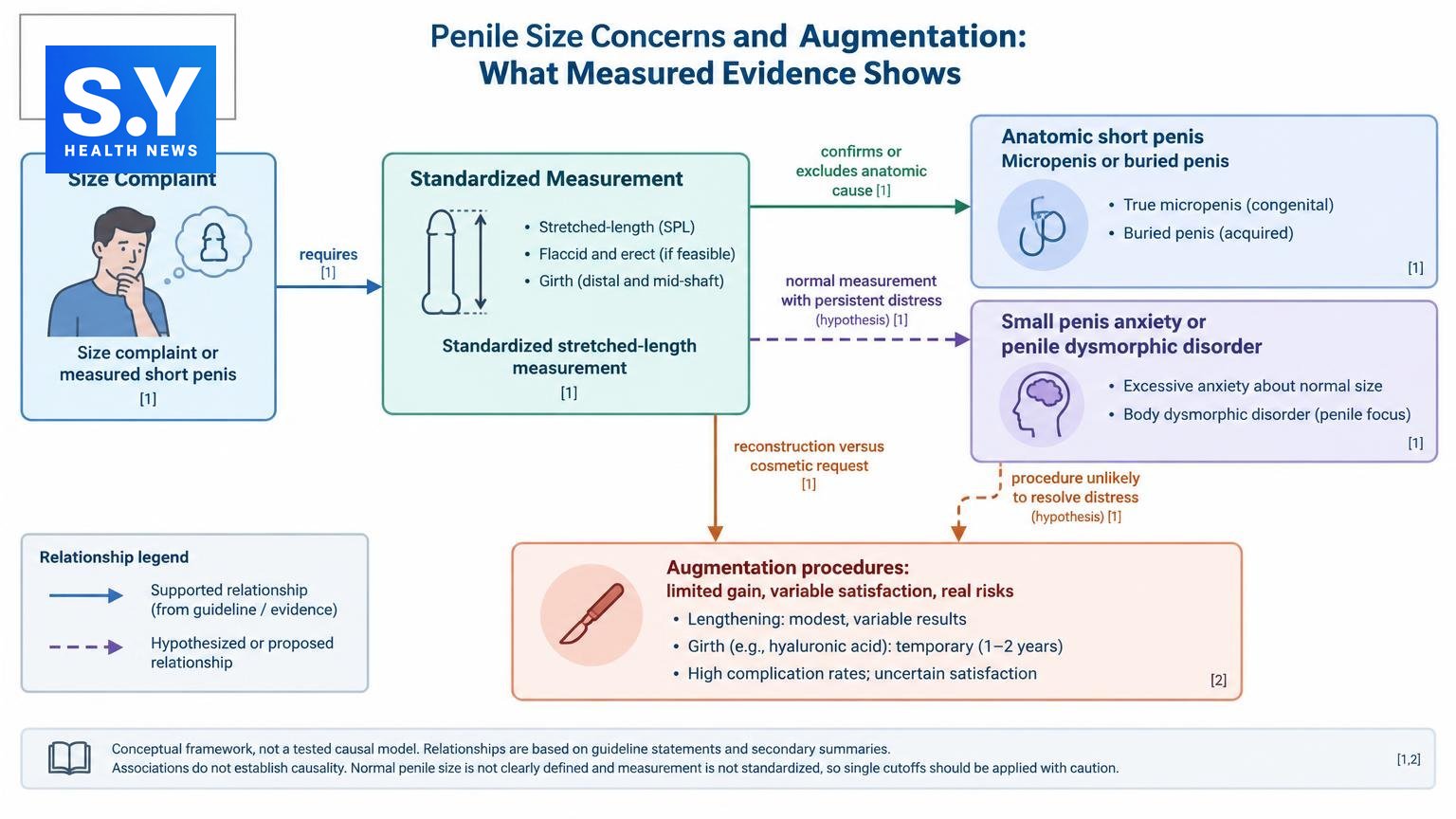
Conceptual framework: Conceptual framework, not a tested causal model. The figure organizes the variables discussed in this evidence review: a size complaint prompts standardized stretched-length measurement, which separates anatomic causes from psychological presentations; augmentation outcomes are limited and variable. Relationships are supported or proposed as labeled, drawn from EAU guideline statements and secondary summaries.
Academic References & Evidence
- Penile Size Abnormalities and Dysmorphophobia – EAU Guidelines on Sexual and Reproductive Health – Uroweb.
- Noppon Arunkajohnsak. เพิ่มขนาดน้องชาย: ขนาดปกติ อะไรได้ผลจริง ความเสี่ยง. 2026
- Taner ÇAVUMİRZA. Penis büyütme nedir, nasıl yapılır? Gerçekten işe yarar mı?.
- P. Capogrosso. UROsource. 2026
- EAU Guidelines on Sexual and Reproductive Health – Uroweb.
SANYUN Science Center explains published research on men's reproductive and sexual health, connecting scientific evidence with everyday questions while making sources and limitations clear.
Disclaimer: This article is for scientific education and research communication only. It does not provide medical advice, diagnosis, or individualized treatment recommendations, and does not endorse any medication, supplement, device, penile enlargement procedure, or other intervention. Decisions about sexual and reproductive health should be made in consultation with a qualified healthcare professional. Do not delay seeking professional care because of information in this article.
Original Content & Copyright Notice
- This article is prepared for SANYUN Science Center, drawing on published research and publicly available academic literature on men’s sexual and reproductive health. Its editorial explanations and presentation are developed for this platform.
- Copyright in the original editorial content, selection, and arrangement is reserved by SANYUN Science Center to the extent protected by applicable law. Referenced research, quotations, and third-party materials remain subject to the rights of their respective owners. This notice does not claim ownership of scientific facts or third-party research.
- Except where permitted by applicable law or an applicable license, prior written permission is required to reproduce, republish, translate, adapt, redistribute, or commercially reuse protected content. Attribution alone does not grant permission for such reuse.
- For permitted quotation or authorized reuse, clearly identify the source and retain a link to the original article.
- Source: SANYUN Science Center
- Original URL: Retain the original article URL on science.san-yun.com.
- Copyright Holder: SANYUN Science Center, for its own protected editorial content.
- Quotation, excerpts, or authorized reuse must not distort the scientific meaning, omit material limitations or disclaimers, or imply unverified medical claims, product efficacy, or endorsement by SANYUN Science Center.



