




Category: Penis Enlargement
Core Research Direction: Evidence-based review of penile size concerns: distinguishing true short penis/micropenis from perceived or apparent shortness (buried penis, measurement error, flaccid variability, post-surgical or erectile-dysfunction-related changes), and clarifying realistic expectations about penile-enlargement interventions
Search Intent: When is a small-appearing penis a genuine medical condition versus a measurement or perception issue, and what can evidence-based assessment and treatment realistically achieve?
Platform: SANYUN Science Center
Evidence reviewed through: 2026-11-03
Executive Summary
Most men who believe their penis is unusually small do not have a medically defined short penis. The more common explanations are normal variation in flaccid appearance, a suprapubic fat pad that hides part of the shaft, inconsistent self-measurement and erectile dysfunction that reduces erect length acutely.[1][2]
True micropenis is a congenital condition defined by stretched penile length far below the population mean for age and race, and it is rare, reported at 0.015-0.66% of male newborns. A separate consumer estimate places adult medically short penis at a few per thousand to about 1% of men, using an erect threshold of roughly 7-8 cm.[3][4]
The central clinical task is classification. Genuine tissue shortening has identifiable causes, including loss of erectile tissue elasticity, Peyronie's plaque and changes after radical prostatectomy. These differ from reduced visible length, where the tissue is unchanged. Penile implants restore erectile function rather than adding length, and no intervention in the available evidence promises a specific gain.[5]
Why This Matters
Size concern is common and not trivial. A secondary clinical summary reports that 45% of men wish they had a larger penis while 84% of female partners report satisfaction with their size, and that concerns about size negatively affect the sex lives of about 10% of men according to a paraphrase of the 2025 EAU Guidelines. These figures are cited without identifying the underlying studies, so they indicate scale rather than precise prevalence.
Misclassification carries costs in both directions. A man with normal anatomy may spend money on unproven enlargement products, while a man with progressive Peyronie's disease or untreated long-standing erectile dysfunction may delay care during a window when tissue preservation is the realistic goal. The clinician-authored material reviewed here frames this as a distinction between true shortening and reduced visible length, and treats it as the first branch point in assessment.
Defining the Categories: Micropenis, Short Penis and Perceived Smallness
Micropenis is congenital. The definition supplied is a stretched penile length more than 2.5 standard deviations below the mean for age and race, meaning far outside the typical range for that population, usually reflecting an underlying genetic or endocrine condition. The 0.015-0.66% figure applies to male newborns and cannot be transferred directly to adults presenting with size anxiety.
An adult threshold is described differently in consumer material: erect length below about 7-8 cm, or clearly below the lower limit of distribution for the age-matched population, with most studies estimating a few per thousand to roughly 1% of men affected. That source names no specific studies, so the cut-off should be read as an approximate epidemiological marker rather than a diagnostic rule.
A third and more frequent category is apparent shortness without tissue loss. Flaccid length and girth vary markedly with temperature, emotion, fatigue and even the interval since last ejaculation, and judging shortness from flaccid appearance alone is not medically accurate. If erection achieves sufficient rigidity and duration without impairing sexual activity, a small-looking flaccid penis is mostly a normal physiological variation.
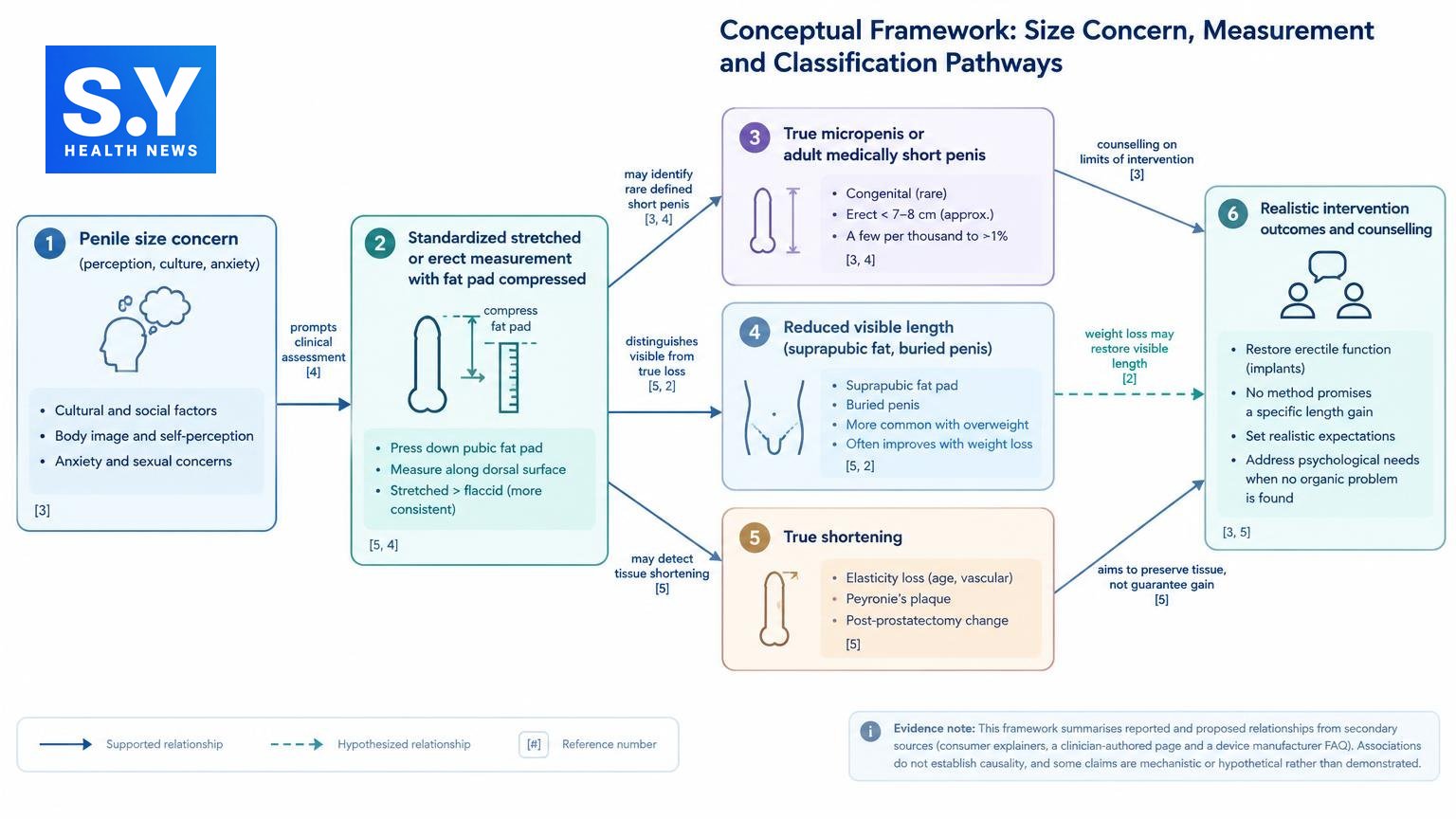
A fourth category is reduced visible length. Only part of the penis lies in front of the pubic bone beneath skin and fatty tissue, so externally visible length is a fraction of total length. In a buried penis the tissue itself is normal but enveloped by suprapubic fat or surrounding tissue, which is more common in overweight men and is described as often improving with weight loss.
How Erection Quality and Tissue Change Affect Apparent Length
Erection requires coordinated neurological, vascular, hormonal and psychological input. Diabetes, hypertension and hyperlipidemia can impair vascular endothelium and reduce cavernosal blood supply, while low androgen levels can affect libido and erection quality. Because a partially rigid erection is visually and measurably shorter than a full one, treating the vascular and hormonal contributors can change the appearance a man is worried about.
Age-related loss of erectile tissue elasticity is usually slow, and vascular disease, diabetes and smoking can accelerate it. In Peyronie's disease, hard inelastic plaques form in the tunica albuginea, the sheath surrounding erectile tissue; when plaque and scar tissue reduce sheath elasticity, erect length may decrease and curvature may develop. The magnitude of loss is not quantified in the available sources.
After radical prostatectomy, some men report shortening. Proposed contributors include re-joining of the urinary passage, tissue remaining contracted for a time because nerves were affected, and prolonged absence of erections postoperatively. The reviewed explainer presents these as suggested mechanisms rather than established causes, and the same reasoning is applied to long-standing untreated erectile dysfunction, where regular blood filling is thought to help maintain tissue elasticity.
What the Evidence Shows
| Presentation | Underlying process | Reported frequency or threshold | What assessment should establish |
|---|---|---|---|
| Congenital micropenis | Stretched length far below the mean for age and race; often genetic or endocrine | 0.015-0.66% of male newborns | Whether the finding is congenital and requires paediatric or endocrine evaluation rather than adult size-focused care |
| Adult medically short penis | Erect length below the population distribution | About 7-8 cm erect or clearly below the age-matched lower limit; a few per thousand to about 1% of men in consumer estimates | Standardized measurement and exclusion of other pathology |
| Buried penis or reduced visible length | Suprapubic fat pad or surrounding tissue hides a normal-length shaft | More common with overweight; improvement often described after weight loss | Whether compression of the fat pad during measurement reveals normal length |
| True tissue shortening | Loss of erectile tissue elasticity or scar tissue, including Peyronie's plaque | Reduction in stretched or erect length; magnitude not quantified in the source | Presence of curvature, pain, palpable plaque; ultrasound when indicated |
| Post-prostatectomy change | Urethral re-anastomosis, nerve-related contraction and prolonged absence of erections are proposed contributors | Qualitative reports only; no frequency supplied | Whether erections are returning and whether a rehabilitation plan is appropriate |
| Erectile dysfunction with size concern | Vascular, hormonal, neurological and psychological contributions to rigidity | Size concerns negatively affect the sex lives of about 10% of men per a guideline paraphrase | Whether improving erectile function changes perceived size before any size-directed intervention |
Intervention evidence is narrow. Penile implants are primarily designed to restore erectile function rather than increase size, and some men perceive a slight decrease in length after implantation compared with their previous natural erections. Reported satisfaction of 92-100% with appropriate counselling comes from a device manufacturer's FAQ that does not specify which studies underpin the range or which domains of satisfaction were measured.
Traction and vacuum devices may be considered as supportive measures in some patients, particularly with Peyronie's disease or after surgery, but effects vary between individuals, regular long-term use is required, and they should not be seen as a lengthening method in their own right. No source in this review reports a quantified length gain for any intervention.
For true shortening, treatment aims are usually to preserve existing tissue, slow progression and improve function. Fully regaining lost length may not be possible, and no method can promise a specific gain. When no organic problem is identified, clinicians more often explain and reassure than prescribe a size-directed treatment plan.
Measurement and Clinical Assessment
Correct measurement presses down the fat pad at the pubic symphysis and runs along the dorsal surface to the tip of the glans. Stretched measurement is described as giving more consistent information in clinic than flaccid length, which shifts with temperature, stress and time of day. Pressing the ruler to the bone removes the apparent loss produced by the fat pad and separates true shortening from reduced visible length.
In practice, clinicians facing a size complaint typically begin with developmental history, measurement data and secondary sexual characteristics, arranging hormonal or imaging tests only when indicated, rather than pronouncing on shortness at first sight. Triggers for earlier assessment include marked reduction over a few months, new curvature or pain with erections, a palpable hard area, erections failing to return after prostate surgery, months of untreated erectile difficulty, or a penis becoming markedly buried with weight gain and causing hygiene or urinary problems.
For men without erectile dysfunction whose only concern is size, a psychosexual assessment is recommended first. Many have a normal-sized penis; some have small penis anxiety, described as excessive worry about a normally sized penis, and others have penile dysmorphic disorder, which requires psychological treatment. This recommendation is a guideline summary reproduced on a commercial site rather than a primary outcome study.
Interpretation and Limitations
This review is built on a weak evidence base. The sources are consumer health explainers, one clinician-authored patient page and a device manufacturer's FAQ; no primary studies, systematic reviews or original guideline text were supplied for verification. Prevalence ranges, the 7-8 cm threshold, partner satisfaction figures and implant satisfaction rates should all be treated as secondary summaries pending confirmation against primary literature.
Several claims are mechanistic or hypothetical rather than demonstrated. Post-prostatectomy contributors are described as thought to contribute, the anxiety-and-erectile-dysfunction loop is presented as a proposed cycle, and the weight-loss benefit for buried penis is described qualitatively without measured outcomes. The statement that no method can promise a specific length gain is an expectation-setting position, not a comparative trial result.
Statistical and clinical meaning also diverge. A length beyond 2.5 standard deviations is a distributional definition, not proof of impaired function, and a man within the normal range can still experience substantial distress. A reported association between excess weight and reduced visible length does not establish how much length, if any, a particular man regains by losing weight.
Research Outlook
Useful progress would require prospective studies using standardized stretched or erect measurement, validated patient-reported measures of size distress and sexual function, and transparent reporting of which satisfaction domains improve after implant surgery. Comparative data on traction and vacuum devices, and on weight loss for buried penis, are needed before any quantified length claim can be responsibly made.
Research should also keep congenital micropenis, acquired shortening and body-image-driven concern as separate groups, because they differ in cause, prognosis and appropriate care. The material reviewed here describes those distinctions but does not quantify them, and future work should report outcomes by cause and by baseline erectile function.
Key Takeaways
- True micropenis is rare, reported at 0.015-0.66% of male newborns, and defined by stretched length far below the mean for age and race.
- Adult medically short penis is estimated at a few per thousand to about 1% of men using an erect threshold of roughly 7-8 cm, though no primary studies are cited.
- Most size concern reflects apparent rather than true smallness, driven by flaccid variability, suprapubic fat, measurement technique or inadequate erection.
- True shortening has identifiable causes, including loss of tissue elasticity, Peyronie's plaque and post-prostatectomy change, assessed by pressed-down stretched measurement and targeted examination.
- Penile implants restore erectile function rather than add length, some men perceive slight shortening afterwards, and realistic counselling is central to satisfaction.
- Men without erectile dysfunction who are concerned only about size should have psychosexual assessment first, as many have normal anatomy and some need psychological treatment.
Questions and Answers
What is the difference between a micropenis and a penis that only looks short?
A micropenis is congenital, defined by a stretched length far below the mean for age and race, and reported in 0.015-0.66% of male newborns. A penis that only looks short usually has normal tissue hidden by a suprapubic fat pad, varies with cold or fatigue, or is measured from the skin rather than with the fat pad compressed.
Why can weight gain make the penis appear shorter without any tissue loss?
Only part of the penis lies in front of the pubic bone beneath skin and fat, so visible length is a fraction of total length. Weight gain thickens the suprapubic fat pad, which surrounds the base of the shaft and hides it. The tissue itself is unchanged, and improvement is often described after weight loss, though no measured amount is given.
Can erectile dysfunction make an erect penis measure shorter?
Yes, in the sense that a rigid, fully engorged erection is longer than a partial one. Erectile function depends on vascular, hormonal, neurological and psychological input, and conditions such as diabetes or hypertension can impair blood supply. Sources suggest that improving erection quality can change how size is perceived, though no quantified comparison was supplied.
How strong is the evidence behind penile size prevalence figures?
Weak. The 0.015-0.66% newborn figure appears on a commercial manufacturer site, and the adult estimate of a few per thousand to about 1% comes from a consumer article that names no studies. The 45% and 84% partner satisfaction figures and the 92-100% implant satisfaction range likewise lack cited primary sources, so all should be treated as approximate.
Do penile implants increase length, and what are the risks of expecting that?
Implants are designed to restore erectile function, not add size, and some men perceive a slight decrease compared with earlier natural erections. Devices are sized to tissue length at surgery, so shortening already present may not reverse. Unrealistic size expectations are therefore a main threat to satisfaction, which is why preoperative counselling about size is emphasized.
When does a penile size concern need medical assessment rather than reassurance?
Assessment is warranted for marked reduction over a few months, new curvature, pain with erections or a palpable hard area, erections not returning after prostate surgery, months of untreated erectile difficulty, a penis becoming buried with weight gain and causing hygiene or urinary problems, or distress affecting relationships. Clinicians usually start with history, measurement and examination rather than judging size on sight.
Conceptual framework: Conceptual framework. Size concern prompts standardized stretched or erect measurement with the fat pad compressed, which helps separate rare true micropenis, reduced visible length from suprapubic fat or buried penis, and true tissue shortening from elasticity loss, Peyronie's plaque or post-prostatectomy change. Arrows summarise reported or proposed relationships, not proven causal pathways; the weight-loss link is proposed rather than quantified, and no intervention promises a specific length gain.
Academic References & Evidence
- 阴茎勃不起还短小?这种状态可能和疾病有关.
- 阴茎疲软状态下短小,是生理差异还是疾病信号.
- Why Is My Erect Penis Smaller Than Normal? – Patient FAQs.
- 阴茎短小的男生有多少?流行病学数据与就医现状.
- Why Does the Penis Get Shorter? Age, Weight, Peyronie's Disease and Length Loss After Surgery | Assoc. Prof. Zülfü Sertkaya, MD.
SANYUN Science Center explains published research on men's reproductive and sexual health, connecting scientific evidence with everyday questions while making sources and limitations clear.
Disclaimer: This article is for scientific education and research communication only. It does not provide medical advice, diagnosis, or individualized treatment recommendations, and does not endorse any medication, supplement, device, penile enlargement procedure, or other intervention. Decisions about sexual and reproductive health should be made in consultation with a qualified healthcare professional. Do not delay seeking professional care because of information in this article.
Original Content & Copyright Notice
- This article is prepared for SANYUN Science Center, drawing on published research and publicly available academic literature on men’s sexual and reproductive health. Its editorial explanations and presentation are developed for this platform.
- Copyright in the original editorial content, selection, and arrangement is reserved by SANYUN Science Center to the extent protected by applicable law. Referenced research, quotations, and third-party materials remain subject to the rights of their respective owners. This notice does not claim ownership of scientific facts or third-party research.
- Except where permitted by applicable law or an applicable license, prior written permission is required to reproduce, republish, translate, adapt, redistribute, or commercially reuse protected content. Attribution alone does not grant permission for such reuse.
- For permitted quotation or authorized reuse, clearly identify the source and retain a link to the original article.
- Source: SANYUN Science Center
- Original URL: Retain the original article URL on science.san-yun.com.
- Copyright Holder: SANYUN Science Center, for its own protected editorial content.
- Quotation, excerpts, or authorized reuse must not distort the scientific meaning, omit material limitations or disclaimers, or imply unverified medical claims, product efficacy, or endorsement by SANYUN Science Center.



