




Category: Penile Size
Core Research Direction: Penile size concerns in adult men: what measured population data show about normal size, how much of the complaint is perceptual rather than anatomical, and what the limited evidence says about enlargement interventions versus psychological care
Search Intent: If most men worried about penis size measure within the normal range, what does the evidence actually support for enlargement, and what are the documented risks and satisfaction outcomes?
Platform: SANYUN Science Center
Evidence reviewed through: 2026-11-02
Executive Summary
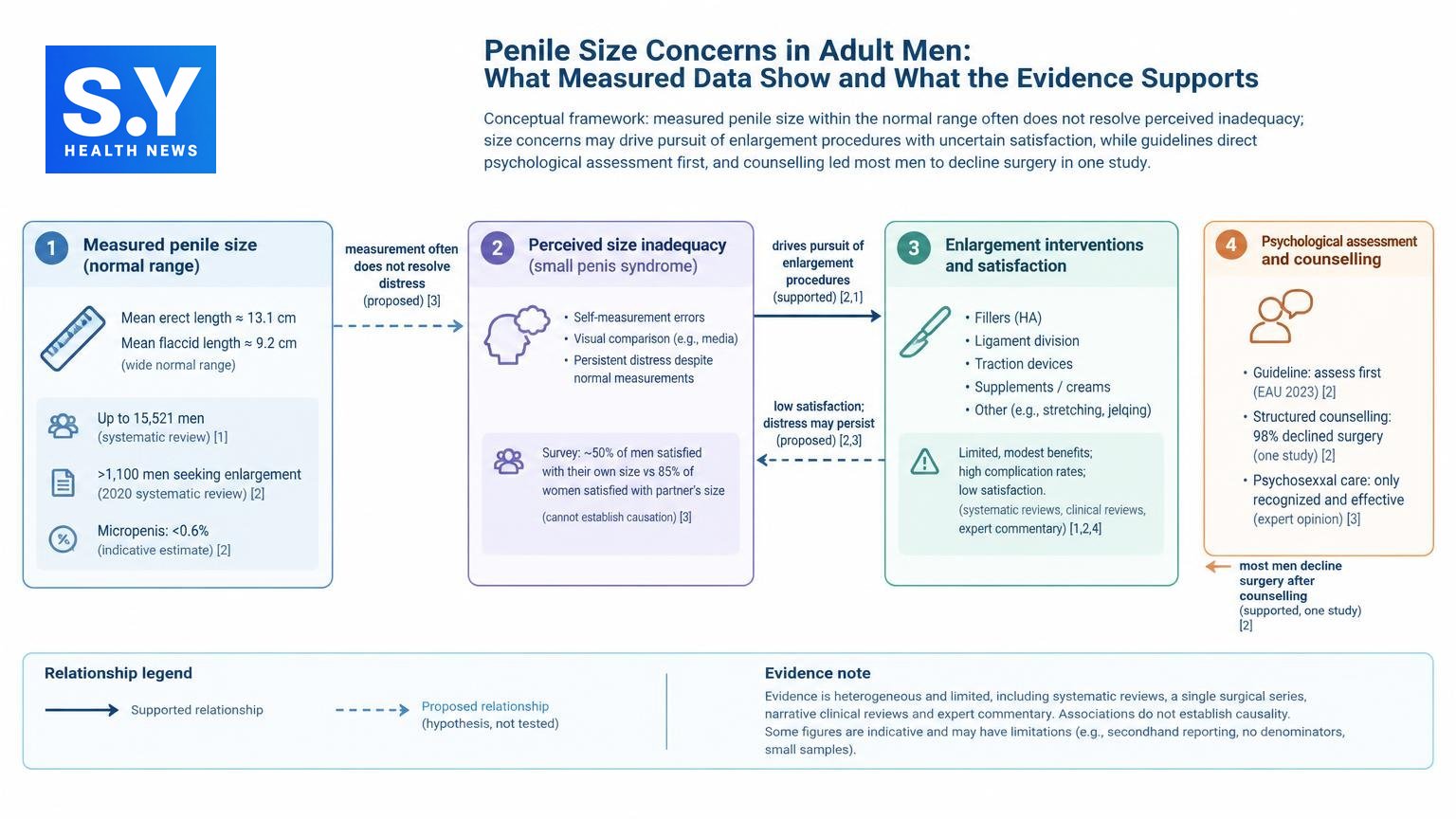
Penile size concerns are a common reason men seek urological or sexual-health consultation, yet the published evidence repeatedly finds a gap between measured anatomy and perceived inadequacy. A systematic review of clinician measurements in up to 15,521 men reported a mean erect length of about 13.1 cm and a mean flaccid length of about 9.2 cm, with a wide normal range. In a 2020 systematic review of 17 studies covering more than 1,100 men seeking enlargement, the great majority measured within the normal range. In one surgical series of penile lengthening, satisfaction was 35% overall and 27% among men with dysmorphic disorder. The European Association of Urology's 2023 guidance states that men of normal size seeking augmentation must be referred for psychological assessment first. In one study, 98% of men with normal penises who had been seeking enlargement decided against surgery after structured counselling. These findings support psychological assessment as the first step for most men in this situation, while acknowledging that the psychological-treatment evidence base is small and of mixed quality.[1][2]
Why This Matters
The mismatch between measured size and self-perceived inadequacy has practical consequences: men may avoid intimacy, seek unproven products, or pay for procedures with uncertain benefit and real risks. Survey data from over 50,000 adults found that only about half of men were satisfied with their own size, while 85% of women were satisfied with their partner's size. This gap suggests that the distress driving many consultations is primarily perceptual rather than anatomical, although survey data cannot establish what causes that dissatisfaction. A consultant urologist describes how self-measured size concerns can translate into perceived inadequacy affecting relationships and daily life. Recognizing this pattern matters because it redirects attention toward what the evidence identifies as the relevant target — the perception — rather than toward anatomy that falls within normal limits.[3]
Normal Size: What Measured Data Show
Population-level measurement data provide the reference against which individual concerns should be assessed. A systematic review of clinician measurements from up to 15,521 men found a mean erect length of about 13.1 cm and a mean flaccid length of about 9.2 cm, with wide normal ranges for both values. A separate source reports the same systematic review with an average erect length of 13.12 cm and a flaccid length of 9.16 cm across over 15,000 men; these are approximate summaries of the same underlying review, not conflicting studies. Measurement methods, differing protocols and heterogeneity across contributing studies remain relevant limitations. Crucially, a 2020 systematic review of 17 studies covering more than 1,100 men seeking enlargement found that the great majority measured within the normal range. Mondaini and colleagues in 2002 similarly measured men requesting lengthening surgery and found most had normal size.
Micropenis is a separate, rare diagnosis defined as more than 2.5 standard deviations below the mean (roughly less than 7 cm erect), affecting less than 0.6% of men and usually identified in childhood. This distinction matters because genuine anatomical abnormality warrants specialist assessment and care, while the more common presentation — a man of normal size who believes he is inadequate — calls for a different approach. The source reporting the 0.6% prevalence figure does not cite its origin, so that estimate should be treated as indicative rather than definitive.
Mechanism: Why Perception Diverges From Measurement
Several proposed explanations help account for why a man's subjective sense of size can diverge from measured anatomy. Self-measurement is prone to error, and repeated checking may reinforce anxiety. Visual comparison with adult media involves a selected group rather than a representative population. A consultant urologist frames small penis syndrome as tied to perceived rather than measured penile size. This framing is a clinical hypothesis rather than a measured mechanism, but it is consistent with the observation that reassurance alone often fails to resolve distress: in the urologist's account, a patient measured at the 98th percentile nonetheless predicted he would resume measuring within an hour. The persistence of distress despite objective evidence of normal size is the central clinical feature that distinguishes perceptual concerns from anatomical ones. These accounts should be read as clinical observations and hypotheses, not as established causal pathways.
What the Evidence Shows: Enlargement Interventions
The evidence for enlargement interventions is limited and consistently points toward modest, unpredictable benefits set against real risks. A narrative clinical review concludes that some techniques yield girth gains in selected patients but carry limitations and risks, while definitive length increase remains controversial with no aesthetic method broadly proven safe, effective and predictable. A systematic review by Marra and colleagues in 2020 concluded that among men of normal size, many enlargement procedures have high complication rates and uncertain satisfaction. A consultant urologist states that most enlargement methods perform poorly and that evidence indicates low satisfaction rates among those treated, though no quantitative figures or citations are given for that statement. These are not head-to-head comparative trial results; they are a convergence of systematic-review conclusions, narrative review observations and clinical commentary.[4]
Specific techniques illustrate the pattern. Hyaluronic acid filler temporarily increases girth but not length, with effects typically lasting about 1 to 2 years before natural resorption; duration varies by product and individual. Suspensory ligament division increases exposed penile length at rest but does not enlarge the corpora cavernosa and does not guarantee functional gain during erection. Published averages for visible flaccid length gain with ligamentolysis are around 1–2 cm, but results are highly variable and some men gain little or none. Reported risks of ligament release include scarring, altered erection angle, reduced penile stability and unsatisfactory aesthetic results. Traction devices may produce modest length gains in specific situations, especially with medical supervision and prolonged use, but results vary and evidence quality and predictability are limited.
Non-medical and unproven approaches carry documented harms. There are currently no medications, creams or supplements with proven efficacy for permanent penile enlargement, and marketed products may contain unknown or undeclared substances. Thailand's FDA detected some men's dietary supplements adulterated with PDE-5-inhibitor-class drugs without labeling, a regulatory surveillance finding whose extent is not quantified in the available report. Online-shared stretching and jelqing techniques have no evidence of efficacy but have documented injuries including capillary rupture, fibrosis and penile curvature. Use of industrial silicone or oils for penile augmentation carries additional risk of migration, chronic inflammation and serious injury. Vacuum pumps provide temporary erection and have a role in erectile dysfunction care but do not produce permanent size increase.
One apparent exception illustrates the difference between visual and anatomical change: exercise and fat loss do not change true penile size, but in men with much abdominal fat, fat loss increases the visible penile portion — a visual effect, not augmentation. This distinction is important for informed consent because patients may interpret increased visibility as genuine enlargement.
Surgical Satisfaction and the Case for Psychological Care
Satisfaction outcomes after surgery are sobering in the available series. In one surgical series of penile lengthening, satisfaction was 35% overall and 27% among men with dysmorphic disorder; denominators were not given in the source. A consultant urologist proposes that after surgery, perceived inadequacy persists and shifts to new targets such as girth or surface appearance — a clinical observation rather than a systematically measured outcome. This pattern is consistent with the conceptual framing of small penis syndrome as perceptual rather than anatomical. The European Association of Urology's 2023 guidance reflects this understanding by stating that men of normal size seeking augmentation must be referred for psychological assessment first, a guideline recommendation rather than a study result.
Evidence for psychological intervention, while limited, is clinically meaningful. In one study, 98% of men with normal penises who had been seeking enlargement decided against surgery after structured counselling. A consultant urologist describes psychosexual work as the only recognized and effective treatment for small penis syndrome — expert opinion rather than a comparative trial result. The source itself acknowledges that the studies in this field are small and of mixed quality. This limitation should temper enthusiasm but does not negate the convergence of guideline recommendations, satisfaction data and counselling outcomes pointing in the same direction.
| Intervention or construct | Reported effect or definition | Durability or evidence limitation |
|---|---|---|
| Hyaluronic acid filler | Temporary girth increase; not length; effect typically about 1–2 years | Duration varies by product and individual; long-term follow-up limited |
| Suspensory ligament division | Visible flaccid length gain averaging around 1–2 cm; does not enlarge corpora cavernosa | Highly variable; some gain little or none; risks include scarring and altered erection angle |
| Traction devices | Modest length gains in specific situations with prolonged supervised use | Results vary; evidence quality and predictability limited |
| Oral products, creams, supplements | No proven efficacy for permanent enlargement | Products may contain unknown or undeclared substances; regulatory adulteration detected |
| Manual stretching or jelqing | No evidence of efficacy | Documented injuries include capillary rupture, fibrosis and penile curvature |
| Structured counselling | 98% of men with normal penises seeking enlargement decided against surgery in one study | Single study; psychological-treatment evidence base small and of mixed quality |
| Surgical lengthening satisfaction | 35% overall; 27% among men with dysmorphic disorder | Single surgical series; denominators not given |
Interpretation and Limitations
Several interpretive cautions apply. First, the evidence base is heterogeneous: systematic reviews, a single surgical series, narrative clinical reviews and expert commentary contribute different levels of evidence. The 2020 systematic review of men seeking enlargement is reported secondhand here, and the exact proportion measuring within the normal range is not stated. Second, the satisfaction figures from the lengthening series come from a single series without denominators, limiting precision. Third, the 98% counselling outcome derives from one study whose sample size and follow-up are not stated. Fourth, the statement that psychological-treatment studies are small and of mixed quality is a general caveat, not a quantified result. Fifth, the prevalence figure of less than 0.6% for micropenis is not sourced to a primary study in the available material. Sixth, several mechanism-level claims — such as distress shifting to new targets after surgery — are clinical observations or hypotheses rather than measured outcomes. Finally, the distinction between statistical and clinical meaning matters here: even where rates are reported, the absence of comparator groups and standardized outcome measures means these figures describe observed series rather than proven intervention effects.
These limitations do not undermine the central convergence: measured population data place most treatment-seekers within the normal range, satisfaction with enlargement procedures is low where measured, and guideline bodies recommend psychological assessment before augmentation. They do, however, argue against overstating the certainty of any single figure and against framing psychological care as proven superior in head-to-head trials.
Research Outlook
The current sources describe what has been measured and what clinicians report. Population-level measurement data are relatively consistent, while intervention evidence is drawn from heterogeneous series and narrative reviews. The most pressing gap concerns psychological intervention: the field lacks adequately powered trials with standardized outcome measures, defined follow-up periods and comparator groups. The existing acknowledgement that studies are small and of mixed quality should be read as a call for better-designed research rather than as evidence of ineffectiveness. Similarly, surgical and filler series would benefit from consistent reporting of denominators, complication rates and patient-reported satisfaction using validated instruments. Until such evidence exists, clinical decisions should rest on the convergence of current data, explicit discussion of uncertainty and respect for patient values.
Key Takeaways
- Mean erect length in population studies is about 13.1 cm and flaccid length about 9.2 cm, with wide normal ranges; most men seeking enlargement measure within the normal range.
- Satisfaction after penile lengthening surgery was 35% overall and 27% among men with dysmorphic disorder in one series.
- The European Association of Urology's 2023 guidance states that men of normal size seeking augmentation must be referred for psychological assessment first.
- Structured counselling led 98% of men with normal penises who had been seeking enlargement to decide against surgery in one study.
- No medication, cream or supplement has proven efficacy for permanent enlargement, and some marketed products contain undeclared substances.
- In a large survey, 85% of women were satisfied with their partner's size versus about half of men with their own.
Questions and Answers
If my penile measurement is in the normal range, why do I still feel inadequate?
Because the distress in small penis syndrome is tied to perceived rather than measured size, as clinicians describe. The normal range is wide, and most men who seek enlargement do measure within it. Reassurance alone often fails to resolve distress, which is why structured psychological assessment — not a procedure — is the recommended first step for men of normal size. These are clinical observations and hypotheses, not proven causal mechanisms.
What does the evidence show about satisfaction after penile lengthening surgery?
In one surgical series, satisfaction was 35% overall and 27% among men with dysmorphic disorder; denominators were not given. A consultant urologist proposes that perceived inadequacy may persist after surgery and shift to new targets such as girth or surface appearance. A 2020 systematic review concluded that among men of normal size, many enlargement procedures have high complication rates and uncertain satisfaction. These are observational series, not controlled trials.
What is the average erect penile length according to measured population data?
A systematic review of clinician measurements in up to 15,521 men reported a mean erect length of about 13.1 cm, with a wide normal range. A separate summary of the same review gives 13.12 cm. The normal range is broad, and many men who believe they are below average measure within it. Measurement methods and heterogeneity across studies are limitations.
Does psychological counselling reduce requests for penile enlargement surgery?
In one study, 98% of men with normal penises who had been seeking enlargement decided against surgery after structured counselling. This is a striking single-study finding, but the source itself acknowledges that psychological-treatment studies in this field are small and of mixed quality. The result should be interpreted as promising but not definitive evidence of comparative effectiveness.
Do traction devices produce lasting penile length gains?
Traction devices may produce modest length gains in specific situations, especially with medical supervision and prolonged use, but results vary and evidence quality and predictability are limited. There is no guarantee of lasting or predictable gain, and long-term comparative data are limited. This is not equivalent to the more substantial effects sometimes claimed by sellers, and supervised use is the appropriate context for any consideration.
Are penile enlargement pills, creams or supplements proven to work?
No. There are currently no medications, creams or supplements with proven efficacy for permanent penile enlargement, and marketed products may contain unknown or undeclared substances. Thailand's FDA detected some men's dietary supplements adulterated with PDE-5-inhibitor-class drugs without labeling, a surveillance finding whose extent is not quantified. These products carry real safety concerns, not merely uncertain benefit.
Conceptual framework: Conceptual framework: measured penile size within the normal range often does not resolve perceived inadequacy; size concerns may drive pursuit of enlargement procedures with uncertain satisfaction, while guidelines direct psychological assessment first, and counselling led most men to decline surgery in one study. Relations marked as proposed are hypotheses from clinical commentary, not tested causal pathways. Evidence is heterogeneous and limited.
Academic References & Evidence
- เพิ่มขนาดน้องชาย: ขนาดปกติ อะไรได้ผลจริง ความเสี่ยง.
- How to Make Your Penis Bigger — A Urologist's Honest Answer | GGO Med.
- Small Penis Syndrome: Micropenis Criteria and What Helps.
- Aumento peniano: métodos, evidências e limitações.
SANYUN Science Center explains published research on men's reproductive and sexual health, connecting scientific evidence with everyday questions while making sources and limitations clear.
Disclaimer: This article is for scientific education and research communication only. It does not provide medical advice, diagnosis, or individualized treatment recommendations, and does not endorse any medication, supplement, device, penile enlargement procedure, or other intervention. Decisions about sexual and reproductive health should be made in consultation with a qualified healthcare professional. Do not delay seeking professional care because of information in this article.
Original Content & Copyright Notice
- This article is prepared for SANYUN Science Center, drawing on published research and publicly available academic literature on men’s sexual and reproductive health. Its editorial explanations and presentation are developed for this platform.
- Copyright in the original editorial content, selection, and arrangement is reserved by SANYUN Science Center to the extent protected by applicable law. Referenced research, quotations, and third-party materials remain subject to the rights of their respective owners. This notice does not claim ownership of scientific facts or third-party research.
- Except where permitted by applicable law or an applicable license, prior written permission is required to reproduce, republish, translate, adapt, redistribute, or commercially reuse protected content. Attribution alone does not grant permission for such reuse.
- For permitted quotation or authorized reuse, clearly identify the source and retain a link to the original article.
- Source: SANYUN Science Center
- Original URL: Retain the original article URL on science.san-yun.com.
- Copyright Holder: SANYUN Science Center, for its own protected editorial content.
- Quotation, excerpts, or authorized reuse must not distort the scientific meaning, omit material limitations or disclaimers, or imply unverified medical claims, product efficacy, or endorsement by SANYUN Science Center.



