




Category: Penile Size
Core Research Direction: Evidence-based review of penile size: measured norms, the gap between perceived and measured size, what suprapubic/visceral adiposity does and does not change, and the limited, risk-bearing options for augmentation
Search Intent: Does losing belly fat or anything else actually make the penis bigger, and what do measured norms and published evidence on augmentation say?
Platform: SANYUN Science Center
Evidence reviewed through: 2026-11-12
Executive Summary
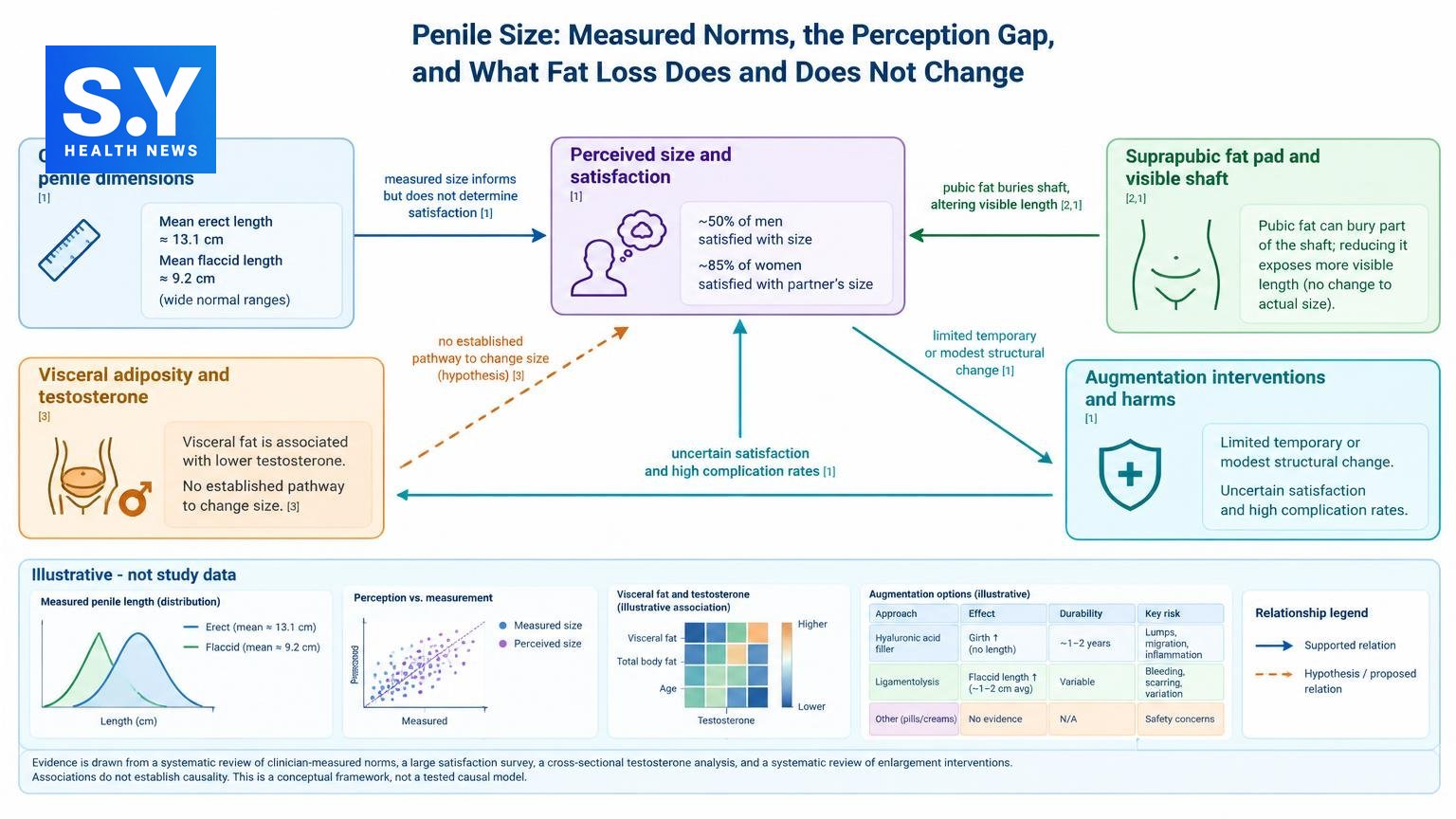
The most common question about penile size is not whether a measurement falls within a range, but whether something can change it. The best available pooled data come from a systematic review of clinician-measured dimensions in up to 15,521 men, which reported a mean erect length of about 13.1 cm and a mean flaccid length of about 9.2 cm, with wide normal ranges for both. The same review is the anchor for a consistent clinical finding: most men who present for lengthening surgery measure within the normal range. Anxiety about size is therefore often a perception problem rather than a measurement problem, and the evidence on interventions is thin, risky, and frequently disappointing.[1]
Weight loss is the most plausible non-surgical factor in this discussion, but its effect is visual rather than structural. Excess fat in the lower abdomen and pubic area can bury part of the penile shaft; reducing it exposes more visible length without changing the organ's actual dimensions. Claims of specific per-pound visible gains exist in web articles but are unverified, internally inconsistent, and unsupported by primary data in the sources reviewed here. Separately, visceral adiposity is strongly associated with lower circulating testosterone in a large cross-sectional analysis, but that association is bidirectional and does not by itself establish a route to changing size.[2][3]
Medical augmentation exists but is narrow in effect and meaningful in risk. Hyaluronic acid filler increases girth temporarily, typically for about one to two years, and does not increase length. Ligamentolysis yields published average visible flaccid gains of roughly 1–2 cm, with wide individual variation and some men showing little change. No pill, cream, or supplement has evidence for permanent size gains, and a systematic review of enlargement interventions in men of normal size reported high complication rates and uncertain satisfaction. The clinical priority is accurate measurement, honest expectation-setting, and recognition that persistent size anxiety is itself a treatable concern.
Why This Matters
The distance between what men believe about their size and what a clinician measures is large. In a survey of more than 50,000 adults, only about half of men were satisfied with their own size, while 85% of women were satisfied with their partner's size. That asymmetry is one of the most informative findings in this literature because it suggests the primary problem is appraisal of the self, not a deficiency in the organ. A clinic-based study of men requesting lengthening surgery found that most measured within the normal range, and a systematic review of interventions in normal-sized men concluded that many procedures carry high complication rates and uncertain satisfaction.
At the same time, questions about belly fat and size are not frivolous. Central adiposity is linked to lower testosterone and erectile dysfunction, and the appearance of a buried penis can be genuinely distressing. But those are overlapping problems, not a single problem with a single fix. Separating anatomical concealment from erectile function, and both from body-image anxiety, determines whether a man needs a weight-management conversation, a sexual-function assessment, psychological support, or simply an accurate measurement and explanation.
Measured Norms and the Perception Gap
The reference standard in this field remains the systematic review of clinician-measured data in up to 15,521 men, published in 2015. Mean erect length was about 13.1 cm and mean flaccid length about 9.2 cm, with wide normal ranges. Two features of those numbers matter more than the point estimates. First, they describe a distribution, not a target; many normal men sit well above or below the mean. Second, flaccid length varies considerably with temperature and circumstances and is a poor predictor of erect length, which is why bathroom or locker-room comparisons are unreliable.
Perception systematically distorts self-measurement. A top-down viewing angle foreshortens the shaft, and adult media present a selected group of performers under favorable conditions rather than a representative sample of men. Against that biased reference, a normal measurement can feel inadequate. The pattern is well recognized clinically: men with normal measured size and high anxiety often remain dissatisfied even after procedures, because the target of their concern is self-perception rather than anatomy. That observation does not dismiss the distress; it redirects care toward measurement and, where indicated, psychological support.
What Suprapubic and Visceral Fat Actually Do
There are two different fat stories in this literature, and conflating them causes most of the confusion. The first is mechanical and cosmetic: a thick pubic fat pad can bury part of the shaft, so reducing it exposes more visible length without altering the organ. The second is metabolic: visceral fat, stored deep around the abdominal organs, is biologically active and is associated with lower testosterone and worse cardiometabolic health. Neither story describes the penis growing.[4]
On the mechanical side, the direction of the effect is consistent across sources: weight loss changes what is visible, not what exists. The magnitude is where sources diverge. One physician-note web article states that many men gain roughly a quarter inch to a half inch of visible length for every 25 to 30 pounds lost, while the same article elsewhere reports that men often see 0.5–2 inches of new visible length once the fat pad shrinks. Those two statements are in tension, neither is tied to a cited study with a denominator or measurement protocol, and both should be treated as unverified estimates rather than expected outcomes. A clinic guide frames the same point more conservatively: exercise and weight loss do not change actual size, but in men with substantial abdominal fat, fat reduction makes more of the concealed shaft visible.
On the metabolic side, the relevant question is whether visceral fat affects hormones in a way that could matter for function. A cross-sectional analysis of 4,984 men with valid serum testosterone measurements found that adiposity, rather than aging, was the dominant determinant of circulating testosterone. Age explained only 2.5% of testosterone variation, whereas DEXA-derived body fat, visceral adipose tissue, and waist circumference explained 18%–20%. Visceral adiposity was more strongly associated with testosterone than total body adiposity. Among men aged 30–39, those with biochemical low testosterone (below 300 ng/dL) had mean total body fat of 30.3% versus 26.4% in men with normal testosterone.
The proposed mechanisms are plausible but not directly tested in that analysis: excess adipose tissue may increase aromatization of testosterone to estradiol and reduce hepatic sex hormone-binding globulin synthesis through insulin resistance, among other pathways. Direction remains unresolved. A reviewing endocrinologist noted the adiposity–testosterone association is bidirectional and that cross-sectional data cannot establish which comes first. That caution matters for anyone hoping weight loss will reliably raise testosterone, improve erections, and thereby change size. The hormone link is a reason to take metabolic health seriously; it is not a size intervention.
What the Evidence Shows on Augmentation
The augmentation evidence is best read as a set of limited tools with defined ceilings. Hyaluronic acid filler increases girth temporarily, not length, and typically lasts about one to two years before resorbing, depending on product and individual. Ligamentolysis increases visible flaccid length, with published averages of roughly 1–2 cm; results vary widely between individuals and some men show little or no change. No pill, cream, or supplement has evidence for permanent size gains. A systematic review of surgical and nonsurgical interventions in men of normal size concluded that many enlargement procedures carry high complication rates and uncertain satisfaction.
The harm profile is not hypothetical. Manual stretching and milking techniques circulated online lack efficacy evidence but have documented injuries, including capillary rupture, fibrosis, and penile curvature. Vacuum pumps draw blood into the penis and cause temporary enlargement for minutes to hours; they have a legitimate role in erectile dysfunction care but no evidence of permanent size increase, and excessive pressure risks injury. Unregulated injectable substances represent the most dangerous end of this spectrum, with reports of chronic inflammation, tissue necrosis, and permanent deformity. Hyaluronic acid filler itself carries risks of lumpiness, migration, and inflammation, although it can be dissolved if results are unsatisfactory.
| Approach | Reported Effect | Durability | Key Evidence Limitation |
|---|---|---|---|
| Hyaluronic acid filler | Temporary girth increase; no length increase | Typically about 1–2 years before resorption | Durability depends on product type and individual; risks include lumps, migration, inflammation |
| Ligamentolysis surgery | Published average visible flaccid gain of about 1–2 cm | Surgical change is lasting but the gain is limited | Wide individual variation; some men show little or no change |
| Pills, creams, supplements | No evidence of permanent size gain | Not applicable | Absence of efficacy evidence is compounded by real safety concerns |
| Manual stretching or milking | No efficacy evidence; documented injuries | Not applicable | Case-report-level harm information; no controlled efficacy data |
| Vacuum pump | Temporary enlargement for minutes to hours | No permanent size increase | Legitimate role in erectile dysfunction care; excessive pressure risks injury |
| Weight loss with substantial abdominal fat | More of the concealed shaft becomes visible | Appearance change, not structural change | No primary data quantify visible gain; published estimates conflict |
Interpretation and Limitations
Several limitations constrain how far this evidence can be pushed. The measurement review pools studies with varied measurement methods, so the point estimates are best understood as central tendencies rather than precise standards. The satisfaction survey is self-reported and does not measure anatomy. The clinic-based finding that most men requesting lengthening measure normally is important but does not quantify the proportion in the source text. The systematic review of interventions covers heterogeneous procedures and study designs, which limits any single pooled estimate of benefit or harm.
The metabolic literature has its own constraints. The testosterone analysis is cross-sectional, so it cannot establish that adiposity causes lower testosterone; the association is acknowledged to be bidirectional. The variance explained (18%–20% for adiposity measures) indicates a substantial statistical relationship but leaves most variation unexplained. The single case report showing testosterone rising from 147 to 467 ng/dL alongside weight loss from 260 to 207 pounds over 12 months is hypothesis-generating only; it has no control group and cannot attribute the change to weight loss alone. In September 2026 the Endocrine Society issued a statement citing insufficient evidence for population-wide hypogonadism screening in asymptomatic men, reinforcing that hormone testing should be symptom-driven and clinically contextualized.
The body-composition and visceral-fat literature adds useful context but not size outcomes. A follow-up of more than 300 participants from two earlier 18-month lifestyle trials found that despite weight regain, many still carried less visceral fat than before and had smaller average waist measurements, even though scale weight had returned to nearly its original value. Each 10% reduction in visceral fat during the original program was associated with about 28% lower long-term type 2 diabetes risk after accounting for later weight regain and other factors. That is a metabolic finding, not evidence that visceral fat reduction increases penile size, and the source is a news summary rather than the primary report.[5]
Fat distribution also explains why weight loss does not reliably change the pubic area. Genetics play a substantial role in where fat is stored and lost, and different body regions change at different rates. A body-composition substudy of the SURMOUNT-1 tirzepatide trial found reductions in both fat mass and lean mass during treatment, a reminder that scale weight alone does not describe what changed. None of this establishes that losing belly fat will produce a predictable visible-length change; it establishes only that the pubic fat pad is one determinant of appearance among several, including fat distribution, skin, and anatomy.[6]
Research and Clinical Outlook
The most defensible clinical pathway begins with measurement. A clinician-measured assessment, a discussion of the wide normal range, and explicit attention to viewing angle and media comparison can resolve a large share of size concerns without any procedure. Where anxiety persists despite a normal measurement, psychological care is the evidence-aligned next step rather than escalation to surgery. Where a buried penis or significant suprapubic fat pad is the actual concern, weight management is reasonable for general health and may improve appearance, but it should be framed as a visibility change, not growth.
For men considering augmentation, the evidence supports a narrow set of options with real ceilings and real risks. Filler offers temporary girth, not length, and requires repeat treatment. Ligamentolysis offers modest average visible flaccid gains with substantial individual variation. Neither is a solution to size anxiety, and the systematic review's finding of high complication rates and uncertain satisfaction in normal-sized men should anchor the conversation. Clinics that guarantee specific gains or permanent results are a warning sign, not a selling point. The most valuable intervention in this field may remain an accurate measurement and a straight answer.
Key Takeaways
- Clinician-measured norms from up to 15,521 men show a mean erect length of about 13.1 cm and a mean flaccid length of about 9.2 cm, with wide normal ranges.
- Most men requesting lengthening surgery measure within the normal range, and only about half of men in a large survey were satisfied with their own size while 85% of women were satisfied with their partner's.
- Weight loss can make more of the penile shaft visible by reducing a burying pubic fat pad, but it does not change actual size; specific visible-gain estimates in web sources are unverified and inconsistent.
- Visceral adiposity is strongly associated with lower testosterone in cross-sectional data, but the direction is bidirectional and this is not a size intervention.
- No pill, cream, or supplement has evidence for permanent size gains; manual stretching has documented injuries; vacuum pumps produce only temporary enlargement.
- Hyaluronic acid filler increases girth temporarily for about 1–2 years, and ligamentolysis yields published average visible flaccid gains of about 1–2 cm with wide individual variation.
Questions and Answers
What is the average penile length according to clinician-measured data?
A systematic review of clinician-measured data from up to 15,521 men reported a mean erect length of about 13.1 cm and a mean flaccid length of about 9.2 cm. Both values have wide normal ranges, and the review pools studies with varied measurement methods, so the numbers describe central tendencies rather than a standard every man should meet.
Does losing belly fat actually make the penis bigger?
It changes appearance, not size. Excess pubic fat can bury part of the shaft, and reducing it exposes more visible length, but the organ itself does not grow. Specific claims such as a quarter to a half inch of visible length per 25–30 pounds lost, or 0.5–2 inches after fat pad shrinkage, come from a web article without cited primary data and are internally inconsistent.
How strong is the evidence that weight loss raises testosterone in men?
The strongest evidence is cross-sectional: in 4,984 men, adiposity measures explained 18%–20% of testosterone variation versus 2.5% for age, and visceral fat was more strongly associated than total body fat. But the association is bidirectional and cannot establish causation. A single case report of testosterone rising alongside weight loss is hypothesis-generating only, and the Endocrine Society cited insufficient evidence for population-wide screening in asymptomatic men in September 2026.
What are the real medical options for penile augmentation and their limits?
Hyaluronic acid filler increases girth temporarily, not length, typically for about 1–2 years. Ligamentolysis surgery yields published average visible flaccid gains of about 1–2 cm, with wide variation and some men showing little change. No pill, cream, or supplement has evidence for permanent gains. A systematic review of interventions in normal-sized men found high complication rates and uncertain satisfaction, so accurate measurement and expectation-setting should come first.
Are manual stretching and vacuum pumps safe or effective for penis enlargement?
Manual stretching and milking lack efficacy evidence but have documented injuries, including capillary rupture, fibrosis, and penile curvature. Vacuum pumps cause temporary enlargement for minutes to hours and have a legitimate role in erectile dysfunction care, but there is no evidence of permanent size increase, and excessive pressure risks injury. Unregulated injectable substances are the most dangerous option and can cause tissue necrosis and permanent deformity.
Why do so many men worry about size when their measurements are normal?
Perception distorts self-assessment. A top-down viewing angle foreshortens the shaft, adult media present a selected group rather than a representative sample, and flaccid size varies too much to predict erect size. In a survey of more than 50,000 adults, only about half of men were satisfied with their own size while 85% of women were satisfied with their partner's. Most men requesting lengthening surgery measure normally, and persistent anxiety often warrants psychological care rather than a procedure.
Conceptual framework: Conceptual framework. Clinician-measured dimensions inform but do not determine satisfaction; suprapubic fat changes visible shaft length without changing the organ; visceral adiposity is associated with lower testosterone but no established pathway to size change; augmentation offers limited, risk-bearing effects. Relations are supported where stated, proposed where marked hypothesis. Not a tested causal model.
Academic References & Evidence
- Dr. Noppon Arunkajohnsak (Win). เพิ่มขนาดน้องชาย: ขนาดปกติ อะไรได้ผลจริง ความเสี่ยง. BJU Int. 2015 115(6):978-986
- Does Losing Belly Fat Make It Bigger? Read The MD Truth Now! | Ubie Doctor's Note.
- Adam W. Potter; Karl E. Friedl. Adiposity or Age?. NHANES 2011-2012, 2013-2014, and 2015-2016 (secondary analysis; Medscape/Medugate report)
- Belly Fat and Visceral Fat and Why Reducing Them Improves Metabolic Health – Women's Journal.
- Urology pearls. Circulation. 2026
- Why Am I Losing Weight Everywhere But My Stomach? | Revive Powell.
SANYUN Science Center explains published research on men's reproductive and sexual health, connecting scientific evidence with everyday questions while making sources and limitations clear.
Disclaimer: This article is for scientific education and research communication only. It does not provide medical advice, diagnosis, or individualized treatment recommendations, and does not endorse any medication, supplement, device, penile enlargement procedure, or other intervention. Decisions about sexual and reproductive health should be made in consultation with a qualified healthcare professional. Do not delay seeking professional care because of information in this article.
Original Content & Copyright Notice
- This article is prepared for SANYUN Science Center, drawing on published research and publicly available academic literature on men’s sexual and reproductive health. Its editorial explanations and presentation are developed for this platform.
- Copyright in the original editorial content, selection, and arrangement is reserved by SANYUN Science Center to the extent protected by applicable law. Referenced research, quotations, and third-party materials remain subject to the rights of their respective owners. This notice does not claim ownership of scientific facts or third-party research.
- Except where permitted by applicable law or an applicable license, prior written permission is required to reproduce, republish, translate, adapt, redistribute, or commercially reuse protected content. Attribution alone does not grant permission for such reuse.
- For permitted quotation or authorized reuse, clearly identify the source and retain a link to the original article.
- Source: SANYUN Science Center
- Original URL: Retain the original article URL on science.san-yun.com.
- Copyright Holder: SANYUN Science Center, for its own protected editorial content.
- Quotation, excerpts, or authorized reuse must not distort the scientific meaning, omit material limitations or disclaimers, or imply unverified medical claims, product efficacy, or endorsement by SANYUN Science Center.



