




Category: Penile Size
Core Research Direction: Evidence review of what penile size measurements and enlargement interventions can and cannot establish, with emphasis on how normal-range size, worry about size, and temporary versus permanent effects are distinguished in clinical literature
Search Intent: For men concerned their penis is too small, what does published evidence actually show about typical size, the gap between measured size and subjective dissatisfaction, and the real limits and risks of fillers, traction devices, and surgery?
Platform: SANYUN Science Center
Evidence reviewed through: 2026-11-26
Executive Summary
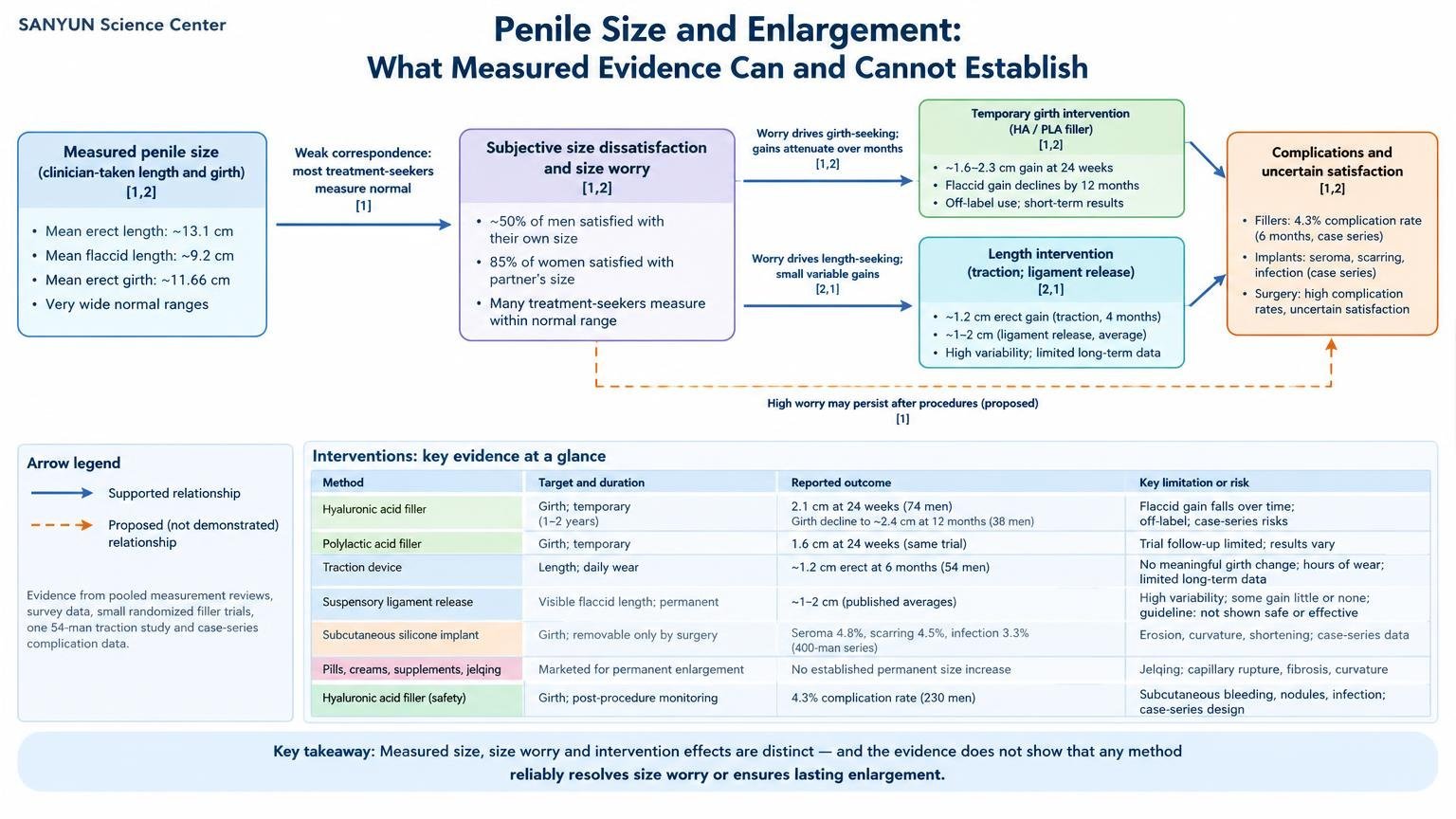
Concern about penile size is common, but the published literature separates two questions that are frequently confused: what size men actually measure, and how size feels to them. A systematic review pooling clinician-performed measurements from up to 15,521 men reported a mean erect length of about 13.1 cm and a mean flaccid length of about 9.2 cm, with very wide normal ranges for both. A separate summary of the same pooled dataset reports an average erect girth of 11.66 cm.[1][2]
The dissatisfaction data point in a different direction than the measurement data. In a large survey of more than 50,000 adults, only about half of men were satisfied with their own size, while 85% of women were satisfied with their partner's size. In a clinic sample of men requesting lengthening surgery, most measured within the normal range.
Interventions exist, but their evidence base is narrow and uneven. Two randomized trials of injectable fillers found girth gains of roughly 1.6 to 2.3 cm at 24 weeks, and those gains attenuate over months. Traction devices produced about 1.2 cm of erect length gain in one 54-man study after 4 months of daily wear, with no meaningful girth change. Surgery carries higher risks, and a systematic review concluded that in men of normal size many enlargement procedures have high complication rates and uncertain satisfaction.
Why This Matters
Size worry sits at an awkward intersection: a measurable anatomical variable, a subjective body-image experience, and a commercial market that profits from the gap between them. The clinical literature uses the term "small penis syndrome" for excessive worry about size in men whose measured size is normal, and many men inquiring about enlargement fall into exactly that group. That framing matters because it changes what a good outcome looks like.
It also changes how evidence should be read. A procedure that adds two centimeters of girth is a real physical change; whether it resolves the underlying concern is a separate question with a weaker evidence base. Research repeatedly finds that men with normal measured size but high worry often remain dissatisfied even after procedures, which suggests the target of care may be perception rather than anatomy.
What the Measurements Show
The most-cited reference point is a systematic review of clinician-taken measurements covering up to 15,521 men, which reported mean erect length of about 13.1 cm and mean flaccid length of about 9.2 cm. The same pooled dataset is summarized elsewhere as giving an average erect length of 13.12 cm (about 5.2 inches) and average erect girth of 11.66 cm (about 4.6 inches). The key word in these figures is "mean": the normal ranges are described as very wide, so a mean is not a threshold below which something is wrong.
The review did not report an exact percentage of men at any specific size threshold. A 7-inch (about 17.8 cm) erect length is well above the pooled average, but the source does not provide a precise percentile, and the measurements were taken by health professionals rather than self-reported. That distinction is not trivial: clinician measurement and self-report are not interchangeable inputs, and pooled clinical norms are the more defensible reference for interpreting an individual measurement.
For a reader trying to place a personal number in context, the practical implication is that a single measurement says relatively little without technique, conditions and a range. A range is not a diagnosis, and an average is not a target.
The Measurement–Satisfaction Gap
- In a survey of more than 50,000 adults, about half of men were satisfied with their own size, while 85% of women were satisfied with their partner's size — a gap located in self-perception rather than in the measured anatomy.
- Most men who presented requesting penile-lengthening surgery were measured as being within the normal size range.
- Partner sexual satisfaction is described as depending on many factors beyond size, with communication, confidence and erection quality playing a larger role according to sexology research.
These findings do not prove that size is irrelevant to anyone's experience. They do show that the population-level distribution of dissatisfaction does not track the population-level distribution of measured size, which is the central puzzle this literature tries to explain.
Interventions: Temporary Versus Permanent
Enlargement methods act on different anatomical targets — visible length, shaft circumference, or the glans — and their duration profiles differ just as sharply. Grouping them as one category is a common source of confusion, because a temporary girth effect and a permanent surgical change carry entirely different risk-benefit calculations.
Hyaluronic acid filler adds girth temporarily and does not increase length; effects typically last about 1 to 2 years before natural resorption. In the first of two randomized trials comparing hyaluronic acid with polylactic acid filler, 74 men received a single injection and at 24 weeks girth had increased by a mean of 2.1 cm with HA and 1.6 cm with PLA, with no serious adverse events. In the second trial, among 64 completers, average gain was about 2.3 cm with HA and 2.0 cm with PLA. Both trials followed men for only 24 weeks, and results vary.
The durability data are less encouraging than the 24-week snapshots. In a study following 38 men for a year after HA filler, flaccid girth gain declined from about 3.4 cm at one month to about 2.4 cm at 12 months — a visible attenuation rather than a stable result. Longer follow-up beyond these windows is limited.
Traction devices work through sustained mechanical stretch rather than volume. In one study of 54 men who wore a device 6 hours daily for 4 months, erect length was about 1.2 cm longer at the 6-month check, with no meaningful girth change; a second, smaller study of 23 men also found length gains without girth change. The demands are substantial — hours of daily wear for months — and longer-term data are limited.
Surgical lengthening works by releasing the suspensory ligament, which increases visible flaccid length; published averages are about 1–2 cm, but results vary widely between individuals and some men see almost no change. The American Urological Association considers dividing the suspensory ligament for length, and injecting fat for girth, to be procedures not shown to be safe or effective.
What the Evidence Shows: Comparative View
| Method | Target and duration | Reported outcome | Key limitation or risk |
|---|---|---|---|
| Hyaluronic acid filler | Girth; temporary, typically about 1–2 years | 2.1 cm at 24 weeks in a 74-man randomized trial | Flaccid gain fell from about 3.4 cm at 1 month to about 2.4 cm at 12 months in 38 men |
| Polylactic acid filler | Girth; temporary | 1.6 cm at 24 weeks in the same randomized trial | Trial follow-up limited to 24 weeks; results vary |
| Traction device | Length; requires prolonged daily wear | About 1.2 cm erect length at 6-month check after 4 months of 6-hour daily wear in 54 men | Small studies; no meaningful girth change; hours of daily wear for months |
| Suspensory ligament release | Visible flaccid length; permanent anatomical change | Published averages of about 1–2 cm | High inter-individual variability; some men gain little or none; guideline policy considers it not shown safe or effective |
| Subcutaneous silicone implant | Girth; removable only by surgery | Seroma 4.8%, scarring 4.5%, infection 3.3% in an original 400-man series | Case-series data; erosion, curvature, shortening and removal described in other series |
| Pills, creams, supplements, jelqing | Marketed for permanent enlargement | No established permanent size increase | Jelqing has reported capillary rupture, fibrosis and curvature; none has evidence of permanent gain |
| Hyaluronic acid filler safety | Girth; post-procedure monitoring | 4.3% complication rate within six months in 230 men | Complications included subcutaneous bleeding, nodules and infection; case-series design |
Methods With No Supporting Evidence
No pill, cream or supplement has evidence of producing permanent penile size increase. That is an absence-of-evidence conclusion based on the published literature rather than a head-to-head trial showing each product fails, and the absence is consistent across the sources reviewed.
Jelqing — manual stretching and squeezing techniques shared online — lacks evidence of effectiveness, but genuine injuries have been reported, including capillary rupture, fibrosis and penile curvature. Vacuum pumps produce temporary engorgement and have a legitimate role in erectile dysfunction care, but do not increase permanent size.
A related confusion concerns body composition. Exercise and weight loss do not change true penile size, but in men with excess abdominal fat, fat reduction makes more of the penis visible — a visual effect rather than actual enlargement. That distinction matters when interpreting before-and-after photographs of any kind.
Interpretation and Limitations
Several structural weaknesses limit what this literature can settle. Many intervention studies are small, single-center and short, with follow-up windows of 24 weeks or a single 6-month check. Complication figures largely come from case series rather than controlled comparisons, so rates describe what happened in a treated cohort without a matched untreated group. Satisfaction outcomes are frequently self-reported and inconsistently defined across studies.
A systematic review of surgical and nonsurgical interventions concluded that in men with normal penile size, many enlargement procedures carry high complication rates and uncertain satisfaction. That is a summary judgment across heterogeneous studies, not a comparative trial of one method against another, and it should not be read as evidence that every procedure fails for every patient.
Regulatory status is a separate axis from efficacy. No dermal filler is FDA-approved for penile use, so all penile filler is off-label — a statement about authorization, not about whether the material works in trials. Similarly, published penile PRP research has focused on erectile dysfunction and Peyronie's disease, mostly in small studies, and there is no good evidence PRP enlarges the penis.
Finally, the satisfaction literature carries an interpretive claim that is often repeated but rarely tested directly in a controlled design: that high-worry men of normal size often remain dissatisfied after procedures. That idea — that the target of care may be perception rather than anatomy — is best treated as a hypothesis with clinical plausibility rather than a demonstrated causal finding.
Research Outlook
The most useful unanswered questions are not about whether a filler can add volume at 24 weeks — several trials address that — but about durability beyond one year, complication profiles in larger and longer cohorts, and whether psychological screening before procedures changes satisfaction trajectories. The observation that many men seeking enlargement measure within normal range implies that outcome measures tied only to centimeters will miss what many patients actually care about.
A practical framework for reading future claims is to ask three things: what was measured (length, girth, or glans), over what time horizon, and compared with what. A temporary girth effect, a small sustained length effect and a permanent surgical change are not competing answers to the same question — they are different interventions with different risk profiles, and treating them as interchangeable is the most common error in both marketing and casual discussion.
Key Takeaways
- Pooled clinician measurements from up to 15,521 men show a mean erect length of about 13.1 cm and mean erect girth of 11.66 cm, with very wide normal ranges.
- Only about half of men were satisfied with their own size in a survey of more than 50,000 adults, while 85% of women were satisfied with their partner's size.
- Most men requesting lengthening surgery measured within the normal range, and size worry in normal-sized men is recognized clinically as small penis syndrome.
- Randomized filler trials showed roughly 1.6 to 2.3 cm of girth gain at 24 weeks, with attenuation over 12 months and off-label regulatory status.
- Traction devices produced about 1.2 cm of erect length gain in one 54-man study after 4 months of daily wear, without meaningful girth change.
- No pill, cream or supplement has evidence of permanent size increase, and jelqing has documented injuries without evidence of benefit.
Questions and Answers
What is the average penile size according to pooled medical measurements?
A systematic review of clinician-taken measurements from up to 15,521 men reported a mean erect length of about 13.1 cm and flaccid length of about 9.2 cm, with very wide normal ranges. A summary of the same pooled dataset gives an average erect girth of 11.66 cm. These are means, not thresholds, and the review did not report exact percentages at specific sizes.
Do penile fillers permanently increase girth?
No. Hyaluronic acid filler adds girth temporarily, typically lasting about 1 to 2 years before resorption, and does not increase length. Two randomized trials found gains of roughly 1.6 to 2.3 cm at 24 weeks, but in a 38-man follow-up the flaccid girth gain fell from about 3.4 cm at one month to about 2.4 cm at 12 months. No dermal filler is FDA-approved for penile use.
How much length can a penile traction device add?
In one study of 54 men who wore a device 6 hours a day for 4 months, erect length was about 1.2 cm longer at the 6-month check, with no meaningful girth change. A second, smaller study of 23 men also found length gains without girth change. The evidence comes from small studies, requires months of daily wear, and longer-term data are limited.
Why do many men with normal measured size still worry about being too small?
The dissatisfaction data do not track measured size. In a survey of more than 50,000 adults, only about half of men were satisfied with their own size, while 85% of women were satisfied with their partner's size. Most men requesting lengthening surgery measured within normal range. The literature calls excessive worry in normal-sized men small penis syndrome and notes perception, not anatomy, may be the target of care.
Is penis enlargement surgery safe and effective?
Surgery carries higher risks than fillers. Suspensory ligament release increases visible flaccid length by published averages of about 1–2 cm, but results vary widely and some men see almost no change. The American Urological Association considers ligament division for length and fat injection for girth as not shown to be safe or effective. A systematic review found many enlargement procedures in normal-sized men carry high complication rates and uncertain satisfaction.
Do pills, creams or jelqing actually enlarge the penis?
No pill, cream or supplement has evidence of producing permanent size increase. Jelqing lacks evidence of effectiveness but has reported injuries including capillary rupture, fibrosis and penile curvature. Vacuum pumps produce temporary engorgement and have a role in erectile dysfunction care but do not increase permanent size. Weight loss can make more of the penis visible in men with abdominal fat, but that is a visual effect, not enlargement.
Conceptual framework: Conceptual framework, not a tested causal model. Nodes represent constructs discussed in this evidence review: pooled clinician-measured size, subjective dissatisfaction, temporary filler girth effects, length interventions and complications. Arrows show reported associations and, where marked, a proposed rather than demonstrated relationship. Evidence is drawn from pooled measurement reviews, survey data, small randomized filler trials, one 54-man traction study and case-series complication data; it is not a physiological pathway, and it does not establish that any intervention resolves size worry.
Academic References & Evidence
- เพิ่มขนาดน้องชาย: ขนาดปกติ อะไรได้ผลจริง ความเสี่ยง.
- Kiara DeWitt. Penis Enlargement Methods: What the Clinical Evidence Shows. 2026
SANYUN Science Center explains published research on men's reproductive and sexual health, connecting scientific evidence with everyday questions while making sources and limitations clear.
Disclaimer: This article is for scientific education and research communication only. It does not provide medical advice, diagnosis, or individualized treatment recommendations, and does not endorse any medication, supplement, device, penile enlargement procedure, or other intervention. Decisions about sexual and reproductive health should be made in consultation with a qualified healthcare professional. Do not delay seeking professional care because of information in this article.
Original Content & Copyright Notice
- This article is prepared for SANYUN Science Center, drawing on published research and publicly available academic literature on men’s sexual and reproductive health. Its editorial explanations and presentation are developed for this platform.
- Copyright in the original editorial content, selection, and arrangement is reserved by SANYUN Science Center to the extent protected by applicable law. Referenced research, quotations, and third-party materials remain subject to the rights of their respective owners. This notice does not claim ownership of scientific facts or third-party research.
- Except where permitted by applicable law or an applicable license, prior written permission is required to reproduce, republish, translate, adapt, redistribute, or commercially reuse protected content. Attribution alone does not grant permission for such reuse.
- For permitted quotation or authorized reuse, clearly identify the source and retain a link to the original article.
- Source: SANYUN Science Center
- Original URL: Retain the original article URL on science.san-yun.com.
- Copyright Holder: SANYUN Science Center, for its own protected editorial content.
- Quotation, excerpts, or authorized reuse must not distort the scientific meaning, omit material limitations or disclaimers, or imply unverified medical claims, product efficacy, or endorsement by SANYUN Science Center.



