




Category: Penile Size
Core Research Direction: Evidence-based review of penile size: normative measurements, the gap between self-perception and measured size, and the limits of enhancement interventions
Search Intent: What does research show about how penile size is measured, what men's actual versus perceived sizes are, and whether any intervention reliably changes size?
Platform: SANYUN Science Center
Evidence reviewed through: 2026-11-06
Executive Summary
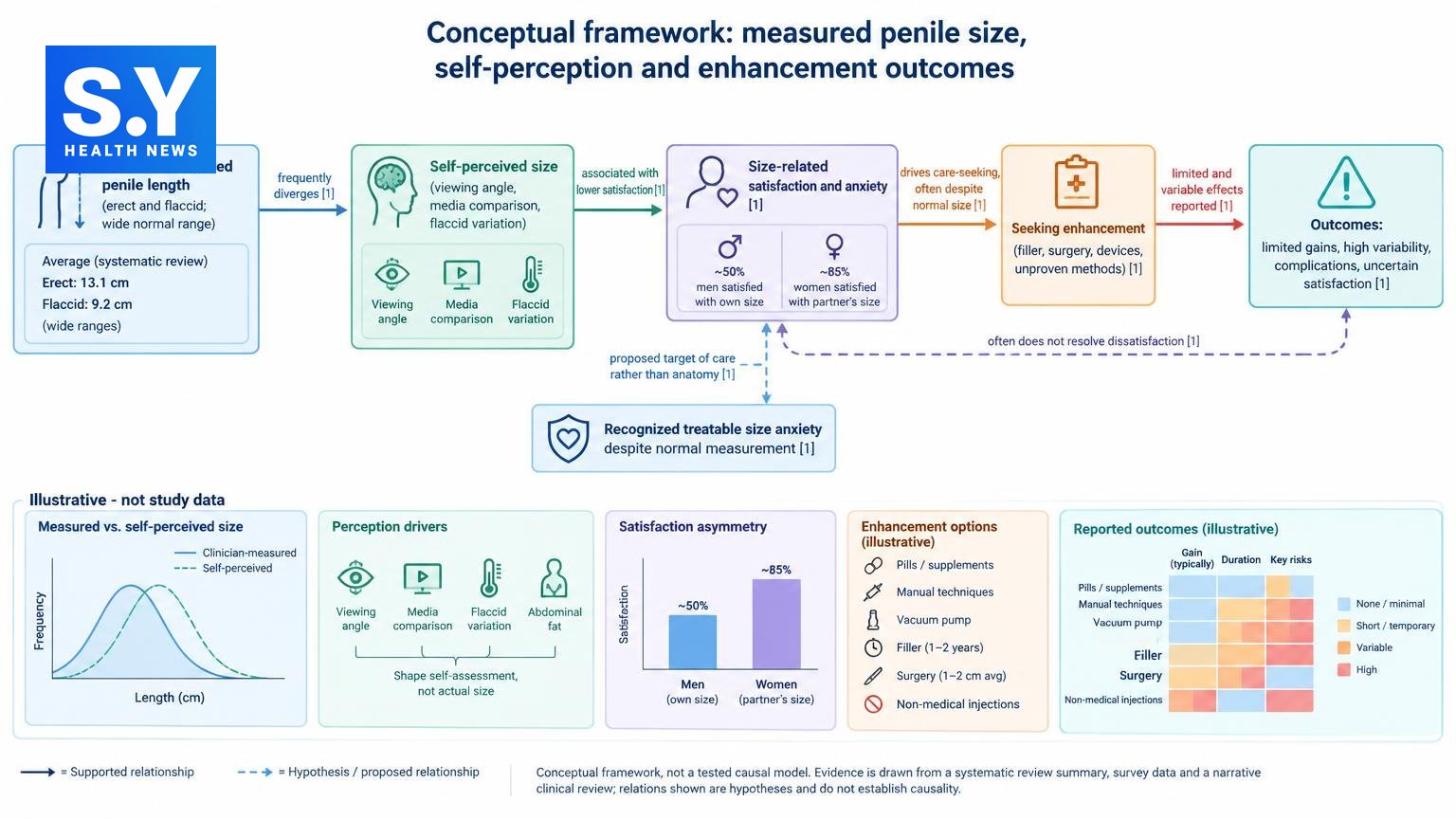
Clinician-measured data are the starting point for any discussion of penile size. A systematic review pooling measurements from up to 15,521 men reported a mean erect length of about 13.1 cm and a mean flaccid length of about 9.2 cm, with wide normal ranges on both measures.[1]
The clinical puzzle is not the norm but the mismatch between it and how many men see themselves. Satisfaction surveys show a striking asymmetry: in a large survey of more than 50,000 adults, only about half of men were satisfied with their own size, while 85% of women were satisfied with their partner's size. Men who present for lengthening surgery are also mostly within the normal range when measured, and everyday habits of self-assessment — a top-down viewing angle, comparison with adult media — distort perception rather than reveal anatomy.
Intervention evidence is thin and uneven. No pill, cream or supplement has evidence of permanent size gain, and stretching methods have documented injuries without efficacy data. Vacuum pumps give temporary rigidity only. Hyaluronic acid filler adds girth for roughly 1 to 2 years, and ligament-cutting surgery averages about 1–2 cm of visible flaccid length with wide individual variation. A systematic review of enhancement procedures in men of normal size found high complication rates and uncertain satisfaction.
Why This Matters
Size anxiety is common, treatable, and rarely a problem of true anatomical deficiency. Persistent daily worry that leads men to avoid relationships or communal changing situations, or that erodes overall confidence despite a normal measurement, is recognized as a condition in its own right and can be addressed clinically.
Without an accurate measurement and a frank conversation, men can be steered toward procedures that do not target their actual concern. Repeated research findings indicate that men with normal size but high anxiety often remain dissatisfied even after procedures, which suggests the appropriate target of care is perception rather than anatomy.
How Size Is Measured and What Norms Look Like
Normative statements about penile size carry weight only if they come from clinician-performed measurement rather than self-report. The commonly cited systematic review pooled such measurements from up to 15,521 men and reported the averages above; the same summary describes the normal ranges as wide on both erect and flaccid measures.
The wide range is central to interpretation. An average is a midpoint, not a threshold, and men whose measurements sit well below the mean can still fall inside the normal range. The clinical statement most often repeated in this literature is that many men who believe they are smaller than normal fall inside that range once measured.
Growth charts provide a different kind of normative anchor: developmental timing rather than adult dimensions. Clinical longitudinal standards built from the British 1965 growth data supply limits of normality for the age at which the adolescent growth spurt occurs and for successive stages of penile, testicular and pubic hair development in boys, alongside height, weight and velocity centiles. These charts were designed for clinical use rather than population survey use, and velocity standards distinguish early-, average- and late-maturing children.[2]
These two literatures answer different questions. Growth standards tell a clinician when development is occurring within expected limits; adult measurement reviews describe where adult dimensions cluster. Neither establishes that a particular adult size requires intervention, and neither supports using a single number as a diagnosis.
The Perception Gap: Why Measured Size and Felt Size Diverge
Several ordinary mechanisms push self-assessment away from measurement. Looking down from one's own eye level foreshortens the image, so the penis appears shorter than its measured length or than another observer would see. Adult media comparisons set a benchmark from a selected group of performers and camera angles, not a representative sample of men. Flaccid size varies greatly with temperature and situation and does not predict erect size, making locker-room comparison nearly uninformative.
Abdominal fat adds a further visual effect. Exercise and weight loss do not change actual penile size, but in men with substantial abdominal fat, fat loss can make more of the penis visible. That is a change in what is seen, not a gain in size, and it is worth stating clearly so that lifestyle change is not sold as enlargement.
The satisfaction data quantify the asymmetry this produces. In a survey of more than 50,000 adults, about half of men were satisfied with their own size while 85% of women were satisfied with their partner's size. The gap is consistent with the perception mechanisms above: the people doing the judging are not the people most affected by the judgment.
What the Evidence Shows About Enhancement
| Approach | Reported effect | Duration | Key limitations |
|---|---|---|---|
| Pills, creams, supplements | No evidence of permanent size gain | Not applicable | No efficacy evidence; regulatory sampling has found some men's supplements adulterated with PDE-5-inhibitor-type drugs without label disclosure |
| Manual stretching/milking techniques | No efficacy evidence | Not applicable | Reported injuries include capillary rupture, fibrosis and penile curvature |
| Vacuum pump | Temporary rigidity only | Minutes to hours | No permanent size gain; has a role in erectile dysfunction care |
| Traction device | Small reported effects | Several hours per day for many months | Limited data; medical guidance advised |
| Hyaluronic acid filler | Girth increase, not length | About 1 to 2 years before natural breakdown | Temporary; breakdown depends on substance and individual; dissolvable if results are unsatisfactory |
| Ligamentolysis surgery | Average visible flaccid length gain about 1–2 cm | Durable change, but results highly variable | Some men show little or no change; risks include scarring and altered sensation |
| Autologous fat injection | Girth increase | Unpredictable because fat resorption is unpredictable | Real risks including scarring and altered sensation |
| Non-medical injections (liquid silicone, oils, unknown substances) | Not an evidence-based enhancement route | Not applicable | Chronic inflammatory masses, tissue necrosis, permanent deformity and need for major corrective surgery reported |
The systematic review by Marra and colleagues concludes the picture for men whose measured size is normal: many enhancement procedures carry high complication rates and uncertain satisfaction. This does not mean the procedures are forbidden, but it reframes the decision. Measurement, expectation screening and full risk disclosure should precede any procedure rather than follow it.
The injection of non-medical substances deserves separate emphasis because the harm profile is different in kind. Liquid silicone, oils and unknown substances injected by non-physicians have been followed by chronic inflammatory masses, tissue necrosis, permanent deformity and major corrective surgery. Anyone who has received such an injection should disclose it at every medical assessment, because prior injections change what a clinician must evaluate.
Supplement safety is a related but distinct issue. Thailand's Food and Drug Administration has detected some men's dietary supplements adulterated with drugs of the same class used to treat erectile dysfunction, without label disclosure. The risk here is not only wasted spending but unrecognized exposure to active pharmaceuticals, which matters most for men with heart disease or those taking nitrate medications.
Interpretation and Limitations
The central limitation of this evidence base is that the strongest normative figure comes from a systematic review as summarized in a clinical educational source, and the individual studies pooled within it vary in measurement protocol. The normal ranges are described as wide but are not quantified in the available summary, so precise percentile statements cannot be made here.
Satisfaction data come from a large survey and describe self-reported attitudes, not clinical outcomes. Survey sampling and response details are not available in the secondary summary, and satisfaction with a partner's size is not the same construct as satisfaction with one's own. The 85% versus roughly half contrast should be read as a description of reported attitudes, not as a measured effect of any intervention.
The enhancement literature is heterogeneous and summarized narratively in the available material. Reported averages for ligamentolysis, such as the roughly 1–2 cm visible flaccid gain, are averages with high inter-individual variability; some men show little or no change, and the passage does not identify the underlying studies or their sample sizes. Filler duration of about 1 to 2 years is likewise a typical figure, not a fixed timeline for every patient.
Several claims in the source are negative-evidence statements — for example, that no pill, cream or supplement has evidence of permanent gain. Absence of evidence is not the same as a pooled null estimate from a rigorous trial program, and consumers should understand that distinction. Similarly, reported injuries from manual techniques derive from case reports rather than controlled comparisons.
Finally, statements about persistent size anxiety being a recognized and treatable condition, and about men remaining dissatisfied after procedures, are made in the source without citing specific diagnostic criteria or trials in that passage. They are clinically plausible and consistent with the wider literature on body image, but they are not quantified here.
Research Outlook
The most useful next step is not another enhancement technique but better measurement and expectation research. Standardizing how erect and flaccid length are measured, and reporting percentile distributions rather than only means, would make clinical conversations more concrete.
Outcome research on enhancement should report individual-level variability and complication rates rather than only average gains, since the averages currently cited — for example the roughly 1–2 cm visible flaccid gain after ligamentolysis — conceal men who gained little or nothing. Studies that pair anatomical outcomes with psychological outcomes would test the observation that dissatisfaction often persists after procedures in men whose size was normal to begin with.
Developmentally, the growth-standard literature reminds clinicians that timing matters. Limits of normality for the age of the growth spurt and for successive pubertal stages give a framework for distinguishing variation from pathology during adolescence, which is often when size concern first arises.
Key Takeaways
- Clinician-measured averages are about 13.1 cm erect and 9.2 cm flaccid, with wide normal ranges; being below the mean does not mean being outside the normal range.
- Most men who request lengthening surgery measure within the normal range, and many men who believe they are small are normal when measured.
- Self-assessment is systematically distorted by viewing angle, adult media comparison and unreliable flaccid variation; abdominal fat loss changes visibility, not size.
- Only about half of men are satisfied with their own size while 85% of women are satisfied with a partner's size, which points to perception as the main target of care.
- No pill, cream or supplement has evidence of permanent gain; manual techniques have injury reports without efficacy data; pumps give temporary rigidity only.
- Hyaluronic acid filler adds temporary girth for about 1 to 2 years; ligamentolysis averages about 1–2 cm of visible flaccid length with high variability and real risks.
- A systematic review found high complication rates and uncertain satisfaction for enhancement procedures in men of normal size, and non-medical injections carry a severe harm profile.
Questions and Answers
What is the average penile size according to research?
A systematic review pooling clinician measurements from up to 15,521 men reported a mean erect length of about 13.1 cm and a mean flaccid length of about 9.2 cm. The normal ranges on both measures are wide, so an average is a midpoint rather than a cut-off, and many men who believe they are below normal measure within the normal range.
Why do many men think their penis is smaller than it actually is?
Self-assessment is distorted by ordinary factors. Looking down from one's own eye level foreshortens the image, so it appears shorter than measured length. Adult media comparisons use a selected group of performers and camera angles rather than a representative sample. Flaccid size also varies greatly with temperature and situation and does not predict erect size.
Do pills, creams or supplements increase penile size?
No pill, cream or supplement has evidence of producing permanent size gains. The safety picture is also concerning: Thailand's Food and Drug Administration detected some men's dietary supplements adulterated with drugs of the same class used for erectile dysfunction, without label disclosure. This matters most for men with heart disease or those taking nitrate medications.
How effective and safe is penile lengthening surgery?
Ligamentolysis increases visible flaccid length, with published averages of about 1–2 cm, but results vary greatly between individuals and some men show little or no change. Risks include scarring and altered sensation. A systematic review found that in men of normal size, many enhancement procedures carry high complication rates and uncertain satisfaction.
How long does hyaluronic acid filler for penile girth last?
Hyaluronic acid filler temporarily increases girth but not length, with effects typically lasting about 1 to 2 years before natural breakdown. Duration depends on the substance used and individual biology. One advantage is that HA can be dissolved with an enzyme if results are unsatisfactory, though risks such as irregular lumps, migration and inflammation remain.
When does concern about penile size need medical attention?
Persistent daily worry that leads to avoiding relationships or communal changing, or that affects overall confidence despite a normal measurement, is a recognized and treatable condition. Repeated research findings indicate that men with normal size but high anxiety often remain dissatisfied even after procedures, which suggests perception rather than anatomy should be the focus of care.
Conceptual framework: Conceptual framework, not a tested causal model. It shows how clinician-measured penile length (about 13.1 cm erect and 9.2 cm flaccid on average, with wide ranges) frequently diverges from self-perceived size, how perception relates to satisfaction and care-seeking, and why procedures in men of normal size report limited, variable gains and uncertain satisfaction. Evidence is drawn from a systematic review summary, survey data and a narrative clinical review; relations shown as hypotheses are proposed, not established.
Academic References & Evidence
- เพิ่มขนาดน้องชาย: ขนาดปกติ อะไรได้ผลจริง ความเสี่ยง.
- Clinical longitudinal standards for height, weight, height velocity, weight velocity, and stages of puberty..
SANYUN Science Center explains published research on men's reproductive and sexual health, connecting scientific evidence with everyday questions while making sources and limitations clear.
Disclaimer: This article is for scientific education and research communication only. It does not provide medical advice, diagnosis, or individualized treatment recommendations, and does not endorse any medication, supplement, device, penile enlargement procedure, or other intervention. Decisions about sexual and reproductive health should be made in consultation with a qualified healthcare professional. Do not delay seeking professional care because of information in this article.
Original Content & Copyright Notice
- This article is prepared for SANYUN Science Center, drawing on published research and publicly available academic literature on men’s sexual and reproductive health. Its editorial explanations and presentation are developed for this platform.
- Copyright in the original editorial content, selection, and arrangement is reserved by SANYUN Science Center to the extent protected by applicable law. Referenced research, quotations, and third-party materials remain subject to the rights of their respective owners. This notice does not claim ownership of scientific facts or third-party research.
- Except where permitted by applicable law or an applicable license, prior written permission is required to reproduce, republish, translate, adapt, redistribute, or commercially reuse protected content. Attribution alone does not grant permission for such reuse.
- For permitted quotation or authorized reuse, clearly identify the source and retain a link to the original article.
- Source: SANYUN Science Center
- Original URL: Retain the original article URL on science.san-yun.com.
- Copyright Holder: SANYUN Science Center, for its own protected editorial content.
- Quotation, excerpts, or authorized reuse must not distort the scientific meaning, omit material limitations or disclaimers, or imply unverified medical claims, product efficacy, or endorsement by SANYUN Science Center.



