




Category: Penile Size
Core Research Direction: Evidence-based review of penile size: measured normative dimensions and what they cannot predict, the gap between self-perception and measured size, and the evidence, limits, and risks of girth/length interventions (fillers, surgery, sleeve implants, pumps, supplements)
Search Intent: What does measured research actually say about average penile size, how common is dissatisfaction among men with normal measurements, and which size-enhancement methods have documented benefit versus unproven benefit or real harm?
Platform: SANYUN Science Center
Evidence reviewed through: 2026-11-25
Executive Summary
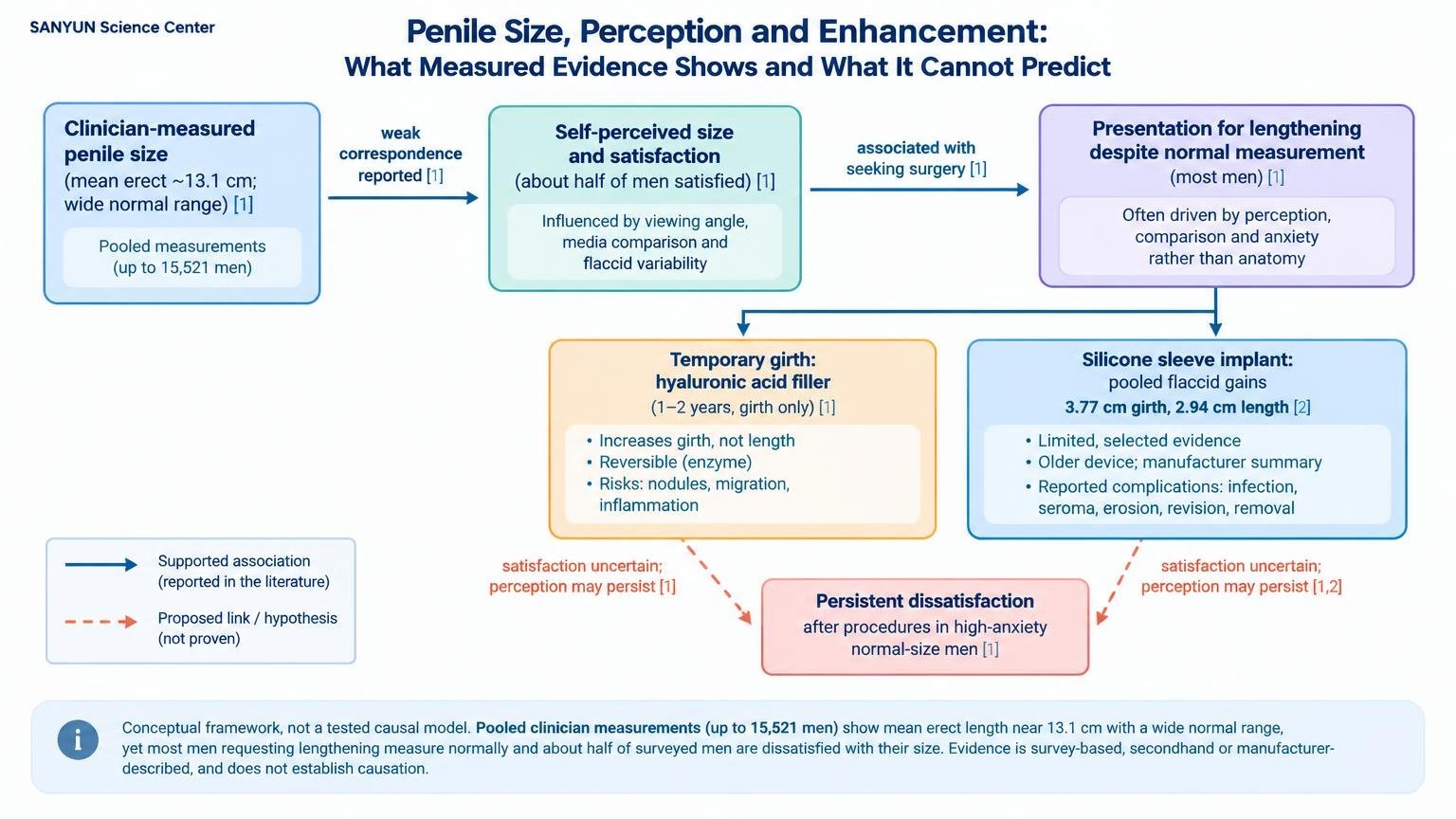
Penile size is one of the most searched and least accurately discussed topics in men's health. The strongest anchor is a systematic review pooling clinician-obtained measurements from up to 15,521 men, which reported a mean erect length of about 13.1 cm and a mean flaccid length of about 9.2 cm, with a very wide normal range. Those central values matter less than the range around them: many men who believe they are abnormal fall comfortably inside it.[1]
The second consistent finding is a perception gap. In one study of men presenting for lengthening surgery, most measured within the normal range. In a survey of more than 50,000 adults, only about half of men were satisfied with their own size, while 85% of women were satisfied with their partner's size. Together these findings suggest that dissatisfaction is often a problem of perception and comparison rather than of anatomy.
Interventions divide sharply by evidence quality. Hyaluronic acid filler temporarily increases girth, not length, with effects typically lasting about one to two years. Ligamentolysis reports published average visible flaccid gains of about 1 to 2 cm, with wide individual variation and some men showing little change. Silicone sleeve implants have peer-reviewed case series and a 2026 systematic review, but the evidence base is small, selected and largely manufacturer-described. Supplements, massage and stretching techniques have no evidence of permanent gain and carry documented harms.[2][3]
Why This Matters
The clinical stakes are modest for most men and substantial for a few. Very few medical problems arise from penile size alone, yet the commercial market built around size anxiety is large, lightly regulated in many countries, and increasingly visible online. A man who searches for enlargement options will encounter supplements, pumps, traction devices, fillers, ligament surgery and subcutaneous implants presented with similar confidence and very different levels of supporting evidence.
The mismatch between worry and measurement is the central clinical fact. Most men who request lengthening surgery measure within the normal range, and research has repeatedly found that men with normal size but high anxiety often remain dissatisfied even after procedures. That pattern implies that an operation aimed at the organ may not address the concern, which is why assessment should begin with an accurate measurement and an honest conversation rather than a procedure list.
There is also a measurement-literacy problem. Self-reported size, informal comparison and adult media all inflate what men believe is typical. The same manufacturer that publishes measured averages on one page promotes an implant on another, and the Portuguese-language version of that page explicitly qualifies an anatomical claim made in the English version: vaginal dimensions vary, and a single circumference figure cannot predict a partner's stimulation. Reading across versions makes the editorial variability visible.[4]
How Size Is Measured and Why the Method Matters
Length is measured from the pubic base to the tip, with the measuring device pressed against the pubic bone; girth is measured by wrapping a non-stretchable string or flexible tape gently around the thickest part of the erect penis. Stretchable tape and string are specifically discouraged because they distort the reading. These details sound trivial but they determine whether a number is comparable to published norms at all.
Flaccid size is a poor predictor of erect size. It varies with temperature, stress and time of day, so locker-room comparison and self-assessment carry little information. The published averages by state illustrate the point: one commercial education page cites erect length of 5.17 inches, erect girth of 4.59 inches, flaccid length of 3.61 inches, stretched flaccid length of 5.21 inches and flaccid girth of 3.67 inches. Those figures come from a manufacturer page that does not name the underlying studies or their sample sizes, so they are useful as orientation rather than as a definitive reference.
| Measure | Reported value | What it tells a reader | Key limitation |
|---|---|---|---|
| Mean erect length | About 13.1 cm | Central estimate from pooled clinician measurements in up to 15,521 men | Normal range is very wide; a single mean cannot classify an individual |
| Mean flaccid length | About 9.2 cm | Pooled clinician-measured flaccid value | Flaccid size varies with temperature and situation and does not predict erect size |
| Erect girth (commercial citation) | 4.59 in | Orientation value cited on a manufacturer education page | Underlying studies and sample sizes not identified |
| Men requesting lengthening who measure normal | Most | Suggests the request is often not explained by measured size | Secondhand summary without a numeric proportion or denominator |
| Men satisfied with own size vs women satisfied with partner's size | About half vs 85% | Quantifies the perception gap between men and their partners | Self-reported satisfaction in a survey, not measured size |
The Perception Gap: Why Normal Measurements Still Cause Distress
Three mechanisms plausibly drive the gap between measured size and felt size. The first is the viewing angle: looking down at oneself foreshortens the image, so a man's own view is systematically smaller than the view others have. The second is comparison with adult media, which selects performers and camera angles and is not a representative sample of men. The third is flaccid variability, which makes casual comparison uninformative. None of these mechanisms requires an anatomical abnormality, and all are modifiable through accurate information.
The survey data quantify the asymmetry. Only about half of men were satisfied with their own size, while 85% of women were satisfied with their partner's size. If partner satisfaction were driven mainly by measured size, the two figures would not diverge so sharply. Sexual satisfaction in the same literature is attributed more to communication, confidence and erectile quality than to size, which reframes the clinical question from "is it big enough" to "is something else limiting satisfaction."
Persistent, intrusive worry about a normal-sized penis is a recognized clinical pattern rather than a surgical one. When the concern is repetitive, drives avoidance of relationships or communal changing, and persists despite a normal measurement, the evidence supports psychological assessment and care. This is also why a reputable clinician will often recommend against a procedure: the outcome the patient wants is relief from the concern, and surgery aimed at the organ frequently does not deliver it.
What the Evidence Shows for Girth and Length Interventions
Hyaluronic acid filler is the best-characterized temporary option. It increases girth but not length, and the effect typically lasts about one to two years before the material resolves naturally, depending on the product and the individual. A practical advantage is reversibility: HA can be dissolved with an enzyme if the result is unsatisfactory. The trade-off is a set of its own risks, including irregular nodules, filler migration and inflammation, and repeat treatment is needed to maintain the result.
Ligamentolysis, which releases the suspensory ligament, increases visible flaccid length rather than true erect length. Published averages are about 1 to 2 cm, but the distribution matters more than the mean: results vary widely between individuals and some men see almost no change. Autologous fat injection for girth has a different limitation, namely unpredictable fat resorption, which makes the final result difficult to plan. Both approaches carry real risks, from scarring to altered sensation.
Silicone sleeve implants occupy a distinct evidentiary position. A 2026 systematic review and meta-analysis examined 12 published clinical reports on the implant technology published between 2018 and 2026 and reported pooled average postoperative increases of 3.77 cm in flaccid girth and 2.94 cm in flaccid length. The review authors concluded that the included studies document increased flaccid dimensions but emphasized the need for larger prospective studies and standardized long-term follow-up.
There are three important qualifications to that pooled estimate. First, the pooled figures derive from historical studies of an earlier-generation implant, not the current device. Second, the evidence comes from a product lineage rather than the whole category of silicone penile implants, and results for one device cannot be assumed to apply to another manufacturer's product. Third, the summary itself is manufacturer-authored, which does not invalidate the underlying publications but does mean the framing should be read with that affiliation in mind.
Newer device-specific data come from small selected series. A study published online in July 2025 evaluated the implant in 12 patients with adult acquired buried penis and reported average increases of 3.52 cm in flaccid dorsal length and 2.78 cm in midshaft girth. During reported follow-up there were no penile infections, skin erosions or implant removals. The authors of the summary correctly caution that small studies cannot establish the complication rates expected across a broader patient population, and this series involved a reconstructive population rather than routine cosmetic patients.
Safety data at the review level are less tidy. The 2026 review's historical pooled complications included infection, seroma, implant erosion or exposure, revision surgery and implant removal. Reported rates varied between studies, and the authors emphasized limitations in study design, outcome definitions and follow-up. The review did not calculate separate pooled complication rates for the current device. Manufacturer-reported cumulative experience of more than 5,000 procedures across product generations describes volume, not audited outcomes.
A broader 2020 systematic review reached a more skeptical conclusion about the field as a whole: in men of normal penile size, many augmentation procedures carry high complication rates and uncertain satisfaction. This is the appropriate frame for a man with a normal measurement who is considering any procedure. It does not prohibit treatment, but it shifts the burden of proof onto the intervention and makes measurement, expectation screening and full risk disclosure prerequisites rather than formalities.
Methods With No Evidence of Permanent Gain, and Real Harms
No pill, cream or supplement has evidence of producing permanent size gain, and the supplement market carries a specific danger beyond wasted money. Thailand's Food and Drug Administration has detected some men's dietary supplements adulterated with PDE-5 inhibitor drugs without labeling. For a man with cardiac disease or one taking nitrate medication, an undisclosed PDE-5 inhibitor is not a cosmetic disappointment but a potentially serious medical exposure.
Shared stretching and massage techniques have no research support for permanent gain and there are real reports of injury, including fibrosis and penile curvature. Blood-flow exercises may be safer than pills when done correctly but can cause pain when performed incorrectly and likewise lack evidence of increasing girth. Vacuum pumps draw blood into the penis and produce temporary enlargement lasting minutes to hours; they have a legitimate role in erectile dysfunction care but no evidence of permanent size increase, and excessive pressure risks capillary rupture and injury.
The most dangerous category is injection of non-medical substances such as liquid silicone, oils or unknown materials by non-physicians. Reported complications include chronic inflammatory masses, tissue necrosis, permanent deformity and the need for major corrective surgery. Case-report-level evidence cannot quantify incidence, but the severity and irreversibility of these outcomes make this a category to avoid rather than compare with regulated options.
Interpretation and Limitations
The normative literature is stronger than the intervention literature. The pooled measurement review provides a large, clinician-measured reference, but the summary available here gives no confidence intervals or measurement protocols and describes the normal range only as wide. That is enough to counter exaggerated beliefs about what is typical, but not enough to classify any individual as abnormal.
The perception data are survey-based and self-reported. Satisfaction figures describe how people feel about size, not how size relates to satisfaction, and the survey design is not described in the available summary. The request-for-surgery finding is reported without a numeric proportion or denominator. These are directionally consistent findings that should inform consultation, not precise prevalence estimates.
The implant evidence is the most detailed intervention evidence in this packet and also the most conflicted. The systematic review is described through a manufacturer's summary, the pooled dimensional estimates reflect an earlier-generation device, and the device-specific series are small and selected. A distinction between statistical and clinical meaning is essential here: a pooled average increase in flaccid dimensions is not the same as a satisfied patient, and zero complications in 12 patients is not a low population complication rate.
One conflict inside the source set is worth naming. The English manufacturer page asserts that most surveyed women consider girth more important than length and reasons from a generalized vaginal circumference that more girth yields more stimulation. The Portuguese version of the same page states that vaginal dimensions vary and that a single circumference measure cannot predict a partner's stimulation or establish that greater girth always produces more pleasure. The more cautious statement is the defensible one.
Finally, the promotional language within the source set should be separated from the evidence. One page states that the implant can increase girth in some men by up to two inches, and another reports a promotional average girth increase of 2.5 to 5 cm with variable results. These are marketing summaries without cited study details, and they should not be read as expected outcomes for an individual patient.
Research Outlook
The clearest research gap is prospective, standardized, long-term follow-up of current-generation implants in routine cosmetic populations, with predefined complication definitions and independent outcome assessment. The 2026 review authors named this need directly. Until such data exist, complication rates for the current device remain uncertain, and consent discussions should say so rather than extrapolating from small selected series.
A second gap concerns the psychological side. The observation that normal-sized, highly anxious men often remain dissatisfied after procedures implies that outcome studies should measure satisfaction and body-image distress, not only centimeters. Trials and registries that capture patient-reported outcomes alongside dimensional change would clarify which patients benefit and which are better served by psychological care.
Key Takeaways
- Pooled clinician measurements place mean erect length near 13.1 cm and flaccid length near 9.2 cm, with a wide normal range; a single number does not classify an individual.
- Most men requesting lengthening surgery measure within the normal range, and about half of surveyed men were dissatisfied with their size while 85% of women were satisfied with their partner's size.
- Hyaluronic acid filler increases girth, not length, for roughly one to two years; ligament surgery adds about 1 to 2 cm of visible flaccid length on published averages, with wide individual variation.
- Silicone sleeve implants have pooled flaccid gains of 3.77 cm in girth and 2.94 cm in length from historical studies, but the evidence base is small, selected, partly manufacturer-described and lacks standardized long-term follow-up.
- Supplements, stretching and massage have no evidence of permanent gain and carry documented harms, including adulterated products and penile injury; unregulated injections can cause necrosis and permanent deformity.
Questions and Answers
What is the average penile size according to measured research?
A systematic review pooling clinician-obtained measurements from up to 15,521 men reported a mean erect length of about 13.1 cm and a mean flaccid length of about 9.2 cm, with a very wide normal range. The available summary does not give confidence intervals or measurement protocols, so these are orientation values rather than thresholds for classifying an individual.
Why do so many men with normal measured penile size still feel too small?
Research has repeatedly found that men with normal size but high anxiety often remain dissatisfied even after procedures, which points to perception rather than anatomy. Viewing angle foreshortens self-view, adult media presents a selected group, and flaccid size varies widely. In surveys, only about half of men were satisfied with their own size while 85% of women were satisfied with their partner's.
Does hyaluronic acid filler increase penile length or only girth?
Hyaluronic acid filler temporarily increases girth, not length. Effects typically last about one to two years before the material resolves naturally, depending on the product and the individual. It can be dissolved if the result is unsatisfactory, but carries its own risks including irregular nodules, filler migration and inflammation, and repeat treatment is needed to maintain girth.
How strong is the evidence that silicone sleeve implants increase penile size?
A 2026 systematic review of 12 clinical reports published between 2018 and 2026 reported pooled average increases of 3.77 cm in flaccid girth and 2.94 cm in flaccid length, but these came from historical studies of an earlier-generation implant. The review authors called for larger prospective studies and standardized long-term follow-up, and device-specific series remain small and selected.
What are the documented risks of penile augmentation procedures?
A 2020 systematic review concluded that in men of normal size many augmentation procedures carry high complication rates and uncertain satisfaction. Pooled implant complications include infection, seroma, erosion or exposure, revision surgery and implant removal, with rates varying between studies. Unregulated injections of silicone, oils or unknown substances have caused chronic inflammatory masses, tissue necrosis and permanent deformity.
Do penile enlargement pills, pumps or stretching exercises work permanently?
No pill, cream or supplement has evidence of permanent size gain, and some men's supplements have been found adulterated with unlabeled PDE-5 inhibitor drugs. Vacuum pumps produce temporary enlargement lasting minutes to hours and have a legitimate erectile dysfunction role but no permanent effect. Stretching and massage techniques lack research support and have caused fibrosis and penile curvature.
Conceptual framework: Conceptual framework, not a tested causal model. Pooled clinician measurements (up to 15,521 men) show mean erect length near 13.1 cm with a wide normal range, yet most men requesting lengthening measure normally and about half of surveyed men are dissatisfied with their size. Supported links reflect reported associations; proposed links (dashed in spirit) reflect the hypothesis that persistent dissatisfaction may survive procedures in high-anxiety men. Evidence is survey-based, secondhand or manufacturer-described, and does not establish causation.
Academic References & Evidence
- Veale D; Miles S; Bramley S; Muir G; Hodsoll J; Mondaini N; Ponchietti R; Gontero P; Marra G; Drury A; Tran L; Veale D; Muir GH; Lever J; Frederick DA; Peplau LA; Vardi Y; Har-Shai Y; Gil T; Gruenwald I; Wylie KR; Eardley I. เพิ่มขนาดน้องชาย: ขนาดปกติ อะไรได้ผลจริง ความเสี่ยง.
- Yang H; Xiao W; Wang H; Tang G. Himplant Clinical Research | 2026 Scientific Review. International Journal of Impotence Research. 2026
- Penile Length & Girth: Penis Anatomy and Average Girth Size | Himplant®.
- Anatomia do pênis: comprimento e circunferência médios | Himplant.
SANYUN Science Center explains published research on men's reproductive and sexual health, connecting scientific evidence with everyday questions while making sources and limitations clear.
Disclaimer: This article is for scientific education and research communication only. It does not provide medical advice, diagnosis, or individualized treatment recommendations, and does not endorse any medication, supplement, device, penile enlargement procedure, or other intervention. Decisions about sexual and reproductive health should be made in consultation with a qualified healthcare professional. Do not delay seeking professional care because of information in this article.
Original Content & Copyright Notice
- This article is prepared for SANYUN Science Center, drawing on published research and publicly available academic literature on men’s sexual and reproductive health. Its editorial explanations and presentation are developed for this platform.
- Copyright in the original editorial content, selection, and arrangement is reserved by SANYUN Science Center to the extent protected by applicable law. Referenced research, quotations, and third-party materials remain subject to the rights of their respective owners. This notice does not claim ownership of scientific facts or third-party research.
- Except where permitted by applicable law or an applicable license, prior written permission is required to reproduce, republish, translate, adapt, redistribute, or commercially reuse protected content. Attribution alone does not grant permission for such reuse.
- For permitted quotation or authorized reuse, clearly identify the source and retain a link to the original article.
- Source: SANYUN Science Center
- Original URL: Retain the original article URL on science.san-yun.com.
- Copyright Holder: SANYUN Science Center, for its own protected editorial content.
- Quotation, excerpts, or authorized reuse must not distort the scientific meaning, omit material limitations or disclaimers, or imply unverified medical claims, product efficacy, or endorsement by SANYUN Science Center.



