




Category: Penile Size
Core Research Direction: Methodological review of penile size measurement in adult men: whether the literature supports any single preferred technique for measuring flaccid, stretched, or erect penile length and girth, and what 'no consensus' means for clinical and research reporting
Search Intent: Is there any agreed, evidence-based way to measure adult penile length and girth, and what does the research actually show about competing measurement methods?
Platform: SANYUN Science Center
Evidence reviewed through: 2026-11-11
Executive Summary
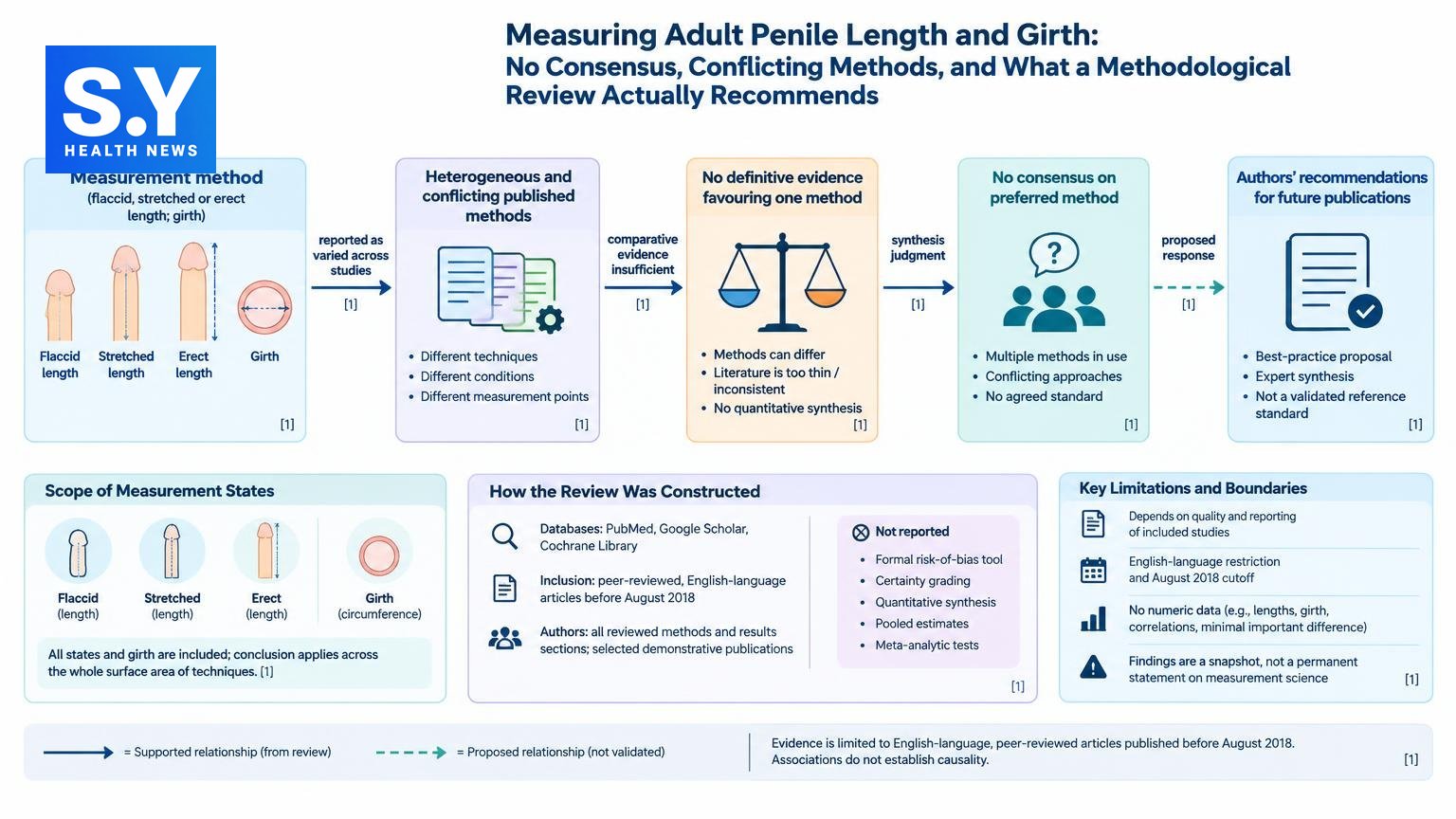
Adult penile size data are treated in the literature as relevant to both clinicians and researchers, but the way those data are generated is far less settled than the numbers themselves imply. A methodological review published in the International Journal of Impotence Research addressed this directly. Its authors set out to compare measurement approaches for the flaccid, stretched and erect penis and to build a best-practice recommendation, and they concluded that no definitive evidence favoured any one method over the others.[1]
That conclusion matters more than a single disappointing result. It describes a field in which published values may differ partly because the tissue was measured differently, not because the men measured were different. The review's response was to propose its own recommendations for future publications rather than to identify a validated reference standard. Those recommendations therefore represent expert synthesis rather than a technique proven superior in comparative studies.
- The review found no consensus on a preferred method for evaluating penile size.
- Published methods for measuring length and girth were characterized as various and conflicting.
- No definitive evidence favoured one measuring method over another.
- The authors recommend their own measurement proposals for future publications.
Why Measurement Technique Deserves Its Own Review
Penile size is not a trivial variable in clinical and research settings. It sits behind referral questions, preoperative and postoperative documentation, device sizing, and a body of literature on men's self-perception and sexual health. The review frames the underlying data as important to clinicians and researchers alike, which is precisely why the reliability of the numbers deserves scrutiny rather than assumption.
When reported sizes are compared across studies, readers implicitly assume a common measurement object. That assumption is unsafe if one study measures a flaccid penis immediately after examination while another applies traction, or if girth is taken at different points along the shaft. Because the review reports that methods in the literature are various and conflicting, cross-study comparison of absolute values carries an unquantified measurement penalty that most published tables do not display.
The review is best understood as a measurement-methodology review, not a prevalence study. It does not aim to establish what typical adult size is; it asks how size should be captured so that future values mean something consistent. That distinction separates a technical quality problem from a biological one, and it explains why the authors' output is a reporting recommendation rather than a new normative dataset.
How the Review Was Constructed
The authors performed a systematic search for articles on penile length and girth measurement techniques using PubMed, Google Scholar and the Cochrane Library. Inclusion was limited to peer-reviewed, English-language articles published before August 2018. All authors reviewed the methods and results sections of each publication, and the paper reports selected demonstrative publications rather than pooling numerical estimates.
This design has clear strengths and clear ceilings. A systematic search across three databases reduces the chance that obvious sources were missed, and having all authors examine methods and results sections directs attention to exactly the details that matter for measurement questions. However, the review reports no formal risk-of-bias instrument, no certainty grading and no quantitative synthesis; there are no pooled lengths, no confidence intervals for method differences and no meta-analytic test of heterogeneity. The absence of a favoured method is therefore a narrative synthesis judgment, not the product of a statistical comparison.
The English-language restriction and the August 2018 cutoff further bound the conclusions. Non-English publications and any work appearing after that date fall outside the evidence base assembled here. The review's finding of no superior technique should be read as accurate for the literature it searched, not as a permanent statement about all measurement science. Later methodological work or consensus initiatives would not contradict the review; they would simply sit outside it.
Flaccid, Stretched and Erect: Three Different Measurement Problems
The review explicitly covers measurement methods for the flaccid, stretched and erect penis, which are not interchangeable conditions. A flaccid measurement is taken in a state whose length can change with temperature, anxiety, recent activity and time since voiding; a stretched measurement introduces an applied traction maneuver that requires standardization of how and how firmly traction is applied; an erect measurement depends on how erection is defined and achieved, which raises issues of privacy, setting and reproducibility. Girth adds a further axis, because circumference can be sampled at different positions along the shaft and under different degrees of tumescence.
Because the review frames its scope around all three states and around girth, its conclusion applies across that whole surface area of technique. The finding that no definitive evidence favours one measuring method over the other is therefore broad rather than narrow: it is not a statement only about, for example, stretched length in a single population, but a characterization of the comparative evidence across the states the authors examined.
What the Evidence Shows — and What It Does Not
The central empirical claim of the review is a negative one: no definitive evidence was found that favours one measuring method over the other. This should be described precisely. It is an absence-of-evidence finding from a narrative review, not a demonstration that methods are equivalent. Two techniques can differ systematically in the values they produce while the comparative literature remains too thin, too inconsistent or too poorly reported to resolve which is preferable. The review's null conclusion is compatible with real method effects that no included study was designed to isolate.
This distinction has practical consequences. A clinician reading a published mean cannot assume it would be reproduced with a different technique. A researcher designing a study cannot cite the review as licence to choose any method casually, because the review's response to the evidence gap was to propose a recommendation for future reporting, not to declare all approaches acceptable. The recommendation is the constructive output of an inconclusive comparative literature.
| Review element | What the review reports | How it should be interpreted |
|---|---|---|
| Measurement states covered | Flaccid, stretched and erect penis, plus girth | Conclusion applies across multiple states; not limited to one technique or one condition |
| Consensus on preferred method | No consensus regarding the preferred method | Interpretive synthesis of a heterogeneous literature, not a measured outcome |
| Comparative performance of methods | No definitive evidence favouring one method over another | Absence of evidence, not proof of equivalence; systematic differences may remain unresolved |
| Authors' output | Recommendations advocated for use in future publications | Expert-derived best-practice proposal, not a validated reference standard |
| Search strategy | Systematic search of PubMed, Google Scholar and Cochrane Library | Broad coverage but no formal certainty grading or quantitative pooling reported |
| Evidence boundaries | Peer-reviewed English articles published before August 2018 | Language and date restrictions limit currency and generalizability |
Interpretation: The Anatomy of a "No Consensus" Finding
"No consensus" is often read as a modest caveat. In measurement science it is a substantive claim with three components. First, there is heterogeneity of practice: methods are various and conflicting. Second, there is a comparative evidence gap: no definitive evidence favours one method. Third, there is a proposed remedy: the authors advocate their own recommendations for future publications. Each component has a different epistemic status — an observation about the literature, a null synthesis finding, and an expert recommendation — and they should not be collapsed into a single claim that "there is no right way to measure."
The review's own framing supports this layered reading. The absence of consensus and the presence of conflicting methods are characterized as features of the existing literature, while the recommendation is presented as a best-practice construction. The authors describe constructing a recommendation, which signals design and judgment rather than discovery of an existing validated standard. That is an honest and useful scientific move, but it places the recommendation in the category of expert guidance awaiting comparative validation.
There is also an important asymmetry between clinical and research implications. For research, the recommendation offers a route to comparability: if future publications report using a shared set of conventions, cross-study synthesis becomes more meaningful. For clinical practice, the review provides no evidence that switching techniques changes patient outcomes, because it did not evaluate outcomes at all. Clinicians should therefore treat the review as a reporting and documentation aid, not as evidence that any measurement approach improves care.
Limitations and Residual Uncertainty
Several limitations constrain how far the review's conclusions can travel. It is a review whose comparative claim depends on the quality and reporting of the underlying studies, and the authors found those studies insufficient to separate the methods definitively. No formal certainty appraisal was reported, so readers cannot attach a graded confidence level to the null finding. No quantitative pooling was presented, so method-to-method differences are neither estimated nor bounded. The demonstrative approach means the cited publications illustrate the argument rather than exhaustively represent the evidence base.
The August 2018 cutoff and English-language restriction are temporal and linguistic boundaries rather than flaws in execution, but they matter here. Measurement standards are partly social: they gain authority through adoption by journals, societies and multicenter groups. A review that stops at a given date cannot capture later standardization efforts, and one restricted to English cannot capture conventions developed in other research traditions. The review's finding should thus be read as a snapshot of the methodological literature at its cutoff, not a verdict on measurement science in perpetuity.
Finally, the review does not provide the numeric data needed to judge clinical significance. It reports no mean lengths, no girth values, no correlation coefficients between methods and no minimal important difference. That is appropriate for a methodological review, but it means the article cannot answer the question many readers actually have — what is typical adult size — and it should not be cited as if it did. Its contribution is to the rules of measurement, not to the distribution of the measured.
Research Outlook: From Recommendation to Validation
The most defensible next step implied by this review is comparative validation. If the authors' recommendations are to become a reference standard, studies are needed that measure the same men with competing techniques and report agreement, repeatability and inter-observer reliability. Such work would convert the current absence-of-evidence finding into an evidence base — either supporting the recommended conventions or revealing which elements require revision. Until then, the recommendation functions as a hypothesis about best practice rather than a tested conclusion.
A second need is transparent reporting in future publications. Studies should state which state was measured, how traction or erection was standardized, where girth was sampled and who performed the measurement. The review's diagnosis that methods are various and conflicting is itself a reporting problem as much as a design problem. Clearer reporting would let later reviewers compare methods quantitatively instead of narratively, and would let readers interpret published values with appropriate caution.
A third avenue is alignment across journals and professional bodies. Because consensus in measurement often emerges through editorial requirements rather than through a single decisive trial, the review's advocacy for its recommendations in future publications is itself a consensus-building strategy. Whether that strategy succeeds is an open empirical and sociological question that this review raises but does not answer.
Key Takeaways
- A methodological review of adult penile measurement found no consensus on a preferred method for evaluating size.
- The review covered flaccid, stretched and erect length as well as girth, and characterized the published methods as various and conflicting.
- No definitive evidence was found favouring one measuring method over another — an absence-of-evidence finding, not proof of equivalence.
- The authors responded by advocating their own measurement recommendations for future publications, which remain expert-derived proposals needing comparative validation.
- Evidence was restricted to peer-reviewed English articles published before August 2018, and no formal certainty grading or quantitative pooling was reported.
- The review concerns how size is measured, not what typical size is; it should not be used as a normative size reference.
Questions and Answers
Why is there no agreed standard method for measuring adult penile length and girth?
A methodological review found no consensus on a preferred measurement method and described published techniques for flaccid, stretched and erect length and girth as various and conflicting. Its systematic search found no definitive evidence favouring one method over another, so no technique has been validated as a reference standard. This reflects a comparative evidence gap and inconsistent reporting rather than a settled scientific choice.
What did the penile size measurement review actually find?
The review found that no definitive evidence favoured one measuring method over the other across flaccid, stretched and erect length and girth. Rather than identifying a validated standard, the authors advocated their own recommendations for future publications. That recommendation is an expert-derived best-practice proposal, not a technique shown superior in comparative studies, and the review reported no pooled numerical comparison of methods.
Does "no evidence favouring one method" mean all penile measurement techniques are equivalent?
No. The finding is an absence of evidence, not evidence of equivalence. Two techniques could produce systematically different values while the comparative literature remains too thin or too inconsistent to resolve which is preferable. The review's own response — proposing recommendations for future reporting — indicates the authors did not regard existing methods as interchangeable or adequately standardized.
How was the penile measurement review conducted, and what limits its conclusions?
The authors systematically searched PubMed, Google Scholar and the Cochrane Library for peer-reviewed English articles published before August 2018, and all authors reviewed methods and results sections. No formal risk-of-bias tool, certainty grading or quantitative pooling was reported, and the English-language and 2018 cutoff restrictions bound the evidence. Findings are a narrative synthesis snapshot, not a permanent verdict.
Can this penile size review tell me what typical adult penile size is?
No. The review examines how size is measured, not the distribution of size itself. It reports no mean lengths, girth values or normative ranges. Although penile size data are framed as important to clinicians and researchers, this paper's contribution is to measurement conventions and reporting standards. Readers seeking typical size values need normative studies, not this methodological review.
What should future research do about penile length and girth measurement standards?
The review implies comparative validation is needed: studies measuring the same men with competing techniques and reporting agreement and reliability. Future publications should also state which state was measured, how traction or erection was standardized and where girth was sampled. Until such work exists, the authors' recommendations function as a best-practice proposal awaiting testing rather than an established standard.
Conceptual framework: Conceptual framework of the methodological review's argument in adult men: measurement methods for flaccid, stretched and erect length and girth are varied and conflicting, no definitive evidence favours one method, and the authors propose their own recommendations. The link to the recommendation is proposed, not validated in comparative studies. Evidence is restricted to English articles published before August 2018.
Academic References & Evidence
- Greenstein A; Dekalo S; Chen J. MEDLINE Abstract. Int J Impot Res. 2020 32(2):153-158
SANYUN Science Center explains published research on men's reproductive and sexual health, connecting scientific evidence with everyday questions while making sources and limitations clear.
Disclaimer: This article is for scientific education and research communication only. It does not provide medical advice, diagnosis, or individualized treatment recommendations, and does not endorse any medication, supplement, device, penile enlargement procedure, or other intervention. Decisions about sexual and reproductive health should be made in consultation with a qualified healthcare professional. Do not delay seeking professional care because of information in this article.
Original Content & Copyright Notice
- This article is prepared for SANYUN Science Center, drawing on published research and publicly available academic literature on men’s sexual and reproductive health. Its editorial explanations and presentation are developed for this platform.
- Copyright in the original editorial content, selection, and arrangement is reserved by SANYUN Science Center to the extent protected by applicable law. Referenced research, quotations, and third-party materials remain subject to the rights of their respective owners. This notice does not claim ownership of scientific facts or third-party research.
- Except where permitted by applicable law or an applicable license, prior written permission is required to reproduce, republish, translate, adapt, redistribute, or commercially reuse protected content. Attribution alone does not grant permission for such reuse.
- For permitted quotation or authorized reuse, clearly identify the source and retain a link to the original article.
- Source: SANYUN Science Center
- Original URL: Retain the original article URL on science.san-yun.com.
- Copyright Holder: SANYUN Science Center, for its own protected editorial content.
- Quotation, excerpts, or authorized reuse must not distort the scientific meaning, omit material limitations or disclaimers, or imply unverified medical claims, product efficacy, or endorsement by SANYUN Science Center.



