




Category: Penile Size
Core Research Direction: What measured penile dimensions have peer-reviewed studies reported across different populations and measurement methods, and how do suprapubic/abdominal fat, measurement technique and self-perception affect apparent size and concerns about 'small penis'?
Search Intent: How long is a 'normal' penis, why do published averages differ between 13 and 17 cm, and can pubic fat or self-measurement make a normal penis look smaller—what should men with size worries actually do?
Platform: SANYUN Science Center
Evidence reviewed through: 2026-11-12
Executive Summary
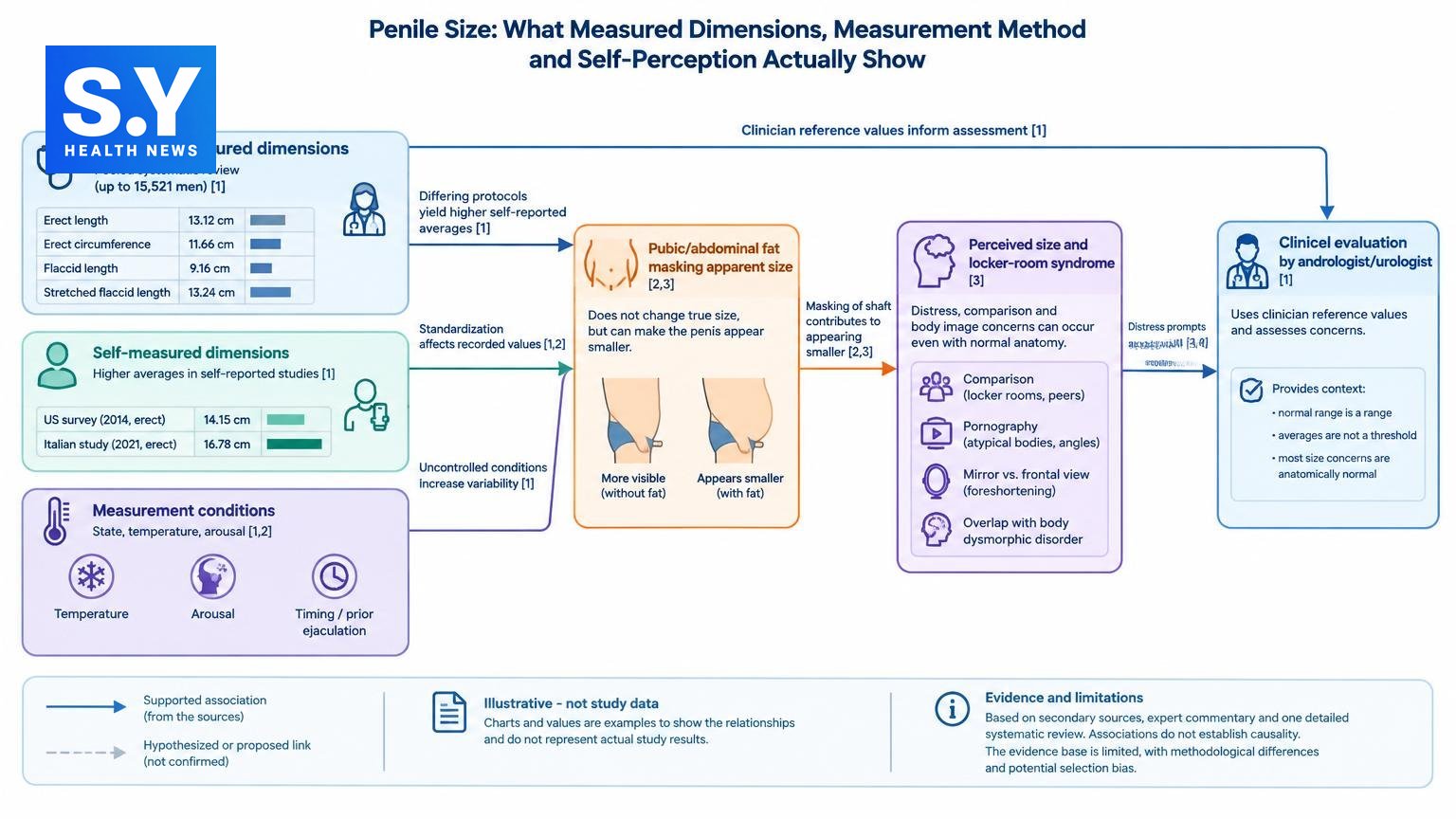
Ask what a "normal" penile length is and the honest answer is a range, not a number. The most cited clinician-measured synthesis, a systematic review by Veale and colleagues published in BJU International in 2015, pooled studies using a standard procedure performed by a healthcare professional and reported a mean erect length of 13.12 cm and mean erect circumference of 11.66 cm, while mean flaccid (pendulous) length was 9.16 cm and mean stretched flaccid length 13.24 cm.[1]
Self-measured studies report higher erect averages: 14.15 cm in a 2014 United States survey and 16.78 cm in a 2021 study of Italian men who measured themselves with manual stimulation. The gap between roughly 13 cm and nearly 17 cm is best read as a difference in protocol, arousal state and population rather than proof that one population is anatomically larger.
Two clinical points follow. First, averages describe a sample, not a threshold of normality. Second, pubic and abdominal fat can bury part of the penile shaft so that the organ appears smaller without its true dimensions changing, an effect repeatedly described in clinical commentary. Alongside this sits a psychological problem: many men who seek help for a "small penis" are anatomically normal but distressed, a pattern sometimes called locker-room syndrome.[2][3][4]
Why This Matters
Size anxiety is common enough to be a public-health-relevant concern rather than a vanity issue. An interviewed urologist observed that in the great majority of cases men who present with size worries turn out to have dimensions that are entirely normal, yet they often do not believe this unless a specialist tells them. A clinical sexologist's commentary goes further, arguing that most male concerns about size are unfounded and that no serious study has shown erect size determines the ability to satisfy a partner or to enjoy sex.[5]
That framing needs care. Calling concerns "unfounded" describes their anatomical basis, not the distress itself: size dissatisfaction can drive avoidance of intimacy, mirror-checking and reduced self-esteem, and in some men it overlaps with body dysmorphic disorder. Meanwhile, visceral fat is not merely a cosmetic issue; it is described as an important risk factor for sexual problems and for general and cardiovascular health.
How Penile Dimensions Are Measured — and Why the Numbers Differ
The single largest source of apparent disagreement between studies is protocol. In the Veale review, included studies had to use a standard measurement procedure carried out by a healthcare professional, with at least 50 participants per sample, and excluded men with congenital or acquired anomalies, prior penile surgery, small-penis complaints or erectile dysfunction; the pooled total reached up to 15,521 men.
Even within that relatively clean dataset, the evidence base is uneven. Erect length rested on 692 men and erect circumference on 381, against 10,704 men for flaccid length and 14,160 for stretched flaccid length. Erect figures are therefore the least precise part of the pooled picture, and the authors flagged stretched flaccid length as the measurement showing the greatest variability between studies.
| Study and design | Measurement condition | Mean length | Mean circumference | Key caveat |
|---|---|---|---|---|
| Veale et al., 2015; systematic review of clinician-measured studies, up to 15,521 men | Flaccid (pendulous) | 9.16 cm | — | Large sample but flaccid state varies with temperature and arousal |
| Veale et al., 2015 | Stretched flaccid | 13.24 cm | — | Greatest between-study variability of all measures |
| Veale et al., 2015 | Erect | 13.12 cm | 11.66 cm | Based on only 692 men (length) and 381 men (circumference), so least precise |
| Herbenick et al., 2014; self-measurement survey, 1,661 US men | Erect, self-measured | 14.15 cm | 12.23 cm | Participant-measured, not clinician-standardized |
| Chen et al., 2014; 5,196 Chinese men in a urology clinic | Flaccid and erect (311 men measured erect) | — | — | Clinic convenience sample; erect subgroup small |
| Di Mauro et al., 2021; 4,685 Italian men self-measuring with manual stimulation | Erect and flaccid | 16.78 cm erect; 9.47 cm flaccid | 12.03 cm erect; 9.59 cm flaccid | Self-measurement with manual stimulation; self-selected sample |
| Prause et al., 2015; 75 US women choosing 3D models | Stated preference, not anatomy | 16.3 cm casual / 16 cm long-term | 12.7 cm casual / 12.2 cm long-term | Expressed preferences in a small sample, not measurements or outcomes |
The table makes the methodological point concrete: the 2001 study in the same source measured stretched flaccid length and reported medians, whereas Herbenick, Veale, Habous and Di Mauro measured erection, and Chen measured both flaccid and erect states in different subsamples. The source explicitly states these values are not comparable without accounting for method.
What the Evidence Shows About Typical Dimensions
Several anchor points recur. Clinical opinion cited in patient-facing sources gives an average erect length of roughly 12-16 cm with a circumference of about 12 cm, adding that variations from these figures can still be within normal limits. An interviewed urologist quotes an international average of about 9 cm flaccid and 14 cm erect. Neither statement is tied to a named primary study in the supplied material, so both should be treated as rounded clinical summaries rather than measured estimates.
The clinician-measured review is the more defensible reference because its inclusion criteria and sample sizes are stated. Its figures — 13.12 cm erect length and 11.66 cm erect circumference — sit below self-reported surveys and below the 12-16 cm clinical range at the lower end, which is exactly what one would expect if clinician measurement is more conservative and self-measurement more generous.
Biological and Clinical Mechanism: Fat, Anatomy and Apparent Size
A central mechanism in this literature is mechanical rather than hormonal. In overweight or obesity, accumulation of adipose tissue in the pubic area does not in itself change penile dimensions, but it can make the penis appear smaller than it is. The same masking effect is attributed to abnormal shaft curvature or to excess skin covering the organ.
Measurement technique interacts with this. Standard clinical practice places a rigid ruler against the pubic bone while stretching the flaccid penis, which compresses the suprapubic fat pad and reveals length that a skin-surface measurement would miss. The clinical expert notes that penile length is not easily standardized even when measured by medical staff, and even less so when a man measures himself alone.
State-dependent factors add further noise. The Di Mauro authors note that temperature, level of arousal and prior ejaculation can affect penile dimensions. This is why a single self-measurement taken in a cold room, after anxiety or without full erection tells a man little about his anatomy.
The source also notes a growth-related correlation: the strongest and most consistent associations in the review were between flaccid or erect length and height, with correlation coefficients between 0.2 and 0.6. That is a modest-to-moderate relationship, consistent with body size contributing somewhat to penile size without determining it.
When Size Becomes a Disorder — and When It Does Not
A medical threshold is often quoted: the penis is defined as small when erect length does not exceed 7 cm, on the rationale that penetration becomes inadequate. This figure comes from a consumer health article citing a national ministry of health and is not derived from primary research in the supplied material, so it should be used as a rough clinical boundary rather than a precise cutoff.
The more common clinical picture is distress without anatomical abnormality. Some people develop locker-room syndrome regardless of actual dimensions: a psychological distress in which they become convinced their penis is unsatisfactory. The name reflects its typical origin in shared showers and comparison with peers. The source also describes a visual mechanism — looking down at one's own body gives a foreshortened, less proportionate image than a frontal mirror view.
Size dissatisfaction has recognized drivers: pornography presenting atypical bodies and camera angles, comparison with other men in locker rooms, and partner comments. In some men it overlaps with body dysmorphic disorder, a condition in which aesthetic procedures tend not to produce satisfaction and may worsen it.[6]
Interpretation and Limitations
Three limitations deserve emphasis. First, most of the supplied sources are secondary: expert answers, news interviews, consumer health articles and one narrative summary of primary studies. Only the Veale review's methods and figures are described in enough detail to assess directly, and even those are reported second-hand here rather than read from the original paper.
Second, the evidence base is thin where it matters most. Erect measurements in the pooled review rest on hundreds rather than thousands of men, and several widely quoted studies used self-measurement, which is inherently less standardized. Self-selected samples — men who volunteer to measure themselves — may not represent the general population.
Third, the claim that most size concerns are unfounded is an expert interpretation, not a measured prevalence. It may be accurate anatomically while understating the reality of the distress. Conversely, the assertion that no serious study links size to sexual satisfaction is a strong negative claim from a commentary without a cited systematic review, and should be read as clinical opinion.
A further caution applies to population extrapolation. One commentary adjusts historical American figures downward by "a good 10%" to apply them to Italians; this is an unsupported correction, and the underlying figures are dated and not representative. It should not be repeated as evidence.
Research Outlook
Several gaps are visible. Most pooled data predate 2015, and erect-state samples remain small. Prospective studies using a single standardized clinician protocol across diverse populations, with erect measurements and recorded suprapubic fat thickness, would clarify how much of the between-study spread is anatomy and how much is method.
On the psychological side, the field lacks good prevalence data for locker-room syndrome and for the overlap with body dysmorphic disorder. Linking measured dimensions to validated distress scores in the same men would separate anatomical variation from perceptual distortion, which is the distinction that actually guides care.
Key Takeaways
- Clinician-measured pooled data give a mean erect length of 13.12 cm and circumference of 11.66 cm, with mean flaccid length 9.16 cm and stretched flaccid length 13.24 cm.
- Self-measured studies report higher erect averages — 14.15 cm in a 2014 US survey and 16.78 cm in a 2021 Italian self-measurement study — and are not directly comparable with clinician data.
- Pubic and abdominal fat does not change true penile size but can make the organ appear smaller, and standard measurement presses a rigid ruler to the pubic bone to account for this.
- Averages describe samples, not normality thresholds; a clinical evaluation by an andrologist or urologist is the appropriate reference for individual concerns.
- Many men with size worries have normal anatomy; the distress is real even when the perceived defect is not, and body dysmorphic features warrant psychological assessment rather than cosmetic procedures.
Questions and Answers
What is the average penile length according to clinician-measured studies?
A widely cited systematic review by Veale and colleagues, published in 2015, pooled clinician-measured studies and reported a mean erect length of 13.12 cm and mean erect circumference of 11.66 cm. Mean flaccid length was 9.16 cm, and mean stretched flaccid length was 13.24 cm. Erect figures rested on fewer men, so they are less precise than flaccid estimates.
Why do penile length averages differ between 13 and 17 cm across studies?
The spread largely reflects measurement method and sample. Clinician-measured pooled data give around 13.12 cm erect, while self-measurement surveys report 14.15 cm and up to 16.78 cm with manual stimulation. Study populations, arousal state, temperature and whether measurements were taken flaccid, stretched or erect all differ, so the figures are not directly comparable.
Can pubic fat or abdominal weight make a normal penis look smaller?
Yes. Clinical sources state that fat accumulation in the pubic area does not change true penile dimensions but can bury part of the shaft so the organ appears smaller. Standard measurement presses a rigid ruler against the pubic bone to compress the fat pad. Visceral fat is also described as a risk factor for sexual and cardiovascular problems.
How strong is the evidence behind published penile size measurements?
Mixed. The most rigorous source is a systematic review restricted to clinician-measured studies with at least 50 participants, totaling up to 15,521 men. However, erect measurements rested on only 692 men for length and 381 for circumference, several other studies used self-measurement, and most supplied sources are secondary summaries rather than primary papers.
What is locker-room syndrome and does it mean the penis is actually small?
Locker-room syndrome is psychological distress in which a man becomes convinced his penis is unsatisfactory regardless of its actual size. It often begins with shared showers and peer comparison, and a downward viewing angle can make the organ look shorter. Most men presenting with size concerns are found to have normal dimensions, though the distress is genuine and can affect intimacy.
What should a man do if he is worried his penis is too small?
Rather than repeated self-measurement, which is hard to standardize, the appropriate step is an evaluation by an andrologist or urologist. Averages describe study samples, not normality thresholds. A clinician can measure consistently, assess whether pubic fat or anatomy is masking size, and identify body dysmorphic features, which are a contraindication to cosmetic procedures.
Conceptual framework: Conceptual framework, not a tested causal model. It organizes the review's variables: clinician-measured versus self-measured dimensions, state-dependent measurement conditions, pubic and abdominal fat that masks apparent size, perceived size and locker-room syndrome, and specialist evaluation. Arrows show supported associations as worded in the sources; they do not establish causation or statistical mediation.
Academic References & Evidence
- Dimensioni del pene: cosa dicono gli studi – Sanihelp.it. PMID: 25487360.
- Mario Maggi. Grasso nella zona pubica e addominale e dimensioni del pene – SapereSalute.
- La storia delle dimensioni e la sindrome da spogliatoio.
- Nicola Mondaini. Giornale del Bisenzio – «Il pene. Istruzioni per l’uso»: Mondaini sfata i falsi miti su dimensioni, prestazioni e sessualità.
- Roberto Bernorio. LUNGHEZZA DEL PENE.
- Quanto sono importanti le dimensioni del pene per un uomo?.
SANYUN Science Center explains published research on men's reproductive and sexual health, connecting scientific evidence with everyday questions while making sources and limitations clear.
Disclaimer: This article is for scientific education and research communication only. It does not provide medical advice, diagnosis, or individualized treatment recommendations, and does not endorse any medication, supplement, device, penile enlargement procedure, or other intervention. Decisions about sexual and reproductive health should be made in consultation with a qualified healthcare professional. Do not delay seeking professional care because of information in this article.
Original Content & Copyright Notice
- This article is prepared for SANYUN Science Center, drawing on published research and publicly available academic literature on men’s sexual and reproductive health. Its editorial explanations and presentation are developed for this platform.
- Copyright in the original editorial content, selection, and arrangement is reserved by SANYUN Science Center to the extent protected by applicable law. Referenced research, quotations, and third-party materials remain subject to the rights of their respective owners. This notice does not claim ownership of scientific facts or third-party research.
- Except where permitted by applicable law or an applicable license, prior written permission is required to reproduce, republish, translate, adapt, redistribute, or commercially reuse protected content. Attribution alone does not grant permission for such reuse.
- For permitted quotation or authorized reuse, clearly identify the source and retain a link to the original article.
- Source: SANYUN Science Center
- Original URL: Retain the original article URL on science.san-yun.com.
- Copyright Holder: SANYUN Science Center, for its own protected editorial content.
- Quotation, excerpts, or authorized reuse must not distort the scientific meaning, omit material limitations or disclaimers, or imply unverified medical claims, product efficacy, or endorsement by SANYUN Science Center.



