




Category: Penile Size
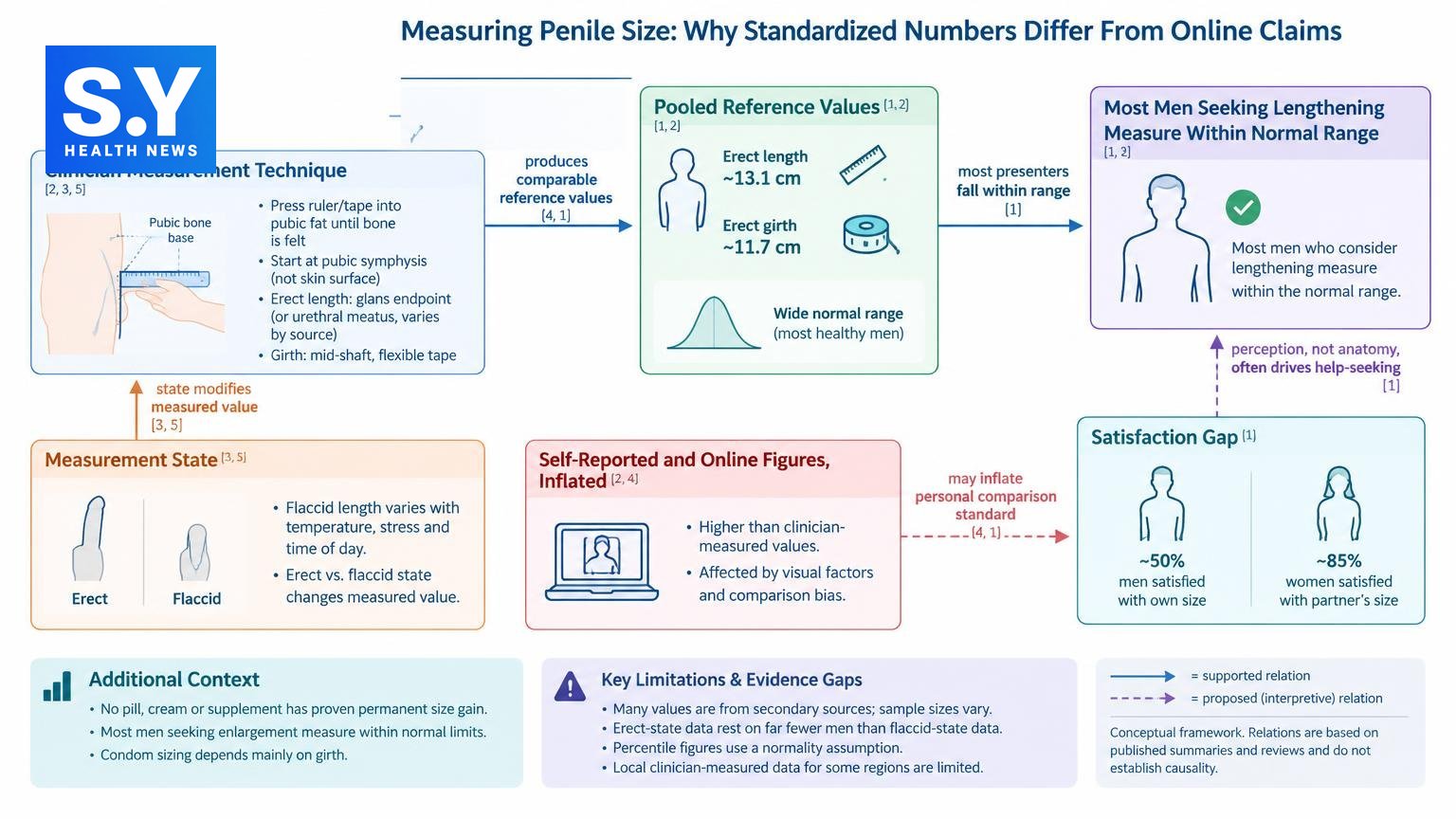
Core Research Direction: Standardized penile measurement (erect length from pubic bone to glans, mid-shaft circumference) versus inflated self-reported/online figures, wide normal ranges, and why most men seeking enlargement measure within normal limits.
Search Intent: How is penile length and girth actually measured, and why do so many men who worry about being small fall within the normal range?
Platform: SANYUN Science Center
Evidence reviewed through: 2026-11-08
Executive Summary
Pooled clinician-measured data summarized in patient-education sources place average erect penile length at roughly 13.1 cm and average erect circumference at roughly 11.7 cm, with a wide spread that most healthy men fall inside. The same summaries note mean flaccid length near 9.2 cm, but flaccid size varies with temperature, stress and time of day, so it is a poor anchor for self-judgment.[1][2][3]
The gap between what men report and what clinicians measure is a recurring theme. In one cited US sample of 130 sexually experienced male students, self-reported erect length averaged 6.62 inches (about 16.8 cm), above prior researcher-measured values; in a Beijing sample of 342, more than 70% estimated their erect length as longer than a physician's stretched measurement.[4]
Technique explains part of the discrepancy. Pressing the ruler into the pubic fat pad until bone is felt, starting at the pubic symphysis rather than the skin surface, measuring the erect penis at a right angle and recording girth at mid-shaft are the elements most consistently described. Endpoints differ between protocols, which matters when numbers are compared across sources.[5]
- A mean is a description of a population, not a personal target; healthy values span a broad natural range.
- Men presenting for lengthening surgery have been found, in the cited literature, to mostly measure within normal limits.
- No pill, cream or supplement has evidence for permanent size gain, and several marketed routes carry documented harms.
Why This Matters
Size anxiety is common and is often driven by comparison rather than by measurement. A large survey of over 50,000 adults summarized in a clinical guide found that only about half of men were satisfied with their own size, while 85% of women were satisfied with their partner's size, a gap that points toward perception rather than anatomy as the main source of distress.
That gap has practical consequences. Men who believe they are unusually small may avoid intimacy, repeatedly re-measure, or seek unproven products and procedures. Consumer guidance stresses that most men who consider themselves too small actually measure within the normal range, and that the anxiety is often produced by comparison with selective imagery rather than by a correct measurement.
Accurate measurement also has legitimate uses. Condom sizing depends mainly on girth, and a poorly fitting condom can slip or break, undermining contraception and infection prevention. Knowing a correctly measured girth is therefore useful beyond reassurance.
How Penile Length and Girth Are Measured
Published instructions converge on a few principles but differ in detail. One patient-education source describes pressing a rigid ruler into the fat layer at the penile base toward the pubic bone, using the urethral meatus as the endpoint, and measuring circumference with a tape about 1 cm below the coronal sulcus. Another clinical guide specifies the glans tip as the endpoint, measured along the dorsal side, with the erect penis held at roughly a right angle to the body.
The most consequential step is at the base. The ruler or tape should be pressed into the pubic fat until bone is felt, because the concealed portion of the penis counts toward length. A ruler laid only on the skin surface, a common self-measurement error, systematically reads short; this is especially pronounced in men with more pubic fat, and in concealed penis the apparent smallness can be largely a matter of fat covering the base.
State matters as much as placement. Flaccid length is influenced by temperature, emotion and fatigue, and one source recommends measuring at a room temperature of 25–30 °C to reduce thermal effects. Because flaccid size varies so much, it is a weak basis for judging erect size, and comparing flaccid appearance in changing rooms conveys little.
Girth is usually taken at mid-shaft with a flexible, non-stretch tape, snug but not constricting, and repeated two or three times for an average. A clinical guide describes an erect circumference of roughly 11–12 cm as average in urological practice. Endpoint and site conventions differ between sources, so figures should only be compared when the method is known.
What the Pooled Clinician Data Show
The most widely cited reference is the 2015 systematic review by Veale and colleagues, summarized in patient-education sources as pooling clinician-standardized measurements from up to 15,521 men, excluding congenital or acquired anomalies, prior surgery, small-penis complaints and erectile dysfunction. Reported means were approximately 13.1 cm erect and 9.2 cm flaccid.
Denominators differ by outcome. Flaccid length data came from 10,704 men, erect length from 692, and erect circumference from 381, while mean stretched length of 13.24 cm was based on 14,160 men. Erect-state measurement was completed in a clinic only for a minority, which is a structural limitation of the reference base rather than a flaw in any single study.
Means alone understate the spread. Reported means of about 9.16 cm flaccid, 13.24 cm stretched and 13.12 cm erect, with circumference near 9.31 cm flaccid and 11.66 cm erect, describe central tendency, while healthy values range widely around them.
| Measure | Pooled mean / reported value | Denominator or basis | Interpretation |
|---|---|---|---|
| Erect length | ~13.1–13.12 cm | 692 men (erect length); summary reports ~13.12 cm | Central estimate from clinician-measured pooled data; wide individual spread |
| Flaccid length | ~9.16–9.2 cm | 10,704 men | Highly variable with temperature and state; weak basis for self-judgment |
| Stretched length | ~13.24 cm | 14,160 men | Used clinically as a proxy when erection is impractical; correlates with erect length |
| Erect circumference | ~11.66 cm; ~11–12 cm described as average | 381 men for pooled mean | Girth is the key variable for condom sizing |
| Modelled 5th percentile (erect) | 10.4 cm length; 9.9 cm girth | Normal-distribution modelling from mean and SD | Modelled, not directly observed; requires confirmatory measurement |
| Modelled 95th percentile (erect) | 15.9 cm length; 13.5 cm girth | Normal-distribution modelling from mean and SD | Illustrates the breadth of the reference range |
Self-Report, Online Figures and Perception Bias
Self-measured studies tend to produce higher values than studies in which clinicians measure, and this should be kept in mind whenever internet figures are used as a benchmark. The direction of the bias is consistent enough that a reported average from a self-measurement survey is not interchangeable with a clinician-measured reference value.
Direct comparisons support this. In the cited US sample of 130 male students, self-reported erect length averaged 6.62 inches (about 16.8 cm), above prior researcher-measured values, and in the Beijing sample of 342 more than 70% estimated their erect length as longer than a physician's stretched measurement.
Visual factors add a second layer. A top-down viewing angle compresses apparent length, adult media presents a selected group rather than a population sample, and flaccid size varies enough that comparing in shared changing rooms is uninformative. Together these inflate the internal standard against which a man judges himself, even when his measured value is unremarkable.
Interpreting Where a Measurement Falls
Percentile tables circulating in patient education are usually modelled, not directly observed. The commonly reproduced figures for erect length and girth at the 5th and 95th percentiles were derived by assuming a normal distribution from a mean and standard deviation of 13.12±1.66 cm and 11.66±1.10 cm, so they indicate where a value sits in a modelled distribution rather than an empirical cut-off.
The clinical category of micropenis is narrower than most worried men assume. One clinical article describes a threshold of about 7.5 cm erect drawn from the literature and notes that true micropenis is very rare; another source states that this frequently cited figure originated as a 1996 suggested threshold for augmentation surgery rather than a definition, with the medical definition based on stretched length well below the mean for age and population. The two summaries conflict on how the number should be labelled, and neither should be treated as a self-diagnosis tool.
Suspected micropenis warrants clinical assessment because it may relate to endocrine or chromosomal conditions, and evaluation can involve more than a tape measure. This is a different situation from the common experience of measuring normally but feeling small.
The literature also indicates that most men who seek lengthening measure within the normal range, which is why a properly performed measurement and a discussion of expectations come before any procedural option in a considered clinical approach.
Augmentation Options and Their Limits
Options that appear to change size operate through different mechanisms and carry different evidence quality. Ligamentolysis increases visible flaccid length, with published averages around 1–2 cm, though results vary widely and some men gain little or nothing; it does not reliably add proportional erect length.
Nonsurgical and device-based routes are weaker still. Vacuum pumps produce temporary erection and have a role in erectile dysfunction care but do not increase permanent size, while traction devices have limited data and small reported effects requiring several hours of daily use over months.
More broadly, a systematic review summarized in a clinical guide concluded that in men of normal size, many augmentation procedures carry high complication rates and uncertain satisfaction. This is a statement about a literature base rather than a claim that every intervention fails, but it argues against treating procedures as a first response to size worry.
Limitations and Evidence Gaps
The evidence base is uneven. Several reference values reach this article through secondary educational summaries rather than primary papers, sample sizes vary widely by outcome, and erect-state data rest on far fewer men than flaccid-state data. The pooled estimates therefore describe a population reasonably well but say less about any individual.
Percentile figures depend on a normality assumption that real distributions may not satisfy exactly, and the commonly cited 7.5 cm figure is framed inconsistently across sources. Self-report comparisons rest on samples cited secondhand without full methods. Claims that no pill or supplement works, and that most men seeking lengthening measure normally, are negative or prevalence statements drawn from educational reviews rather than from a formal meta-analysis reproduced here.
Another gap concerns local data. Published clinician-measured figures for general adult men in some regions, including Taiwan, were not identified in the sources reviewed here, with available local data coming from circumcision patients and therefore not representative of the general male population.
Research Outlook
The most useful direction is not a search for larger norms but better measurement methodology and better characterization of the perception gap. Standardizing endpoint and base conventions across studies would make reference values comparable, and collecting more clinic-based erect measurements would strengthen a thin part of the evidence base.
Equally important is distinguishing men with accurately normal measurements who remain distressed from those with an identifiable medical condition. The pattern that most men seeking lengthening measure normally suggests evaluation should include expectations, satisfaction and psychological factors, not only anatomy.
Key Takeaways
- Erect length is measured from the pubic bone after pressing through the fat pad to the glans tip; surface-only measurement reads short.
- Pooled clinician-measured means are about 13.1 cm erect length and 11.7 cm erect girth, with a wide normal spread.
- Self-reported figures run higher than clinician measurements, and internet benchmarks are further inflated by selective imagery.
- Percentile tables are modelled from a mean and standard deviation rather than directly observed.
- Micropenis is rare; the frequently quoted 7.5 cm figure is described inconsistently and is not a self-diagnosis standard.
- No pill, cream or supplement has evidence for permanent gain, and many procedures for normal-sized men show high complication rates and uncertain satisfaction.
Questions and Answers
How is penile length and girth actually measured by clinicians?
Length is taken along the dorsal side from the pubic bone to the glans tip after pressing the ruler through the pubic fat pad, with the erect penis held roughly at a right angle; some protocols use the urethral meatus as the endpoint instead. Girth is measured at mid-shaft with a flexible, non-stretch tape, repeated for an average.
What do pooled clinician measurements show about average erect penile length and circumference?
Summaries of Veale and colleagues' 2015 systematic review report mean erect length of about 13.1 cm and mean erect circumference of about 11.7 cm, with about 9.2 cm for flaccid length. Erect measurements were available for far fewer men than flaccid ones, and individual values spread widely around these means.
Why are self-reported and online penile size figures higher than clinical measurements?
Self-measured studies tend to give higher values than clinician-measured studies, and the gap is large in cited samples. In 130 US male students, self-reported erect length averaged 6.62 inches, and over 70% of 342 Beijing men overestimated versus stretched measurement. Selective adult media adds a further inflated benchmark.
Is the 7.5 cm figure a medical definition of micropenis?
Sources conflict. One clinical article cites roughly 7.5 cm erect from the literature as a micropenis threshold and calls true micropenis very rare; another states the figure came from a 1996 suggested surgery threshold, not a definition, with the definition based on stretched length far below the population mean. Suspected cases need clinical evaluation.
What are the limitations of penile size percentile tables and reference ranges?
Many percentile tables are modelled from a mean and standard deviation, here 13.12±1.66 cm erect length and 11.66±1.10 cm girth, assuming a normal distribution rather than directly observing those cut-offs. Denominators differ by outcome, and erect data come from far fewer men, so a percentile is a modelled position, not a diagnosis.
Do enlargement pills, pumps or surgery work, and why do most men seeking lengthening measure normally?
No pill, cream or supplement has evidence for permanent gain. Pumps give temporary erection only, traction data are limited, and ligament surgery adds roughly 1–2 cm of visible flaccid length with variable results. A cited review found many procedures in normal-sized men carry high complication rates and uncertain satisfaction, and most men seeking lengthening measure within normal limits.
Conceptual framework: Conceptual framework. Clinician measurement technique and penile state shape pooled reference values for erect length and girth; self-reported and online figures run higher, and most men seeking lengthening measure within normal limits. Relations marked as proposed are interpretive, not tested causal pathways.
Academic References & Evidence
- Dr. Noppon Arunkajohnsak (Win). เพิ่มขนาดน้องชาย: ขนาดปกติ อะไรได้ผลจริง ความเสี่ยง. 2026
- Dr Franklin Kuehhas. Wie messe ich meinen Penis richtig? – Dr Kuehhas. 2026
- 阴茎一拳能握住是短小吗?别被错误测量方式吓到自己. 39健康网. 2026
- 陳昭安. 台灣男性平均長度是多少?泌尿科醫師教您正確測量,對照自己落在哪裡 – 昭安泌尿科診所.
- 丁炜宏. 怎样测量阴茎.
SANYUN Science Center explains published research on men's reproductive and sexual health, connecting scientific evidence with everyday questions while making sources and limitations clear.
Disclaimer: This article is for scientific education and research communication only. It does not provide medical advice, diagnosis, or individualized treatment recommendations, and does not endorse any medication, supplement, device, penile enlargement procedure, or other intervention. Decisions about sexual and reproductive health should be made in consultation with a qualified healthcare professional. Do not delay seeking professional care because of information in this article.
Original Content & Copyright Notice
- This article is prepared for SANYUN Science Center, drawing on published research and publicly available academic literature on men’s sexual and reproductive health. Its editorial explanations and presentation are developed for this platform.
- Copyright in the original editorial content, selection, and arrangement is reserved by SANYUN Science Center to the extent protected by applicable law. Referenced research, quotations, and third-party materials remain subject to the rights of their respective owners. This notice does not claim ownership of scientific facts or third-party research.
- Except where permitted by applicable law or an applicable license, prior written permission is required to reproduce, republish, translate, adapt, redistribute, or commercially reuse protected content. Attribution alone does not grant permission for such reuse.
- For permitted quotation or authorized reuse, clearly identify the source and retain a link to the original article.
- Source: SANYUN Science Center
- Original URL: Retain the original article URL on science.san-yun.com.
- Copyright Holder: SANYUN Science Center, for its own protected editorial content.
- Quotation, excerpts, or authorized reuse must not distort the scientific meaning, omit material limitations or disclaimers, or imply unverified medical claims, product efficacy, or endorsement by SANYUN Science Center.



