




Category: Penile Size
Core Research Direction: Evidence-based measurement and evaluation of penile size: how penile length is objectively measured in boys and men, what published normative data show, and how 'small penis' concerns should be assessed before any intervention is considered.
Search Intent: What does the published evidence actually show about how penile size is measured, what counts as normal, and why do most men who seek lengthening measure within the normal range?
Platform: SANYUN Science Center
Evidence reviewed through: 2026-11-05
Executive Summary
Questions about penile size usually begin with a comparison rather than a measurement. The published evidence suggests this order should be reversed. Clinician-performed measurement data summarized in a clinical guide, drawing on a systematic review of up to 15,521 men, place mean erect length at about 13.1 cm and mean flaccid length at about 9.2 cm, with wide normal ranges for both.[1]
Two consistent themes emerge from the sources reviewed here. First, penile measurement is method-dependent: researchers use different techniques, and results vary across regions and populations, which complicates routine clinical assessment. Second, many men who present with size concerns measure within the normal range, according to a secondary citation of men seeking lengthening surgery.[2]
Pediatric evidence adds a distinct clinical lesson. In a single-center prospective series of 106 boys operated on for hidden penis, true shaft length corresponded to age while visible length was significantly reduced, with a difference versus healthy peers reaching 4.1 cm in the 5-9 year age group. The visible appearance and the anatomical measurement were not the same variable.[3]
This review is an interpretive synthesis of published literature and secondary summaries, not new clinical research. Several key norms are cited secondhand, and the supplied material does not permit verification of primary data, measurement protocols or effect sizes. Conclusions should be read with that limitation in view.[4]
Why Measurement Comes Before Reassurance
Penile length assessment has recognized clinical purposes. The authors of a pediatric ultrasound study note that measurement is important in diagnosing and evaluating treatment of micropenis, concealed penis, hypospadias and disorders of sex development. The same authors observe that length measurements vary by region, ethnicity and population, and that different researchers commonly use different methods, creating confusion in daily clinical evaluation.
That methodological variability matters for adults too. A comparison based on self-report, a bathroom-glance estimate and a clinician's stretched-length measurement are not interchangeable. When a clinic guide states that most men requesting lengthening measure in the normal range, the implication is not that their concern is imaginary, but that the concern and the measurement are different things and should be assessed separately.
The distinction also shapes what a responsible assessment looks like. The hidden-penis literature is explicit that separating concealment from a genuinely small organ depends on measurement and radiological diagnostics rather than first visual impression. Extending that logic, a visual impression of smallness is a reason to measure, not a diagnosis in itself.
How Penile Length Is Objectively Measured
The pediatric methodological study aimed to explore a panoramic ultrasound method applicable to penile morphometry in prepubertal children of all ages, compare it with conventional manual penile length measurement, and use it to try to establish normal length values by age in normal children. Those were the stated objectives; the supplied abstract does not report results, so the accuracy and feasibility of the ultrasound approach cannot be judged from this material.
A separate bibliographic record lists the same study as published in issue 4 of 2015 of the Chinese Journal of Andrology, pages 371-375. This confirms a publication record but adds no numerical findings. Readers should therefore treat the panoramic ultrasound technique as a proposed measurement approach with a published objective, not as an established standard.[5]
What the broader literature does establish, as summarized in the review sources, is that normative values exist and are wide. The cited systematic review of clinician-performed measurements in up to 15,521 men reported mean erect length around 13.1 cm and flaccid length around 9.2 cm, with broad normal ranges. This is a secondary citation; the primary review and its inclusion criteria were not supplied for this analysis.
What Clinician-Measured Norms Show
| Variable | Reported value | Population or context | Interpretation |
|---|---|---|---|
| Mean erect length | About 13.1 cm | Up to 15,521 men; clinician-performed measurements in cited systematic review | A central estimate, not a target; normal range is wide |
| Mean flaccid length | About 9.2 cm | Same cited review | Flaccid size varies and is a weak basis for comparison |
| Size in men seeking lengthening | Most within normal range | Men presenting for penile lengthening surgery (cited 2002 study) | Concern and measured abnormality frequently diverge |
| Visible false shortfall in hidden penis | Difference versus healthy peers reached 4.1 cm | Boys aged 5-9 years with hidden penis in a surgical cohort | Concealment can mimic smallness without true short shaft |
| Median concealment index | 0.64 | 106 boys with hidden penis | An index-based measure, distinct from absolute length |
| Satisfaction with own size | About half of men | Survey of more than 50,000 adults (cited 2006 survey) | Dissatisfaction is common even when anatomy is unremarkable |
The table illustrates a central point of this review: the numbers that matter clinically are not a single length but a set of related variables, including absolute length, visible versus true length, concealment indices, and the person's own appraisal. Each answers a different question.
Hidden Penis: When Visible Length Misleads
The single-center prospective study examined 106 boys aged 1 to 17 years, with a mean age of 5.9 years, who underwent surgery in a urology department between 2021 and 2026. It combined history, anthropometry, ultrasound with Doppler, uroflowmetry and a pediatric penile perception scale. Because this was a surgical cohort, its findings describe boys selected for operation, not the general pediatric population.
Body habitus featured prominently. Forty-six children (43.4%) had excess body weight, and 30 (28.3%) had grade 2-3 obesity. Pronounced pubic fatty tissue was present in 104 of 106 children, shifted attachment of the suspensory ligament to the middle third of the penile trunk was observed in 93 (87.7%), and the median concealment index was 0.64.
The authors concluded that hidden penis in children is a soft-tissue condition rather than a disorder of the organ itself or its vasculature: the shaft is formed, blood supply is intact, and its length is normal, with only part externally visible. They proposed that excess body weight is the leading factor, while the depth of concealment is determined by the skin-fascial and ligamentous apparatus. These are interpretive conclusions from one surgical series, not results of a controlled causal study.
Perception data reinforce why measurement matters. Before surgery, children's own penile perception scores were 3.21 ± 1.41 out of 12, lower than parents' ratings of 4.21 ± 1.77 and surgeons' ratings of 4.37 ± 1.61. The children judged their own appearance most harshly, which is consistent with the broader observation that self-appraisal can diverge from anatomic findings.
Interventions and Their Limits
The intervention evidence summarized in the clinic guide is modest and largely secondhand. No pill, cream or supplement is described as having evidence for permanent size gains. Hyaluronic acid filler is described as temporarily increasing girth but not length, with effects typically lasting about 1 to 2 years. Ligamentolysis is reported to increase visible flaccid length, with published averages of roughly 1-2 cm, highly variable between individuals and little or no change in some men.
A cited systematic review (Marra et al., 2020) is described as concluding that among men of normal penile size, many enhancement procedures carry high complication rates and uncertain satisfaction. The underlying review was not supplied here, so specific rates and study details cannot be verified in this analysis. The direction of the conclusion, however, is consistent with the measurement findings: intervention in anatomically normal men is difficult to justify on size grounds alone.
Satisfaction data add context. A cited survey of more than 50,000 adults (Lever, 2006) reported that only about half of men were satisfied with their own size, while 85% of women were satisfied with their partner's size. This is a secondary citation of a survey; sampling and question wording were not supplied, and the gap should be read as a signal about perception rather than a precise population estimate.
Interpretation and Limitations
Several cautions apply. The normative means of about 13.1 cm erect and 9.2 cm flaccid come from a clinic guide citing a systematic review, not from a primary dataset examined for this article. The finding that most men seeking lengthening measure within normal range rests on a secondary citation of a 2002 study. The intervention figures are published averages summarized secondhand, and individual variability is explicitly described as large.
The pediatric evidence has its own boundaries. The 106-boy cohort was single-center and surgical, so it does not define normal development in the community. The comparison with healthy peers is reported without a described comparison group in the supplied abstract, and subgroup denominators are not given. The concealment index threshold of 0.68 is cited but not validated in this cohort.
Finally, the measurement-method study exists in the supplied material only as an abstract and a bibliographic record. Its proposed ultrasound technique cannot be assessed for accuracy or feasibility without results. The heterogeneity of measurement methods that motivated that study remains an unresolved issue in the literature summarized here.
Research Outlook
The clearest research gap is methodological standardization. If different researchers use different measurement methods and results vary across regions and populations, then comparisons across studies and clinical settings will remain uncertain until measurement protocols converge. The panoramic ultrasound proposal addresses this gap in principle, but its performance relative to manual measurement remains unpublished in the supplied material.
A second gap concerns the assessment pathway for size concerns. The evidence summarized here supports starting with accurate measurement and an explicit distinction between true length and visible length, particularly where concealment or adiposity is present. Whether structured measurement plus counseling reduces unnecessary intervention has not been tested in the sources reviewed, and should be framed as a proposed direction rather than a demonstrated outcome.
Key Takeaways
- Clinician-measured norms cited in the reviewed sources place mean erect length near 13.1 cm and flaccid length near 9.2 cm, with wide normal ranges.
- Measurement methods differ between researchers and results vary across populations, which complicates clinical assessment of penile length.
- Most men presenting for lengthening surgery have measured within the normal range, according to a secondary citation.
- In a surgical cohort of boys with hidden penis, true shaft length matched age while visible length was reduced, with a difference versus peers reaching 4.1 cm in the 5-9 year group.
- No pill, cream or supplement is described as having evidence for permanent size gains; surgical and filler options carry limited, variable results and real risks.
Questions and Answers
How is penile length objectively measured in clinical research?
Published work uses clinician-performed measurement, with conventional manual techniques compared against newer approaches such as panoramic ultrasound in a pediatric methodological study. That study's stated aim was to test ultrasound against manual measurement and build age-based normal values, but the supplied abstract reports no results. Measurement methods differ between researchers, which the authors note complicates clinical assessment.
What is the average penile length according to published norms?
A clinic guide citing a systematic review of clinician-performed measurements in up to 15,521 men reports mean erect length of about 13.1 cm and mean flaccid length of about 9.2 cm, with wide normal ranges. These are secondary citations; the primary review and its measurement protocol were not supplied, so the figures should be read as central estimates rather than thresholds.
Why do most men who seek penile lengthening measure within the normal range?
The reviewed sources suggest the explanation lies in perception rather than anatomy. A cited 2002 study of men presenting for lengthening found most were normal in size. Separately, a large cited survey found only about half of men were satisfied with their own size while 85% of women were satisfied with their partner's, pointing to self-appraisal as a major driver of concern.
How strong is the evidence that size enhancement procedures work?
The summarized evidence is limited and largely secondhand. No pill, cream or supplement is described as producing permanent gains. Hyaluronic acid filler is reported to add girth temporarily, typically for about 1 to 2 years. Ligamentolysis is reported to add roughly 1-2 cm of visible flaccid length on average, with wide individual variation and little or no change in some men.
What are the limitations of studies on penile size norms?
Key norms are cited through a clinic guide rather than primary datasets, and the underlying reviews were not supplied for verification. The pediatric hidden-penis evidence comes from a single-center surgical cohort of 106 boys, which does not represent the general population. Measurement methods vary between researchers, comparison-group details are missing, and the concealment index threshold is cited without validation in that cohort.
What is a hidden penis and why can it look like a small penis?
In a prospective series of 106 boys, hidden penis was described as a soft-tissue condition in which the shaft is formed, blood supply is intact and length is normal, with only part externally visible. Pronounced pubic fatty tissue was present in 104 of 106 children. The authors state that distinguishing concealment from a genuinely small organ requires measurement and imaging, not visual impression.
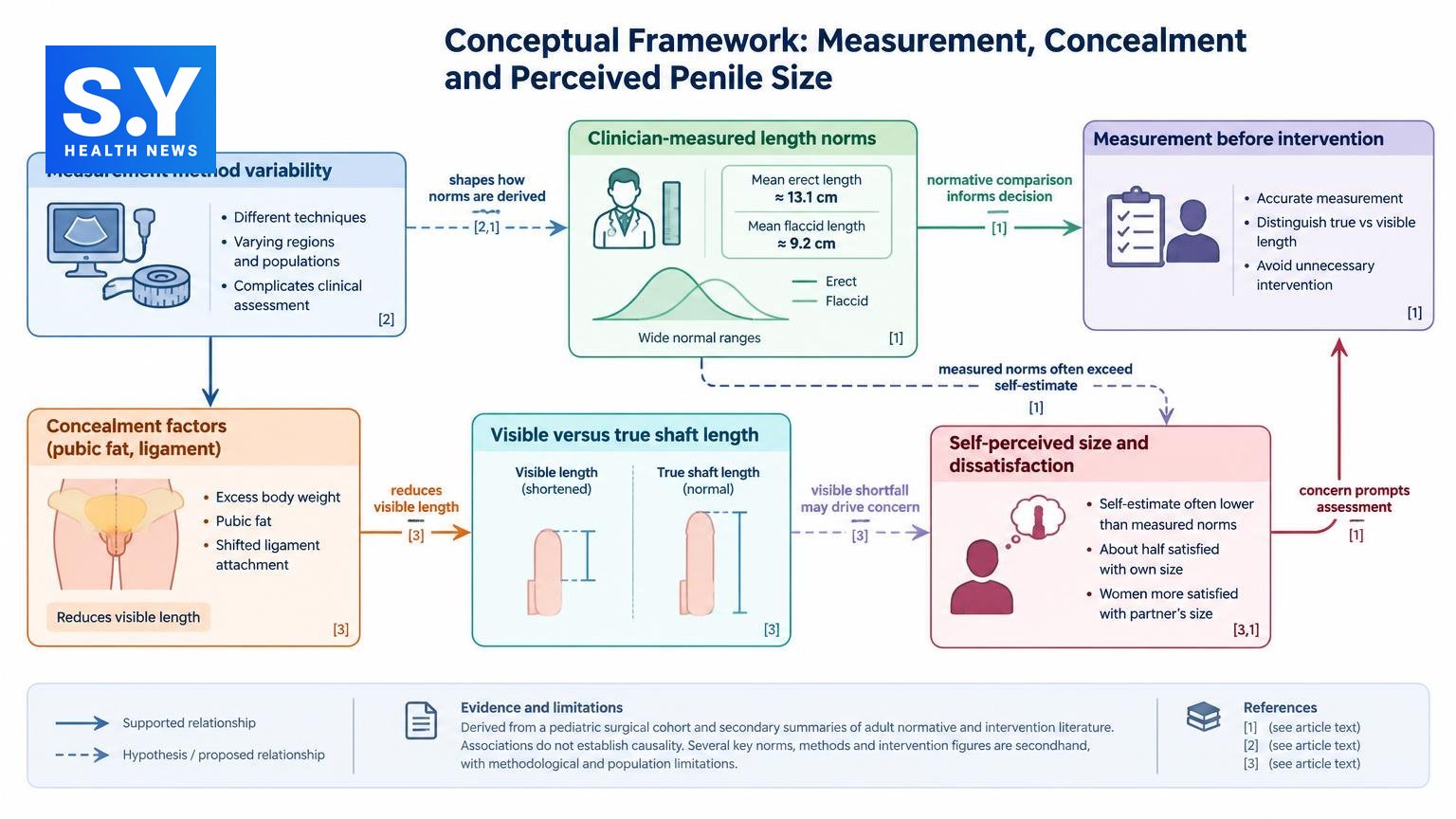
Conceptual framework: Conceptual framework, not a tested causal model. Derived from a pediatric surgical cohort and secondary summaries of adult normative and intervention literature; arrows indicate supported associations or proposed relationships, and measurement standardization remains unresolved.
Academic References & Evidence
- เพิ่มขนาดน้องชาย: ขนาดปกติ อะไรได้ผลจริง ความเสี่ยง. 2026
- 郭丽丽; 唐达星. 儿童阴茎生长指标超声全景测量的研究. 2015
- Tojiyev T.Kh; Agzamkhodjaev S.T.. CLINICAL ANAMNESTICAL AND INSTRUMENTAL CHARACTERISTICS OF THE HIDDEN PENIS IN CHILDREN (SINGLE-CENTER PROSPECTIVE STUDY OF 106 OBSERVATIONS). Journal of modern medicine. 2026 14(3):779–787
- 儿童阴茎生长指标超声全景测量的研究.
- 超声论文文章列表. 《中华男科学》. 2015 (04):371-375
SANYUN Science Center explains published research on men's reproductive and sexual health, connecting scientific evidence with everyday questions while making sources and limitations clear.
Disclaimer: This article is for scientific education and research communication only. It does not provide medical advice, diagnosis, or individualized treatment recommendations, and does not endorse any medication, supplement, device, penile enlargement procedure, or other intervention. Decisions about sexual and reproductive health should be made in consultation with a qualified healthcare professional. Do not delay seeking professional care because of information in this article.
Original Content & Copyright Notice
- This article is prepared for SANYUN Science Center, drawing on published research and publicly available academic literature on men’s sexual and reproductive health. Its editorial explanations and presentation are developed for this platform.
- Copyright in the original editorial content, selection, and arrangement is reserved by SANYUN Science Center to the extent protected by applicable law. Referenced research, quotations, and third-party materials remain subject to the rights of their respective owners. This notice does not claim ownership of scientific facts or third-party research.
- Except where permitted by applicable law or an applicable license, prior written permission is required to reproduce, republish, translate, adapt, redistribute, or commercially reuse protected content. Attribution alone does not grant permission for such reuse.
- For permitted quotation or authorized reuse, clearly identify the source and retain a link to the original article.
- Source: SANYUN Science Center
- Original URL: Retain the original article URL on science.san-yun.com.
- Copyright Holder: SANYUN Science Center, for its own protected editorial content.
- Quotation, excerpts, or authorized reuse must not distort the scientific meaning, omit material limitations or disclaimers, or imply unverified medical claims, product efficacy, or endorsement by SANYUN Science Center.



