




Category: Penile Size
Core Research Direction: How adult penile size is measured and distributed across populations, and how ethnic comparisons and proportional erect growth are interpreted clinically without overreach
Search Intent: What do pooled measurements of adult penile length and circumference actually show about normal variation, population differences, and what clinicians can and cannot conclude?
Platform: SANYUN Science Center
Evidence reviewed through: 2026-11-06
Executive Summary
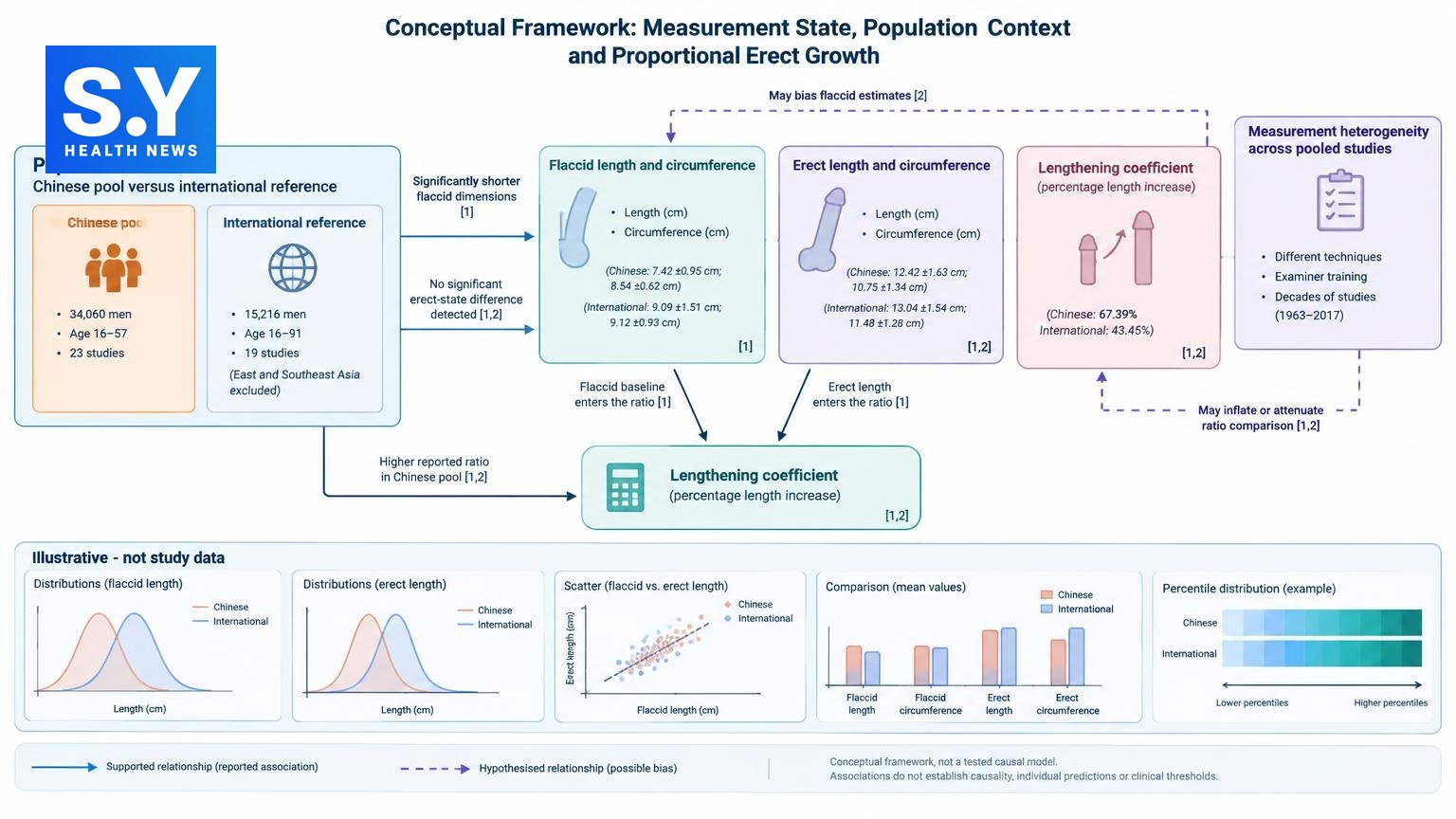
Pooled measurement data from Chinese adult men describe mean flaccid length of 7.42 cm (SD ±0.95 cm) and flaccid circumference of 8.54 cm (SD ±0.62 cm), with mean erect length of 12.42 cm (SD ±1.63 cm) and erect circumference of 10.75 cm (SD ±1.34 cm). These estimates come from a meta-analysis pooling 23 Chinese studies of 34,060 men aged 16–57 and 19 international studies of 15,216 men aged 16–91, with East and Southeast Asian studies excluded from the international pool to reduce regional confounding.[1][2]
Compared with the international reference group (flaccid length 9.09 ±1.51 cm; circumference 9.12 ±0.93 cm), Chinese men had significantly shorter flaccid length and circumference (p<0.05 for both). In the erect state, however, no significant length or circumference differences were reported (p>0.05 for both), against international erect values of 13.04 ±1.54 cm length and 11.48 ±1.28 cm circumference. The lengthening coefficient from flaccid to erect, defined as percentage length increase, was 67.39% in Chinese men versus 43.45% internationally (p<0.05).
The authors interpret the lengthening difference as support for a hypothesis that shorter penises generally show proportionally greater growth toward erection. That remains a proposed explanation rather than a demonstrated mechanism, and it is vulnerable to differences in how flaccid and erect states were measured across the pooled studies. An independent, larger systematic review cited in a clinical guide reports mean erect length of roughly 13.1 cm and flaccid length of roughly 9.2 cm across up to 15,521 men, with a wide normal range.[3]
Clinically, these numbers support counselling about wide normal variation and about the difference between flaccid and erect dimensions. They do not establish individual predictions, do not define a threshold for abnormality, and do not justify claims that any group is functionally different. Most men presenting for lengthening procedures in cited work measured within the normal range, and available nonsurgical and surgical options carry documented limits.
Why This Matters
Penile size is a frequent source of male anxiety and a common reason for clinical enquiry, yet the underlying data are uneven. Much of what circulates online is self-selected, methodologically inconsistent or commercially motivated. A meta-analysis that pools clinician measurements across many studies and constructs percentile distributions offers a more useful reference frame than anecdotal comparison.
The topic also illustrates a broader methodological lesson: a statistically significant difference between population averages is not the same as a clinically meaningful difference for an individual. Flaccid measurements vary with temperature, stress, time of day and measurement technique, and they predict erect size poorly. Erect dimensions are more relevant to most clinical and personal concerns but are harder to obtain at scale.
Finally, the reported pattern of similar erect dimensions despite different flaccid dimensions, if robust, would be a useful corrective to assumptions based on flaccid appearance. The strength of that corrective depends on measurement quality across the pooled studies, which the review design cannot fully control.
How Penile Dimensions Are Defined and Measured
In the pooled literature, length is typically recorded from the pubic bone to the tip of the glans along the dorsum, with flaccid and erect states recorded separately, and circumference is recorded at a defined shaft position. The meta-analysis reported means with standard deviations for both states, allowing percentile distributions to be constructed rather than relying on a single average.
The lengthening coefficient used in the comparison is a derived proportional measure: the percentage increase in length from the flaccid to the erect state. It is not a measure of tissue volume, rigidity or function. Two populations with similar erect length can differ in this coefficient if their flaccid starting points differ, which is exactly the pattern reported here.
A key limitation is measurement heterogeneity. The Chinese and international pools draw on studies published between 1963 and 2017, spanning decades of changing technique, examiner training and documentation standards. If flaccid measurement conditions differed systematically between the pools, the lengthening coefficient comparison could be inflated or attenuated independently of any biological difference.
| Variable | Pooled Chinese estimate | International reference estimate | Interpretation |
|---|---|---|---|
| Flaccid length | 7.42 cm (SD ±0.95 cm) | 9.09 cm (SD ±1.51 cm); p<0.05 | Significantly shorter in the Chinese pool; flaccid values are highly state-dependent |
| Flaccid circumference | 8.54 cm (SD ±0.62 cm) | 9.12 cm (SD ±0.93 cm); p<0.05 | Significantly smaller in the Chinese pool |
| Erect length | 12.42 cm (SD ±1.63 cm) | 13.04 cm (SD ±1.54 cm); p>0.05 | No statistically significant difference reported |
| Erect circumference | 10.75 cm (SD ±1.34 cm) | 11.48 cm (SD ±1.28 cm); p>0.05 | No statistically significant difference reported |
| Lengthening coefficient | 67.39% | 43.45%; p<0.05 | Derived proportional measure, sensitive to measurement consistency |
What the Evidence Shows
The central finding is a state-dependent pattern. In the flaccid state, the pooled Chinese estimates are lower than the international reference, and the difference is statistically significant for both length and circumference. In the erect state, the pooled Chinese estimates are close to the international values, and the reported tests do not reach significance for either dimension.
The widening of the gap from flaccid to erect is captured by the lengthening coefficient. A 67.39% increase in the Chinese pool versus 43.45% internationally is a substantial relative difference, and it is reported as statistically significant. Because the coefficient is computed from two separate measurements, it inherits the error of both: any systematic difference in flaccid measurement conditions between pools propagates directly into this comparison.
The authors frame this as supporting the hypothesis that shorter penises generally gain proportionally more length on erection. This is a plausible geometric intuition: if erect dimensions are constrained toward a similar range while flaccid dimensions vary more widely, the proportional gain must be larger from a smaller starting point. But the review does not test the mechanism, does not model individual-level growth curves, and does not exclude measurement artifact.
Independent reference values help contextualise the numbers. A systematic review cited in a clinical guide, covering clinician-measured data from up to 15,521 men, reports mean erect length of about 13.1 cm and flaccid length of about 9.2 cm, with a wide normal range. The erect figure is close to both pooled estimates above, while the flaccid figure sits between them.
The meta-analysis also produced what its authors describe as the first nomogram and percentile distribution chart for penile size in adult Chinese men. Percentile charts are more informative than means alone because most individuals sit somewhere within a broad distribution rather than at the average. The novelty claim is the authors' own and should be read as such.[4]
Interpreting Population Comparisons Without Overreach
A statistically significant difference between pooled population means says nothing definitive about any individual. The distributions overlap substantially: an international man may measure below the Chinese mean, and a Chinese man may measure above the international mean. Reporting a group difference as a personal prognosis, a ranking of masculinity or a functional claim would misuse the data.
The comparison is also observational and ecological. Grouping by population cannot isolate genetic, nutritional, secular or measurement-related contributors, and the exclusion of East and Southeast Asian studies from the international pool was a design choice to reduce regional confounding, not a guarantee that confounding was eliminated. The international pool spans men aged 16–91, a range that includes developmental and age-related variation.
Terminology matters. A difference that is statistically significant may be small in absolute terms and clinically inconsequential. Conversely, the absence of a significant erect-state difference is not proof of equivalence; it reflects the pooled estimates and the available sample, and it should be described as no detected significant difference rather than as demonstrated equality.
Clinical context reinforces caution. Cited work reports that most men seeking penile lengthening surgery measured within the normal range, and a systematic review cited in the same guide concluded that many augmentation procedures in men of normal size carry high complication rates and uncertain satisfaction. No pill, cream or supplement has evidence for permanent size gains.
Survey data cited in that guide also point to a perception gap: in a survey of over 50,000 adults, only about half of men were satisfied with their own size, while 85% of women were satisfied with their partner's size. These are self-reported figures from a secondary citation, but they align with the clinical observation that concern often exceeds measured deviation.
Limitations of the Pooled Evidence
The most important limitation is the age of the underlying literature. The systematic review pooled Chinese studies published between 1963 and 2017 and international studies from the same period. Measurement conventions, examiner training and population characteristics have changed over that window, and the meta-analysis cannot fully harmonise them.
Second, the review compares pooled published estimates rather than individual participant data. Without individual-level records, the analysis cannot adjust for age, body size, measurement setting or examiner, and it cannot properly test whether the lengthening coefficient differs within populations as well as between them. The reported hypothesis therefore remains at the group level.
Third, publication and selection bias are plausible. Studies that measured penile size may have recruited particular subgroups, and studies with unusual results may have been published or cited differently. The review design cannot rule this out, and the exclusion of East and Southeast Asian studies, while intended to reduce confounding, also limits generalisability of the international reference to other Asian populations.
Fourth, some contextual figures in this review come from a clinic educational guide that cites primary studies rather than from the primary papers directly. The large reference review and the survey figures are therefore secondary citations, and their exact methods and confidence intervals are not verifiable from the available material.
Research and Clinical Outlook
The clearest research priority is prospective measurement with a standardised protocol applied consistently across populations and states. Recording flaccid and erect dimensions under defined conditions, with documented examiner technique and ideally with repeated measures, would allow the lengthening coefficient to be estimated with known error rather than inferred across heterogeneous studies.
Individual participant data meta-analysis would let investigators examine whether the proportional growth pattern holds within populations, whether it varies with age or body size, and whether it is explained by measurement conditions. Until then, the hypothesis that shorter penises gain proportionally more on erection should be presented as a proposed explanation supported by group averages, not as an established biological rule.
For clinical practice, percentile-based reference material is the most directly useful output. A nomogram and percentile chart give a clinician a way to place a measurement in context and to discuss the wide range of normal values. They do not replace an individual assessment, and they should be paired with attention to body image concerns and to treatable conditions such as incomplete erection.
The absence of evidence for permanent size gains from pills, creams or supplements, and the documented limits of surgical and filler options, belong in any honest counselling conversation. The evidence supports informed discussion and expectation management more strongly than it supports intervention.
Key Takeaways
- Pooled Chinese data give mean flaccid length 7.42 cm (SD ±0.95 cm), flaccid circumference 8.54 cm (SD ±0.62 cm), erect length 12.42 cm (SD ±1.63 cm) and erect circumference 10.75 cm (SD ±1.34 cm).
- Flaccid dimensions were significantly smaller than the international reference values, but erect dimensions showed no significant difference in the pooled comparison.
- The lengthening coefficient was 67.39% in Chinese men versus 43.45% internationally (p<0.05), a derived proportional measure sensitive to measurement consistency across studies.
- The authors' explanation that shorter penises gain proportionally more on erection is a hypothesis, not a demonstrated mechanism.
- Most men seeking lengthening in cited work measured within the normal range, and no pill, cream or supplement has evidence for permanent size gains.
Questions and Answers
How is penile length and circumference measured in pooled research?
Pooled studies typically record dorsal length from the pubic bone to the glans tip and shaft circumference, separately in flaccid and erect states. The meta-analysis reported means with standard deviations for each state, which allowed percentile distributions to be built. Measurement technique varied across the included studies, and that heterogeneity is a central limitation of any pooled comparison.
What were the average penile dimensions reported for Chinese men?
The pooled estimates were 7.42 cm (SD ±0.95 cm) flaccid length and 8.54 cm (SD ±0.62 cm) flaccid circumference, rising to 12.42 cm (SD ±1.63 cm) erect length and 10.75 cm (SD ±1.34 cm) erect circumference. These are group means from 23 studies of 34,060 men aged 16–57, not individual predictions, and the distributions around them are wide.
Do Chinese and international men differ in erect penile size?
In the pooled comparison, no statistically significant erect length or circumference difference was reported (p>0.05 for both), whereas flaccid length and circumference were significantly smaller in the Chinese pool (p<0.05). This is a statement about pooled group estimates, not proof of equivalence, and it depends on the quality and comparability of the underlying measurements.
What does the penile lengthening coefficient of 67.39% versus 43.45% mean?
It is the percentage increase in length from the flaccid to the erect state, reported as 67.39% in Chinese men and 43.45% internationally (p<0.05). Because it is computed from two separate measurements, systematic differences in how flaccid size was recorded between pools could inflate or attenuate the comparison. It is not a measure of rigidity, volume or function.
Is it true that shorter penises grow proportionally more when erect?
That is a hypothesis offered by the review authors, not a demonstrated mechanism. The group-level pattern is consistent with it, but the review did not test individual growth curves and could not fully exclude measurement artifact. It should be described as a proposed explanation supported by pooled averages rather than as an established biological rule.
What should someone worried about penile size understand from this evidence?
Normal variation is wide, and flaccid size varies greatly with temperature and situation while predicting erect size poorly. Cited work reports that most men seeking lengthening measured within the normal range, and no pill, cream or supplement has evidence for permanent gains. A clinician-measured assessment and an honest discussion are a more useful starting point than visual comparison.
Conceptual framework: Conceptual framework, not a tested causal model. Nodes summarise pooled measurement variables and the population comparison; supported edges reflect reported associations, while proposed edges indicate that measurement heterogeneity may bias flaccid estimates and the lengthening ratio. The framework cannot establish individual predictions, causation or biological mechanism.
Academic References & Evidence
- Cuntong Wang; Yihe WangDing. Metaanalyse: Chinesische Männer haben bei Erektion eine besonders steile Zuwachsrate. Andrology. 2025
- 国内外成人阴茎长度及周长的系统分析与比较研究. 中国性科学
- เพิ่มขนาดน้องชาย: ขนาดปกติ อะไรได้ผลจริง ความเสี่ยง. 2026
- Wang Cuntong; WangDing Yihe. 进展!中央财经大学王存同发表了2024年第1篇SCI-论论. Andrology. 2024 DOI: 10.1111/andr.13727.
SANYUN Science Center explains published research on men's reproductive and sexual health, connecting scientific evidence with everyday questions while making sources and limitations clear.
Disclaimer: This article is for scientific education and research communication only. It does not provide medical advice, diagnosis, or individualized treatment recommendations, and does not endorse any medication, supplement, device, penile enlargement procedure, or other intervention. Decisions about sexual and reproductive health should be made in consultation with a qualified healthcare professional. Do not delay seeking professional care because of information in this article.
Original Content & Copyright Notice
- This article is prepared for SANYUN Science Center, drawing on published research and publicly available academic literature on men’s sexual and reproductive health. Its editorial explanations and presentation are developed for this platform.
- Copyright in the original editorial content, selection, and arrangement is reserved by SANYUN Science Center to the extent protected by applicable law. Referenced research, quotations, and third-party materials remain subject to the rights of their respective owners. This notice does not claim ownership of scientific facts or third-party research.
- Except where permitted by applicable law or an applicable license, prior written permission is required to reproduce, republish, translate, adapt, redistribute, or commercially reuse protected content. Attribution alone does not grant permission for such reuse.
- For permitted quotation or authorized reuse, clearly identify the source and retain a link to the original article.
- Source: SANYUN Science Center
- Original URL: Retain the original article URL on science.san-yun.com.
- Copyright Holder: SANYUN Science Center, for its own protected editorial content.
- Quotation, excerpts, or authorized reuse must not distort the scientific meaning, omit material limitations or disclaimers, or imply unverified medical claims, product efficacy, or endorsement by SANYUN Science Center.



