




Category: Penile Size
Core Research Direction: Penile size: what measurement evidence and clinical research establish about normal adult dimensions, measurement methods, size-related concerns, and the limits of enhancement options
Search Intent: What does research actually establish about adult penile size, how it should be measured, and which size concerns or enhancement claims are supported by evidence?
Platform: SANYUN Science Center
Evidence reviewed through: 2026-11-05
Executive Summary
Published evidence on adult penile size is constrained less by a scarcity of measurements than by disagreement about how those measurements should be taken. A 2020 review of measurement methods reported that no consensus exists on the preferred way to evaluate penile size and that the literature describes various, conflicting approaches.[1]
That review set out to examine data on flaccid, stretched and erect measurement in order to construct a best-practice recommendation, searching PubMed, Google Scholar and the Cochrane Library for peer-reviewed English-language articles published before August 2018. Its central finding was a negative one: the authors did not find definitive evidence favoring one measurement method over another, and instead advocated their own recommendations for future publications.
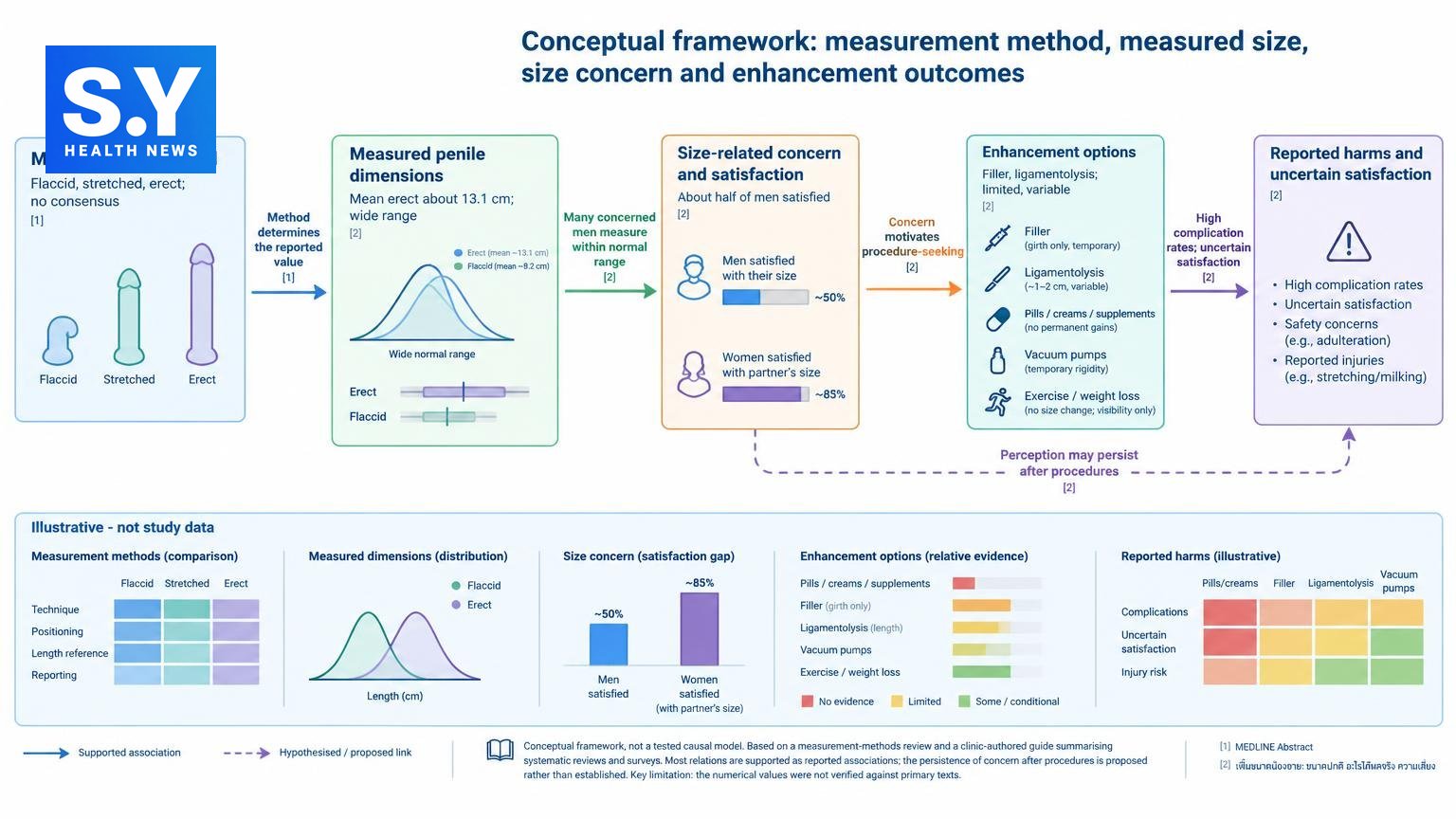
Clinical guidance commonly cites a systematic review pooling clinician-performed measurements from up to 15,521 men, reporting a mean erect length near 13.1 cm and a mean flaccid length near 9.2 cm, with a very wide normal range for both. Those figures are means, not thresholds, and the article treats them as reported through the clinical guide rather than verified against the primary review.[2]
On the intervention side, the available summary evidence is similarly cautious. No pill, cream or supplement is reported to have evidence of permanent gains; hyaluronic acid filler is described as a temporary girth option lasting about one to two years; ligamentolysis is described as adding roughly 1–2 cm of visible flaccid length with wide individual variation; and a cited systematic review concluded that many enhancement procedures in men of normal size carry high complication rates and uncertain satisfaction.
Why This Matters
Size-related concern is common enough to be a clinical presentation in its own right rather than a fringe cosmetic request. The same clinical guide reports that a large survey of more than 50,000 adults found only about half of men were satisfied with their own size, while 85% of women were satisfied with their partner's size. That gap points toward perception and expectation as major drivers of distress.
The measurement problem sits directly underneath this distress. If the field cannot agree on how to measure, then comparisons across studies, across clinics and across internet claims are not like-for-like, and the numbers a man encounters may not describe the quantity he thinks they describe. The guide's observation that many men who believe they are smaller than normal fall within the normal range when actually measured is consistent with that concern.
This also has practical consequences for clinical conversations. The guide describes men presenting for lengthening surgery who, when measured, were mostly within the normal range in the cited 2002 study. When the presenting complaint and the measured value diverge this way, the appropriate clinical task shifts from offering a procedure to understanding what is being asked for.
How Penile Size Is Measured, and Why the Method Matters
Penile size is not a single quantity. The 2020 review separated measurement of the flaccid, stretched and erect penis, implying that each state requires its own defined technique before any value can be compared meaningfully. Without a shared protocol, a reported length is only interpretable alongside the method used to obtain it.
Flaccid measurement is especially unstable. The guide notes that flaccid size varies substantially with temperature and circumstances and therefore cannot be used to predict erect size. This is a straightforward point with wide implications: comparisons made in changing rooms, in cold rooms or under anxiety describe a state, not a stable trait.
The review's search strategy was systematic in scope, covering PubMed, Google Scholar and the Cochrane Library and restricting inclusion to peer-reviewed English-language articles published before August 2018. Even so, the authors described their synthesis as arriving at a recommendation rather than at comparative proof. A systematic search is a method for finding evidence; it does not manufacture evidence that the included studies did not contain.
| Construct | Reported value or finding | Context and interpretation |
|---|---|---|
| Mean erect length | About 13.1 cm | Pooled clinician-performed measurements from up to 15,521 men, reported through a clinical guide; a mean, not a cut-off |
| Mean flaccid length | About 9.2 cm | Same pooled source; flaccid size varies substantially with temperature and circumstances |
| Consensus on measurement method | No consensus; various and conflicting methods reported | Basis for treating cross-study size comparisons as non-equivalent |
| Comparative method evidence | No definitive evidence favoring one method over another | Review recommendation is expert synthesis, not a head-to-head trial |
| Men seeking lengthening surgery | Most measured within the normal range | Cited 2002 study; suggests mismatch between perceived and measured size |
| Satisfaction with size | About half of men; 85% of women with partner size | Large survey of more than 50,000 adults; self-reported satisfaction |
What the Evidence Shows About Normal Dimensions
The most widely repeated figures in this area come from a systematic review pooling measurements taken by healthcare personnel from up to 15,521 men, with a mean erect length of about 13.1 cm and a mean flaccid length of about 9.2 cm. The same source emphasizes a very wide normal range for both values.
Two qualifications deserve emphasis. First, these are means derived from pooled studies, and the underlying studies were not conducted to a single agreed method, since the measurement literature is explicitly conflicting. Second, a wide range means that falling above or below a mean is not itself a finding of abnormality. A mean describes a distribution's centre; it does not define the edges.
This article has not independently verified the primary systematic review, because the supplied material presents these values through a clinic-authored guide rather than through the original publication. Readers should treat the specific figures as well-rehearsed summary values with a wide range, and should be sceptical of any single number presented as a pass/fail threshold.
Size-Related Concern as a Clinical Problem
The gap between male and female satisfaction in the cited survey is one of the more informative findings in this literature, because it locates much of the problem in self-perception rather than in anatomy. A large survey of more than 50,000 adults found roughly half of men satisfied with their own size against 85% of women satisfied with their partner's.
Consistent with this, the guide states that many men who believe themselves smaller than normal measure within the normal range, and that the 2002 Mondaini study found most men presenting for lengthening surgery were within normal limits. The pattern across these statements is a mismatch between measured size and experienced concern.
The guide goes further, stating that research repeatedly finds men of normal size with high concern often remain dissatisfied even after procedures, framing the target of care as perception rather than anatomy. That claim is presented as a general assertion without named studies, sample sizes or follow-up periods in the supplied text, so it should be read as a clinical impression supported by a body of work the guide does not itemise here.
There is also a plausible alternative explanation that the evidence cannot fully separate out: a man who undergoes an invasive procedure for a concern that was never anatomical may remain dissatisfied because the outcome does not address the concern, not because perception is intrinsically treatment-resistant. Both readings point to the same clinical priority — assess the concern before intervening on the anatomy.
Enhancement Options: What Is Claimed and What Is Supported
The strongest negative statement in the supplied evidence concerns ingestible products: the guide states that no pill, cream or supplement has evidence of producing permanent penile size gains. This is a negative evidence claim rather than a trial result, and the guide does not enumerate the literature behind it. Separately, the guide warns that regulators have detected undeclared pharmaceutical adulteration in some male supplements, which is a safety issue rather than an efficacy one.
Mechanical and manual techniques fare little better. Online-shared stretching and milking techniques are described as lacking evidence of benefit while being associated with reported injuries including capillary rupture, fibrosis and penile curvature. Vacuum pumps are described as producing temporary rigidity with a role in erectile dysfunction care but no permanent size increase. These are qualitative harm statements without case counts in the supplied text.
Medical options are real but bounded. Hyaluronic acid filler is described as temporarily increasing girth but not length, with effects typically lasting about one to two years before natural breakdown depending on product and individual. Ligamentolysis is described as increasing visible flaccid length, with published averages of roughly 1–2 cm, large individual variation, and some men showing almost no change. The guide states plainly that all options have clear limitations and none guarantees results.
A cited systematic review by Marra and colleagues (2020) concluded that among men of normal penile size, many enhancement procedures carry high complication rates and uncertain satisfaction. That conclusion does not prohibit procedures; it reframes the decision around measurement, expectation screening and full risk disclosure. The numeric complication rates are not supplied here and should not be inferred.
One modest and often overlooked point concerns body composition. Exercise and weight loss are described as not changing actual penile size, but in men with substantial abdominal fat, fat loss can make more of the penis visible. That is a visual effect rather than growth, and distinguishing the two is exactly the kind of clarification measurement can provide.
Interpretation and Limitations
The evidence base described here has a specific shape that should temper confidence. The measurement review is a narrative synthesis with an English-language and peer-reviewed restriction, and it explicitly found no definitive comparative evidence. Its recommendations are therefore expert consensus, useful for standardising future work but not proof that one technique is superior.
Most of the clinical and numerical content in this article reaches the reader through a clinic-authored educational guide that summarises systematic reviews, surveys and case series. That guide is a secondary source: it cites Veale et al. (2015), Mondaini et al. (2002), Marra et al. (2020) and Lever (2006), but the primary texts were not supplied for verification, and several quoted statements give no sample size, effect size or protocol.
The comparison of male and female satisfaction comes from a survey of more than 50,000 adults, but survey design, sampling method and exact denominators are not described in the supplied material, and satisfaction is self-reported. Such a figure is informative about the direction of a gap and unreliable as a precise population estimate.
The remaining statements — on flaccid variability, on the absence of evidence for pills and manual techniques, and on outcomes after procedures in men with normal size and high concern — are explanatory or general assertions made within the guide without a primary citation in the quoted passage. They are plausible and consistent with each other, but they are not equivalent to trial evidence.
Research Outlook
The clearest research priority emerging from this material is methodological rather than pharmacological. If no consensus exists on how to measure penile size and no method has been shown superior, then a standardised protocol applied consistently in future publications would make every subsequent comparison more informative. The 2020 review's recommendation is best read as a proposed solution to a coordination problem, not as a validated measurement standard.
A second priority concerns outcomes that matter to patients. The evidence summarised here reports satisfaction as uncertain after enhancement procedures in men of normal size, yet the supplied material does not provide the prospective, well-characterised follow-up needed to predict who benefits. Linking measured baseline size, pre-existing concern severity and long-term satisfaction in the same cohort would address that gap directly.
Third, the harm side needs better quantification. Injuries from manual techniques and the complication profile of girth and length procedures are described qualitatively, without rates. Registries or prospective series reporting complications per procedure would allow men to weigh risk against the modest effect sizes described for filler and ligamentolysis.
Key Takeaways
- There is no consensus on the preferred method for measuring penile size, and the literature contains various, conflicting approaches — so values from different sources are not automatically comparable.
- A pooled review of clinician measurements from up to 15,521 men reported mean erect length near 13.1 cm and mean flaccid length near 9.2 cm, with a very wide normal range; these are means, not thresholds.
- Flaccid size varies substantially with temperature and circumstances and does not predict erect size, which limits what casual visual comparison can tell anyone.
- Many men who believe they are smaller than normal measure within the normal range, and most men presenting for lengthening surgery in the cited 2002 study were within normal limits.
- No pill, cream or supplement has been reported to produce permanent size gains, while stretching and milking techniques lack benefit evidence and are associated with reported injuries.
- Hyaluronic acid filler temporarily increases girth but not length, with effects typically lasting about 1–2 years; ligamentolysis has reported averages of roughly 1–2 cm of visible flaccid length gain, with wide individual variation.
- A cited 2020 systematic review concluded that many enhancement procedures in men of normal size carry high complication rates and uncertain satisfaction, and no option guarantees results.
Questions and Answers
What do systematic reviews report as the average adult penile length?
A systematic review pooling clinician-performed measurements from up to 15,521 men, as reported through a clinical guide, found a mean erect length of about 13.1 cm and a mean flaccid length of about 9.2 cm. Both values come with a very wide normal range. These are distribution means reported secondhand, not diagnostic cut-offs, and individual variation is substantial.
Why is there no agreed method for measuring penile size?
A 2020 review that systematically searched the literature on flaccid, stretched and erect measurement found that the field reports various and conflicting methods, and it identified no definitive evidence favoring one technique over another. The authors therefore proposed their own recommendations for future publications. That is expert synthesis addressing an absence of comparative evidence, not proof that a single method is superior.
Can flaccid penile size predict erect length?
No. Flaccid size varies substantially with temperature, stress and circumstances, and the available guidance states it cannot be used to predict erect size. This is one reason informal comparisons, such as in changing rooms or cold environments, describe a transient state rather than a stable characteristic. Formal measurement of erect or stretched length under defined conditions is a different exercise.
Is it true that most men seeking penile lengthening surgery are already normal size?
The cited Mondaini study from 2002 measured men presenting for lengthening procedures and found most were within the normal range. The guide also states that many men who believe they are smaller than normal measure normally. However, the supplied text gives no sample size or normal-range definition for that study, so the finding is best treated as a consistent clinical pattern rather than a precise estimate.
Do pills, creams or stretching exercises increase penile size permanently?
The available guidance states that no pill, cream or supplement has evidence of producing permanent gains, and that online-shared stretching or milking techniques lack benefit evidence while being linked to reported injuries such as capillary rupture, fibrosis and curvature. These are negative evidence statements without enumerated trials in the source. Regulators have separately flagged undeclared drug adulteration in some male supplements, which is a safety concern.
What are the realistic limits of filler and surgery for penile size?
Hyaluronic acid filler is described as temporarily increasing girth, not length, typically lasting about one to two years. Ligamentolysis increases visible flaccid length, with published averages of roughly 1–2 cm but large individual variation and some men seeing almost no change. A cited systematic review found many enhancement procedures in normal-sized men carry high complication rates and uncertain satisfaction, and none guarantees results.
Conceptual framework: Conceptual framework, not a tested causal model. It links measurement method to measured dimensions, measured dimensions to size-related concern, and concern to enhancement options and reported harms, based on a measurement-methods review and a clinic-authored guide summarising systematic reviews and surveys. Most relations are supported as reported associations; the persistence of concern after procedures is proposed rather than established. Key limitation: the numerical values were not verified against primary texts.
Academic References & Evidence
- Greenstein A; Dekalo S; Chen J. MEDLINE Abstract. Int J Impot Res. 2020 32(2):153-158
- Veale D; Miles S; Bramley S; Muir G; Hodsoll J; Mondaini N; Ponchietti R; Gontero P; Marra G; Drury A; Tran L; Veale D; Muir GH; Lever J; Frederick DA; Peplau LA. เพิ่มขนาดน้องชาย: ขนาดปกติ อะไรได้ผลจริง ความเสี่ยง. BJU Int. 2015
SANYUN Science Center explains published research on men's reproductive and sexual health, connecting scientific evidence with everyday questions while making sources and limitations clear.
Disclaimer: This article is for scientific education and research communication only. It does not provide medical advice, diagnosis, or individualized treatment recommendations, and does not endorse any medication, supplement, device, penile enlargement procedure, or other intervention. Decisions about sexual and reproductive health should be made in consultation with a qualified healthcare professional. Do not delay seeking professional care because of information in this article.
Original Content & Copyright Notice
- This article is prepared for SANYUN Science Center, drawing on published research and publicly available academic literature on men’s sexual and reproductive health. Its editorial explanations and presentation are developed for this platform.
- Copyright in the original editorial content, selection, and arrangement is reserved by SANYUN Science Center to the extent protected by applicable law. Referenced research, quotations, and third-party materials remain subject to the rights of their respective owners. This notice does not claim ownership of scientific facts or third-party research.
- Except where permitted by applicable law or an applicable license, prior written permission is required to reproduce, republish, translate, adapt, redistribute, or commercially reuse protected content. Attribution alone does not grant permission for such reuse.
- For permitted quotation or authorized reuse, clearly identify the source and retain a link to the original article.
- Source: SANYUN Science Center
- Original URL: Retain the original article URL on science.san-yun.com.
- Copyright Holder: SANYUN Science Center, for its own protected editorial content.
- Quotation, excerpts, or authorized reuse must not distort the scientific meaning, omit material limitations or disclaimers, or imply unverified medical claims, product efficacy, or endorsement by SANYUN Science Center.



