




Category: Research-Programs
Core Research Direction: Perfusion, skin pressure, sensory tolerability, and neurovascular risk assessment
Search Intent: penile traction blood flow, extender safety, penile numbness traction, penile tissue care
Platform: SANYUN® — A Biomechanics-Driven, Multidisciplinary Male Health Technology Research Program.
Article Type: Translational Physiology and Safety Research Framework
Evidence Status: Editorial research synthesis / prospective research framework referencing the device design documented in granted Chinese utility model patent ZL201920197062.4 (CN209827502U).
Evidence Cut-off: 24 November 2026
Patent Reference: ZL201920197062.4 (Application No. 201920197062.4; grant publication CN209827502U).
Structured abstract
Background. External penile traction applies mechanical forces near skin, vascular structures, sensory nerves and erectile tissue. Any discussion of enhanced circulation must be balanced against the possibility of local pressure-related perfusion reduction.
Objective. To propose an exposure–response framework for microcirculation, sensory function, skin integrity and device tolerability.
Interpretation. Existing penile traction studies suggest potential clinical use in selected populations, but no SANYUN-specific perfusion or safety dataset has been established.
Conclusion. Multimodal physiological monitoring should prioritize adverse-event surveillance and standardized exposure before mechanistic or efficacy claims.
SANYUN scientific mechanism figure
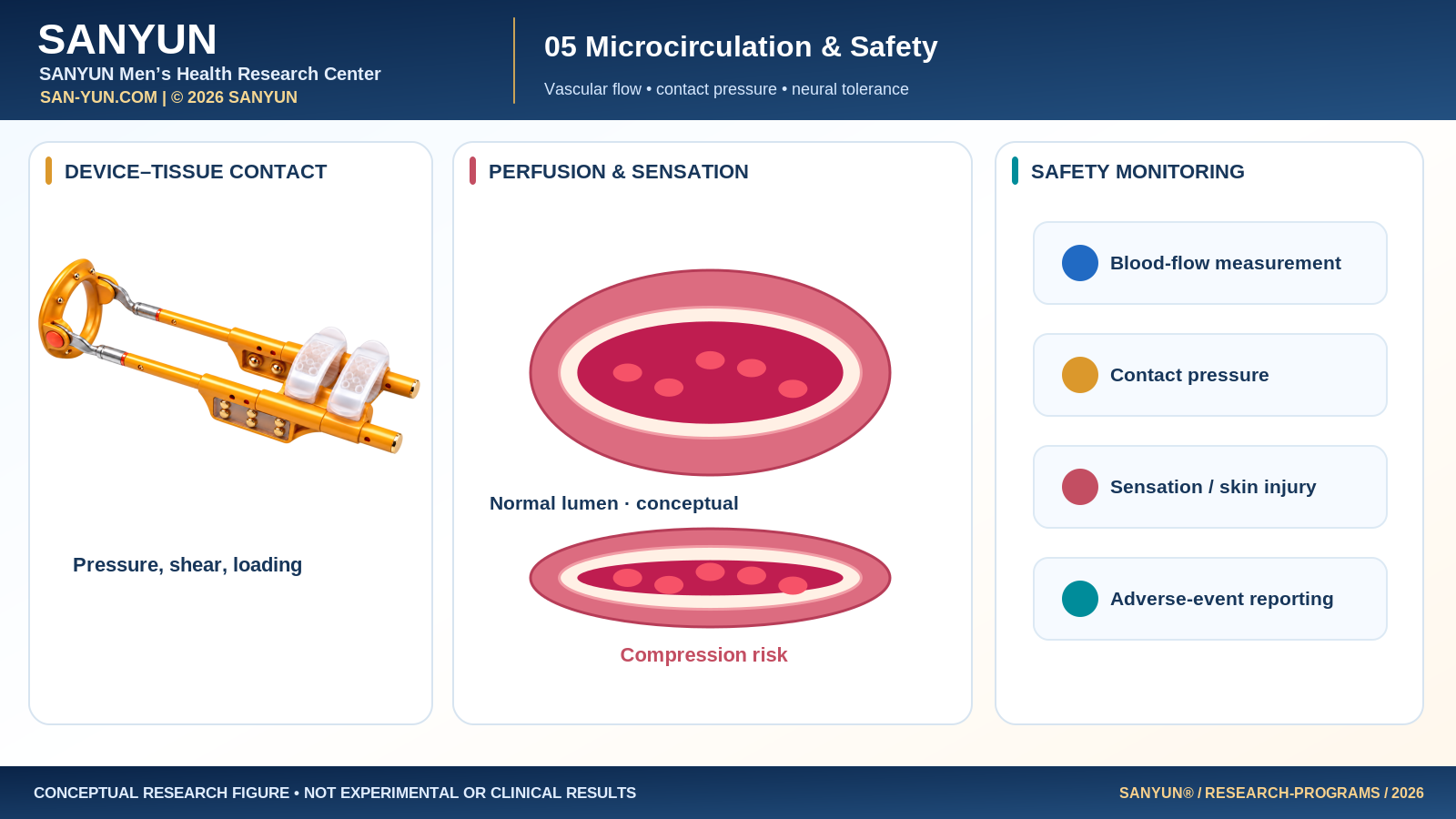
Figure 5. Safety pathways are hypotheses for prospective measurement; increased circulation is not assumed. © 2026 SANYUN. Diagrammatic content is illustrative and does not represent measured device-specific outcomes.
1. The assumption that stretch necessarily improves blood flow is unsafe
The penis is a highly vascular organ whose functional responses depend on arterial inflow, sinusoidal filling, smooth-muscle relaxation and venous outflow regulation. External traction generates a distinct mechanical environment. It can simultaneously impose longitudinal tension, local compression, friction and movement-dependent shear. Whether tissue perfusion increases, remains unchanged or decreases depends on the applied conditions and interface design.
The 2019 SANYUN-associated utility-model patent describes a dual-rod, spring-actuated extender, contact ring and securing system. It asserts circulation-related benefits, but provides no controlled microvascular measurement, perfusion imaging or neurophysiological safety series. This makes the claimed physiologic pathway a testable hypothesis, not an established outcome.
Trials of other traction devices have recorded tolerability and adverse events. The 2019 randomized RestoreX study in men with Peyronie’s disease reported primarily mild transient events during its study period, but its safety results cannot automatically be assigned to a different structural device, material set or wearing regimen. Device-specific assessment is required.
2. A mechanistic risk map for pressure and perfusion
Two forces should be distinguished. Longitudinal traction acts through the apparatus along a general penile axis. Local normal contact force acts where the retention and support components contact tissue. An apparently acceptable global traction load may coexist with excessive localized pressure, particularly when an attachment is narrow, asymmetric or displaced.
In a prospective bench study, sensitive pressure-mapping films or validated transducers could identify focal peaks and shear-prone regions on anatomically relevant surrogates. These measurements would guide redesign of edges, padding, retention geometry and release mechanisms. Their interpretation must not imply that a test phantom duplicates living tissue.
The physiological question can then be examined in a carefully supervised feasibility protocol. Potential tools include skin-temperature monitoring, perfusion measurement techniques appropriate to the anatomical site, sensory testing and structured documentation of pain or numbness. If ultrasound is clinically indicated, imaging methods and outcomes should be agreed with a urologist. Routine imaging purely to lend technical prestige is unnecessary.
| Domain | Proposed endpoint | Safety interpretation |
|---|---|---|
| Mechanical exposure | Recorded force and duration | Establishes actual treatment dose, not efficacy |
| Contact mechanics | Pressure map, slippage and shear | Detects local concentrations requiring design action |
| Microcirculation | Standardized perfusion or temperature measure | Must distinguish compression from possible flow improvement |
| Neurologic tolerance | Numbness, altered sensation and recovery | New deficits require prompt clinical review |
| Skin integrity | Redness, swelling, abrasion and injury | Foreseeable contact-related harms |
| User experience | Pain, wearability and adherence | Influences acceptability but cannot override objective safety |
3. Safety is a longitudinal outcome
An uncomplicated first hour does not predict the effects of repeated use. Skin integrity and nerve-related symptoms can evolve with prolonged contact, movement, insufficient recovery or an incorrect fit. A safety framework should include baseline assessment, predefined stop conditions, early reassessment, scheduled follow-up and a clear escalation pathway for any persistent pain, sensory change, discoloration or swelling. This article does not provide instructions for self-experimentation or force selection.
Predefined adverse-event categories might cover mechanical damage, material-related irritation, skin trauma, transient sensory symptoms, suspected neurovascular compromise, infection associated with poor hygiene and mechanical malfunction. Distinguish patient-reported observations from objectively verified findings. Assign severity and relatedness using a consistent system, report all withdrawals and document use outside the intended protocol.
4. What the oxidative-stress literature adds—and what it does not
Oxidative stress is relevant to endothelial biology. Excess reactive oxygen species can reduce nitric oxide (NO) availability and contribute to vascular dysfunction in erectile dysfunction; well-described mechanisms include NADPH oxidase activation, mitochondrial sources and eNOS uncoupling. This justifies considering vascular health and cardiometabolic risk in the scientific discussion of male sexual health.
However, neither oxidative-stress biomarkers nor antioxidant nutrition prove that external traction enhances blood flow or lengthens penile tissue. Interventional trials of antioxidant supplements largely examine erectile-function scores and are not substitutes for contact pressure measurement. A study combining antioxidant intake and traction without separate control groups would confound interpretation and obscure which component contributed to any observed change.
A conservative research program therefore maintains independent pathways: mechanical safety evaluation for the device; clinical assessment of erectile dysfunction when present; and dietary or medical management guided by standard care rather than device marketing.
5. Human research should follow bench validation
Before enrolling participants, investigators should document device manufacturing consistency, force calibration, material compatibility, cleaning procedures, risk control and investigator training. Clinical eligibility criteria should account for pre-existing pain, altered sensation, vascular disease, bleeding risk, infection or penile skin disorders. Appropriate exclusions and assessment should be specified by qualified clinicians rather than inferred from consumer narratives.
A small physiology study may initially prioritize feasibility, recruitment, measurement repeatability and adverse-event capture. A larger controlled study would be needed to determine whether physiological or patient-centered benefits exceed the risks. Where blinding is impossible, outcome assessors should at minimum remain unaware of assigned exposure whenever feasible.
6. From safety data to responsible product design
A useful outcome is not merely a lower count of adverse events. Designers should establish whether interface geometry and force distribution can be consistently measured and improved, whether devices can be removed rapidly, and whether participants understand foreseeable risks. Human-factors testing is essential: a safe laboratory prototype can fail when normal users misunderstand adjustment, placement or stop signals.
Research conclusion. Circulation and neurovascular physiology are important research areas for SANYUN, but the first scientific responsibility is to demonstrate controlled exposure and acceptable safety—not to assume that stretching necessarily increases circulation or sexual longevity.
Evidence hierarchy and claim boundaries
| Claim or theme | Evidence anchor | Limit of inference |
|---|---|---|
| Adverse-event reporting | RestoreX randomized trial | Different apparatus and population |
| Pressure and perfusion hypothesis | Proposed SANYUN protocol | Not yet measured |
| Material contact risk | ISO 10993-1:2025 | Biological evaluation guidance |
Academic references and evidence
- Peng H. New multifunctional male genital extender. Chinese utility-model patent ZL201920197062.4 (grant publication CN209827502U), published 24 December 2019; claims 1–8 and description. https://patents.google.com/patent/CN209827502U/en
- European Association of Urology. Guidelines on Sexual and Reproductive Health: Penile Curvature. Current online chapter, accessed November 2026. https://uroweb.org/guidelines/sexual-and-reproductive-health/chapter/penile-curvature
- European Association of Urology. Guidelines on Sexual and Reproductive Health: Penile Size Abnormalities and Dysmorphophobia. Current online chapter, accessed November 2026. https://uroweb.org/guidelines/sexual-and-reproductive-health/chapter/penile-size-abnormalities-and-dysmorphophobia
- Ziegelmann MJ, et al. Outcomes of a novel penile traction device in men with Peyronie’s disease: a randomized, single-blind, controlled trial. J Urol. 2019;202:599–610. doi:10.1097/JU.0000000000000245. https://doi.org/10.1097/JU.0000000000000245
- The use of penile traction devices for Peyronie’s disease: position statements from the European Society for Sexual Medicine. Sex Med Open Access. 2021;9(4):100387. https://pmc.ncbi.nlm.nih.gov/articles/PMC8360933/
- International Organization for Standardization. ISO 14971:2019: Medical devices—Application of risk management to medical devices. https://www.iso.org/standard/72704.html
- International Organization for Standardization. ISO 10993-1:2025: Biological evaluation of medical devices—Part 1. https://www.iso.org/standard/10993-1
Related research in the SANYUN series
- Dual-Spring Penile Traction Engineering: Force, Tissue Strain, and Safety by Design
- Penile Length, Erectile Function, and Oxidative Stress: Evidence for Multimodal Care
- Clinical Evaluation of a Dual-Spring Penile Traction Device: A Trial Protocol Framework
Editorial transparency
Prepared for the SANYUN-branded Research-Programs editorial series. Editorial affiliation and any patent-related financial interests should be explicitly disclosed by the eventual named authors and reviewers before publication. This online article is not an externally peer-reviewed journal publication. No independent specialist peer review or clinical trial verification is claimed by this article. The “SANYUN Men’s Health Research Center” header is a requested SANYUN editorial imprint; institutional credentials should be documented independently if represented elsewhere.
Frequently asked questions (SANYUN evidence FAQ)
Does penile traction automatically improve blood flow?
No. Local compression may also reduce perfusion. The response depends on contact geometry, force and physiological conditions and must be directly measured.
Can penile extenders cause numbness or discomfort?
Contact pressure and mechanical exposure can produce discomfort or sensory symptoms. New or persistent numbness, pain, swelling or discoloration warrants stopping exposure and seeking medical evaluation.
What does SANYUN’s patent establish about circulation?
The patent describes a structure and makes circulation-related claims. It does not include controlled blood-flow data sufficient to establish improved perfusion in users.
What should a microcirculation study measure?
A justified protocol may include actual traction load, interface pressure, validated perfusion measures, temperature, sensory function and a structured adverse-event record.
Can a user choose traction force from online instructions?
A safe force prescription for this specific design has not been clinically validated here. Individual use should not be guided by unverified force or wear-duration advice.
Is oxidative stress relevant to penile neurovascular health?
Yes, published erectile-dysfunction research links redox imbalance with endothelial nitric oxide biology. This does not prove that traction or tourmaline changes oxidative stress beneficially.
What is the strongest SANYUN safety research priority?
Map contact pressure and define mechanical fail-safe and clinical stop criteria before making circulation or tissue-health claims.
Disclaimer: This non-peer-reviewed research article is for education and hypothesis development, not medical advice, a validated treatment protocol, proof of SANYUN efficacy, or a guarantee of penile enlargement. Seek individualized guidance from a qualified clinician.



