




Category: Penis Enlargement
Core Research Direction: Nonsurgical penile traction therapy for Peyronie's disease: what clinical evidence supports curvature reduction, length restoration, and functional benefit, and what remains uncertain for penile-enlargement applications
Search Intent: In men with Peyronie's disease, how much do modern penile traction devices reduce curvature and restore penile length, and how reliable and applicable is that evidence?
Platform: SANYUN Science Center
Evidence reviewed through: 2026-11-10
Executive Summary
Penile traction therapy (PTT) has moved from a marginal option to a widely discussed non-surgical treatment for Peyronie's disease, a connective tissue disorder of the tunica albuginea that causes curvature, deformity, erectile dysfunction and substantial psychosocial distress. The central evidence source for this review is a structured narrative review published in 2025 that searched PubMed, ScienceDirect and Wiley Online Library for publications from 2009 to 2025 and synthesised 15 major studies involving more than 1,000 patients.[1]
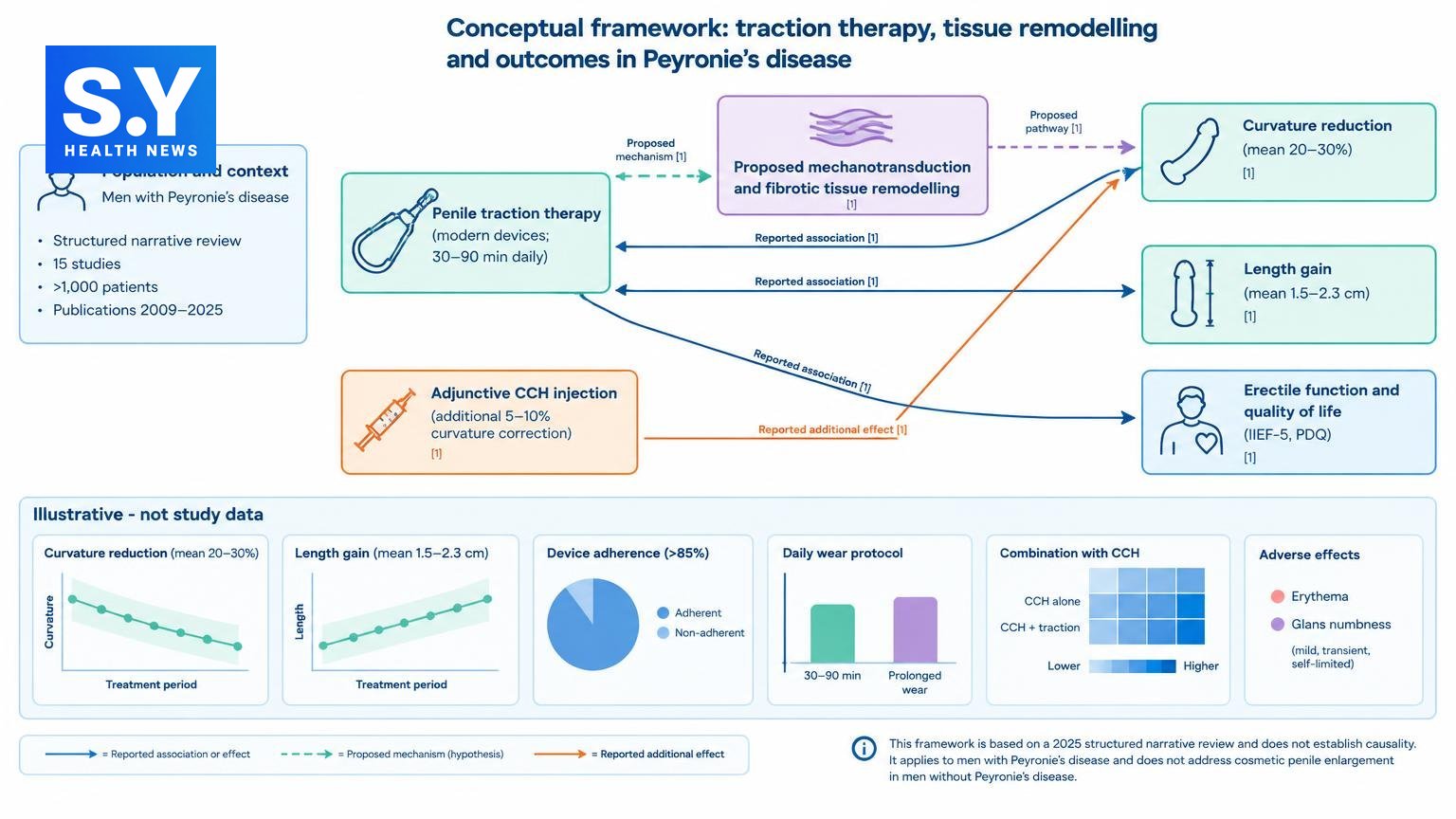
The review reports that modern devices such as RestoreX and Penimaster PRO achieved mean curvature reductions of 20–30% and penile length gains averaging 1.5–2.3 cm, with adherence exceeding 85%. Shorter protocols of 30–90 minutes daily reportedly performed as well as, or better than, older devices requiring prolonged wear. Adding traction to collagenase Clostridium histolyticum (CCH) injection was associated with an additional 5–10% curvature correction compared with CCH alone, and erectile function and Peyronie's-specific quality-of-life scores improved. Adverse effects were described as mild, transient and self-limited, mainly erythema and glans numbness.
These are encouraging figures for a condition with limited non-surgical options, but they come from a narrative synthesis rather than an independent meta-analysis or a single rigorous trial. The evidence supports PTT as a plausible, generally well-tolerated adjunct in Peyronie's disease under clinical supervision. It does not establish traction as a method of cosmetic penile enlargement in men without Peyronie's disease, and the durability of benefit, optimal protocol and effect on surgical avoidance remain unresolved.
Why This Matters
Peyronie's disease is not merely a cosmetic concern. The fibrotic plaque and resultant deformity can make intercourse difficult or painful, and the associated erectile dysfunction and psychosocial distress can affect relationships and mental health. Surgery remains effective but is generally reserved for severe deformity, leaving many men seeking less invasive options.
Penile traction therapy is attractive because it is non-invasive, can be used at home and is proposed to act on the underlying fibrotic tissue rather than only on symptoms. The same properties have made traction devices a staple of direct-to-consumer marketing for penile enlargement, a use for which the clinical evidence base is far thinner and fundamentally different. Distinguishing the Peyronie's evidence from enlargement claims is therefore both a scientific and a consumer-protection issue.
Biological and Clinical Mechanism
The rationale for traction rests on mechanotransduction: controlled, sustained tensile force is proposed to stimulate remodelling of fibrotic tissue in the tunica albuginea, thereby reducing curvature and restoring length. In principle, gradual mechanical loading may influence collagen organisation and tissue compliance in a manner analogous to other controlled stretch therapies. This is a mechanistic hypothesis rather than a demonstrated human pathway in the reviewed literature; the review describes the principle but does not report direct histological or molecular confirmation in patients.
Clinically, the proposed chain runs from device wear to tissue remodelling to measurable change in curvature and length, with parallel effects on erectile function and psychosocial wellbeing. The review reports improvements in International Index of Erectile Function (IIEF-5) and Peyronie's Disease Questionnaire (PDQ) scores, which is consistent with this chain but does not isolate the mechanism. Improvement in curvature could plausibly reflect tissue remodelling, reduced plaque-related contracture, concurrent therapies such as CCH, or natural history of the disease; the narrative review design cannot separate these contributions.
Adverse effects reported were local and mostly minor, chiefly erythema and glans numbness, described as mild, transient and self-limited. This safety profile is consistent with the mechanical nature of the intervention but should be read with caution: adverse-event rates and the methods used to ascertain them were not detailed in the review text, and longer or higher-force use outside supervised protocols may carry different risks.
What the Evidence Shows
| Variable | Reported finding | Population and context | Interpretation |
|---|---|---|---|
| Curvature reduction | Mean 20–30% reduction | Men with Peyronie's disease using modern devices (RestoreX, Penimaster PRO), aggregated across included studies | Suggests clinically relevant improvement; percentage reductions are averages across heterogeneous studies, not individual predictions |
| Penile length gain | Average 1.5–2.3 cm | Men with Peyronie's disease using modern devices | Restoration of length lost to disease is plausible; the range reflects variation across studies and protocols |
| Adherence | Exceeding 85% | Users of modern devices in reviewed studies | High adherence supports feasibility, but adherence is self-reported in many device studies and may not reflect routine practice |
| Daily wear protocol | 30–90 minutes daily | Modern versus older prolonged-wear devices | Shorter protocols showed similar or improved efficacy in narrative synthesis; not a randomized head-to-head comparison as described |
| Combination with CCH injection | Additional 5–10% curvature correction versus CCH alone | Men receiving collagenase Clostridium histolyticum | Consistent with additive or synergistic benefit; trial-level details and durability are not provided in the review text |
| Erectile function and quality of life | Improved IIEF-5 and PDQ scores | Men with Peyronie's disease | Supports functional and psychological benefit; magnitude and durability of score changes are not specified |
| Adverse effects | Mild, transient, self-limited; mainly erythema and glans numbness | Men using traction therapy | Reassuring short-term profile; event rates and ascertainment methods not detailed |
The evidence base itself shapes how these numbers should be read. The review was a structured narrative synthesis searching three databases for publications from 2009 to 2025, and it included randomized controlled trials, prospective cohorts, meta-analyses and systematic or narrative reviews of PTT used alone or with adjunctive treatments. Mixing these designs means the pooled impressions are not equivalent to randomized trial evidence, and the review text does not describe a formal risk-of-bias assessment or a quantitative meta-analysis.
The aggregate size of 15 major studies and more than 1,000 patients is substantial for this field, but the figure is an aggregate count. The text does not detail overlap between studies, differences in baseline curvature, disease phase or device protocols, or how outcomes were measured across centres. Mean curvature reductions of 20–30% and length gains of 1.5–2.3 cm should therefore be understood as summary ranges from heterogeneous sources rather than precise expected results for an individual patient.
The reported comparison between short-duration and prolonged-wear protocols is clinically important because burden of wear is a major barrier to adherence. However, the review describes this as a comparative impression from narrative synthesis, not as a head-to-head randomized comparison. Similarly, the additional 5–10% curvature correction with CCH plus traction is a promising signal that would need confirmation in adequately powered trials before it could be treated as an established synergistic effect.
Interpretation and Limitations
The review's authors conclude that consistent evidence demonstrates clinically meaningful reductions in curvature, length restoration and improved erectile function with minimal side effects. That is a reasonable summary of the direction of the literature, but it is the authors' synthesis of a narrative review, not an independent meta-analysis. Readers should distinguish statistical reporting of mean changes from clinical meaning: a 20–30% curvature reduction may be meaningful for one man and insufficient for another, depending on baseline deformity, plaque characteristics and functional goals.
Several uncertainties remain. The durability of benefit after stopping traction is not established. The optimal device, force, duration and treatment schedule are not standardized. The relative contribution of traction versus concurrent therapies, and versus natural history, is unclear. Psychosocial outcomes were assessed with validated questionnaires but the magnitude and persistence of change are not specified. These gaps are acknowledged by the authors, who call for multicentre research to standardize protocols, evaluate long-term durability and incorporate psychosocial outcomes into treatment assessment.
The suggestion that traction combined with pharmacological or injection therapy may delay or prevent surgical intervention is a hypothesis rather than an established outcome. Surgery remains effective and is typically reserved for severe deformity; whether traction changes the proportion of men who eventually need surgery has not been demonstrated in the reviewed text. This is a key distinction between a plausible care pathway and a proven one.
Most importantly for the broader topic of penile enlargement, the evidence described here applies to men with Peyronie's disease, a fibrotic disorder with deformity. It cannot be extrapolated to men without Peyronie's disease who seek cosmetic enlargement. The biological rationale of tissue remodelling in fibrotic plaque is not the same as inducing growth in normal tissue, and no evidence in this review addresses that population or that goal.
Research Outlook
The field needs multicentre trials with standardized device protocols, objective and blinded outcome measurement, longer follow-up and prespecified psychosocial endpoints. Head-to-head comparisons of modern short-duration devices against older prolonged-wear devices, and of traction versus or combined with CCH and other therapies, would clarify the incremental value of each component. Trials should also report adverse-event rates systematically rather than only describing events as mild and transient.
For clinical practice, the current evidence supports discussing PTT as a non-invasive option within a supervised Peyronie's disease care plan, with realistic expectations about average effects, the need for consistent wear and the possibility that benefits may not persist after treatment stops. Patients should be told clearly that cosmetic enlargement is not an established indication. For research and public communication alike, the priority is to keep the Peyronie's evidence and enlargement marketing claims conceptually separate.
Key Takeaways
- A 2025 structured narrative review of 15 studies and more than 1,000 patients reports that modern traction devices achieved mean curvature reductions of 20–30% and length gains of 1.5–2.3 cm in Peyronie's disease, with adherence above 85%.
- Shorter daily wear of 30–90 minutes showed similar or improved efficacy versus older prolonged-wear devices in narrative synthesis, but this was not a randomized head-to-head comparison as described.
- Adding traction to collagenase Clostridium histolyticum injection was associated with an additional 5–10% curvature correction versus injection alone, a promising but not independently confirmed finding.
- Erectile function (IIEF-5) and Peyronie's-specific quality-of-life (PDQ) scores improved, and adverse effects were mainly mild, transient erythema and glans numbness.
- Key uncertainties include durability after treatment stops, protocol standardization and whether traction delays or prevents surgery; the latter remains a hypothesis.
- The evidence applies to Peyronie's disease, not to cosmetic penile enlargement in men without the condition, and it should not be generalized to that use.
Questions and Answers
What is penile traction therapy and how is it thought to work in Peyronie's disease?
Penile traction therapy uses a device to apply controlled, sustained stretch to the penis. In Peyronie's disease, a fibrotic disorder of the tunica albuginea causing curvature and erectile dysfunction, the proposed mechanism is mechanotransduction: mechanical loading may remodel fibrotic tissue, reduce curvature and restore length. This remains a mechanistic rationale, with no direct human histological confirmation reported in the reviewed literature.
How much do modern penile traction devices reduce curvature and restore length in Peyronie's disease?
A 2025 structured narrative review of 15 studies and more than 1,000 patients reported that modern devices such as RestoreX and Penimaster PRO achieved mean curvature reductions of 20–30% and penile length gains averaging 1.5–2.3 cm, with adherence above 85%. These are summary ranges across heterogeneous studies, not predictions for an individual patient.
How strong is the evidence that penile traction therapy improves erectile function and quality of life?
The review reports improvements in International Index of Erectile Function (IIEF-5) and Peyronie's Disease Questionnaire (PDQ) scores, supporting functional and psychological benefit. However, the magnitude and durability of these score changes are not specified, and the evidence comes from a narrative synthesis that mixes trial designs rather than an independent meta-analysis or a single definitive trial.
Does penile traction therapy help men without Peyronie's disease who want penile enlargement?
The reviewed evidence applies specifically to Peyronie's disease, a fibrotic condition causing curvature and deformity. The biological rationale concerns remodelling of fibrotic plaque, not inducing growth in normal tissue. No evidence in this review addresses cosmetic enlargement in men without Peyronie's disease, so traction should not be presented as a proven enlargement method for that population.
What are the limitations and risks of the evidence on penile traction therapy?
The main limitations are the narrative review design, heterogeneous study types, lack of a described formal risk-of-bias assessment, and unresolved questions about durability, optimal device protocol and whether surgery is delayed or avoided. Reported adverse effects were mild, transient erythema and glans numbness, but event rates and ascertainment methods were not detailed, so longer or unsupervised use may carry different risks.
Can penile traction combined with collagenase injection improve Peyronie's curvature more than injection alone?
The review reports that adding traction to collagenase Clostridium histolyticum (CCH) injection enhanced curvature correction by an additional 5–10% compared with CCH alone. This is a promising signal consistent with additive benefit, but it comes from narrative synthesis rather than an independently confirmed trial, and trial-level details and durability are not provided in the review text.
Conceptual framework: Conceptual framework. Population and context: men with Peyronie's disease in a structured narrative review of 15 studies and over 1,000 patients (publications 2009–2025). Solid relations are supported as reported associations or effects; dashed relations are proposed mechanistic hypotheses. The framework is not a tested causal model, and it does not address cosmetic penile enlargement in men without Peyronie's disease.
Academic References & Evidence
- Gopi. P; Ishfaq. M; Das. SK; Shkoukani. ZW; Khattak. AQ; Chamsin. A; Awsare. N; Birley. R; Hughes. KE. Publications. Cureus. 2025 17(11):e97544 DOI: 10.7759/cureus.97544.
SANYUN Science Center explains published research on men's reproductive and sexual health, connecting scientific evidence with everyday questions while making sources and limitations clear.
Disclaimer: This article is for scientific education and research communication only. It does not provide medical advice, diagnosis, or individualized treatment recommendations, and does not endorse any medication, supplement, device, penile enlargement procedure, or other intervention. Decisions about sexual and reproductive health should be made in consultation with a qualified healthcare professional. Do not delay seeking professional care because of information in this article.
Original Content & Copyright Notice
- This article is prepared for SANYUN Science Center, drawing on published research and publicly available academic literature on men’s sexual and reproductive health. Its editorial explanations and presentation are developed for this platform.
- Copyright in the original editorial content, selection, and arrangement is reserved by SANYUN Science Center to the extent protected by applicable law. Referenced research, quotations, and third-party materials remain subject to the rights of their respective owners. This notice does not claim ownership of scientific facts or third-party research.
- Except where permitted by applicable law or an applicable license, prior written permission is required to reproduce, republish, translate, adapt, redistribute, or commercially reuse protected content. Attribution alone does not grant permission for such reuse.
- For permitted quotation or authorized reuse, clearly identify the source and retain a link to the original article.
- Source: SANYUN Science Center
- Original URL: Retain the original article URL on science.san-yun.com.
- Copyright Holder: SANYUN Science Center, for its own protected editorial content.
- Quotation, excerpts, or authorized reuse must not distort the scientific meaning, omit material limitations or disclaimers, or imply unverified medical claims, product efficacy, or endorsement by SANYUN Science Center.



