




Category: Penis Enlargement
Core Research Direction: Penile traction therapy for Peyronie's disease: curvature reduction and length gain, and what the evidence cannot establish about penile enlargement in men without Peyronie's disease
Search Intent: For men with Peyronie's disease, how much curvature reduction and length gain does penile traction therapy produce in the published clinical evidence, and how reliable and applicable is that evidence?
Platform: SANYUN Science Center
Evidence reviewed through: 2026-11-02
Executive Summary
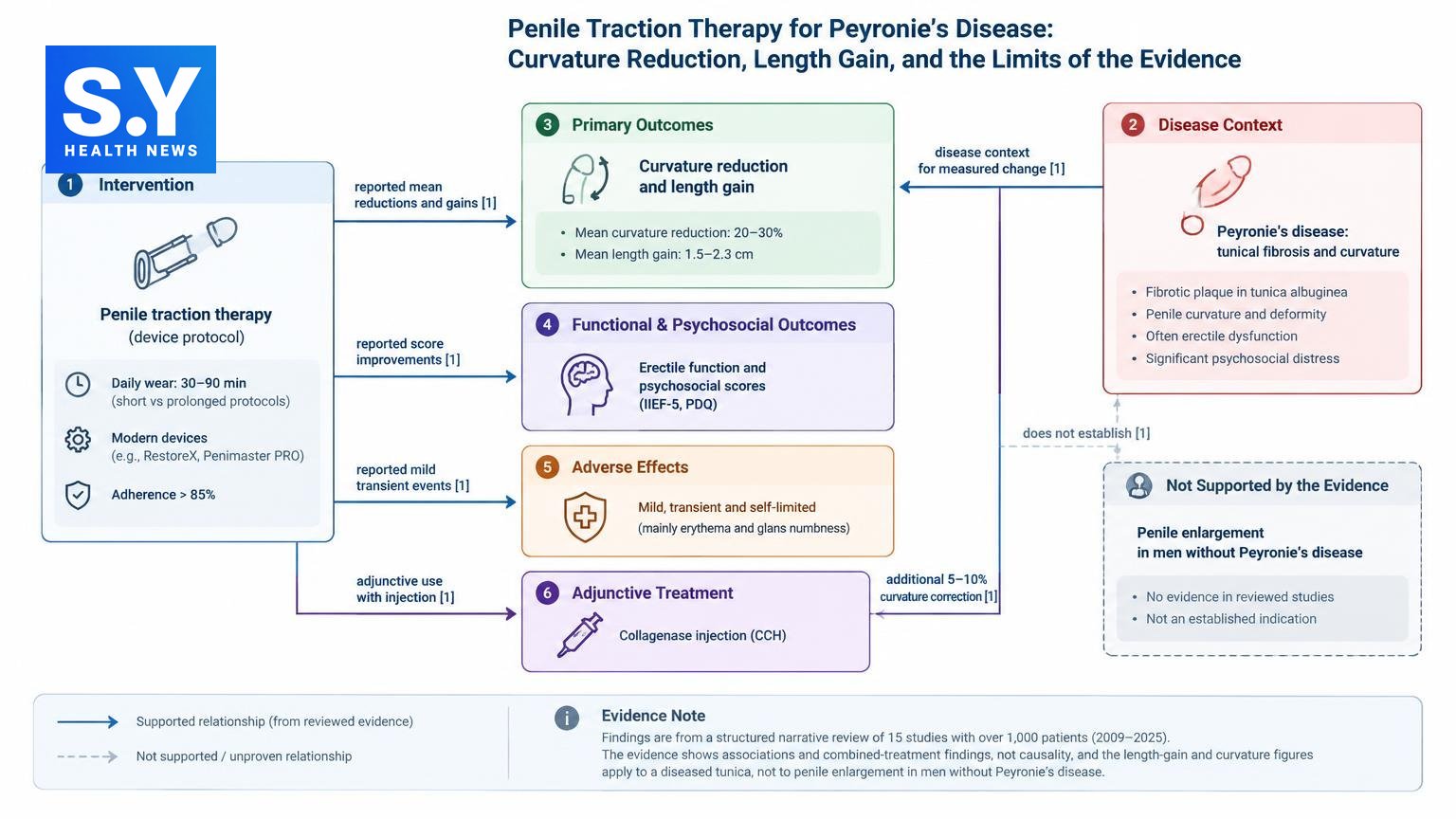
Penile traction therapy (PTT) applies controlled mechanical force to the penis over repeated sessions. It has been promoted for Peyronie's disease (PD), a connective tissue disorder of the tunica albuginea that causes penile curvature, deformity and erectile dysfunction, and that carries significant psychosocial distress. A 2025 structured narrative review covering publications from 2009 to 2025 pooled the narrative literature on this intervention, including randomised controlled trials, prospective cohorts, meta-analyses and systematic or narrative reviews. Across 15 major studies with over 1,000 patients, the authors reported that modern devices achieved mean curvature reductions of 20-30% and penile length gains averaging 1.5-2.3 cm, with adherence exceeding 85%. Short daily protocols of 30-90 minutes showed similar or improved efficacy compared with older devices requiring prolonged wear. Adding PTT to collagenase Clostridium histolyticum (CCH) injection reportedly improved curvature correction by an additional 5-10%. Reported adverse effects — mainly erythema and glans numbness — were mild, transient and self-limited.[1]
Those figures are clinically interesting but they rest on a narrative synthesis, not a pooled meta-analysis with formal risk-of-bias grading. The evidence speaks specifically to men with Peyronie's disease and does not establish that traction therapy enlarges the penis in men without this condition. The authors themselves call for multicentre research to standardise protocols, assess long-term durability and incorporate psychosocial outcomes, which identifies where certainty is currently thinnest.
Why This Matters
Peyronie's disease is not a cosmetic problem. The fibrotic plaque in the tunica albuginea produces a bend that can make intercourse difficult or painful, shortens the erect penis in many men, and is frequently accompanied by erectile dysfunction and marked psychological distress. Surgical correction — plication, grafting or prosthesis — remains effective for severe deformity but is invasive and irreversible in important respects, including further length loss with some procedures. A non-surgical, reversible option that could reduce curvature and restore length therefore addresses a genuine unmet need, provided the effect sizes and safety profile hold up under scrutiny.
The same evidence is often read by the public through a different lens. Traction is widely marketed online as a method of penile enlargement for healthy men. The review's numbers concern curvature and length in a diseased tunica with fibrotic plaque; importing them into the context of anatomically normal adult men is an extrapolation the data do not license. Readers weighing traction devices should understand which claim is supported (curvature reduction in PD) and which remains untested (enlargement in men without PD).
The Biological Rationale: Mechanotransduction in Fibrotic Tissue
The review frames PTT as an application of mechanotransduction — the conversion of mechanical force into cellular biochemical responses. In principle, sustained low-magnitude stretch applied to a collagen-rich fibrotic plaque could alter collagen remodelling and help restore tissue length and alignment. This is a plausible biological hypothesis rather than an established pathway in this source. The review's rationale paragraph is a mechanistic premise; it does not report tissue-level or molecular data linking traction dose to plaque composition in humans. Readers should treat the mechanism as explanatory framing for the observed clinical outcomes, not as independent proof of how the intervention works.
What the Evidence Shows
The review is a structured narrative review performed in PubMed, ScienceDirect and Wiley Online Library, covering publications from 2009 to 2025. Eligible work included randomised controlled trials, prospective cohorts, meta-analyses, and systematic or narrative reviews of PTT as monotherapy or combined with adjunctive treatments. Fifteen major studies with more than 1,000 patients in total were reviewed. The synthesis reports that modern devices such as RestoreX and Penimaster PRO achieved mean curvature reductions of 20-30% and penile length gains averaging 1.5-2.3 cm, with high adherence exceeding 85%.
Two further findings are notable. First, shorter protocols of 30-90 minutes daily were reported to show similar or improved efficacy compared with older devices that required prolonged wear — a practically important point, since burden of use is a major determinant of whether patients persist with traction. Second, adjunctive PTT with collagenase Clostridium histolyticum enhanced curvature correction by an additional 5-10% compared with CCH alone. Functional and psychological benefit was reported through improvements on the International Index of Erectile Function (IIEF-5) and the Peyronie's Disease Questionnaire (PDQ). Adverse effects were mild, transient and self-limited, primarily erythema and glans numbness.
| Outcome or feature | Reported result | Population and context | Interpretive note |
|---|---|---|---|
| Curvature reduction, modern devices | Mean 20-30% | Men with Peyronie's disease | Narrative synthesis across heterogeneous studies; no per-study comparator detail given in the review |
| Penile length gain, modern devices | Average 1.5-2.3 cm | Men with Peyronie's disease | Applies to a diseased tunica with fibrotic plaque; not evidence of enlargement in men without PD |
| Daily wear protocol, short-duration devices | 30-90 minutes | Men with Peyronie's disease | Reported similar or improved efficacy versus older prolonged-wear devices |
| Added curvature correction, PTT plus CCH vs CCH alone | Additional 5-10% | Men with Peyronie's disease treated with collagenase injection | Underlying trial designs and follow-up durations not specified in the review text |
| Adherence to modern device protocols | Exceeding 85% | Men with Peyronie's disease | High adherence in reviewed studies; real-world persistence may differ |
| Adverse effects | Mild, transient, self-limited; mainly erythema and glans numbness | Men with Peyronie's disease using traction devices | Reassuring narrative summary; precise rates and ascertainment methods not reported |
Interpreting the Numbers
A 20-30% mean curvature reduction is a relative figure. Whether it is clinically meaningful depends on the starting angle: a 30% reduction of a 90-degree curve leaves roughly 63 degrees, which may still impair intercourse; the same relative reduction of a 40-degree curve leaves about 28 degrees, which many men would find acceptable. The review does not disaggregate outcomes by baseline severity in the text supplied, so the distribution of benefit across mild, moderate and severe deformity is unknown. A mean change also conceals the proportion of non-responders, and narrative reviews rarely report that proportion systematically.
The length figure of 1.5-2.3 cm requires similar care. In Peyronie's disease, length gain may represent recovery of length lost to the plaque and curvature rather than net growth beyond a man's original anatomy. The review does not specify how length was measured (stretched flaccid versus erect), which matters because the two correlate imperfectly, particularly in the presence of deformity. The claim of 'restoration' is therefore reasonable for some patients but should not be read as evidence that traction adds length to a penis unaffected by fibrotic disease.
The adherence figure above 85% in reviewed studies is encouraging but is a study-context observation. Highly motivated participants in monitored protocols typically adhere better than patients in routine practice, especially with a device that must be worn for 30-90 minutes daily. Real-world durability, discontinuation and the relationship between adherence and outcome remain uncertain in this evidence base.
Limitations and Conflicting Interpretations
The most important limitation is design. A structured narrative review can summarise a heterogeneous literature, but it does not pool effect estimates, grade the certainty of evidence, or formally assess risk of bias in the text supplied. The included studies span randomised trials, prospective cohorts and prior reviews, which differ in comparator, device, protocol and endpoint definition. Device comparisons — modern versus older devices, short versus prolonged wear — are presented as narrative contrasts rather than head-to-head trials with effect sizes. Reported gains therefore cannot be ranked as if the devices had been directly compared.
Second, the review text does not report the magnitude of IIEF-5 or PDQ change, the duration of follow-up, or the proportion of patients lost to follow-up. Long-term durability is explicitly identified by the authors as an open question requiring multicentre research, alongside standardisation of protocols and incorporation of psychosocial outcomes. Without such data, a claim that PTT 'may delay or prevent surgery' remains a hypothesis to be tested rather than a demonstrated outcome.
Third, uncertainty surrounds the combination with collagenase. An additional 5-10% curvature correction sounds substantial, but the underlying trial designs and denominators are not described in this review text, and the sequence, timing and intensity of traction relative to injection are not standardised in the field. The authors' overall conclusion — that PTT is safe and effective for PD — is their interpretation of a favourable but methodologically heterogeneous literature, not an independent regulatory or guideline determination.
Applicability and the Enlargement Question
The population studied is men with Peyronie's disease. Nothing in this review describes traction for adult men without the condition, and no outcome in the reviewed evidence addresses penile enlargement as a goal in anatomically normal men. Applying PD figures to that population would require assuming that a fibrotic tunica responds the same way as healthy tissue — an assumption the review neither tests nor supports. Men seeking enlargement should understand that the published traction evidence is disease-specific, and that the safety data (erythema, glans numbness) come from a clinical population under device protocols rather than from unsupervised consumer use.
For men with Peyronie's disease, the practical implications are more concrete. A reversible, non-surgical option with reported curvature reduction, length restoration, improved erectile function scores and mild adverse effects is a reasonable topic for a clinical conversation, especially where surgery is being considered. Whether it is appropriate in an individual case depends on plaque characteristics, baseline deformity, erectile function and patient preference — factors outside the scope of a narrative review's aggregate figures.
Research Outlook
The review's own agenda is clear: multicentre research to standardise protocols, evaluate long-term durability, and incorporate psychosocial outcomes into treatment assessment. To that could be added the questions this evidence cannot answer — direct device-to-device trials with pre-specified endpoints, measurement standards for length and curvature, responder analyses by baseline severity, and data in men without Peyronie's disease if enlargement claims are ever to be tested rather than assumed. Until such work exists, the appropriate reading is that PTT has encouraging, disease-specific supporting evidence with important methodological limits, and that its role relative to injection therapy and surgery is still being defined.
Key Takeaways
- A 2025 structured narrative review of 15 studies with over 1,000 patients reported mean curvature reductions of 20-30% and average length gains of 1.5-2.3 cm with modern traction devices in Peyronie's disease.
- Short daily protocols of 30-90 minutes were reported as similar or better than prolonged-wear older devices, and adding traction to collagenase injection reportedly improved curvature correction by an additional 5-10%.
- Adverse effects were mainly mild, transient erythema and glans numbness, but rates and ascertainment methods are not detailed in the review.
- The evidence is a narrative synthesis, not a pooled meta-analysis with formal bias grading; long-term durability and protocol standardisation remain unresolved according to the authors.
- These findings concern men with Peyronie's disease and do not establish penile enlargement in men without the condition.
Questions and Answers
What is penile traction therapy and how is it proposed to work in Peyronie's disease?
Penile traction therapy applies controlled mechanical stretch to the penis over repeated sessions. In Peyronie's disease, a connective tissue disorder of the tunica albuginea that causes curvature, deformity and erectile dysfunction, the proposed rationale is mechanotransduction: mechanical force may influence collagen remodelling in the fibrotic plaque. This mechanism is a plausible premise in the reviewed source rather than a demonstrated tissue-level pathway, and it should be understood as explanatory framing for the reported clinical outcomes.
How much curvature reduction and length gain does penile traction therapy produce in Peyronie's disease?
A 2025 narrative review of 15 studies with over 1,000 patients reported that modern devices such as RestoreX and Penimaster PRO achieved mean curvature reductions of 20-30% and penile length gains averaging 1.5-2.3 cm, with adherence exceeding 85%. These are narrative summary figures across heterogeneous studies. A 20-30% relative reduction means different things at different starting angles, and length gain may partly reflect recovery of length lost to the plaque rather than net growth.
Does adding penile traction to collagenase injection improve Peyronie's disease curvature?
The review reports that adjunctive penile traction with collagenase Clostridium histolyticum enhanced curvature correction by an additional 5-10% compared with collagenase alone. This is a narrative synthesis claim; the underlying trial designs, sample sizes and follow-up durations are not described in the review text. The sequence and intensity of traction relative to injection are not standardised in the field, so the combination should be discussed with a clinician rather than assumed to be an established protocol.
How strong is the evidence that penile traction therapy works for Peyronie's disease?
The evidence comes from a structured narrative review covering publications from 2009 to 2025, including randomised trials, prospective cohorts and prior reviews. A narrative review can summarise a heterogeneous literature but does not pool effect estimates or formally grade risk of bias in the text supplied. Device comparisons are narrative contrasts rather than head-to-head trials, and long-term durability remains an open question the authors themselves identify as needing multicentre research.
Is penile traction therapy safe, and what side effects are reported?
The review describes adverse effects as mild, transient and self-limited, primarily erythema and glans numbness. These safety observations come from clinical studies of men with Peyronie's disease using device protocols; the review does not report precise event rates or how adverse events were ascertained. Unsupervised consumer use, longer wear times or use in men without Peyronie's disease are not covered by this safety summary, so the reassuring profile should not be generalised beyond the studied context.
Can penile traction devices enlarge the penis in men without Peyronie's disease?
The reviewed evidence concerns men with Peyronie's disease, a fibrotic disorder of the tunica albuginea. No outcome in this review addresses penile enlargement in men with normal anatomy. Extrapolating curvature and length results from a diseased tunica to healthy tissue would require an assumption the review neither tests nor supports. Men considering traction for enlargement should recognise that the published clinical evidence is disease-specific, and that this remains an evidence gap rather than a demonstrated benefit.
Conceptual framework: Conceptual framework of the variables examined in the reviewed evidence on penile traction therapy for Peyronie's disease. Arrows summarize reported associations and combined-treatment findings from a narrative review of 15 studies with over 1,000 patients; they are not a tested causal model, and the length-gain and curvature figures apply to a diseased tunica, not to penile enlargement in men without Peyronie's disease.
Academic References & Evidence
- Gopi. P; Ishfaq. M; Das. SK; Shkoukani. ZW; Khattak. AQ; Chamsin. A; Awsare. N; Birley. R; Hughes. KE. Publications. Cureus. 2025 17(11):e97544 DOI: 10.7759/cureus.97544.
SANYUN Science Center explains published research on men's reproductive and sexual health, connecting scientific evidence with everyday questions while making sources and limitations clear.
Disclaimer: This article is for scientific education and research communication only. It does not provide medical advice, diagnosis, or individualized treatment recommendations, and does not endorse any medication, supplement, device, penile enlargement procedure, or other intervention. Decisions about sexual and reproductive health should be made in consultation with a qualified healthcare professional. Do not delay seeking professional care because of information in this article.
Original Content & Copyright Notice
- This article is prepared for SANYUN Science Center, drawing on published research and publicly available academic literature on men’s sexual and reproductive health. Its editorial explanations and presentation are developed for this platform.
- Copyright in the original editorial content, selection, and arrangement is reserved by SANYUN Science Center to the extent protected by applicable law. Referenced research, quotations, and third-party materials remain subject to the rights of their respective owners. This notice does not claim ownership of scientific facts or third-party research.
- Except where permitted by applicable law or an applicable license, prior written permission is required to reproduce, republish, translate, adapt, redistribute, or commercially reuse protected content. Attribution alone does not grant permission for such reuse.
- For permitted quotation or authorized reuse, clearly identify the source and retain a link to the original article.
- Source: SANYUN Science Center
- Original URL: Retain the original article URL on science.san-yun.com.
- Copyright Holder: SANYUN Science Center, for its own protected editorial content.
- Quotation, excerpts, or authorized reuse must not distort the scientific meaning, omit material limitations or disclaimers, or imply unverified medical claims, product efficacy, or endorsement by SANYUN Science Center.



