




Category: Penis Enlargement
Core Research Direction: What surgical and non-surgical penile enhancement interventions are actually supported by published evidence for adult men, what outcomes (erect vs. flaccid length, girth, satisfaction, complications) do they achieve, and how should men with normal measured penile size and size-related anxiety be managed instead?
Search Intent: For adult men considering penis enlargement, which procedures and products have real published evidence, what do they actually change (erect length, flaccid length, girth, satisfaction), what are the documented risks, and why is surgery usually not recommended for men whose measured size is normal?
Platform: SANYUN Science Center
Evidence reviewed through: 2026-11-10
Executive Summary
Men searching for penis enlargement encounter far more marketing than evidence. The published literature describes only a small number of procedures that are actually performed and studied: suspensory ligament release, which changes visible flaccid length, and autologous fat grafting, which adds girth. Neither reliably changes erect length, and published group averages are modest. In one ligament-release case series, about 35% of men were satisfied, with dissatisfaction driven mainly by expectations exceeding what surgery can deliver.[1]
The evidence base is itself limited. Much of what patients can read is clinic-authored guidance that summarises primary studies secondhand rather than pooled trial data. Two systematic reviews are repeatedly cited: one concluding that gains are usually small, complications are not uncommon, and satisfaction is low when expectations are unrealistic in men of normal size; and one concluding that many enhancement interventions in normal-size men carry high complication rates and uncertain satisfaction. The American Urological Association has stated that fat injection for girth and ligament release in men of normal size have not been proven safe and effective.[2]
Measurement reframes the question. A systematic review of clinician measurements in up to 15,521 men reported mean erect length of about 13.1 cm and mean flaccid length of about 9.2 cm, with very wide normal ranges. Most men who request lengthening measure within the normal range. For that group, published guidance converges on measurement, expectation-setting and assessment of size-related anxiety before any procedure — and often instead of one.
Why This Matters
Size dissatisfaction is common and mostly not anatomical. A large survey of more than 50,000 adults found that only about half of men were satisfied with their own size, while 85% of women were satisfied with their partner's size. That gap points toward perception and self-assessment rather than measurable deficit in most cases, and it shapes what a responsible consultation should address first.
The market, however, responds to the anxiety rather than the anatomy. Pills, creams, supplements, massage and stretching routines, pumps, traction devices, unregulated injections and surgery are all sold with varying degrees of certainty. Sorting them requires distinguishing three separate questions: whether a method changes flaccid length, whether it changes erect length, and whether it changes girth — because the answers differ, and because satisfaction depends on which change a man actually wanted.
Risk also lives outside the operating theatre. Unregulated injections of liquid silicone, oils or unknown substances by non-physicians have repeatedly been reported to cause chronic inflammatory masses, tissue necrosis, permanent deformity and the need for major revision surgery. Some male dietary supplements have been found adulterated with erectile-dysfunction drugs not declared on the label, a serious hazard for men with heart disease or those using nitrates.
Biological and Clinical Mechanism: What Each Intervention Actually Alters
Suspensory ligament release works by anatomy rather than by growth. The ligament that suspends the penis is divided so that a portion of the penis previously held internally hangs more externally. The visible consequence is a modest increase in flaccid length; the erect length, determined by internal structures the operation does not touch, changes little. Published averages for the flaccid gain are around 1–2 cm, with wide individual variation, and some men see essentially no difference. Postoperative traction or weighting devices are often used for months to limit scar retraction.
Autologous fat grafting is a volume procedure, not a length procedure. Fat is harvested from the abdomen or thighs and injected beneath the penile skin to increase circumference. The central biological limitation is resorption: transplanted fat is absorbed in an unpredictable proportion, so what is visible at one month is typically not what remains a year later. Reported resorption ranges widely, from about 20% to 80% across heterogeneous reports, and uneven resorption can leave lumpy or irregular contours that require revision.
Hyaluronic acid filler occupies a different category: a temporary, non-surgical girth intervention that does not add length. Effects are typically reported to last about 1–2 years before natural resorption, varying by product and individual. Its distinguishing property is reversibility — the filler can be dissolved with an enzyme if the result is unsatisfactory — but it carries its own risks of irregular nodules, material migration and inflammation.
Several marketed approaches have no plausible mechanism for permanent size change. Vacuum pumps draw blood into the penis and produce temporary engorgement; they have a genuine role in erectile dysfunction care but do not increase size permanently. Traction devices have limited data, with small reported gains requiring several hours of daily use over many months. Massage and stretching techniques shared online have no supporting evidence but documented injuries, including capillary tearing, fibrosis and penile curvature. Exercise and weight loss do not change true penile size, though in men with substantial abdominal fat, fat loss can make more of the penis visible — a visual effect rather than enlargement.
What the Evidence Shows: Outcomes and Their Limits
The table below summarises the principal reported outcomes for the interventions most discussed in the source material. Values are group-level findings from published series and summaries; they are not predictions for any individual, and the source does not supply pooled sample sizes or follow-up durations for most of them.
| Intervention | Primary reported change | Reported outcome figures | Key documented limitations |
|---|---|---|---|
| Suspensory ligament release | Visible flaccid length; erect length changes little | About 1–2 cm flaccid gain in published series | Wide individual variation; some men gain little or none |
| Suspensory ligament release — satisfaction | Patient-reported satisfaction | About 35% satisfied in one case series | Single series; dissatisfaction driven mainly by expectations |
| Autologous fat grafting | Girth | Reported resorption about 20–80% across reports | Unpredictable and uneven resorption; lumpy contours may need revision |
| Hyaluronic acid filler | Girth, temporary; no length change | Effect typically about 1–2 years | Nodules, migration, inflammation; requires repeat treatment |
| Vacuum pump | Temporary engorgement | No permanent size gain reported | Useful in erectile dysfunction care, not as enlargement |
| Traction device | Small reported gains with prolonged use | Several hours daily for many months | Limited data; physician guidance advised |
| Pills, creams, supplements | None established for permanent gain | No product with evidence of permanent effect | Adulteration with undeclared ED drugs reported by Thai FDA |
| Unregulated injections | None legitimate; harm | No outcome data supporting benefit | Tissue necrosis, permanent deformity, major revision surgery |
Two systematic reviews anchor the interpretation. The first, summarised in the guidance literature, concluded that in men of normal size the gains are usually small, complications are not uncommon, and satisfaction is low when expectations exceed what procedures can deliver. The second, by Marra and colleagues in 2020, concluded that many enhancement interventions in normal-size men who complain of small penis size have high complication rates and uncertain satisfaction. Together they shift the question from whether a technique can produce a centimetre to whether it produces a satisfied patient.
Complications are specific rather than generic. Ligament release can be followed by scar retraction that pulls the penis back, so that some men look shorter than before surgery; the erection angle may change because the supporting ligament has been divided; and skin sensation may be altered. Fat grafting risks irregularity — some fat resorbs, some forms firm lumps or distorts contour — and revision carries its own risks. Surgery in this area also carries the ordinary risks of infection, bleeding and scarring, and the changes made are not reversible even when the result disappoints. Recovery generally requires abstaining from intercourse for about 4–6 weeks, with swelling and pain initially, and months of traction-device discipline after ligament release.
Interpretation and Limitations
The most important limitation is the nature of the evidence itself. This review interprets published guidance and systematic-review summaries, not a new meta-analysis. The source articles are clinic-authored and physician-reviewed, and they report findings from primary studies and reviews secondhand. The ligament-release satisfaction figure of about 35% comes from a single series whose denominator is not stated. The 1–2 cm flaccid figure is a group average without a pooled sample or follow-up duration. The 20–80% resorption range reflects heterogeneous reports rather than a single controlled measurement.
Statistical versus clinical meaning matters here. A group mean flaccid gain of 1–2 cm may be statistically describable yet clinically trivial for a man hoping for a visible erect change, and the wide variance means the mean describes almost no individual well. Conversely, a low satisfaction rate is a clinical signal even without formal statistics, because it reflects the gap between expectation and outcome in the population actually requesting the operation.
The regulatory picture is also incomplete. The statement that the American Urological Association regards fat injection for girth and ligament release in normal-size men as unproven for safety and effectiveness is cited secondhand; the primary policy text is not reproduced in the source material. Readers should treat this as a strong signal of professional caution rather than a formal finding with effect estimates. Similarly, the complication pattern from unregulated injections is drawn from repeated case reports and news-type accounts rather than incidence studies, so absolute risk in any given setting is unknown.
One further limitation is contextual. Some evidence about filler safety in this packet concerns breast procedures, where dermal fillers are not approved by the FDA and carry higher complication rates than fat grafting in published comparisons. That evidence is not direct evidence about penile filler and should not be transferred as if it were; it does, however, illustrate a general pattern in which injectable fillers carry migration, granuloma and revision risks that merit explicit discussion.[3]
Why Most Men of Normal Measured Size Should Not Rush to Surgery
The measurement literature provides the strongest argument against reflexive intervention. In the pooled review of up to 15,521 men, mean erect length was about 13.1 cm with a wide normal range, and the Mondaini study of men requesting lengthening found most were within the normal range when actually measured. A procedure performed on a normal-sized penis is therefore not correcting a deficit; it is exchanging a normal anatomy for a modest, variable and partly irreversible change.
The psychological evidence reinforces the point. Research in men of normal size who are anxious about size finds that distress often persists after surgery, because the root lies in perception rather than anatomy; the International Society for Sexual Medicine accordingly recommends assessing anxiety before considering any procedure. This is not a dismissal of the concern. Persistent worry that affects relationships, confidence or daily life deserves its own assessment, and a frank conversation with a doctor or psychologist is often more useful than a procedure.
Several groups warrant particular caution: men whose measured size is normal but whose anxiety is high; men seeking a guaranteed number of centimetres; and men with uncontrolled diabetes, heavy smoking, a history of keloid scarring or a bleeding disorder, all of which raise wound and complication risk. Consultation should include real measurement, explicit discussion of average and worst-case outcomes, clarity about who performs the procedure and in what registered facility, and an explanation of how unsatisfactory results could be revised. A consultation that ends without an operation can be a success rather than a refusal.
Research Outlook
The field needs better evidence rather than more promotion. Priorities include prospective series with standardised measurement methods, defined follow-up periods and validated satisfaction and body-image instruments; clear separation of flaccid, stretched and erect outcomes; and reporting of complication rates by grade rather than as narrative warnings. The wide resorption range for fat grafting and the single-series satisfaction figure for ligament release both signal how much heterogeneity remains unexplained.
Non-surgical options also need comparative study. Hyaluronic acid filler is reversible and temporary, which makes it attractive for testing expectation alignment, but its complication profile in this anatomical site is poorly characterised. Meanwhile, the most consequential unanswered question is behavioural: which men, identified at first consultation by measurement and anxiety screening, actually benefit from being advised against a procedure, and what psychological support helps them most.
Key Takeaways
- Only a small number of procedures are actually performed and studied: suspensory ligament release for visible flaccid length and autologous fat grafting for girth; neither reliably changes erect length.
- Published ligament-release averages are about 1–2 cm flaccid gain with wide individual variation, and about 35% satisfaction in one series, largely because expectations exceeded what surgery delivers.
- Fat grafting resorption is reported across a wide 20–80% range, so early results often do not persist, and uneven resorption can require revision.
- Hyaluronic acid filler adds temporary girth, not length, typically lasting about 1–2 years and dissolvable, but with its own risks of nodules, migration and inflammation.
- No pill, cream or supplement has evidence of permanent size gain, and some male supplements have been found adulterated with undeclared erectile-dysfunction drugs.
- Mean erect length in pooled measurements is about 13.1 cm with a wide normal range, and most men requesting lengthening measure within the normal range.
- Professional guidance supports measuring first and assessing size-related anxiety before any procedure, because distress often persists after surgery when perception rather than anatomy is the root.
Questions and Answers
How does suspensory ligament release change penile length and girth?
It divides the ligament that suspends the penis so that more of the internally held shaft hangs externally, increasing visible flaccid length while erect length changes little. Published averages report about 1–2 cm of flaccid gain, with wide individual variation and some men seeing almost no difference. It does not add girth.
What satisfaction rates are reported after penis enlargement surgery?
In one ligament-release case series, about 35% of men were satisfied, with dissatisfaction driven mainly by expectations exceeding what surgery can deliver. Systematic-review summaries similarly conclude that satisfaction is low when expectations are unrealistic, and that many enhancement interventions in normal-size men have high complication rates and uncertain satisfaction.
How strong is the evidence for penis enlargement procedures?
It is limited. Much of the accessible material is clinic-authored guidance summarising primary studies and systematic reviews secondhand, without pooled sample sizes or follow-up durations. The 35% satisfaction figure comes from a single series, and the resorption range spans 20–80% across heterogeneous reports. The American Urological Association has stated that fat injection and ligament release in normal-size men are unproven for safety and effectiveness.
Why are most men who request penile lengthening advised against surgery?
Pooled measurements of up to 15,521 men put mean erect length around 13.1 cm with a wide normal range, and studies of men seeking lengthening found most measured within the normal range. Surgery on a normal-sized penis offers modest, variable and partly irreversible change, so measurement and anxiety assessment are recommended before any procedure.
What are the documented risks of penile fat grafting and ligament release?
Ligament release can cause scar retraction that makes the penis look shorter, altered erection angle and changed skin sensation. Fat grafting carries unpredictable resorption reported from about 20% to 80%, with lumpy or irregular contours that may require revision. Unregulated injections of silicone, oils or unknown substances have caused tissue necrosis and permanent deformity.
Do pills, creams, pumps or traction devices permanently enlarge the penis?
No medication, cream or supplement has evidence of permanent size gain, and some male supplements have been found adulterated with undeclared erectile-dysfunction drugs. Vacuum pumps produce only temporary engorgement and have a role in erectile dysfunction care. Traction devices have limited data, with small reported gains requiring several hours of daily use for many months.
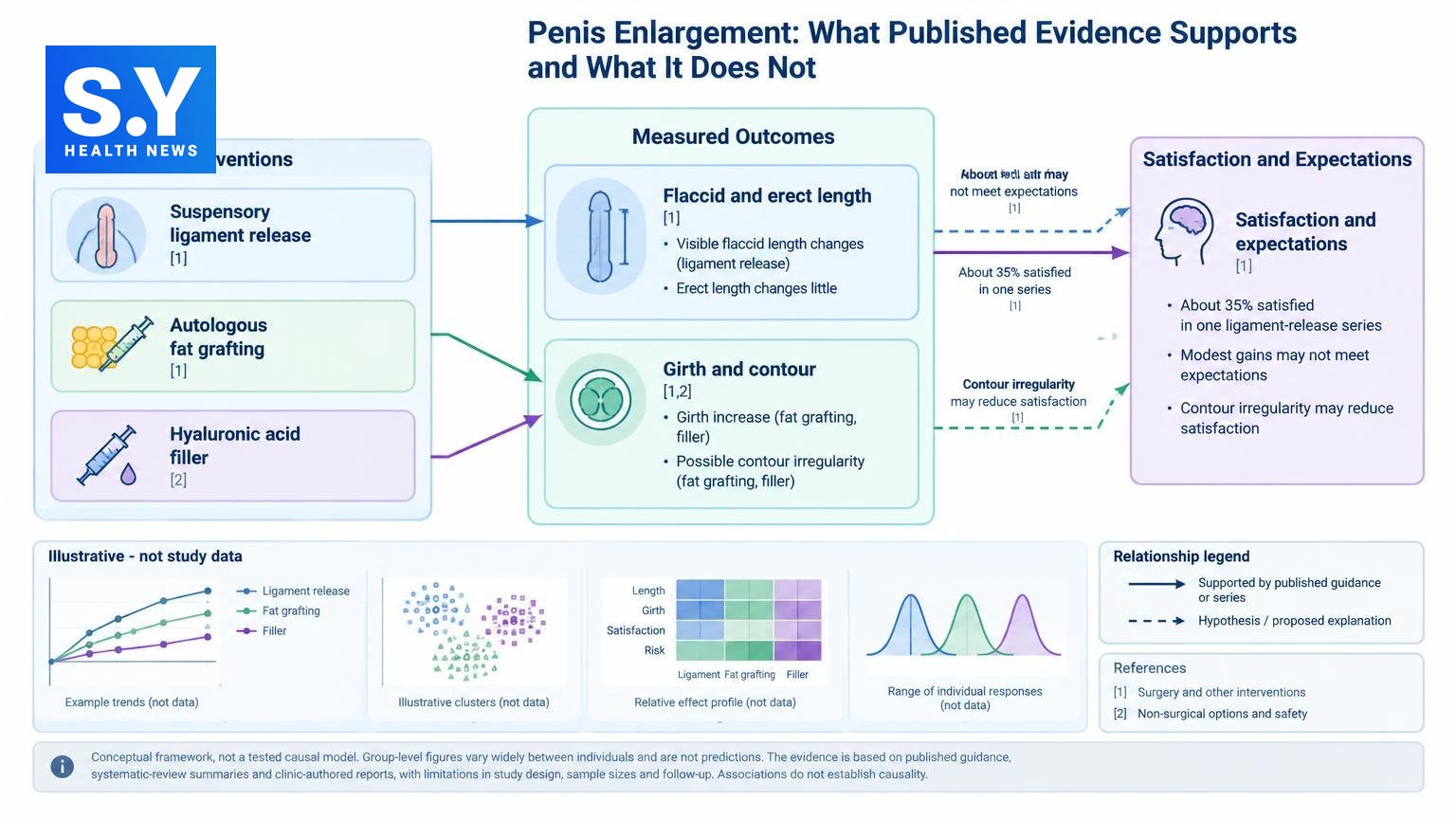
Conceptual framework: Conceptual framework, not a tested causal model. It maps the interventions discussed — suspensory ligament release, autologous fat grafting and hyaluronic acid filler — to the outcomes reported in published series: flaccid and erect length, girth and contour, and patient satisfaction. Solid arrows reflect associations or reported outcomes in the cited guidance; the dashed relationships concerning expectation are proposed explanations. Group-level figures vary widely between individuals and are not predictions.
Academic References & Evidence
- ผ่าตัดเพิ่มขนาด: มีวิธีไหนจริง ความเสี่ยง และข้อจำกัด.
- เพิ่มขนาดน้องชาย: ขนาดปกติ อะไรได้ผลจริง ความเสี่ยง.
- Dr. Akash Chandawarkar. Breast Augmentation Without Implants: What Actually Works.
SANYUN Science Center explains published research on men's reproductive and sexual health, connecting scientific evidence with everyday questions while making sources and limitations clear.
Disclaimer: This article is for scientific education and research communication only. It does not provide medical advice, diagnosis, or individualized treatment recommendations, and does not endorse any medication, supplement, device, penile enlargement procedure, or other intervention. Decisions about sexual and reproductive health should be made in consultation with a qualified healthcare professional. Do not delay seeking professional care because of information in this article.
Original Content & Copyright Notice
- This article is prepared for SANYUN Science Center, drawing on published research and publicly available academic literature on men’s sexual and reproductive health. Its editorial explanations and presentation are developed for this platform.
- Copyright in the original editorial content, selection, and arrangement is reserved by SANYUN Science Center to the extent protected by applicable law. Referenced research, quotations, and third-party materials remain subject to the rights of their respective owners. This notice does not claim ownership of scientific facts or third-party research.
- Except where permitted by applicable law or an applicable license, prior written permission is required to reproduce, republish, translate, adapt, redistribute, or commercially reuse protected content. Attribution alone does not grant permission for such reuse.
- For permitted quotation or authorized reuse, clearly identify the source and retain a link to the original article.
- Source: SANYUN Science Center
- Original URL: Retain the original article URL on science.san-yun.com.
- Copyright Holder: SANYUN Science Center, for its own protected editorial content.
- Quotation, excerpts, or authorized reuse must not distort the scientific meaning, omit material limitations or disclaimers, or imply unverified medical claims, product efficacy, or endorsement by SANYUN Science Center.



