




Category: Penis Enlargement
Core Research Direction: Psychological and evolutionary dimensions of penis-size concerns in men: how masculinity threat, shame, social attitudes, and mate/rival perception shape the importance men attach to penis size, and what clinical context this provides for men seeking enlargement.
Search Intent: Why do some men worry so much about penis size, and what does research actually show about how penis size affects attractiveness, rivalry, and men's self-image?
Platform: SANYUN Science Center
Evidence reviewed through: 2026-11-06
Executive Summary
Concern about penis size is common enough that it sustains a commercial market promising enhancement, yet the psychological research on why men care is thinner than the volume of advertising suggests. A critical discourse analysis of 42 websites selling sexual performance enhancement products found a consistent ideology: a big penis is presented as a source of prestige and confidence, a marker of health, and a guarantee of women's satisfaction, an ideology the author links to patriarchal views of male sexuality. That is a study of persuasion, not of anatomy or clinical outcomes, and it describes what advertisers claim rather than what is true.[1]
Separately, an experimental perception study asked more than 600 men and more than 200 women to rate computer-generated male figures varying in height, body shape, and penis size. Women rated taller, more V-shaped, larger-penis figures as more sexually attractive, but gains flattened beyond a point. Men rated the same exaggerated features as more intimidating as rivals and fighters; unlike women's flattening preference, men kept rating ever-larger penises as more of a sexual threat, which the authors read as men overestimating size's importance in mate attraction.[2]
A news report of four psychological studies adds a moderator: men insecure about their masculinity were the ones most focused on penis length, and that concern tracked shame rather than sexual frequency. The reporter's framing of political and religious correlates should be treated cautiously, but the broader pattern — size concern as a masculinity-threat phenomenon — is the most clinically useful thread running through this evidence.[3]
Why This Matters
Men who seek enlargement often arrive with a genuine distress that is poorly captured by a ruler. Reported research indicates that concerns about one's genitals can seriously affect mental well-being, which means the clinical task is not simply to measure and reassure but to understand what the measurement means to the man in front of the clinician.
The commercial environment complicates this. Advertising analyzed in the discourse study does not merely sell a product; it constructs a standard — that size confers prestige, signals health, and determines a partner's satisfaction. A man who absorbs those claims may present for enlargement not because of a physical finding but because he has accepted a narrative about what his body must demonstrate.
The Mechanism: Masculinity Threat, Shame, and Perceived Competition
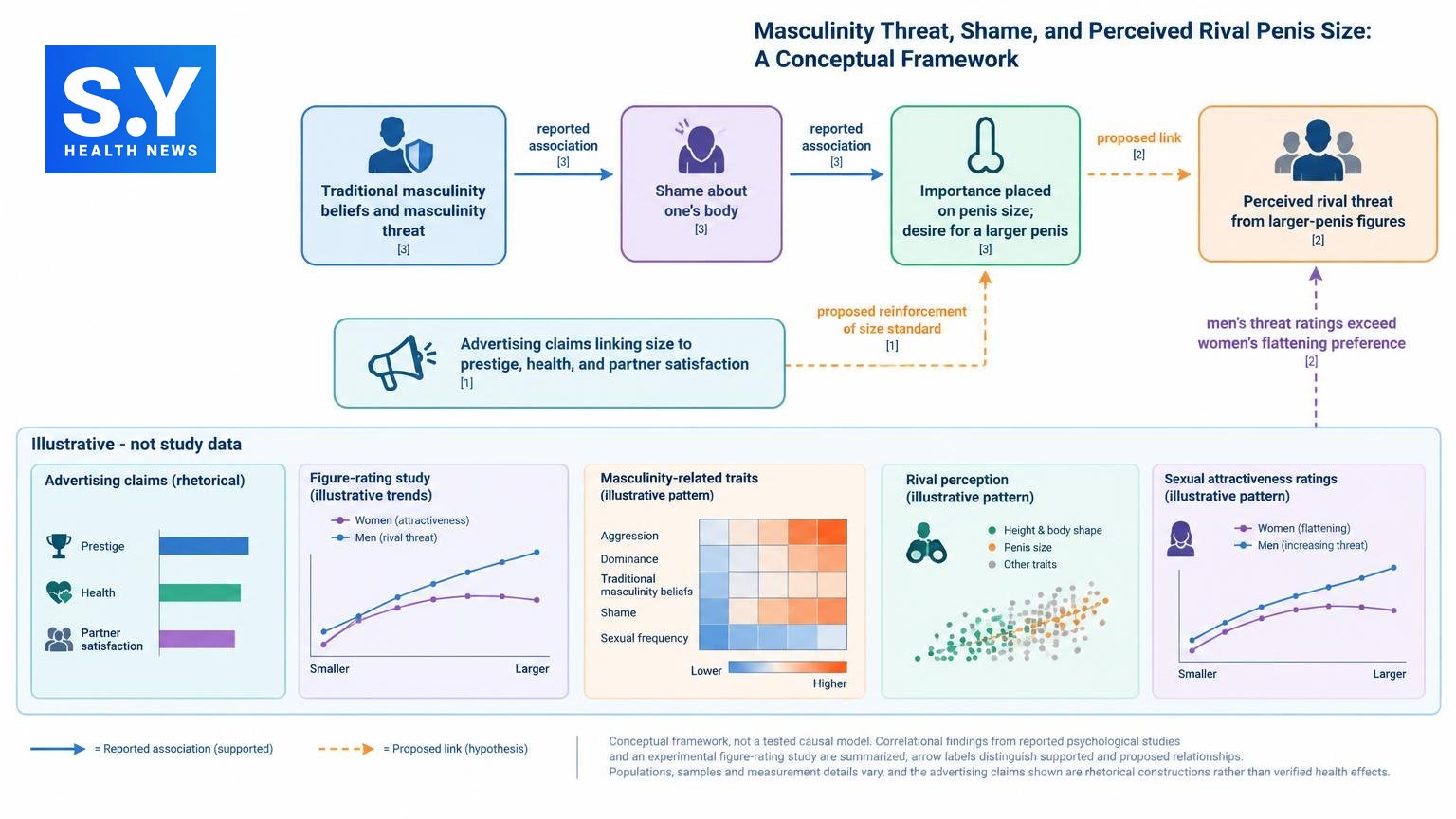
The most coherent psychological account across these sources is that penis-size concern is not primarily about sex. In the reported studies, men who placed more importance on penis length scored higher on aggression, dominance, traditional masculinity beliefs, and shame, while penis-length anxiety was not associated with how often participants had sex. That null association is informative: if concern were driven by sexual experience or performance, frequency should matter. It appears instead to be driven by identity.
A second test with 201 participants, more than double the first group of 88 American men, replicated the pattern that men worried about their masculinity place more value on penis length. A third study extended this: men concerned about masculinity both valued length more and wanted a larger penis themselves, with threatened masculinity accompanied by shame. A fourth study was reported as adding further evidence linking threatened masculinity, shame, and desire for a larger penis.
Shame is the connecting emotion here, and it has a particular structure. Shame concerns the self as observed and judged rather than a discrete act, which fits an organ that is hidden in ordinary life but hypothetically exposed to comparison. The discourse analysis supports this social dimension: the author argues that the big-penis ideology correlates with societal views of male sexuality and patriarchal ideology, meaning the standard is culturally transmitted rather than privately invented.
The rival-perception experiment adds a competitive layer. Men rated taller, more V-shaped, larger-penis figures as more intimidating both as sexual rivals and as fighting opponents, and the study is described as the first experimental evidence that men consider penis size when assessing a rival's fighting ability and attractiveness. Notably, height and body shape influenced men's perceptions of rivals more than penis size, which the authors take to suggest that penis size was more strongly favored in evolution for attracting mates than for intimidating competitors.
If men overweight size relative to other traits when scanning rivals, they may also overweight it when evaluating themselves — a plausible bridge between competitive perception and personal shame, though these studies did not directly test that pathway.
What the Evidence Shows
The figure-rating experiment is the strongest design in this packet: an experimental manipulation of depicted traits, with participants rating life-sized images in person or scaled images online. Women's ratings rose with height, shoulder-to-hip ratio, and penis size, but with diminishing returns beyond a certain point. Men's threat ratings also rose with the same traits, but men continued to rate ever-larger penises as more of a sexual threat. The divergence between the two curves is the study's most striking result.
The authors connect their findings to evolutionary questions: these pressures may help explain why humans evolved larger penises than other primates. That is an inference from a single perception study, not direct phylogenetic evidence, and it should be read as a hypothesis about selection pressures rather than a demonstration of them.
| Source and design | What was examined | Main reported result | Interpretive status |
|---|---|---|---|
| Critical discourse analysis of 42 websites selling men's sexual performance enhancement products | How advertising language constructs the meaning of penis size | Three recurring claims: size brings prestige and confidence, signals health, and satisfies women; linked by the author to patriarchal ideology | Interpretive analysis of advertising; not clinical evidence |
| Experimental figure-rating study, more than 600 men and more than 200 women | Sexual attractiveness (women) and rival threat (men) across varied height, body shape, penis size | Women's attractiveness ratings rose then flattened; men's threat ratings kept rising with larger penis size; height and shape mattered more to men's rival ratings | Experimental but based on computer-generated figures |
| First reported psychological test, 88 American men | Association between valuing penis length and personality and masculinity measures | Higher aggression, dominance, traditional masculinity beliefs, and shame; no association with sexual frequency | Correlational; details limited in secondary reporting |
| Second reported test, 201 participants | Replication of the masculinity-threat pattern | Men worried about masculinity placed more value on penis length | Replication as reported; secondary source |
| Fourth reported study | Threatened masculinity, shame, and desire for a larger penis | Reported as further evidence linking the three | Sample size not specified in the report |
Interpretation and Limitations
Several limits deserve emphasis. The psychological studies reached this article through a secondary news report; sample sizes beyond the first two tests are not specified, exact statistics are not given, and the political and religious correlates are correlational and framed in a charged way. The proposed explanation — that these groups more often hold traditional views of masculinity — is an interpretive hypothesis, not a tested causal pathway.
The figure-rating experiment has its own boundaries. Participants rated computer-generated figures, not real partners or real rivals, and viewing conditions mixed life-sized in-person images with scaled online images. Ratings of attractiveness and threat are not measures of mate choice, relationship outcomes, or violence. The evolutionary interpretation is a plausible inference from one study, not established fact.
The discourse analysis describes advertising rhetoric, not verified health effects. Its three-part ideology is evidence that advertisers make these claims, not that size confers health or guarantees a partner's satisfaction. Treating those claims as findings would repeat the very error the analysis documents.
A further caveat concerns directionality. Correlations between masculinity beliefs, shame, and size concern cannot establish whether traditional beliefs generate shame, whether shame drives men toward traditional beliefs as consolation, or whether both reflect a third factor. The reported studies appear to test associations rather than manipulate masculinity threat in a way that would settle the causal question in this packet.
Research Outlook
The convergence between experimental perception work and correlational psychology suggests a testable agenda: manipulating masculinity threat and measuring subsequent size concern and treatment-seeking, and examining whether men's overestimation of size's importance — the pattern the authors infer from their rating data — predicts real-world distress or pursuit of unproven products.
The evolutionary hypothesis would benefit from comparative and cross-cultural data rather than further single-sample rating experiments, and the advertising analysis invites research on exposure effects: whether repeated exposure to enhancement marketing shifts men's self-evaluation or their willingness to seek clinical care.
Clinical Relevance for Men Seeking Enlargement
These findings do not evaluate any enlargement method, and nothing in this packet supports a product or procedure. What they offer is context. A man presenting with size concerns may be reporting a masculinity-threat experience in which shame, comparison with rivals, and cultural messaging converge, and the absence of an association with sexual frequency in the reported data suggests that asking about sex life alone may miss the point.
Because concerns about one's genitals can seriously affect mental well-being, clinicians should take the distress seriously while being honest that the evidence base linking size to attractiveness, health, or partner satisfaction is far weaker and more conditional than advertising implies — with attractiveness gains flattening and competitive threat exaggerated in men's own ratings.
Questions and Answers
Why do some men worry so much about penis size even when there is no medical problem?
Reported studies suggest the worry is tied to masculinity and shame rather than sexual activity: men who valued penis length more scored higher on traditional masculinity beliefs and shame, and penis-length anxiety was not associated with sexual frequency. Advertising that links size to prestige, health, and partner satisfaction may reinforce the standard. These are correlational findings reported through a secondary source.
Do women actually prefer larger penises, according to the figure-rating study?
In the experiment, women rated taller, more V-shaped figures with larger penises as more sexually attractive, but gains flattened beyond a certain point, so further increases made little difference. Ratings of computer-generated figures are not real-world mate choice, and other traits also contributed. The study does not show that size determines a partner's satisfaction.
Why do men see larger-penised rivals as more threatening than women rate them attractive?
Men rated taller, more V-shaped, larger-penis figures as more intimidating as sexual rivals and fighters, and unlike women's flattening preference, men kept rating ever-larger penises as more of a sexual threat. The authors read this as men overestimating size's importance in attracting a mate. It is an inference from ratings of artificial figures, not evidence about real encounters.
How strong is the evidence linking threatened masculinity to wanting a larger penis?
The evidence is correlational and arrives via a news report of four studies. The first test involved 88 American men, the second 201 participants, and later samples are unspecified in the report. The pattern replicated, which strengthens confidence, but causality, effect sizes, and measurement details are not available, and political and religious correlates remain interpretive.
Is penis size really a sign of health or the key to a partner's satisfaction?
That claim comes from advertising, not clinical research. The discourse analysis found that enhancement advertisements construct an ideology in which a big penis increases prestige and confidence, indicates health, and satisfies women, but the study analyzed persuasion, not verified effects. Treating these claims as health facts would overstate what the evidence supports.
What are the limitations of research on penis-size anxiety and attraction?
Key limits include reliance on computer-generated figures, mixed viewing conditions, correlational psychology with limited published detail, a secondary news source, and evolutionary interpretation from a single study. None of these designs measured treatment outcomes or real relationship satisfaction. The findings describe perceptions and associations, not proven causes of distress or effective enlargement methods.
Conceptual framework: Conceptual framework, not a tested causal model. Correlational findings from reported psychological studies and an experimental figure-rating study are summarized; arrow labels distinguish reported associations (supported) from proposed links (hypothesis). Populations, samples, and measurement details vary, and the advertising claims shown are rhetorical constructions rather than verified health effects.
Academic References & Evidence
- Nantawat Nedjaroen. The Ideology of “Men Must Have a Big Penis.” in Online Advertisement about Men’s Sexual Performance Enhancement Product. Journal of Arts and Thai Studies. 2022 44(2):21–32
- Upama Aich; Michael D Jennions. Women find well endowed men more attractive, while men find them more. PLOS Biology. 2026
- Onzekere mannen en Trump-supporters hechten meer waarde aan penislengte, bewijst wetenschap.
SANYUN Science Center explains published research on men's reproductive and sexual health, connecting scientific evidence with everyday questions while making sources and limitations clear.
Disclaimer: This article is for scientific education and research communication only. It does not provide medical advice, diagnosis, or individualized treatment recommendations, and does not endorse any medication, supplement, device, penile enlargement procedure, or other intervention. Decisions about sexual and reproductive health should be made in consultation with a qualified healthcare professional. Do not delay seeking professional care because of information in this article.
Original Content & Copyright Notice
- This article is prepared for SANYUN Science Center, drawing on published research and publicly available academic literature on men’s sexual and reproductive health. Its editorial explanations and presentation are developed for this platform.
- Copyright in the original editorial content, selection, and arrangement is reserved by SANYUN Science Center to the extent protected by applicable law. Referenced research, quotations, and third-party materials remain subject to the rights of their respective owners. This notice does not claim ownership of scientific facts or third-party research.
- Except where permitted by applicable law or an applicable license, prior written permission is required to reproduce, republish, translate, adapt, redistribute, or commercially reuse protected content. Attribution alone does not grant permission for such reuse.
- For permitted quotation or authorized reuse, clearly identify the source and retain a link to the original article.
- Source: SANYUN Science Center
- Original URL: Retain the original article URL on science.san-yun.com.
- Copyright Holder: SANYUN Science Center, for its own protected editorial content.
- Quotation, excerpts, or authorized reuse must not distort the scientific meaning, omit material limitations or disclaimers, or imply unverified medical claims, product efficacy, or endorsement by SANYUN Science Center.



