




Category: Penis Enlargement
Core Research Direction: Quantifying flaccid dimensional change and complication rates after subcutaneous silicone penile sleeve implantation (Penuma/Himplant) from single-arm evidence, and clarifying what this evidence cannot establish about comparative effectiveness, erect dimensions, and patient-reported outcomes
Search Intent: In men undergoing Penuma or Himplant penile sleeve implantation, how much flaccid girth and length change has been reported, what complication rates have been pooled, and what limits the strength and applicability of that evidence?
Platform: SANYUN Science Center
Evidence reviewed through: 2026-11-12
Executive Summary
Subcutaneous silicone penile sleeve implants, marketed as Penuma and later Himplant, are positioned to increase flaccid penile dimensions and to address selected reconstructive problems. A 2026 systematic review and single-arm meta-analysis set out to quantify how much dimensional change and what complication profile the published literature actually reports. Twelve publications from 2018 to 2026 met inclusion criteria, but only four cohort studies provided data suitable for pooling; reports on special indications or complications were described narratively instead.[1]
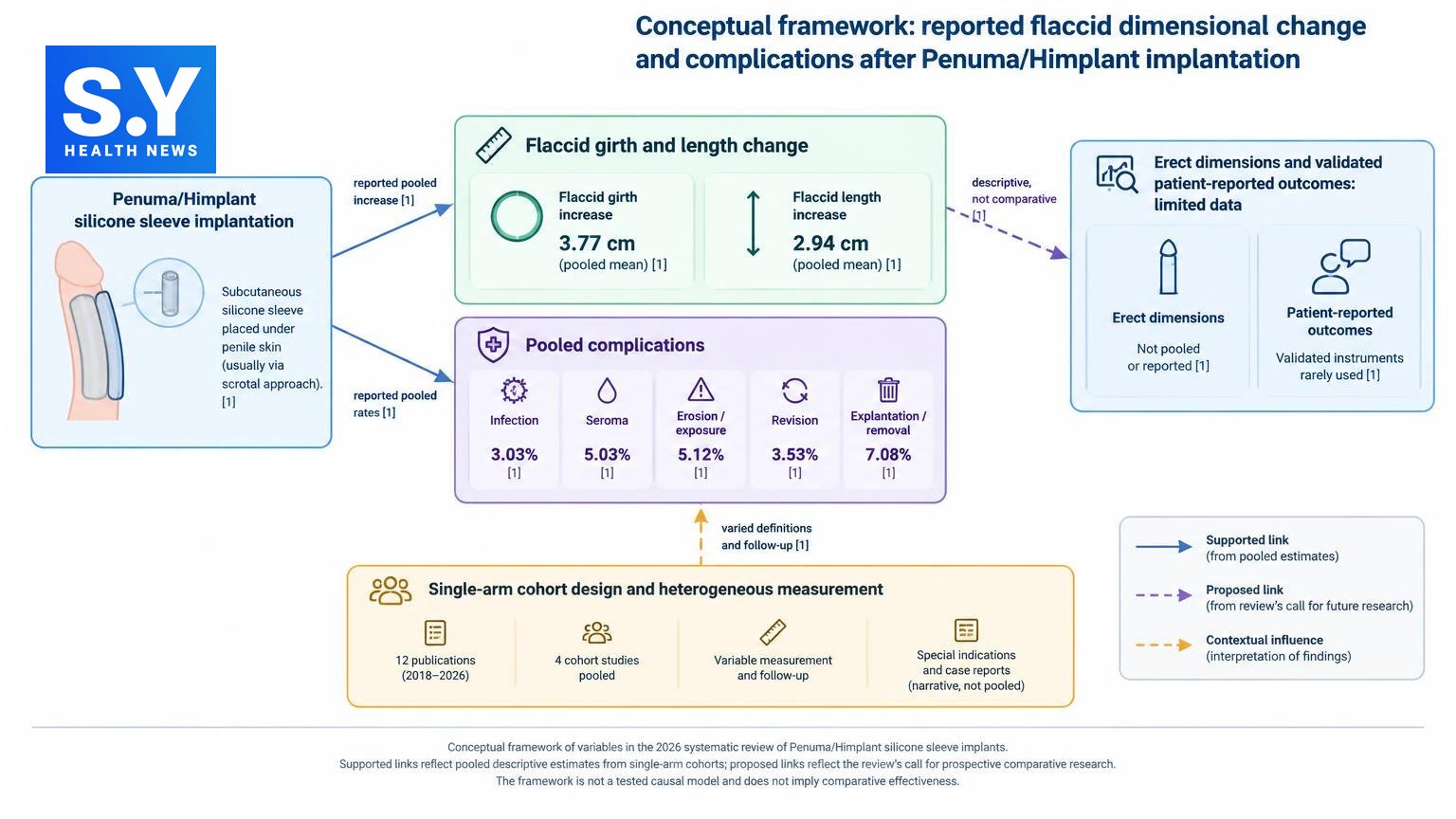
The pooled mean increase was 3.77 cm in flaccid girth and 2.94 cm in flaccid length. Pooled complication rates were 3.03% for infection, 5.03% for seroma, 5.12% for erosion or implant exposure, 3.53% for revision, and 7.08% for explantation or implant removal.[2]
These are descriptive, single-arm findings. They are limited to flaccid dimensions, do not establish comparative effectiveness, and rest on sparse data for erect dimensions and patient-reported outcomes, with validated instruments rarely used. The authors call for prospective comparative studies with standardized penile measurement, formal psychological assessment, validated instruments and longer follow-up.
Why This Matters
Penile augmentation is a field where patient expectations, commercial pressure and limited evidence intersect. Men considering a silicone sleeve implant usually want to know two things: how much change is realistic, and how often something goes wrong. The 2026 review provides the clearest pooled numbers available for the Penuma/Himplant product line, but its design determines what those numbers can and cannot mean.
The distinction matters clinically. A pooled average change from single-arm cohorts describes outcomes in the men who were operated on; without a comparison group, it cannot show that the procedure outperforms non-surgical alternatives, watchful waiting, or the natural variation that occurs with temperature, arousal and measurement technique. The review itself states that its findings do not establish comparative effectiveness.
Readers should also note the source landscape. Much of the accessible plain-language and translated material promoting these results is manufacturer-authored or adapted from a company blog, not independent peer-reviewed research, and the manufacturer discloses that outcomes vary and surgery carries risks. That does not invalidate the peer-reviewed review, but it should temper how confidently the pooled figures are marketed.[3][4][5]
How the Procedure Is Intended to Work
A silicone sleeve implant is a pre-formed medical-grade silicone shell placed beneath the penile skin, usually through a scrotal approach, so that it adds bulk around the shaft. In concept this increases measured circumference and, depending on device and technique, can change apparent length in the flaccid state. The review frames the technology as intended for flaccid dimensional increase and for selected reconstructive indications, and notes that the magnitude of change and the complication profile had not previously been systematically quantified.
Because the device sits as a sleeve around the shaft rather than replacing erectile tissue, its measured effects in published studies are reported in the flaccid penis. The review explicitly limits its descriptive findings to flaccid penile dimensions. This is an important boundary: it means the pooled centimetre figures should not be read as predicted erect length or girth gain, and no pooled erect measurement was available to test that assumption.
The plausibility of complications follows from the anatomy and materials rather than from any new mechanism claimed here. A foreign body under skin creates a potential space where fluid can collect (seroma), a surface where bacteria can seed (infection), and an interface where pressure can erode overlying tissue (erosion or exposure). These are general principles of implanted devices, not findings generated by the review.
What the Evidence Shows
The quantitative synthesis was deliberately narrow. Of 12 eligible publications from 2018 to 2026, only four cohort studies had clearly defined denominators and extractable outcome data and therefore entered the primary meta-analysis. Reports addressing special indications or complications were summarized narratively, which means complication case reports and reconstructive case series contributed context but not pooled rates.
The pooled complication estimates are best read as a descriptive summary across heterogeneous single-arm cohorts. Infection was pooled at 3.03%, seroma at 5.03%, erosion or implant exposure at 5.12%, revision at 3.53%, and explantation or implant removal at 7.08%. The excerpt does not state the total pooled denominator, and outcome definitions and follow-up varied between studies, so these percentages should carry visible uncertainty rather than being quoted as fixed personal risks.
The reconstruction literature sits outside the pooled estimate. A manufacturer-cited study of 12 patients with adult acquired buried penis, published online in July 2025, reported an average 3.52 cm increase in flaccid dorsal penile length, no penile infections, skin erosions or implant removals during the reported follow-up, and improved self-confidence in six of seven questionnaire respondents. A manufacturer article notes that the length figure exceeds the 2.94 cm pooled estimate, but states this is not evidence of superiority or a prediction for routine cosmetic patients because the populations and objectives differ.
| Outcome | Pooled or reported value | Population or source | Key limitation |
|---|---|---|---|
| Flaccid girth increase | 3.77 cm pooled mean | Four pooled Penuma/Himplant cohort studies | Single-arm cohorts; total denominator not stated in excerpt |
| Flaccid length increase | 2.94 cm pooled mean | Four pooled Penuma/Himplant cohort studies | Flaccid only; erect dimensions not pooled |
| Infection | 3.03% pooled | Included cohorts | Definitions and follow-up varied |
| Seroma | 5.03% pooled | Included cohorts | Definitions and follow-up varied |
| Erosion or implant exposure | 5.12% pooled | Included cohorts | Definitions and follow-up varied |
| Revision surgery | 3.53% pooled | Included cohorts | Whether revision was device-related may differ by study |
| Explantation or removal | 7.08% pooled | Included cohorts | Reasons for removal not pooled in excerpt |
| Flaccid dorsal length, buried penis | 3.52 cm average increase | 12 patients with adult acquired buried penis | Small, selected, reconstructive population; second-hand summary |
Interpretation and Limitations
The central limitation is design. Single-arm meta-analysis sums what happened in treated men; it has no concurrent comparator. Without one, a 3.77 cm girth or 2.94 cm length figure cannot be attributed to the device versus measurement practice, patient selection, concomitant procedures or reporting enthusiasm. The review authors are explicit that the findings do not establish comparative effectiveness.
Measurement standardization is a second problem. Penile dimensions are sensitive to temperature, arousal, technique and the site measured. The review recommends standardized penile measurements for future work, which implies the underlying studies were not uniform. A pooled mean can therefore blend different measurement conventions and follow-up windows.
Patient-reported outcomes are a third gap. The review found that validated instruments were rarely used, so satisfaction, body image and sexual function are poorly captured overall. The buried-penis self-confidence result (six of seven respondents) came from a follow-up questionnaire with partial response and a small sample, and should not be generalized to cosmetic patients.
Device generation adds complexity. A manufacturer article states that the pooled dimensional estimates derived from historical studies of the earlier-generation Penuma implant, with newer Himplant-specific publications evaluated separately, and that the review did not calculate separate pooled complication rates for the current Himplant device. Current-generation risks and benefits therefore remain incompletely quantified even where the lineage is well described.
Finally, the review's complication pooling mixes planned synthesis with narrative description. Complication and special-indication reports were summarized narratively, so serious or unusual events that appeared only in case reports may be under-represented in the pooled percentages. The pooled rates describe common outcomes in the included cohorts; they are not a complete safety inventory.
Research Outlook
The review's own prescription is the clearest roadmap: prospective comparative studies using standardized penile measurements, formal psychological assessment, validated outcome instruments and longer follow-up. Such designs would allow erect dimensions, satisfaction and durability to be evaluated alongside complications, and would let surgeons counsel men with realistic ranges rather than single pooled averages.
Until then, readers should treat the 2026 pooled figures as the best available descriptive summary of a narrow literature. The manufacturer reports more than 5,000 procedures across the technology's development and product generations, but that company-reported experience is not an audited outcome dataset and does not substitute for denominator-based follow-up.
Key Takeaways
- Twelve publications from 2018 to 2026 met inclusion, but only four cohort studies entered the primary meta-analysis.
- Pooled mean increases were 3.77 cm in flaccid girth and 2.94 cm in flaccid length.
- Pooled complication rates were 3.03% infection, 5.03% seroma, 5.12% erosion or exposure, 3.53% revision and 7.08% explantation or removal.
- Findings are limited to flaccid dimensions, do not establish comparative effectiveness, and lack validated erect and patient-reported outcome data.
- The evidence base is single-arm and non-comparative, so pooled figures are descriptive rather than causal or predictive for an individual.
Questions and Answers
What are Penuma and Himplant silicone sleeve penile implants?
They are pre-formed silicone sleeve devices placed under the penile skin, intended to increase flaccid penile dimensions and to address selected reconstructive indications. The 2026 review treats them as one product lineage. They are distinct from inflatable or malleable penile prostheses used to treat erectile dysfunction, and published evidence should not be generalized to unrelated implant brands.
How much flaccid girth and length increase did the 2026 Penuma and Himplant meta-analysis report?
The pooled mean increase was 3.77 cm in flaccid girth and 2.94 cm in flaccid length across four pooled cohort studies. These are flaccid measurements from single-arm cohorts, with the total pooled denominator not stated in the available excerpt. They should not be read as predicted erect gain or as an individual guarantee.
What complication rates were pooled for silicone penile sleeve implants?
Pooled rates were 3.03% for infection, 5.03% for seroma, 5.12% for erosion or implant exposure, 3.53% for revision and 7.08% for explantation or implant removal. These pooled percentages came from heterogeneous single-arm cohorts with varying definitions and follow-up, and the review did not compute separate pooled rates for the current Himplant device.
How strong is the evidence that Penuma or Himplant implantation works?
It is descriptive and low on the comparative hierarchy. Twelve publications were included but only four cohorts could be pooled, and all were single-arm. The review explicitly states the findings do not establish comparative effectiveness, erect-dimension and validated patient-reported data were limited, and prospective comparative studies with standardized measurement are still needed.
Does the 2026 review apply to the current Himplant device and to other silicone penile implants?
Partly. A manufacturer article states the pooled dimensional estimates came from historical Penuma studies, with newer Himplant publications assessed separately, and no separate pooled complication rates were calculated for current Himplant. The review concerns the Penuma/Himplant lineage only; it does not establish outcomes or regulatory status for unrelated silicone implants.
What limitations matter most when reading silicone penile sleeve implant results?
Single-arm design, sparse pooling, non-standardized measurement and limited validated patient-reported outcomes. A 12-patient buried-penis study reported a 3.52 cm average flaccid dorsal length increase with no infections, erosions or removals, but that small selected population cannot establish complication rates or superiority. Company-reported procedure counts also do not replace audited follow-up.
Conceptual framework: Conceptual framework of variables in the 2026 systematic review of Penuma/Himplant silicone sleeve implants. Supported links reflect pooled descriptive estimates from single-arm cohorts; proposed links reflect the review's call for prospective comparative research. The framework is not a tested causal model and does not imply comparative effectiveness.
Academic References & Evidence
- Hao Yang; Wenming Xiao; Hongquan Wang; Guoqiang Tang. Subcutaneous penile silicone sleeve implants for penile augmentation: a systematic review and meta-analysis – International Journal of Impotence Research. International Journal of Impotence Research. 2026 DOI: 10.1038/s41443-026-01368-8.
- Hao Yang. Subcutaneous penile silicone sleeve implants for penile augmentation: a systematic review and meta-analysis – NewsBreak. International Journal of Impotence Research. 2026
- Yang H; Xiao W; Wang H; Tang G. Himplant Clinical Research | 2026 Scientific Review. International Journal of Impotence Research. 2026
- Pesquisa clínica Himplant® | Revisão científica de 2026.
- Investigación clínica de Himplant®: revisión científica de 2026 sobre el aumento peneano cosmético | Himplant®.
SANYUN Science Center explains published research on men's reproductive and sexual health, connecting scientific evidence with everyday questions while making sources and limitations clear.
Disclaimer: This article is for scientific education and research communication only. It does not provide medical advice, diagnosis, or individualized treatment recommendations, and does not endorse any medication, supplement, device, penile enlargement procedure, or other intervention. Decisions about sexual and reproductive health should be made in consultation with a qualified healthcare professional. Do not delay seeking professional care because of information in this article.
Original Content & Copyright Notice
- This article is prepared for SANYUN Science Center, drawing on published research and publicly available academic literature on men’s sexual and reproductive health. Its editorial explanations and presentation are developed for this platform.
- Copyright in the original editorial content, selection, and arrangement is reserved by SANYUN Science Center to the extent protected by applicable law. Referenced research, quotations, and third-party materials remain subject to the rights of their respective owners. This notice does not claim ownership of scientific facts or third-party research.
- Except where permitted by applicable law or an applicable license, prior written permission is required to reproduce, republish, translate, adapt, redistribute, or commercially reuse protected content. Attribution alone does not grant permission for such reuse.
- For permitted quotation or authorized reuse, clearly identify the source and retain a link to the original article.
- Source: SANYUN Science Center
- Original URL: Retain the original article URL on science.san-yun.com.
- Copyright Holder: SANYUN Science Center, for its own protected editorial content.
- Quotation, excerpts, or authorized reuse must not distort the scientific meaning, omit material limitations or disclaimers, or imply unverified medical claims, product efficacy, or endorsement by SANYUN Science Center.



