




Category: Penile Size
Core Research Direction: Perceived versus measured penile size: what normative measurements exist, why men whose measured size is normal nonetheless seek lengthening or remain dissatisfied, and what the published evidence says about body-image factors, intervention efficacy and harms in men without pathological small penis.
Search Intent: If a man's measured penile size is within the normal range, why does he still worry about it — and what does published research actually show about the benefits and risks of enhancement attempts?
Platform: SANYUN Science Center
Evidence reviewed through: 2026-11-13
Executive Summary
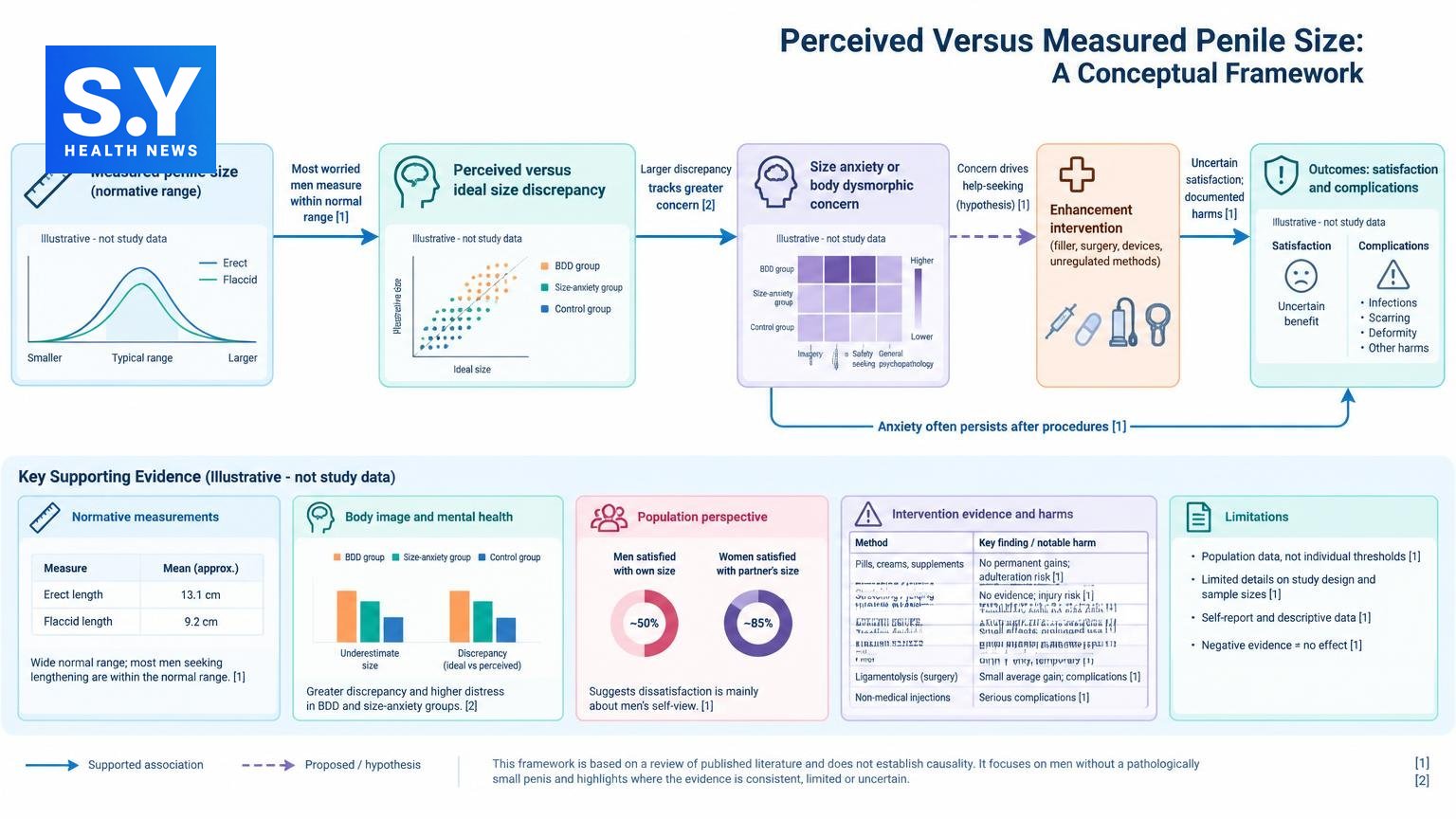
A consistent finding across clinical and psychological research is that the men most worried about penile size are usually not the men with the smallest measured penises. A systematic review of clinician-taken measurements in up to 15,521 men reported a mean erect length of about 13.1 cm and a mean flaccid length of about 9.2 cm, with a wide normal range for both.[1]
Yet in Mondaini et al. (2002), most men who presented requesting penile-lengthening surgery were measured and found to be within the normal size range. That single observation frames much of the clinical literature: the complaint is real, but the anatomical deficit often is not.
Body-image research helps explain the gap. In studies comparing men with body dysmorphic disorder concerning penis size, men anxious about size and controls, most men underestimated their penis size; the discrepancy between perceived and ideal size was largest in the BDD group and larger in the size-anxiety group than in controls.[2]
The intervention evidence is sobering. A systematic review by Marra et al. (2020) concluded that, among men with normally sized penises, many enhancement procedures carry high complication rates and uncertain satisfaction. No pill, cream or supplement has evidence for permanent gains, and several non-medical methods carry documented harms.
This review is an interpretation of published literature prepared for 2026, not a new study or systematic review. It focuses on men whose measured size is within normal limits, the psychological context of their concern, and what the published record says about helping versus harming them.
Why Measured Size and Perceived Size Diverge
Before evaluating any enhancement claim, it is useful to ask what the normative numbers actually are. The most widely cited reference — a systematic review of clinician-taken measurements in up to 15,521 men — reported a mean erect length of about 13.1 cm and a mean flaccid length of about 9.2 cm, with a wide normal range for both.
Those averages describe populations, not individuals. A man whose measurement sits anywhere inside that broad range can be entirely normal, yet comparisons with adult media — where performers are selected and camera angles are engineered — shift the internal benchmark upward. Many men who believe their penis is smaller than normal fall within the normal range when actually measured.
Measurement conditions also matter. Flaccid penile size varies substantially with temperature, stress and time of day and does not correlate directly with erect size, so locker-room comparisons or self-estimates made in a cold room say little about erect dimensions.
Body fat introduces a further visual distortion. Exercise and weight loss do not change actual penile size, but in men with a large abdominal fat pad, fat loss makes more of the penis visible — a visual effect rather than true size gain. This distinction between what is visible and what is measured recurs throughout the enhancement literature.
The clinical significance of this measurement-versus-perception gap is large. In the Mondaini cohort, most men seeking lengthening surgery were measured and found to be within the normal size range. The procedure they requested would have addressed a perception, not a documented anatomical deficiency.
The Psychology of Penile Size Dissatisfaction
Research from the body-dysmorphic-disorder literature provides the clearest window into why normal measurements can still cause distress. In a study comparing men with body dysmorphic disorder concerning penis size, men anxious about size, and controls, most men underestimated their penis size; the discrepancy between perceived and ideal size was largest in the BDD group and larger in the size-anxiety group than in controls.
The same study found that men with BDD concerning penis size scored significantly higher than both men anxious about penis size and men without penile concerns on measures of imagery, avoidance, safety seeking and general psychopathology. These are features of a clinical disorder, not simply vanity or a preference for a larger body part.
The authors also reported developing a screening scale that distinguishes penile dysmorphic disorder from non-pathological size anxiety, with good internal reliability and significant convergent validity with related constructs. Such a tool matters clinically because it separates men who might benefit from psychological care from those whose concern is milder and may resolve with accurate information.
Population-level data suggest the concern is common. In a large survey of more than 50,000 adults, only about half of men were satisfied with their own penis size, whereas 85% of women were satisfied with their partner's size. That gap suggests the dissatisfaction is predominantly about how men see themselves, not about how partners see them.
One hypothesis, consistent with the cohort data, is that being smaller or feeling different during adolescence — including teasing by peers or a sexual partner — increases vulnerability to later body dysmorphic concern. The authors noted this was not their original hypothesis, so it should be treated as a proposed explanation rather than an established causal pathway.
Research also repeatedly finds that men with normal measured size but high anxiety often remain dissatisfied even after procedures, because the target of care is perception rather than anatomy. This observation — a pattern rather than a single trial — is the strongest practical argument for screening expectations before offering any intervention.
What the Evidence Shows: Efficacy and Harms of Enhancement Attempts
The intervention literature for men with normal-sized penises and size dissatisfaction is limited, heterogeneous and generally discouraging. A systematic review by Marra et al. (2020) concluded that, among men with normally sized penises, many enhancement procedures carry high complication rates and uncertain satisfaction.
| Intervention | Reported Effect | Notable Harms |
|---|---|---|
| Pills, creams, supplements | No evidence for permanent size gains | Adulteration with undeclared PDE-5 inhibitors documented by regulators |
| Stretching / jelqing techniques | No evidence of effectiveness | Capillary rupture, fibrosis, penile curvature |
| Vacuum pumps | Temporary erection; no permanent size gain | Excessive pressure risks capillary injury |
| Traction devices | Reported small effects with several hours per day over several months | Prolonged use burden; supervised use advised |
| Hyaluronic acid filler | Temporary girth increase; no length increase; lasts about 1–2 years | Lumps, product migration, inflammation |
| Ligamentolysis (surgery) | Average visible flaccid gain roughly 1–2 cm; wide individual variation, some show little change | Scarring, altered sensation, complications |
| Non-medical injections (liquid silicone, oils, unknown substances) | No legitimate size benefit | Chronic inflammatory masses, tissue necrosis, permanent deformity, need for major corrective surgery |
For non-surgical methods, the evidence ranges from absent to modest. No pill, cream or supplement has evidence for producing permanent penile size gains. The more concrete risk in this category is product safety: Thailand's Food and Drug Administration has detected some men's dietary supplements adulterated with PDE-5-inhibitor drugs without label disclosure — a particular danger for men with heart disease or those using nitrate medications.
Mechanical methods fare little better. Online-shared stretching techniques lack evidence of effectiveness, but documented injuries exist, including capillary rupture, fibrosis and penile curvature. Vacuum pumps produce temporary erections and have a role in managing erectile dysfunction, but do not increase penile size permanently. Traction devices have limited evidence; reported effects are small and require continuous use of several hours per day over several months.
Medical options are more regulated but still limited. Hyaluronic acid filler temporarily increases girth but not length, with results typically lasting about 1 to 2 years before resorption, depending on product and individual. Ligamentolysis increases visible flaccid length; published studies report averages of roughly 1–2 cm, with wide individual variation and some men showing little or no change.
The most serious harms cluster around unregulated injections. Injection of non-medical substances such as liquid silicone, oils or unknown materials by non-physicians has been associated with serious complications, including chronic inflammatory masses, tissue necrosis, permanent deformity and the need for major corrective surgery. These are not theoretical risks; they represent a recurring pattern in the case-report literature.
Interpretation and Limitations
Several limitations qualify this evidence base. The normative review of up to 15,521 men provides mean values and a wide range, but the supplied summary does not report dispersion measures, age range or eligibility criteria, so the data describe populations rather than providing a precise diagnostic threshold for any individual.
The Mondaini finding that most men seeking lengthening measured within the normal range is important but summarized without the exact proportion, sample size or normality criteria. The Marra review conclusion is likewise a second-hand summary; pooled complication figures, study designs and certainty grading are not available in the supplied text.
The psychological literature carries its own constraints. The body-image findings derive from a cohort study of men with BDD, men anxious about size and controls, described through an author profile summary rather than the full paper; sample size, recruitment and measurement details are not stated. The screening-scale claim rests on the authors' own summary, without reliability coefficients or comparator measures.
The Lever survey of more than 50,000 adults is self-report and summarized only; response rates, sampling method and question wording are not provided. Its widely cited satisfaction gap should be read as descriptive rather than as a precise estimate of the proportion of men who are dissatisfied with their own anatomy.
For harms, several statements — including the absence of evidence for pills, creams and supplements — are negative assertions stated without individual study citations in the supplied text. Absence of evidence is not proof of no effect, but it is a sound basis for clinical caution when combined with documented adulteration and injury reports.
Research and Clinical Outlook
The most productive research direction may not be a new enlargement technique but better identification of who is genuinely helped by procedures and who is not. The distinction between penile dysmorphic disorder and non-pathological size anxiety — supported by a screening scale with good internal reliability and convergent validity — offers a practical way to triage men before surgery.
For clinical practice, the evidence supports starting with an accurate measurement and an honest conversation rather than an intervention. The documented pattern that men with normal measured size but high anxiety often remain dissatisfied even after procedures implies that psychological assessment and expectation management should precede, not follow, any discussion of surgery or fillers.
For men themselves, the key message from the published record is that the tools with the most confident evidence are the least invasive: correct measurement, realistic comparison and, where anxiety is persistent or impairing, psychological care. Interventions carry real risks, uncertain satisfaction and, in the unregulated space, severe documented harms.
Key Takeaways
- Normal erect length averages about 13.1 cm and flaccid length about 9.2 cm, with a wide normal range; most men who worry about size measure within that range.
- Most men underestimate their own size; perceived-versus-ideal discrepancies are largest in men with body dysmorphic disorder, intermediate in size-anxious men and smallest in controls.
- No pill, cream or supplement has evidence for permanent size gains, and some supplements have been found adulterated with undeclared prescription drugs.
- Hyaluronic acid filler adds girth for about 1–2 years; ligamentolysis surgery yields average visible flaccid gains of roughly 1–2 cm with wide individual variation.
- Unregulated injections of silicone, oils or unknown substances have caused chronic inflammation, tissue necrosis, permanent deformity and the need for major corrective surgery.
- Men with normal measured size but high anxiety often remain dissatisfied after procedures, which argues for psychological screening before any intervention.
Questions and Answers
What is the average penile length, and how wide is the normal range?
A systematic review of clinician-taken measurements in up to 15,521 men reported a mean erect length of about 13.1 cm and a mean flaccid length of about 9.2 cm, with a wide normal range for both. The supplied summary does not report dispersion measures or age ranges, so these are population averages rather than individual cut-offs.
Why do men with normal penile measurements still worry about their size?
Body-image research shows most men underestimate their own size, and the gap between perceived and ideal size is largest in men with body dysmorphic disorder and intermediate in men with size anxiety. Flaccid size varies with temperature and stress, media comparisons distort benchmarks, and men with normal measured size but high anxiety often remain dissatisfied even after procedures.
Do pills, creams or supplements for penile enlargement work?
No pill, cream or supplement has evidence for producing permanent penile size gains. Beyond wasted spending, some men's dietary supplements have been found adulterated with undeclared PDE-5-inhibitor drugs, which can be dangerous for men with heart disease or those using nitrates. Absence of evidence is not proof of no effect, but it is a sound basis for caution.
What are the benefits and risks of penile filler and lengthening surgery?
Hyaluronic acid filler temporarily increases girth but not length, with results lasting about 1–2 years; risks include lumps, migration and inflammation. Ligamentolysis surgery reports average visible flaccid gains of roughly 1–2 cm, with wide individual variation and some men showing little change. A 2020 systematic review concluded that many enhancement procedures in normally sized men carry high complication rates and uncertain satisfaction.
Are vacuum pumps or traction devices effective for permanent penile enlargement?
Vacuum pumps produce temporary erections and have a role in managing erectile dysfunction but do not increase penile size permanently. Traction devices have limited evidence; reported effects are small and require continuous use of several hours per day over several months. Excessive vacuum pressure risks capillary injury, and supervised use is advised.
When should persistent worry about penile size be treated as a psychological concern rather than a surgical one?
When worry recurs despite a normal measured size, affects confidence, relationships or daily life, or persists after an intervention, the target of care is perception rather than anatomy. Research distinguishes penile dysmorphic disorder from non-pathological size anxiety, and men with normal size but high anxiety often remain dissatisfied after procedures. An accurate measurement followed by psychological assessment is the evidence-aligned starting point.
Conceptual framework: Conceptual framework. In men without a pathologically small penis, measured size usually falls within the normal range, yet perceived-ideal discrepancy and size anxiety can drive help-seeking and procedures with uncertain satisfaction and documented harms. Relations shown are supported associations or proposed pathways from published summaries, not tested causal effects.
Academic References & Evidence
SANYUN Science Center explains published research on men's reproductive and sexual health, connecting scientific evidence with everyday questions while making sources and limitations clear.
Disclaimer: This article is for scientific education and research communication only. It does not provide medical advice, diagnosis, or individualized treatment recommendations, and does not endorse any medication, supplement, device, penile enlargement procedure, or other intervention. Decisions about sexual and reproductive health should be made in consultation with a qualified healthcare professional. Do not delay seeking professional care because of information in this article.
Original Content & Copyright Notice
- This article is prepared for SANYUN Science Center, drawing on published research and publicly available academic literature on men’s sexual and reproductive health. Its editorial explanations and presentation are developed for this platform.
- Copyright in the original editorial content, selection, and arrangement is reserved by SANYUN Science Center to the extent protected by applicable law. Referenced research, quotations, and third-party materials remain subject to the rights of their respective owners. This notice does not claim ownership of scientific facts or third-party research.
- Except where permitted by applicable law or an applicable license, prior written permission is required to reproduce, republish, translate, adapt, redistribute, or commercially reuse protected content. Attribution alone does not grant permission for such reuse.
- For permitted quotation or authorized reuse, clearly identify the source and retain a link to the original article.
- Source: SANYUN Science Center
- Original URL: Retain the original article URL on science.san-yun.com.
- Copyright Holder: SANYUN Science Center, for its own protected editorial content.
- Quotation, excerpts, or authorized reuse must not distort the scientific meaning, omit material limitations or disclaimers, or imply unverified medical claims, product efficacy, or endorsement by SANYUN Science Center.



