




Category: Clinical Insights
Core Research Direction: Peyronie's disease as a topic is supported only by consumer/tertiary reference content in the supplied sources; the only primary indexed research in the packet concerns a systematic review and meta-analysis of higher versus routine intraoperative blood pressure targets in noncardiac surgery, which does not address men's reproductive or sexual health. A defensible research direction cannot be anchored for the stated topic.
Search Intent: What do available sources actually establish about the nature, diagnosis, and treatment of Peyronie's disease, and what are the limits of that evidence?
Platform: SANYUN Science Center
Evidence reviewed through: 2026-11-06
Executive Summary
Peyronie's disease is described in reference sources as a condition in which fibrous tissue proliferation causes penile contraction and deformity, producing curvature during erection. The same manual-level description links penile inflammation to fibrotic scar tissue that makes penetration difficult or impossible, and notes that the cause of that inflammation is not precisely known.[1]
What follows is an interpretive review of the available source material, not a new experiment or systematic review. The evidence base here is essentially tertiary and consumer-facing: a peer-reviewed consumer manual entry, a tertiary health article, and several consumer disease summaries. No primary Peyronie's trial data are present in the packet, and one indexed primary research item in the packet concerns intraoperative blood pressure in noncardiac surgery, which has no bearing on men's sexual health. This review therefore reports what those sources claim, flags where they conflict, and avoids upgrading their statements into established clinical facts.[2][3][4][5]
Key claims across sources converge on the clinical picture — palpable plaque, erectile pain, curvature, and possible erectile dysfunction — but diverge on prevalence, etiology terminology, and the role of surgery. Prevalence is stated as 0.39–2% for clinically apparent cases and 3–4% in the general male population, figures that require cautious reading because denominators and study methods are not supplied. Surgical outcome ranges are extremely wide, which itself signals heterogeneous case series rather than standardized comparative evidence.
Why This Matters
Peyronie's disease affects a domain — erectile function and sexual intercourse — where deformity, pain and penetration difficulty can carry substantial psychological and relational weight. Reference sources describe curvature severe enough to make intercourse difficult or impossible, and note that scar tissue extending into the erectile tissue can cause erectile dysfunction. These are functional consequences, not cosmetic ones, and they shape how clinicians frame diagnosis and when intervention is justified.
The topic also matters because it is a case study in evidence asymmetry. Widely repeated claims — about prevalence, about how often ultrasound visualizes plaque, about how well surgery works — are circulated in consumer-facing material without visible study-level support. A patient or clinician reading such material cannot distinguish an estimate from a measurement. This review's purpose is to make that distinction explicit rather than to resolve it with unavailable data.
Biological and Clinical Mechanism as Described
The consumer manual frames the disease mechanistically: inflammation within the penis leads to fibrotic scar tissue, and because scar tissue does not expand during erection, the erect penis bends. Penetration becomes difficult or impossible, and scar tissue may extend into the corpora cavernosa and cause erectile dysfunction. The manual explicitly states that the cause of the inflammation cannot be accurately determined.
The tertiary article adds theoretical detail. The prevailing theory is chronic trauma to the penis during intercourse, with inflammatory mediators at microtrauma sites disrupting repair and altering the ratio of elastic to collagen fibers. A second, explicitly labeled theory proposes autoimmune inflammation of the tunica with lymphocyte and plasma cell infiltration. Neither is presented as established; the article elsewhere states the etiology is unknown. The same source describes plaque formation and stabilization typically occurring 6 to 18 months after onset and divides the course into an acute phase and a stable phase lasting 6 to 12 months.
A caution is warranted on terminology. One consumer summary relabels the condition as chronic cavernositis with atrophy and degeneration of the corpora cavernosa and possible congenital factors, a description that partially conflicts with the fibrosis-and-plaque framing in the more detailed sources. Where reference sources disagree on basic descriptors, the disagreement itself is informative: it shows the disease's pathophysiology is not settled in this literature layer.
What the Evidence Shows
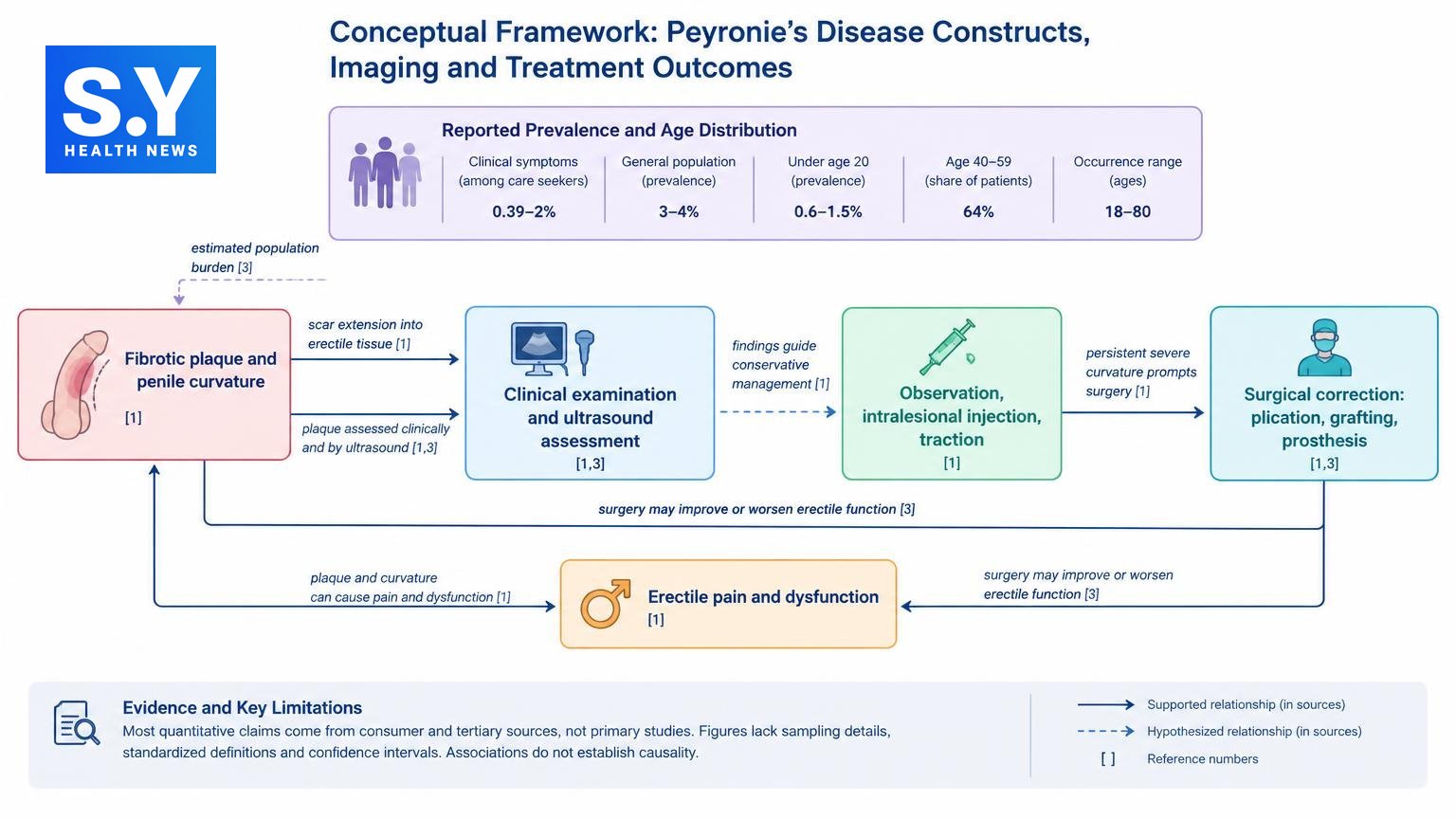
On prevalence, the tertiary article reports that clinical symptoms appear in 0.39–2% of cases — a figure it says reflects only patients presenting for care — while stating the actual prevalence in the general male population is higher at 3–4%. The same source reports that 64% of patients are aged 40–59, that occurrence spans ages 18–80, and that prevalence under age 20 is 0.6–1.5%. These numbers are stated without cited study designs, sampling frames, or denominators. They should be treated as the source's estimates, not as verified epidemiological measurements, and the gap between the two prevalence figures may reflect ascertainment differences as much as true disease frequency.
On diagnosis, the manual states that clinicians usually diagnose by examining the penis and sometimes use ultrasound to assess scar tissue. The tertiary article reports that penile ultrasound is widely used but that structurally detailed plaque was detected in only 39% of cases, attributed to pleomorphic and multi-level plaque growth. It also notes that plaque size and its dynamic change are generally considered non-decisive clinically and prognostically. That 39% figure is notable because it implies imaging may under-visualize disease rather than exclude it — but it comes from an unsourced tertiary statement, so it cannot be treated as a benchmark detection rate without primary confirmation.
On management, the sources describe a spectrum. The manual says no treatment is needed when curvature is minimal and sexual function is unimpaired, and that the condition may resolve without treatment after several months. It lists intralesional injections of steroids, verapamil, or Clostridium histolyticum collagenase as means of breaking down scar tissue, notes that radiotherapy may relieve pain but often worsens tissue damage, and reserves surgery for progression with severe curvature preventing intercourse. Plication tightens or shortens the contralateral side; scar excision shortens the penis and may worsen disease or cause erectile dysfunction; penile prosthesis may address both erectile dysfunction and curvature in men with baseline erectile dysfunction.
The tertiary article is more expansive but also more qualified. It states there is no etiology-directed treatment, that conservative therapy aims to stabilize the process, and that efficacy data for drug and physical therapies are very unclear because standardized outcome assessment is lacking. It provides surgical effectiveness ranges: 75–96% for Nesbit and modifications, with erectile dysfunction in 8–23%, glans sensitivity loss in 12%, and penile shortening in 14–98%; 52–94% for plication, with shortening in 41–90% and recurrence in 5–91%; and varied graft outcomes (75–96% for autologous vein, 70–75% for flap, 41% for freeze-dried dura, 58% for tunica vaginalis) with erectile dysfunction in 12–40%. These figures are aggregated without sample sizes or definitions, and the extraordinary width of the ranges is itself a red flag for pooling heterogeneous series.
| Variable | Definition in sources | Reported value | How to interpret it |
|---|---|---|---|
| Symptomatic prevalence | Share of cases in which clinical symptoms are reported | 0.39–2% | Described as reflecting only patients seeking care; denominators not supplied |
| Stated population prevalence | Prevalence in the general male population | 3–4% | Stated estimate; sampling method not described |
| Prevalence under age 20 | Prevalence among men younger than 20 | 0.6–1.5% | Source-stated; no study-level detail |
| Age concentration | Share of patients aged 40–59 | 64% | Distribution claim; occurrence reported across ages 18–80 |
| Ultrasound plaque detection | Cases with structurally detailed plaque on penile ultrasound | 39% | Attributed to pleomorphic plaque growth; no primary source given |
| Time to stabilization | Interval from onset to plaque formation and disease stability | 6–18 months | Typical course claim; phases described as acute and stable (stable phase 6–12 months) |
| Nesbit effectiveness | Deformity correction with Nesbit and modifications | 75–96% | Pooled heterogeneous series; erectile dysfunction 8–23% |
| Plication effectiveness | Deformity correction with plication | 52–94% | Shortening 41–90%; recurrence 5–91% |
Interpretation and Limitations
The central limitation is evidentiary, not clinical. Every quantitative claim in this review traces to consumer or tertiary reference content, not to primary cohorts, randomized trials, or systematic reviews of Peyronie's disease. That matters because numbers presented without methods cannot be checked for selection bias, outcome definitions, or follow-up. The wide surgical ranges — for example 14–98% for shortening after Nesbit and 5–91% for recurrence after plication — almost certainly reflect differences in case mix, surgical technique, and how outcomes were defined, rather than a single stable risk estimate.
There are also direct conflicts among sources that a careful reader should not smooth over. One consumer portal states that more cases require surgical excision of the fibrotic mass, which sits uneasily with the manual's position that surgery is not recommended unless disease has progressed with severe curvature preventing intercourse. One summary relabels the condition as chronic cavernositis. Such discrepancies suggest that some consumer material simplifies or misstates clinical nuance; where tertiary sources disagree, the safer reading is the more conservative one, pending better evidence.
A separate and important limitation concerns the packet itself. The only primary indexed research included is a systematic review and meta-analysis of higher versus routine intraoperative blood pressure targets in elective noncardiac surgery — 15 trials and 15,603 patients showing no reduction in acute kidney injury or myocardial injury with higher targets. That study is methodologically instructive about how randomized evidence can overturn observational assumptions, but it has no applicability to Peyronie's disease and must not be pressed into service as support for any claim about men's sexual health. It is mentioned here only to be explicit that no relevant primary trial evidence was available.
Statistical versus clinical caution applies even to the numbers that are reported. A 39% ultrasound detection figure and a 3–4% population prevalence are point statements without confidence intervals or sampling error. They may be clinically meaningful if confirmed, but in their current form they are descriptive claims, not measurements suitable for counseling an individual patient about his likelihood of disease or imaging success.
Research Outlook
What this evidence base needs is not more repetition of the same claims but primary studies with explicit sampling, standardized curvature measurement, defined acute and stable phases, and consistent outcome definitions for pain, curvature, erectile function, and penile length. The tertiary article's own observation that drug and physical therapy efficacy data are very unclear because of non-standardized assessment methods identifies the gap precisely: it is a measurement problem as much as a therapeutic one.
The theoretical literature also invites prospective testing. Chronic microtrauma and autoimmune mechanisms are stated as theories, and the 6–18 month stabilization timeline is stated as typical rather than derived from a described cohort. Formal natural history studies with serial assessment would allow clinicians to distinguish patients likely to stabilize from those who progress, and could clarify when observation is appropriate versus when intervention is justified. None of that is available in the supplied sources.
For surgical outcomes, the priority is registry-level or trial-level data using consistent definitions of correction, recurrence, shortening, and erectile dysfunction. The current ranges are so broad that they cannot inform shared decision-making with any precision, and the absence of sample sizes means even the direction of comparative advantage between plication and grafting remains unresolved in this material.
Key Takeaways
- Peyronie's disease is described as fibrous tissue proliferation causing penile contraction and curvature during erection, with inflammation-linked scar tissue and an incompletely understood cause.
- Diagnosis is usually clinical via penile examination, with ultrasound sometimes used to assess scar tissue; one tertiary source reports detailed plaque detected in only 39% of cases.
- Prevalence is stated as 0.39–2% for symptomatic cases and 3–4% in the general male population, with 64% of patients aged 40–59 — estimates lacking described sampling methods.
- No etiology-directed treatment is described; options range from observation and intralesional injections to plication, grafting, and prosthesis, with surgery generally reserved for severe curvature impairing intercourse.
- Surgical outcome ranges are very wide (plication effectiveness 52–94%, shortening 41–90%), reflecting heterogeneous series without standardized definitions.
- No primary Peyronie's trial evidence was available in the packet; the only indexed primary research concerned intraoperative blood pressure in noncardiac surgery and is not applicable here.
Questions and Answers
What is Peyronie's disease and what causes the penile curvature?
Reference sources describe Peyronie's disease as fibrous tissue proliferation that causes penile contraction and deformity, producing curvature during erection. Inflammation leads to fibrotic scar tissue that does not expand during erection, so the penis bends, and scar extending into the corpora cavernosa can cause erectile dysfunction. The cause of the inflammation is explicitly stated as not precisely known.
How common is Peyronie's disease according to available prevalence estimates?
One tertiary source states clinical symptoms appear in 0.39–2% of cases, reflecting only patients seeking care, while the actual prevalence in the general male population is stated as 3–4%. It also reports 64% of patients are aged 40–59 and prevalence under age 20 is 0.6–1.5%. These are source-stated estimates without described sampling methods or denominators, so they should not be treated as verified measurements.
How is Peyronie's disease diagnosed and how reliable is penile ultrasound?
The consumer manual states diagnosis is typically made by physical examination of the penis, with ultrasound sometimes used to assess scar tissue. A tertiary source adds that penile ultrasound is widely used but that structurally detailed plaque was detected in only 39% of cases, attributed to pleomorphic and multi-level plaque growth. That detection figure lacks a described primary source, so it is a caution about imaging limits rather than a validated benchmark.
What treatment options are described for Peyronie's disease and when is surgery considered?
Sources describe observation when curvature is minimal and sexual function is intact, noting possible spontaneous improvement over months; intralesional injections of steroids, verapamil, or collagenase; and physical approaches such as traction. Surgery is generally reserved for progression with severe curvature preventing intercourse, using plication, scar excision, or prosthesis in men with baseline erectile dysfunction. Radiotherapy may relieve pain but often worsens tissue damage.
How strong is the evidence behind reported Peyronie's disease surgical success rates?
The reported ranges come from tertiary consumer content pooling heterogeneous surgical series without sample sizes or standardized definitions: Nesbit correction 75–96% with erectile dysfunction 8–23% and shortening 14–98%; plication 52–94% with shortening 41–90% and recurrence 5–91%; graft procedures 41–96% depending on material with erectile dysfunction 12–40%. The very wide ranges signal real heterogeneity and weak comparability rather than precise risk estimates.
Can Peyronie's disease resolve without treatment, and what is its typical course?
The consumer manual states that when curvature is minimal and sexual function is not impaired, no treatment is needed, and the condition may resolve without treatment after several months; no proportion of spontaneous resolution is given. A tertiary source describes an acute phase and a stable phase lasting 6 to 12 months, with plaque formation and stabilization typically occurring 6 to 18 months after onset. These are typical-course claims, not cohort-derived probabilities for an individual patient.
Conceptual framework: Conceptual framework, not a tested causal model. Based on consumer and tertiary reference sources: plaque and curvature relate to pain and erectile dysfunction; examination and ultrasound inform conservative management; surgery is considered for severe curvature. Prevalence and surgical outcome figures are source-stated estimates without described sampling or standardized definitions.
Academic References & Evidence
- Patrick J. Shenot, MD; Leonard G. Gomella, MD. 佩罗尼病 – 男性健康 – 《默沙东诊疗手册大众版》. MSD Manuals (Consumer Edition). 2025
- Katie Chiou; Sovann Vikram; Kiana Rowshan; Smeet Shah; Dolly Modha; Edgard Engelman; David Guthrie; Anil Tiwari; Joseph Rinehart; Alexandre Joosten; Bernd Saugel; Sean Coeckelenbergh. Higher versus Routine Intraoperative Blood… : Anesthesiology. Anesthesiology. 2026 145(4):872-888 DOI: 10.1097/ALN.0000000000006190.
- 阿列克谢·波特诺夫. 佩罗尼氏病. 2012
- 佩罗尼病.
- 佩罗尼病介绍、症状、病因、治疗_疾病库_健康之路. 健康之路
SANYUN Science Center explains published research on men's reproductive and sexual health, connecting scientific evidence with everyday questions while making sources and limitations clear.
Disclaimer: This article is for scientific education and research communication only. It does not provide medical advice, diagnosis, or individualized treatment recommendations, and does not endorse any medication, supplement, device, penile enlargement procedure, or other intervention. Decisions about sexual and reproductive health should be made in consultation with a qualified healthcare professional. Do not delay seeking professional care because of information in this article.
Original Content & Copyright Notice
- This article is prepared for SANYUN Science Center, drawing on published research and publicly available academic literature on men’s sexual and reproductive health. Its editorial explanations and presentation are developed for this platform.
- Copyright in the original editorial content, selection, and arrangement is reserved by SANYUN Science Center to the extent protected by applicable law. Referenced research, quotations, and third-party materials remain subject to the rights of their respective owners. This notice does not claim ownership of scientific facts or third-party research.
- Except where permitted by applicable law or an applicable license, prior written permission is required to reproduce, republish, translate, adapt, redistribute, or commercially reuse protected content. Attribution alone does not grant permission for such reuse.
- For permitted quotation or authorized reuse, clearly identify the source and retain a link to the original article.
- Source: SANYUN Science Center
- Original URL: Retain the original article URL on science.san-yun.com.
- Copyright Holder: SANYUN Science Center, for its own protected editorial content.
- Quotation, excerpts, or authorized reuse must not distort the scientific meaning, omit material limitations or disclaimers, or imply unverified medical claims, product efficacy, or endorsement by SANYUN Science Center.



