




Category: Clinical Insights
Core Research Direction: Peyronie's disease (penile induration/fibrous cavernositis): clinical definition, natural history, and what current nonsurgical versus surgical management can and cannot achieve in adult men
Search Intent: For an adult man with Peyronie's disease, what does the clinical evidence say about the condition's natural course and about whether injection, traction, or surgical treatments actually work?
Platform: SANYUN Science Center
Evidence reviewed through: 2026-11-06
Executive Summary
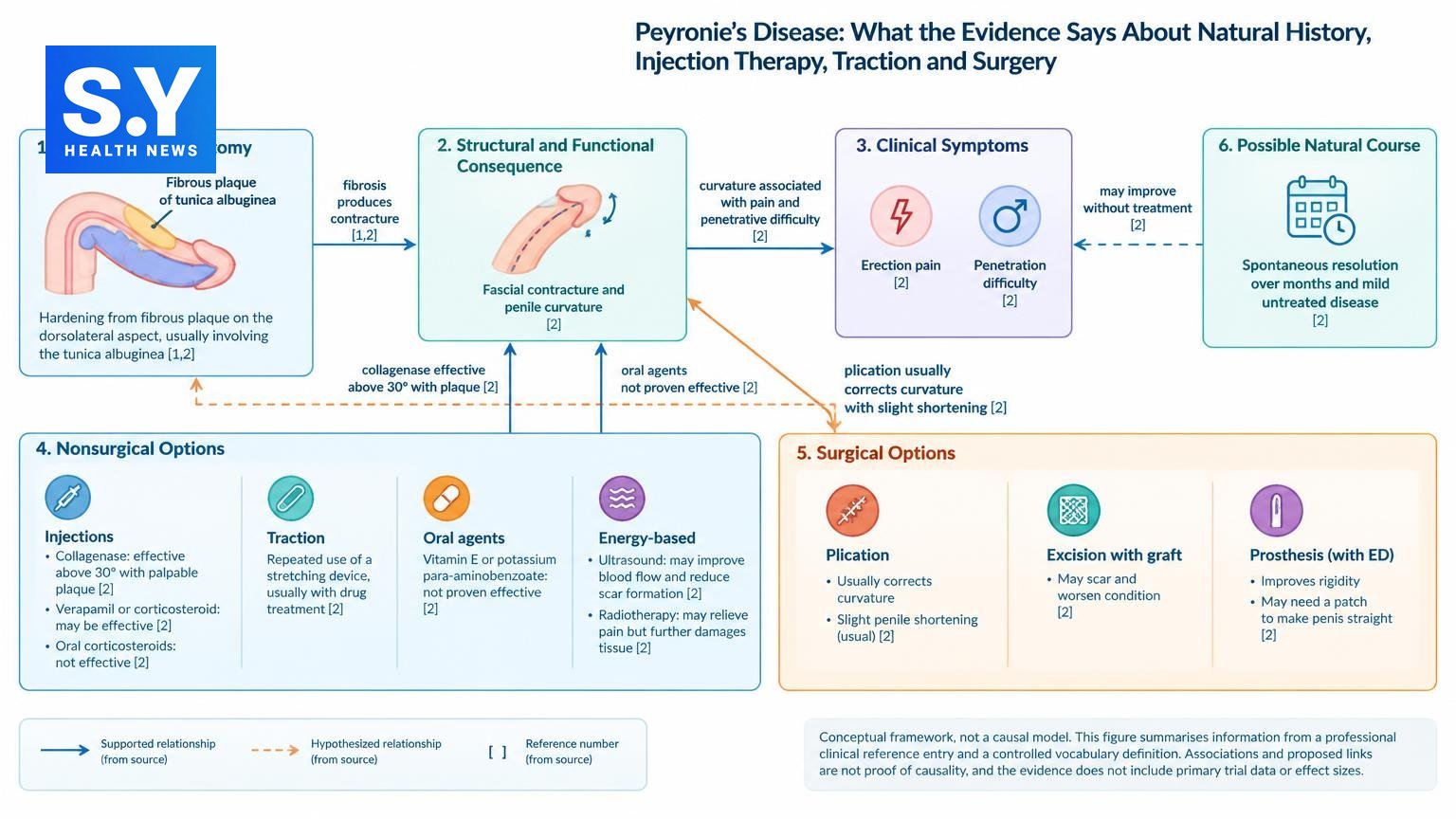
Peyronie's disease, also recorded in controlled medical vocabulary as penile induration, is penile hardening caused by fibrous plaques on the dorsolateral aspect of the penis, usually involving the tunica albuginea that surrounds the erectile tissue. The same condition appears in clinical reference material as fibrosis of the sheath of the corpora cavernosa, producing fascial contracture that bends the erect penis and causes erection pain.[1][2]
Several features of the published clinical picture matter for anyone weighing treatment. The cause is unknown, and reference material links it speculatively to processes resembling Dupuytren contracture and to prior trauma, possibly during intercourse. Curvature typically points toward the affected side, erection pain occurs in some men, and penetration may become difficult. The condition may settle on its own over months, and mild disease without sexual dysfunction needs no treatment.
Treatment expectations should stay modest. Clinical reference text describes treatment response as somewhat unpredictable and states that oral agents such as vitamin E or potassium para-aminobenzoate have not been proven effective. Intralesional collagenase has been described as effective for curvature greater than 30 degrees with a palpable plaque, given as 1 to 4 courses; verapamil or potent corticosteroid injections may be effective; traction and several surgical options exist, each with defined limitations.
Why This Matters
Peyronie's disease is a condition of adult men, and its defining problem is mechanical as much as inflammatory: a plaque tethers and contracts tissue so that the erect penis bends. Because penetration can be hindered and because the deformity is visible and sexually consequential, men often seek treatment quickly and are receptive to confident claims. The evidence base available here does not support confident claims about most nonsurgical options.
A second reason for caution is that the condition can improve without intervention. Reference material notes that over months the disease may resolve spontaneously and that mild disease not causing sexual dysfunction requires no treatment. Any treatment therefore has to be judged against a background of possible natural improvement, not against a fixed baseline of deterioration.
Definition and Biological Context
Controlled vocabulary defines penile induration as hardening of the penis from fibrous plaque formation on the dorsolateral aspect, usually involving the tunica albuginea surrounding the corpus cavernosum. The clinical reference description adds the functional consequence: fibrosis of the cavernosal sheath causes fascial contracture, bending the erect penis and producing erection pain. Both descriptions point to the same structure — the fibrous envelope of the erectile bodies — as the site of disease.
The definition also flags later consequences. The condition may eventually cause painful deformity of the penile shaft, constriction of the urethra, or both. That urethral involvement is worth noting because it frames the disease as potentially more than a cosmetic curvature issue, although the source gives no frequency or time course for these outcomes.
Mechanistically, the sources stay descriptive rather than molecular. No cell-level or animal data on fibroblast activity, collagen subtype switching or plaque remodeling are provided in this evidence packet, so any statement about how fibrosis begins or reverses at tissue level would go beyond what can be supported here. The plausible mechanisms described — fascial contracture and plaque tethering — explain the deformity but not its origin.
Natural History: Spontaneous Change and Mild Disease
The most clinically important natural-history statement in the source is that the condition may resolve on its own over months. This is an imprecise statement: it does not specify what proportion of men improve, how much curvature reduction counts as resolution, or whether pain and curvature follow the same course. It is nonetheless significant, because it means a new diagnosis is not automatically an indication for immediate intervention.
The complementary statement is that mild disease which does not cause sexual dysfunction requires no treatment. The source does not define 'mild' or 'sexual dysfunction', so the boundary is a clinical judgment rather than a measured threshold. In practice, this suggests that the decision to treat should hinge on symptoms and functional impact — pain, penetration difficulty, distress — rather than on the mere presence of a plaque.
What the packet does not contain is equally important. There are no incidence or prevalence figures, no data on the proportion of men with stable versus progressive curvature, and no long-term follow-up describing which men develop urethral constriction. Statements implying a typical trajectory would be unsupported.
Diagnosis: Clinical Examination and Documentation
Diagnosis is described as based on history and physical examination, with additional tests such as ultrasound of the erect penis used to document fibrosis. That sequence matters for interpreting the treatment literature: the palpable plaque and the measured curvature are clinical findings, not laboratory biomarkers, and the same examination findings are used to select men for specific therapies.
The source does not report the diagnostic accuracy of ultrasound or of physical examination, so it is not possible to state from this packet how often imaging changes management. It also does not describe how curvature is measured in a standardized way, which is relevant because at least one treatment recommendation is tied to a specific curvature threshold.
What the Evidence Shows for Nonsurgical Options
Oral therapy is the weakest area. The reference text states that treatment response is somewhat unpredictable and that oral treatments such as vitamin E or potassium para-aminobenzoate have not been proven effective. This is a negative evidentiary statement, not proof that they are harmful; the practical implication is that a man taking an oral supplement should not assume a plaque will respond.
Injection therapy is more differentiated. Local injection of verapamil or potent corticosteroids may be effective, but oral corticosteroids are not effective; local corticosteroids are hedged with 'may'. For intralesional collagenase from Clostridium histolyticum, the source is more specific: in men with penile curvature greater than 30 degrees and a palpable plaque, 1 to 4 courses have been shown to be effective. That effectiveness claim is tied to a defined population and a defined curvature threshold.
The collagenase protocol as described is one course approximately every 6 weeks, each course consisting of two injections followed by home manual penile remodeling — stretching and straightening exercises. The source does not give the magnitude of curvature improvement, the comparator used, or the frequency of adverse effects; the claim of effectiveness should therefore be read as a categorical statement rather than a quantified benefit.
Physical and energy-based modalities are described in mechanistic terms. Ultrasound therapy is said to accelerate blood flow and reduce ongoing scar formation, while radiotherapy may relieve pain but further damages tissue. Neither statement is accompanied by comparative outcome data in this source, and the ultrasound claim in particular is a proposed rationale rather than a demonstrated clinical benefit.
External traction is described as repeated use of a stretching device to straighten the penis, usually combined with drug treatment. The source offers no data on the degree of straightening achieved, adherence, or how traction compares with injection therapy alone.
What Surgery Can and Cannot Achieve
Surgery is presented as effective in selected cases but with real trade-offs. Excision of fibrous tissue with patch grafting may be effective, yet it may also generate scarring that worsens the condition. Patch material options listed include autologous grafts (dermis, tunica vaginalis or buccal mucosa), allografts (usually cadaveric pericardium), xenografts (bovine pericardium or intestinal submucosa) and synthetic materials.
Plication surgery takes a different approach: sutures shorten the side opposite the plaque. The source states that this usually corrects the curvature successfully but usually results in slight penile shortening. That is a trade-off of geometry rather than a complication, and it is the clearest example in this evidence packet of a treatment that achieves its primary anatomical goal while accepting a predictable cost.
For men with erectile dysfunction requiring a prosthesis, the source notes that a prosthesis can be implanted to improve penile function but that a patch may be needed to make the penis straight. This combines two problems — rigidity and deformity — in one surgical plan and is described qualitatively only.
Interpreting the Evidence: What Kind of Literature This Is
The core evidence here is tertiary clinical reference material, a professional manual entry last updated in December 2025, supported by a controlled vocabulary definition. It summarizes practice and cites guidelines and reviews but does not itself report primary trial data, effect sizes, confidence intervals or adverse-event rates for the treatments it lists. Statements such as 'may be effective' or 'has been shown to be effective' therefore cannot be converted into numbers from this packet.
This matters for how the review should be read. Categorical claims — effective, not proven effective, may worsen — are useful for orienting a conversation but are not the same as comparative effectiveness. A reader should not infer that collagenase is superior to traction or to plication, because the source does not make that comparison. Similarly, the statement that oral vitamin E is unproven does not establish that it is inferior to injection therapy in a head-to-head trial.
A further interpretive limit is population definition. The effectiveness claim for collagenase is explicitly restricted to men with curvature greater than 30 degrees and a palpable plaque. Applying that claim to men with lesser curvature, or to men without a palpable plaque, is an extrapolation the source does not authorize.
| Option | Stated position in the source | Key condition or trade-off | What remains unquantified |
|---|---|---|---|
| Oral vitamin E or potassium para-aminobenzoate | Not proven effective | Oral route; treatment response described as somewhat unpredictable | Any effect size, trial data or subgroup response |
| Intralesional verapamil or potent corticosteroid | May be effective; oral corticosteroids are not effective | Local injection route | Magnitude of benefit and comparative performance |
| Intralesional collagenase (Clostridium histolyticum) | Shown to be effective in a defined group | Curvature greater than 30 degrees with palpable plaque; 1 to 4 courses, one course about every 6 weeks with two injections plus home remodeling | Degree of curvature change and adverse-event frequency |
| External traction device | Used to straighten the penis, usually with drug treatment | Repeated device use | Straightening achieved and adherence |
| Ultrasound or radiotherapy | Ultrasound proposed to improve blood flow and limit scar formation; radiotherapy may reduce pain but further damages tissue | Energy-based modalities | Comparative clinical outcomes |
| Excision with patch graft | May be effective but may scar and worsen the condition | Graft type choice among autologous, allograft, xenograft or synthetic material | Success and complication rates |
| Plication | Usually corrects curvature successfully | Usually causes slight penile shortening | Degree of shortening and patient satisfaction |
Practical Interpretation for Adult Men
Three messages follow from the source material. First, a new diagnosis is not automatically an emergency: the disease may resolve over months, and mild disease without sexual dysfunction requires no treatment. Second, the choice among options depends on measurable features — curvature magnitude, presence of a palpable plaque, pain, penetration difficulty and erectile function — because at least one therapy is explicitly tied to a curvature threshold above 30 degrees with a palpable plaque. Third, surgical options trade deformity for a predictable cost, most clearly penile shortening after plication.
This article cannot recommend a specific treatment for an individual. Decisions about injection therapy, traction or surgery require clinical assessment of plaque characteristics, curvature, erectile function and patient priorities, and the evidence summarized here is a reference synthesis rather than a comparative trial.
Research Outlook and Evidence Gaps
The gaps in this packet define what a better evidence base would need to supply. Natural-history data should quantify what proportion of men improve, stabilize or progress over defined periods, and distinguish pain resolution from curvature change. Nonsurgical comparisons should report curvature in degrees rather than categorical effectiveness, with adverse events such as penile hematoma or pain after injection, and with traction adherence recorded. Surgical reporting should separate anatomical success from patient-reported outcomes such as shortening, rigidity and satisfaction.
None of these studies are reported in the available sources, and this review does not claim to have performed a systematic search. It should be read as an interpretation of a current clinical reference entry and a controlled definition, not as a new synthesis of trial evidence.
Key Takeaways
- Peyronie's disease is penile hardening from fibrous plaques, usually involving the tunica albuginea, causing fascial contracture that bends the erect penis and can cause erection pain.
- The cause is unknown; prior trauma, possibly during intercourse, and a process resembling Dupuytren contracture are speculative associations.
- The condition may resolve on its own over months, and mild disease without sexual dysfunction requires no treatment.
- Oral vitamin E and potassium para-aminobenzoate have not been proven effective; treatment response overall is described as somewhat unpredictable.
- Intralesional collagenase has been described as effective for curvature greater than 30 degrees with a palpable plaque, using 1 to 4 courses at roughly 6-week intervals with post-injection manual remodeling.
- Plication usually corrects curvature but usually shortens the penis slightly, and excision with patch grafting may improve deformity or may scar and worsen it.
Questions and Answers
What is Peyronie's disease and what causes the penile curvature?
Peyronie's disease, also called penile induration, is penile hardening caused by fibrous plaques on the dorsolateral penis, usually involving the tunica albuginea around the erectile tissue. Fibrosis of this sheath causes fascial contracture that bends the erect penis, often toward the affected side, and can cause erection pain. The cause is unknown; prior trauma and a process resembling Dupuytren contracture are suggested but not established.
Can Peyronie's disease improve without treatment?
Yes. Clinical reference material states the condition may resolve on its own over months and that mild disease which does not cause sexual dysfunction requires no treatment. However, the source does not specify what proportion of men improve, how much curvature reduction counts as resolution, or whether pain and curvature follow the same course, so spontaneous improvement should be treated as possible rather than predictable.
Is there evidence that collagenase injections work for Peyronie's disease?
Intralesional collagenase from Clostridium histolyticum has been described as effective specifically for men with penile curvature greater than 30 degrees and a palpable plaque, given as 1 to 4 courses, with one course about every 6 weeks comprising two injections followed by home manual penile remodeling. The source does not report the degree of improvement, the comparator or adverse-event rates, and the claim does not extend to lesser curvature or absent plaques.
Do vitamin E or oral supplements treat Peyronie's disease effectively?
The available clinical reference states that oral therapies such as vitamin E or potassium para-aminobenzoate have not been proven effective, and that treatment response overall is somewhat unpredictable. This is a negative evidentiary statement rather than proof of harm. By contrast, local injection of verapamil or potent corticosteroids is described as possibly effective, while oral corticosteroids are described as not effective.
What are the trade-offs of surgery for penile curvature from Peyronie's disease?
Plication uses sutures to shorten the side opposite the plaque; it usually corrects curvature but usually causes slight penile shortening. Excision of fibrous tissue with patch grafting may be effective but may also scar and worsen the condition, with graft options including autologous, allograft, xenograft and synthetic material. The source gives no success or complication rates, so these trade-offs cannot be quantified from it.
How strong is the evidence behind Peyronie's disease treatment recommendations?
The available evidence is a professional clinical reference entry last updated in December 2025 plus a controlled vocabulary definition, not primary trial data. It summarizes practice with hedged language such as 'may be effective' and cites guidelines, but reports no effect sizes, confidence intervals, comparator trials or adverse-event rates. It therefore orients clinical conversations but cannot establish comparative superiority among injections, traction and surgery.
Conceptual framework: Conceptual framework, not a causal model. Nodes summarise constructs from a professional clinical reference entry and a controlled vocabulary definition: plaque fibrosis of the tunica albuginea, fascial contracture, pain and penetrative difficulty, nonsurgical options (collagenase above 30 degrees with a palpable plaque, verapamil or corticosteroid injection, traction, oral agents not proven effective), surgical options (plication with usual slight shortening; excision with graft that may scar), and possible spontaneous resolution over months. Relations are reported associations or proposals, not demonstrated causal effects; the framework is not peer-reviewed original research.
Academic References & Evidence
- Penile Induration MeSH Descriptor Data 2026. MeSH (NLM) Descriptor Data PMID: D010411.
- Patrick J. Shenot; Leonard G. Gomella. 阴茎纤维性海绵体炎病 – 泌尿生殖系统疾病 – MSD诊疗手册专业版. MSD诊疗手册专业版 (MSD Manual Professional Version). 2025
SANYUN Science Center explains published research on men's reproductive and sexual health, connecting scientific evidence with everyday questions while making sources and limitations clear.
Disclaimer: This article is for scientific education and research communication only. It does not provide medical advice, diagnosis, or individualized treatment recommendations, and does not endorse any medication, supplement, device, penile enlargement procedure, or other intervention. Decisions about sexual and reproductive health should be made in consultation with a qualified healthcare professional. Do not delay seeking professional care because of information in this article.
Original Content & Copyright Notice
- This article is prepared for SANYUN Science Center, drawing on published research and publicly available academic literature on men’s sexual and reproductive health. Its editorial explanations and presentation are developed for this platform.
- Copyright in the original editorial content, selection, and arrangement is reserved by SANYUN Science Center to the extent protected by applicable law. Referenced research, quotations, and third-party materials remain subject to the rights of their respective owners. This notice does not claim ownership of scientific facts or third-party research.
- Except where permitted by applicable law or an applicable license, prior written permission is required to reproduce, republish, translate, adapt, redistribute, or commercially reuse protected content. Attribution alone does not grant permission for such reuse.
- For permitted quotation or authorized reuse, clearly identify the source and retain a link to the original article.
- Source: SANYUN Science Center
- Original URL: Retain the original article URL on science.san-yun.com.
- Copyright Holder: SANYUN Science Center, for its own protected editorial content.
- Quotation, excerpts, or authorized reuse must not distort the scientific meaning, omit material limitations or disclaimers, or imply unverified medical claims, product efficacy, or endorsement by SANYUN Science Center.



