




Category: Latest Research
Core Research Direction: Recent clinical development milestones of two investigational non-hormonal male contraceptives (Plan A device and NLS-133 oral pill), and what these early-phase announcements do and do not establish about efficacy
Search Intent: Where do the non-hormonal male contraceptives Plan A and NLS-133 currently stand in clinical testing, and what has actually been shown so far?
Platform: SANYUN Science Center
Evidence reviewed through: 2026-11-22
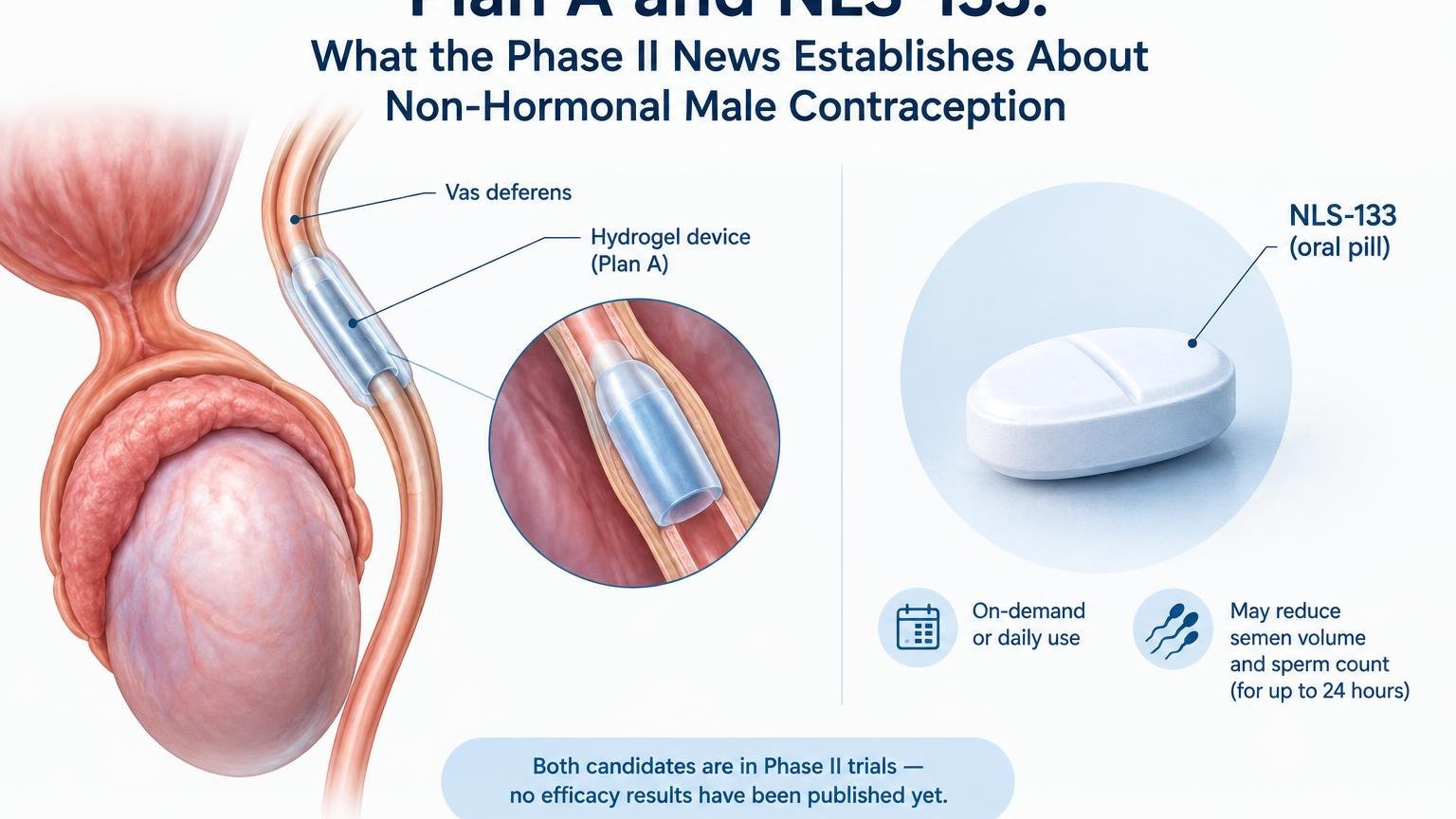
NEXT Life Sciences has announced that two non-hormonal male contraceptive candidates have reached Phase II clinical trials: Plan A, a long-acting device placed in the vas deferens, and NLS-133, an oral pill described for on-demand or daily use. Both are early-stage investigational products. The announcements mark development milestones, not demonstrated contraception, and the available public record carries no peer-reviewed efficacy results, no Phase II sample sizes and no pregnancy outcomes for either candidate.[1][2]
Why These Announcements Matter
Male contraceptive options remain narrow: condoms, vasectomy and withdrawal. Hormonal male methods are still investigational, so non-hormonal candidates address a genuine gap. The company frames the need with broad context figures. One article states that half of pregnancies worldwide remain unplanned and that research in Andrology indicated 7 in 10 men are willing to try new male contraceptive methods; those figures are secondary citations without a supplied primary source, sample or design, so they orient the reader rather than measure demand precisely.
The two candidates also represent different scientific bets. Plan A tries to block sperm transport physically; NLS-133 tries to change semen output pharmacologically for a short window. Because those strategies carry different evidence burdens, a single milestone announcement tells us little until we know which endpoints each trial is measuring.[3][4]
Two Mechanisms, Two Different Evidence Burdens
Plan A is described as occluding the vas deferens, the duct that carries sperm. It descends from Vasalgel, a polymer that forms a hydrogel and blocks sperm movement; animal studies of vas deferens injection were published in 2016-2017. In 2023 the Parsemus Foundation licensed Vasalgel to NEXT Life Sciences, which launched a first-in-human small-scale trial. The stated aspiration is a non-surgical, reversible alternative to vasectomy. That is a hypothesis about what the device could offer, not a demonstrated clinical result, and reversibility in humans is not established in the supplied record.
NLS-133 is an oral pill whose active ingredients are not public, although the clinical trial record reportedly indicates it contains two US FDA-approved drugs. Developers describe it as intended to allow male-controlled, on-demand contraception with anticipated rapid time to efficacy, and to reduce semen volume and sperm count in semen for up to 24 hours. Each of these is a design intent or developer expectation, not a measured effect. The mechanism is listed only as "other" in the tracker entry, so the biological pathway by which two repurposed drugs might alter semen within hours is not disclosed.
These mechanisms imply different evidence requirements. An occlusive device must show placement success, durability, absence of sperm in ejaculate, reversibility on removal and safety of the implant material. A pericoital pill must show that a short dosing window reliably suppresses sperm output, that the effect is timed correctly relative to intercourse, that repeat dosing is safe and that suppression reverses promptly. The sources do not report any of these outcomes quantitatively for either product.
What the Public Record Actually Shows
The clearest statements the record supports are chronological. In 2025 NEXT announced completion of a North American Phase 1 trial of Plan A with 20 male volunteers and intent to raise $20M for pivotal trials. In October 2025 the full Plan A system entered Phase II. In 2026 the company announced completion of a Phase II trial and initiation of feasibility evaluation. Also in 2026, the company announced initiation of Phase II research for NLS-133, with a tracker history stating that a Phase II trial concluded in May 2026. Initiation and completion are reported close together, and no results accompany either.
The most quotable efficacy-adjacent number is the reported 100% success of the Plan A delivery device in early trials in Australia and Canada. That figure concerns the device, not contraception. Without knowing how many placements were attempted, what counted as success, how long participants were followed and whether an independent group verified the count, a reader cannot convert it into a probability of pregnancy prevention. Company-reported percentages from small early studies routinely look more decisive than the underlying data justify.
For NLS-133, the only described clinical activity is semen analysis after dosing. That is a reasonable Phase II biomarker strategy, but semen parameters are surrogate endpoints. Sperm concentration and semen volume vary within and between men, and a demonstration that a parameter falls after a dose does not establish that fecundity falls enough, or at the right time, to prevent pregnancy. The record contains no numbers even for this surrogate.
| Candidate | Design intent | Stated mechanism | Reported trial status | Results reported |
|---|---|---|---|---|
| Plan A | Long-acting, reversible, on-demand device | Vas deferens occlusion via hydrogel polymer | Phase II completed in 2026; feasibility evaluation initiated, per tracker | None supplied; 100% figure refers to device performance in earlier trials |
| NLS-133 | On-demand or daily oral pill, described as providing 24 hours of protection | Not publicly disclosed; contains two US FDA-approved drugs | Phase II begun in 2026, with semen analysis after dosing | None supplied |
| Plan A Phase 1 | Early human safety and tolerability phase, North America | Not stated | Completed 2025 with 20 male volunteers | None supplied |
How to Read Early-Phase Announcements
Three habits help here. First, separate phase from result. Progression into Phase II shows a sponsor cleared an earlier hurdle and committed resources; it says nothing about how the next trial will read out. Second, separate surrogate from outcome. Semen analysis and device placement are intermediate measures, and contraceptive efficacy is a couple-level pregnancy outcome over a defined exposure period. Third, separate company statements from peer review. Every efficacy-framed number in the record traces to a company announcement or a tracker entry summarizing one.
The market-context statistics deserve the same scrutiny. The claim that half of pregnancies worldwide are unplanned is asserted without a cited primary source, denominator or reference year, and the 7-in-10 willingness figure is a secondary citation whose original design is not supplied. Neither undermines the case for more male options, but neither should be repeated as though it were a fresh measurement of demand.
For readers trying to understand semen parameters as endpoints, the difference between a within-person change and a clinically meaningful threshold matters: interpreting an abnormal semen analysis covers reference limits and repeat testing.
Limitations and Open Questions
The central limitation is simple: no efficacy data are reported for either candidate in the available sources. We do not know Phase II sample sizes, participant characteristics, dosing schedules actually tested, duration of follow-up or prespecified endpoints. We do not know how "successful device performance" was defined. We do not know whether Plan A reversibility was tested in humans or inferred from animal work. We do not know what the two FDA-approved components of NLS-133 are, which makes independent mechanistic assessment impossible.
There is also a timeline tension. One tracker entry says the NLS-133 Phase II trial concluded in May 2026, while a February 2026 news article describes the trial as just begun. Both can be true if the study was short, but the record does not reconcile them or report what the conclusion showed. Readers should treat the milestone language as provisional until a protocol, registry results or peer-reviewed report appears.
Finally, safety reporting is absent. For a vas deferens implant, questions include procedure-related discomfort, inflammatory response and whether reversal requires a second procedure. For a repeated oral pill, questions include the tolerability of its undisclosed components and any interaction with existing medications. Early-phase announcements rarely foreground these details, and their absence here is not evidence of absence.
Research Outlook
The next informative steps are concrete: posted trial registrations with enrollment targets and primary endpoints; peer-reviewed Phase I safety data for Plan A beyond the announced completion; human data on reversal after device removal; and Phase II semen and tolerability results for NLS-133 that specify the dosing interval tested. A pivotal program for Plan A would require a contraceptive-efficacy design with pregnancy outcomes, which the company has signaled as a fundraising goal rather than a completed step.
Until those appear, the honest summary is that two non-hormonal male contraceptive candidates have advanced through early clinical stages and that the field now has more activity than published evidence. That is progress worth tracking, and it is not yet proof that either method prevents pregnancy. Readers weighing future options should watch for peer-reviewed results and regulatory submissions rather than milestone announcements.
Key Takeaways
- Plan A, a vas deferens occlusion device, is reported to have completed a Phase II trial in 2026 and begun feasibility evaluation; no outcomes are supplied.
- NLS-133, an oral pill with undisclosed active ingredients, is reported to have begun a Phase II trial in 2026 focused on semen analysis; no results are supplied.
- The reported 100% device-success figure for Plan A refers to delivery-device performance in early trials, not to pregnancy prevention, and it lacks a denominator and independent verification.
- NLS-133 is described as intended to reduce semen volume and sperm count for up to 24 hours; these are design intentions and surrogate endpoints, not demonstrated contraceptive outcomes.
Questions and Answers
What are Plan A and NLS-133 in male contraception research?
Plan A is an investigational long-acting device that occludes the vas deferens with a hydrogel polymer, intended as a reversible alternative to vasectomy. NLS-133 is an investigational oral pill described for on-demand or daily use, intended to reduce semen volume and sperm count for up to 24 hours. Both are non-hormonal and both are reported to have reached Phase II testing; neither has published efficacy results in the supplied record.
Has Plan A been shown to prevent pregnancy in clinical trials?
No. The available record shows a completed North American Phase 1 trial with 20 male volunteers, entry into Phase II in October 2025, and an announced Phase II completion in 2026, without reported outcomes. The widely quoted 100% figure concerns delivery-device success in early trials, not pregnancy prevention, and lacks a denominator or peer-reviewed report. Contraceptive efficacy remains unestablished.
What can semen-analysis results for NLS-133 tell us, and what can they not tell us?
Semen analysis measures sperm concentration, sperm count and semen volume after dosing. These are surrogate markers: they can show whether the pill changes reproductive biomarkers, but they do not by themselves prove that couples relying on the method would avoid pregnancy. The supplied sources report no numerical semen results, no sample size and no pregnancy outcomes, so the clinical meaning of the ongoing testing is unknown.
How strong is the evidence behind the Plan A and NLS-133 Phase II announcements?
The evidence is limited to company announcements and tracker entries. There are no peer-reviewed trial publications, no effect estimates and no independent verification in the supplied record. Milestone statements such as progression to Phase II or completion of a trial establish that research activity occurred, not that a product works. The 100% device-success claim and the market-demand statistics are company-reported or secondary citations without supplied primary data.
Who might eventually use Plan A or NLS-133, and what limits apply today?
Both are intended for adult men and couples seeking non-hormonal options, with Plan A positioned as long-acting and NLS-133 as on-demand or daily. Today neither is available outside research, and key questions remain unanswered: Plan A reversibility in humans, the identity and safety of NLS-133's two FDA-approved components, and both products' contraceptive efficacy. Anyone considering participation should rely on the formal trial protocol and consent information, not on announcements.
What should readers watch for before treating these non-hormonal male contraceptives as proven?
Watch for trial registrations with defined primary endpoints, peer-reviewed Phase I safety data, human reversal data for Plan A, and Phase II semen and tolerability results for NLS-133. The decisive evidence would be a contraceptive-efficacy study reporting pregnancy rates in couples using the method. Until those appear, milestone announcements and surrogate biomarker changes should be read as early-stage progress rather than proof of protection.
Sources and References
- Two Non-Hormonal Male Contraceptives Advance to Phase II Trials.
- NEXT Life Sciences Advances Two Non Hormonal Male Contraceptives Into Phase II Trials. 2026
- Plan A Male Contraceptive System.
- NLS-133 Non-Hormonal Oral Contraceptive.
SANYUN Science Center explains published research on men's reproductive and sexual health, connecting scientific evidence with everyday questions while making sources and limitations clear.
Disclaimer: This article is for scientific education and research communication only. It does not provide medical advice, diagnosis, or individualized treatment recommendations, and does not endorse any medication, supplement, device, penile enlargement procedure, or other intervention. Decisions about sexual and reproductive health should be made in consultation with a qualified healthcare professional. Do not delay seeking professional care because of information in this article.
Original Content & Copyright Notice
- This article is prepared for SANYUN Science Center, drawing on published research and publicly available academic literature on men’s sexual and reproductive health. Its editorial explanations and presentation are developed for this platform.
- Copyright in the original editorial content, selection, and arrangement is reserved by SANYUN Science Center to the extent protected by applicable law. Referenced research, quotations, and third-party materials remain subject to the rights of their respective owners. This notice does not claim ownership of scientific facts or third-party research.
- Except where permitted by applicable law or an applicable license, prior written permission is required to reproduce, republish, translate, adapt, redistribute, or commercially reuse protected content. Attribution alone does not grant permission for such reuse.
- For permitted quotation or authorized reuse, clearly identify the source and retain a link to the original article.
- Source: SANYUN Science Center
- Original URL: Retain the original article URL on science.san-yun.com.
- Copyright Holder: SANYUN Science Center, for its own protected editorial content.
- Quotation, excerpts, or authorized reuse must not distort the scientific meaning, omit material limitations or disclaimers, or imply unverified medical claims, product efficacy, or endorsement by SANYUN Science Center.



