




Category: Latest Research
Core Research Direction: Plan A (Vasalgel-based) reversible vas deferens occlusion system for male contraception: current clinical trial design, what has been completed versus planned, and what it cannot yet establish
Search Intent: Where does the Plan A reversible male contraceptive stand in clinical testing, and what can the Phase 2 feasibility trial actually tell us about safety, effectiveness, and reversibility?
Platform: SANYUN Science Center
Evidence reviewed through: 2026-11-13
Executive Summary
Plan A is a non-hormonal male contraceptive in development that works by occluding the vas deferens, the tube that carries sperm from the testis. It is built on the Vasalgel hydrogel concept, an improved formulation of RISUG, and is being developed with the stated aim of offering a non-surgical, reversible alternative to vasectomy. The developer's tracker describes it at Phase II development, while a clinical trial registry lists an active, recruiting Phase 2 feasibility study with a planned enrollment of 40 men.[1][2]
The study is prospective, multicenter, single-arm and open-label. It plans to follow 30 men after the occlusion procedure for up to 6 months or until azoospermia, and to allocate 10 men who reach azoospermia to a reversal procedure with follow-up of up to 3 further months. Because no outcome data appear in either source, the trial cannot yet establish that the device prevents pregnancy, that reversal restores fertility in people, or that the risk profile is acceptable outside carefully selected volunteers.
Why This Matters
Male contraceptive options remain narrow. Condoms depend on consistent use, vasectomy is intended to be permanent, and hormonal male methods have been studied but are not widely available. A method that could be placed without surgery and later reversed would address a genuine gap. That is why early human studies of vas deferens occlusion attract attention beyond specialist circles.
The gap between promise and proof is the central story here. A registry entry describes what researchers plan to do and how they intend to measure it. It does not report whether sperm counts fell, whether reversal worked, or whether participants experienced pain, infection or other complications. Those are the questions that determine whether a device becomes a real option.
How the Occlusion Mechanism Is Intended to Work
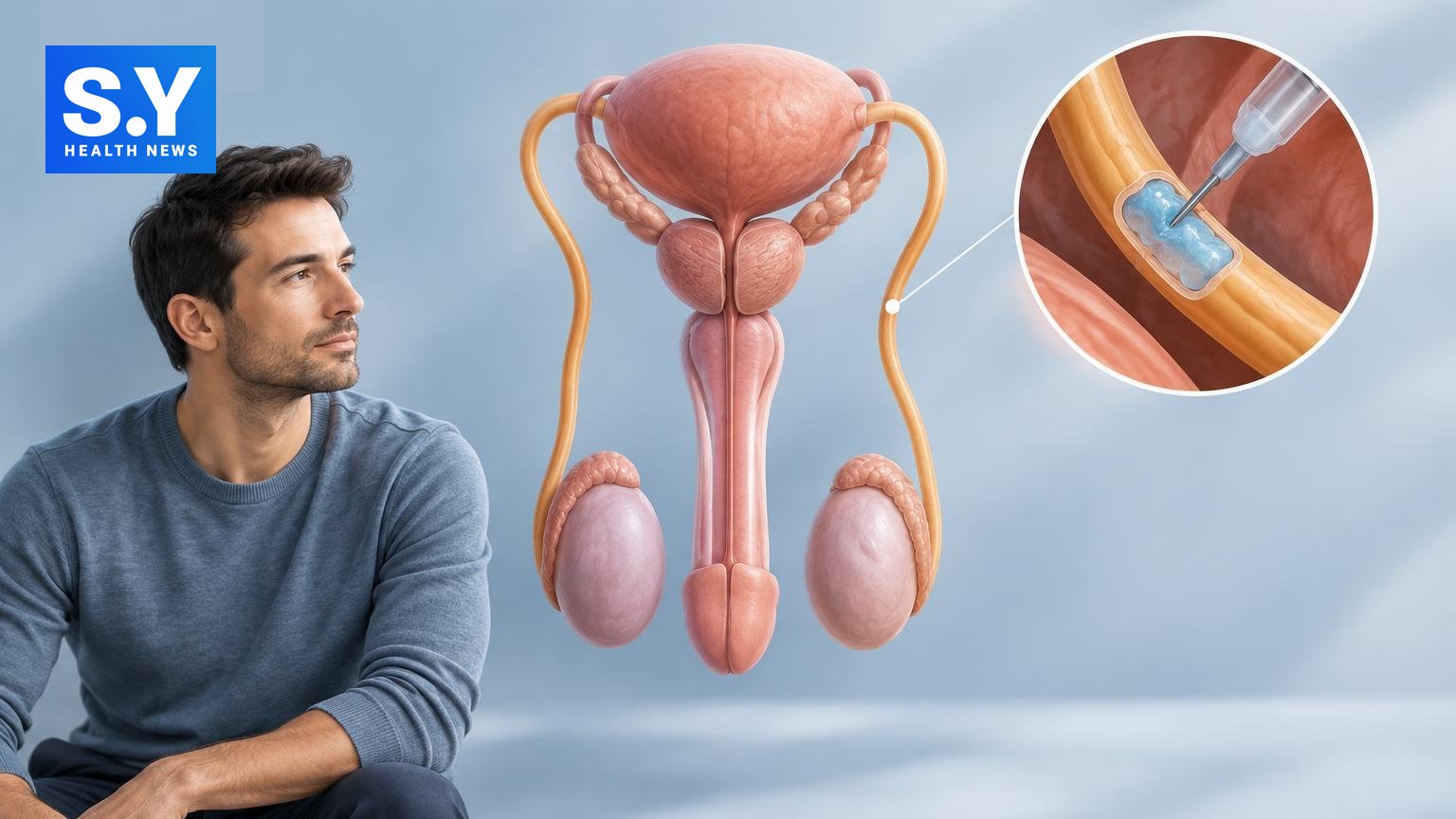
Plan A is described as acting through vas deferens occlusion. The vas deferens is a muscular tube that transports sperm from the epididymis toward the urethra. Blocking it means sperm cannot enter the ejaculate, although semen volume and the sensation of ejaculation are generally not abolished because most seminal fluid comes from the prostate and seminal vesicles. The tracker describes the system as a vas deferens occlusion device delivered through a single administration, and describes the active material as a Vasalgel hydrogel.
The earlier development history helps explain the concept. Between 2016 and 2017, animal studies of vas deferens injection of Vasalgel, described as an improved formulation of RISUG, were reported to suggest high contraceptive potential with side effects comparable to vasectomy. Those findings are animal data. They support the plausibility of the mechanism but cannot be treated as human efficacy or human safety evidence.
What Has Actually Been Completed
According to the tracker narrative, the path to human testing included a licensing step: in 2023, the Parsemus Foundation licensed Vasalgel to NEXT Life Sciences for development as Plan A, and NEXT launched a first-in-human small-scale trial. In 2024, the company announced an intention to pursue additional clinical research in the United Kingdom, Australia and New Zealand.
In 2025, NEXT announced completion of a North American Phase 1 trial involving 20 male volunteers, together with an intent to raise 20 million US dollars for pivotal clinical trials. In December 2025, the company announced receipt of a US patent. In 2026, NEXT announced completion of a Phase II trial and the start of a feasibility evaluation. These are company announcements recorded in a development tracker. No peer-reviewed results, effect estimates or adverse-event tables are provided in that source, so the announcements mark milestones rather than answer questions about performance.
There is an apparent tension worth flagging: one source describes the current activity as a Phase 2 feasibility study that is actively recruiting, with a listed start date of January 15, 2026 and an estimated completion date of December 31, 2026, while another reports a Phase II trial as completed. The available material does not reconcile these statements. Possible explanations include different trials, different phases of activity, or lag between company announcements and registry updates, but the sources do not confirm any of these. Readers should treat the precise status as uncertain.
Inside the Phase 2 Feasibility Trial Design
The registry describes a prospective, multicenter, single-arm, open-label interventional trial. Its stated purpose is to investigate the safety and effectiveness of the system to occlude the vas deferens, blocking sperm passage, and then be reversed to allow sperm to pass again. The planned total enrollment is 40 participants. Participants are men aged 25 to 65 at consent who are seeking and suitable to undergo vasectomy as a long-term contraceptive method. Eligibility also requires good health for vasectomy, a body-mass index below 31 kg per square meter, and a normal semen analysis based on the average of two samples collected 2 to 7 days apart according to the WHO laboratory manual.
Group 1 is planned to include 30 subjects followed for up to 6 months after the occlusion procedure, or until they achieve azoospermia, at which point they will be offered a vasectomy. Group 2 is planned to recruit 10 subjects followed for up to 6 months after occlusion, or until azoospermia, at which point they will undergo reversal using the Plan A reversal device. That group is then planned to be followed for up to an additional 3 months, or until baseline semen levels are reached, at which point vasectomy will again be offered. The registry states that 10 men reaching azoospermia after occlusion will be allocated to Group 2.
That structure shapes what the study can measure. Azoospermia is a sperm-count laboratory outcome, not a pregnancy outcome. Because every participant is also expected to use contraception during the trial and is offered vasectomy after the study procedure, the design does not test contraceptive effectiveness against pregnancy in real-world conditions. It tests whether the device can produce and then release a blockage under observation.
Reading the Design: Strengths and Structural Limits
| Design feature | Source-grounded description | What it can show | What it cannot show |
|---|---|---|---|
| Population | Men aged 25 to 65 seeking vasectomy, with normal baseline semen and BMI below 31 | Performance in men already accepting permanent contraception | Use by men who want to avoid permanent methods or who have abnormal semen parameters |
| Study structure | Prospective, multicenter, single-arm, open-label | Practical feasibility, safety signals and laboratory sperm outcomes over short follow-up | Blinded comparison, causality against an alternative method, or a concurrent control group |
| Group 1 follow-up | 30 subjects for up to 6 months post occlusion or until azoospermia | Time to azoospermia and short-term local tolerability | Long-term safety, delayed failure, or use beyond six months |
| Group 2 reversal | 10 men reaching azoospermia, up to 3 months after reversal or until baseline semen | Early return of sperm after reversal in a small selected subset | Reversal reliability in the wider population or long-term restoration of fertility |
| Effectiveness endpoint | Semen analysis, including azoospermia as the allocation point | Device effect on sperm passage under protocol conditions | Contraceptive efficacy measured by pregnancy prevention |
The single-arm, open-label design is efficient for early feasibility work but structurally limited. Without a control group, adverse events cannot be attributed confidently to the device versus the injection procedure or background rates. Without blinding, participants and clinicians know their treatment status, which can influence reporting of symptoms. Forty participants is a reasonable size for detecting common procedural problems but too small to characterize uncommon risks or to estimate failure rates with useful precision.
Reversal is the most delicate question. Only ten men who first achieve azoospermia are planned to receive the reversal procedure, and their follow-up is capped at 3 months or until baseline semen levels return. This means the reversal evidence will come from a small, conditionally selected group observed for a limited period. A positive result would support further testing, not establish that the method is dependably reversible. Non-return of sperm and persistent low sperm counts are also possible, and they are precisely why longer and larger studies matter.
What Remains Unknown
Several basic questions are unaddressed in the available material. Did the Phase 1 trial report any adverse events, and were they serious? How many men in earlier testing achieved azoospermia, and over what time frame? Did the announced Phase II completion include reversal data, and were those data submitted for peer review? The tracker and registry provide no answers. The absence of reported harm is not evidence of safety, and the absence of reported failure is not evidence of effectiveness.
There are also biological and practical unknowns that the protocol itself cannot settle. The hydrogel is described as occluding the vas deferens, but long-term behavior inside the duct, tissue response, and whether the plug can be removed cleanly in all cases are not described in the sources. The registry also excludes a long list of conditions that would make a person unsuitable, which is standard for early trials but narrows the population in which any later results would apply.
Research Outlook
The trajectory described in the material is one of incremental human testing: a small first-in-human trial, then a 40-participant study with a reversal arm, with stated ambitions to raise funds for pivotal trials. That sequence is conventional for a novel device. What matters next is transparent reporting: peer-reviewed safety and semen outcomes, disaggregated results for the occlusion and reversal groups, and longer follow-up than the current plans specify. A registry listing is a starting point for scrutiny, not a conclusion.
Key Takeaways
- Plan A is a non-hormonal vas deferens occlusion system built on the Vasalgel hydrogel, described as having the potential to be a non-surgical, reversible alternative to vasectomy.
- The active Phase 2 feasibility study is prospective, multicenter, single-arm and open-label, with a planned enrollment of 40 men aged 25 to 65 who are already seeking vasectomy.
- Group 1 (planned 30 subjects) tests occlusion for up to 6 months or until azoospermia; Group 2 (planned 10 men) adds reversal with up to 3 further months of follow-up.
- Earlier animal work from 2016-2017 suggested high contraceptive potential with side effects comparable to vasectomy, but animal findings do not establish human safety or efficacy.
- No outcome data are public, and the single-arm design with short follow-up and a small reversal subset cannot establish contraceptive effectiveness, reliable reversibility, or rare long-term risks.
Questions and Answers
What is Plan A male contraception and how does it work?
Plan A is a non-hormonal male contraceptive being developed as a vas deferens occlusion system. A Vasalgel hydrogel is intended to block the tube that carries sperm, preventing sperm from entering the ejaculate. It is described as having the potential to offer a non-surgical, reversible alternative to vasectomy, but those characteristics are stated aims rather than demonstrated human outcomes.
What did the Plan A Phase 2 feasibility trial find?
No results are available in the cited sources. The registry lists the study as active and recruiting, and the tracker reports a 2026 company announcement of Phase II completion and feasibility evaluation, but neither provides semen outcomes, adverse events or reversal data. The study design and planned enrollment of 40 men can be described; its findings cannot.
How does the Plan A trial test whether the male contraceptive is reversible?
The protocol plans to allocate 10 men who achieve azoospermia after occlusion to a reversal procedure using a dedicated reversal device. They are to be followed for up to 3 months or until baseline semen levels return. This is a small, conditionally selected subset with short follow-up, so it cannot establish dependable reversal across a broader population.
Who can join the Plan A vas deferens occlusion clinical trial?
Eligible participants are men aged 25 to 65 who are seeking and suitable for vasectomy, in good health for that surgery, with a body-mass index below 31 kg per square meter and a normal semen analysis based on two samples collected 2 to 7 days apart. Men with abnormal scrotal anatomy, prior testicular surgery or certain other conditions are excluded.
What are the main limitations of the Plan A Phase 2 study design?
It is a single-arm, open-label study of 40 men with roughly six months of post-occlusion follow-up. There is no control group, so harms cannot be confidently attributed to the device. The reversal group is limited to 10 men observed for up to 3 months. The study measures sperm counts rather than pregnancy prevention, and it cannot characterize rare or long-term risks.
Is Vasalgel-based male contraception proven to be safe and effective?
No. Early 2016-2017 animal studies suggested high contraceptive potential with side effects comparable to vasectomy, but animal data do not establish human efficacy or safety. A Phase 1 trial of 20 volunteers was announced as completed, yet without peer-reviewed results its safety profile remains unclear. Effectiveness in preventing pregnancy has not been demonstrated in the sources reviewed.
Sources and References
SANYUN Science Center explains published research on men's reproductive and sexual health, connecting scientific evidence with everyday questions while making sources and limitations clear.
Disclaimer: This article is for scientific education and research communication only. It does not provide medical advice, diagnosis, or individualized treatment recommendations, and does not endorse any medication, supplement, device, penile enlargement procedure, or other intervention. Decisions about sexual and reproductive health should be made in consultation with a qualified healthcare professional. Do not delay seeking professional care because of information in this article.
Original Content & Copyright Notice
- This article is prepared for SANYUN Science Center, drawing on published research and publicly available academic literature on men’s sexual and reproductive health. Its editorial explanations and presentation are developed for this platform.
- Copyright in the original editorial content, selection, and arrangement is reserved by SANYUN Science Center to the extent protected by applicable law. Referenced research, quotations, and third-party materials remain subject to the rights of their respective owners. This notice does not claim ownership of scientific facts or third-party research.
- Except where permitted by applicable law or an applicable license, prior written permission is required to reproduce, republish, translate, adapt, redistribute, or commercially reuse protected content. Attribution alone does not grant permission for such reuse.
- For permitted quotation or authorized reuse, clearly identify the source and retain a link to the original article.
- Source: SANYUN Science Center
- Original URL: Retain the original article URL on science.san-yun.com.
- Copyright Holder: SANYUN Science Center, for its own protected editorial content.
- Quotation, excerpts, or authorized reuse must not distort the scientific meaning, omit material limitations or disclaimers, or imply unverified medical claims, product efficacy, or endorsement by SANYUN Science Center.



