




Category: Erectile Dysfunction
Core Research Direction: Post-prostatectomy erectile and sexual dysfunction: survivorship care models, assessment timing, and the strength of the evidence base for erectile dysfunction treatments
Search Intent: After radical prostatectomy, how do survivorship-focused care pathways and the timing of functional assessment affect erectile and urinary outcomes, and how reliable is the broader evidence base for erectile dysfunction treatments?
Platform: SANYUN Science Center
Evidence reviewed through: 2026-11-15
Executive Summary
Erectile dysfunction after radical prostatectomy sits at the intersection of surgical oncology, rehabilitation and survivorship. Three strands of evidence are often conflated in discussion: whether structured survivorship pathways improve the process and experience of care, whether they restore erectile function, and how much confidence the wider erectile dysfunction treatment literature can carry. The available packet separates these strands more cleanly than many summaries do.[1][2][3]
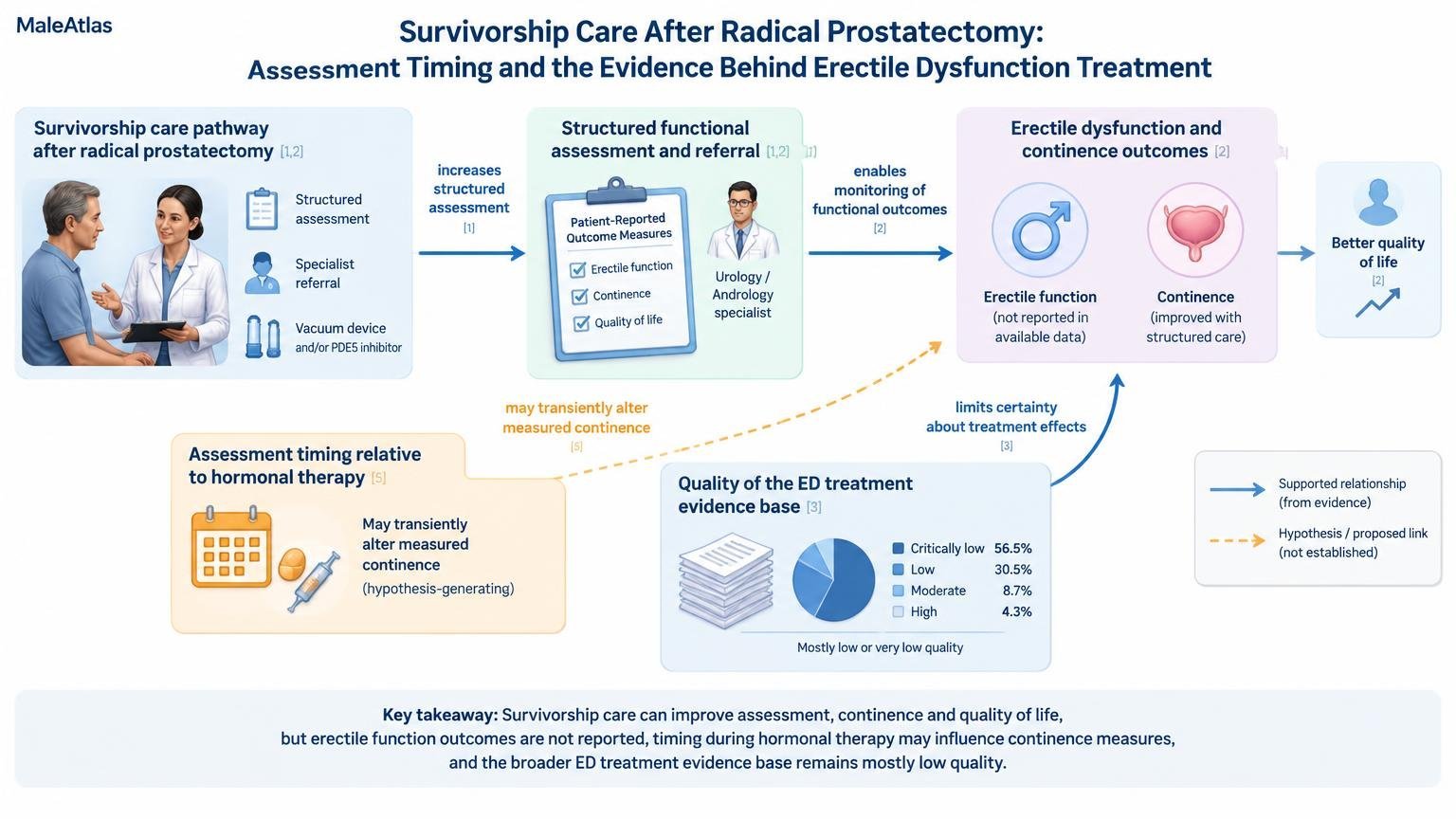
A single-centre UK audit found that before a survivorship-focused pathway, only 8 of 293 men (2.7%) had a patient-reported outcome measure for erectile dysfunction and 49 (16.7%) for continence, although 97% were informally asked about erectile dysfunction and 2% saw a functional or andrological surgeon in the first year. After the pathway was introduced in January 2020, 81% completed patient-reported outcome measures at 12 months, every patient saw a continence or andrology specialist more than once in the first year, and all left hospital with a vacuum erection device and, where relevant, a daily PDE5 inhibitor. These are process and experience outcomes in a before-after design, not proof of better erectile function.
A separate retrospective cohort at one tertiary centre compared 673 men receiving conventional perioperative care with 1062 men receiving an enhanced survivorship model. The intervention group had a length of stay shortened by approximately one day and a lower urinary fistula rate (0.76% versus 2.75%), alongside better incontinence severity scores at catheter removal and 3 months and higher prostate-cancer quality-of-life scores, with a large effect size at 3 months. Sexual dysfunction screening and referral were pathway components, but erectile function outcomes were not reported in the available summary.[4]
Two questions remain open. First, when should functional outcomes be measured in men whose hormonal treatment continues after surgery? A two-centre cohort of 98 men found lower 6-month social continence after perioperative hormonal therapy than after upfront surgery, but similar rates at 12 months, with confounding explicitly acknowledged. Second, how reliable is the treatment evidence base itself? An umbrella review of 23 meta-analyses covering 36 interventions found that 13 meta-analyses (56.5%) were critically low quality by AMSTAR-2 and only one was high quality; the authors concluded that the evidence base is predominantly low or very low quality despite statistically significant signals for many interventions.[5]
Why This Matters
Radical prostatectomy is a common treatment for localised prostate cancer, and treatment regret has been linked to the gap between expected and achieved functional outcomes. That gap is partly a communication problem and partly a measurement problem. If erectile dysfunction is discussed informally but never quantified with a validated instrument, clinicians cannot track recovery, compare strategies or identify men who need escalation. The pre-pathway audit illustrates how wide that gap can be: almost every man was asked about erectile dysfunction, but almost none had a structured assessment.
Measurement timing matters as much as measurement choice. In men receiving perioperative hormonal therapy, the conventional 6-month assessment may occur while androgen suppression is still active, which complicates attribution of continence status to surgery, to treatment or to both. The same logic applies to erectile function, although the packet's timing cohort measured continence rather than erection. Anchoring functional outcomes to both surgery and the end of treatment has been proposed as a reporting framework, and it is a hypothesis-generating suggestion rather than an established standard.
Finally, patients and clinicians make decisions inside a treatment literature whose certainty is often overstated. The umbrella review's quality distribution is a useful corrective: statistically significant improvements in erectile function scores were observed across pharmacological and nonpharmacological interventions, but the authors cautioned that these findings rest on limited patient numbers and subjective outcome indicators. That caution does not make treatment ineffective; it changes how confidently any single intervention should be recommended over another.
Biological and Clinical Mechanism
Erection depends on coordinated nerve signalling, penile arterial blood flow, smooth-muscle relaxation and hormonal modulation. Radical prostatectomy can injure the cavernous nerves that run alongside the prostate, and this neurovascular insult is a recognised contributor to postoperative erectile dysfunction. That mechanism explains why recovery is often prolonged and why rehabilitation is usually framed as a months-to-years process rather than a single postoperative prescription. The packet does not provide nerve-sparing subgroup data, so the contribution of surgical technique to individual outcomes cannot be quantified from these sources.[6]
Vacuum erection devices, which draw blood into the corpora cavernosa under negative pressure and maintain erection with a constriction ring, are described as non-invasive and standard in penile rehabilitation after prostate surgery. Daily PDE5 inhibitor use is another common rehabilitation component. The pre-pathway audit found inconsistent PDE5 inhibitor use and poor access to vacuum devices across the entire cohort, so the pathway's decision to provide every patient with a device and, where relevant, a daily PDE5 inhibitor was a deliberate standardisation of access rather than a new biological therapy.
The continence timing hypothesis is conceptually distinct from the erectile mechanism. When hormonal therapy continues after surgery, pelvic floor recovery and androgen-dependent tissue processes may overlap with ongoing treatment effects. The authors of the 98-man cohort proposed three non-exclusive hypotheses and emphasised that neoadjuvant therapy ending at surgery has been associated with faster recovery, which would make the timing of androgen exposure, not hormonal therapy as such, the relevant variable. None of these hypotheses was tested with mediation analysis in the available text.
What the Evidence Shows
The single-centre pathway data are best read as a care-delivery evaluation. The pre-pathway audit included 293 men of mean age 60 (range 44-76), and the post-pathway programme enrolled over 1000 patients with prospective patient-reported outcome measures, pad assessment and erection hardness scores at five time points from baseline to two years. Among 236 patients who completed the two-year pathway, 150 completed the Client Satisfaction Questionnaire-8, reported with a median of 32/32; the abstract also states an interquartile range of 27-30, which is internally inconsistent because the median lies outside the stated range and should be treated cautiously. Of 234 patients completing a tailored experience measure, 91% reported their holistic care needs were being met, and 83% and 86% felt well informed about erectile dysfunction and continence before surgery, rising to 90% and 93% after the first rehabilitation appointment.
The enhanced-care cohort provides the only comparative functional data in the packet, but it is retrospective with a historical control. The 673 control patients were treated between June and December 2023 and the 1062 intervention patients between June 2024 and May 2025 at one tertiary urology centre. Lower incontinence severity scores at catheter removal and 3 months, higher quality-of-life scores at all follow-up points, and the effect size of 0.89 at 3 months are consistent with a structured programme adding value. Erectile function was screened and referred within the model, but the summary reports no erectile function outcome, so the pathway's effect on erectile dysfunction specifically is unknown.
| Care element or outcome | Reported finding | Design and context | What it does and does not show |
|---|---|---|---|
| Structured erectile dysfunction assessment before pathway | 8/293 (2.7%) had a patient-reported outcome measure; 97% were informally asked | Single-centre audit, 293 men, up to 12 months post-operatively | Large measurement gap; informal inquiry is not a validated assessment |
| Structured assessment after pathway | 81% completed patient-reported outcome measures at 12 months | Single-centre before-after pathway, over 1000 enrolled | Process improvement; no control group and no erectile function effect estimate |
| Urinary fistula rate | 0.76% with enhanced care versus 2.75% with conventional care | Retrospective single-centre cohort, 1062 versus 673 men | Large relative difference; temporal confounding possible |
| Prostate-cancer quality of life | Higher FACT-P scores at all follow-up points; Cohen's d = 0.89 at 3 months | Retrospective single-centre cohort | Clinically large signal; not specific to erectile function |
| Social continence with perioperative hormonal therapy | 6 months: 65.0% versus 87.1% clinician-reported, 58.3% versus 81.3% patient-reported; 12 months: 95.0% versus 96.9% | Two-centre cohort, 98 men, perioperative therapy versus upfront surgery | Transient difference pattern; confounding cannot be excluded; continence, not erection |
| Quality of included erectile dysfunction meta-analyses | 13 critically low (56.5%), 7 low (30.5%), 2 moderate (8.7%), 1 high (4.3%) | Umbrella review, 23 meta-analyses, 42 summary effects, 36 interventions | Evidence base mostly low quality; statistical significance does not equal certainty |
The umbrella review supplies the broadest evidence-quality statement. From 1191 studies, 23 meta-analyses produced 42 summary effects on the International Index of Erectile Function, its five-item and erectile-function domains, and the Erection Hardness Score, covering 36 interventions. The quality distribution is the central result: more than half of the meta-analyses were critically low by AMSTAR-2, and the review authors concluded that the current evidence base is predominantly low or very low quality. That statement applies to the meta-analytic literature as summarised, not to every individual trial within it.
Intervention-specific estimates in the packet are narrower than the umbrella review's scope. A 2025 Cochrane review of 21 randomised trials in 1357 men found that low-intensity shockwave therapy may improve IIEF-EF scores by roughly 3.9 points in the short term and 5.3 points in the long term versus sham, rated low certainty, with several included studies industry-funded. That is an illustrative case of a statistically positive signal whose certainty rating limits routine recommendation. For men who do not respond to an adequate PDE5 inhibitor trial, second-line options described include intracavernosal injections, intraurethral alprostadil and, ultimately, irreversible penile prosthesis implantation.
Interpretation and Limitations
The most important interpretive boundary is that the survivorship pathway evidence is about care processes, experience and non-erectile functional outcomes. Satisfaction and information measures can improve even when erectile function does not, and the pathway authors themselves described the programme as a first step and stated that clinical outcomes would be reported in future work. Reading the 81% patient-reported outcome completion or the 91% holistic-needs figure as evidence of better erections would overreach.
The enhanced-care cohort has the strengths and weaknesses of a large single-centre retrospective study. Its authors acknowledged possible temporal confounding, absence of postoperative pathological features and comprehensive geriatric assessment data, and the need for prospective multicentre validation. The historical control was treated in a different period, so changes in surgical technique, staffing or case mix could contribute to the observed differences. The lower fistula rate is a striking finding that would benefit from independent replication before being attributed to the care model.
The timing cohort is explicitly hypothesis-generating. Its 98 men came from two centres, confounding could not be excluded, and the outcome was social continence rather than erectile function. The 6-month differences were large, but the convergence by 12 months is equally important: it argues against a permanent harm signal and in favour of a transient on-treatment effect, while leaving open whether the pattern reflects treatment, patient selection or measurement timing.
The umbrella review's quality ratings describe the meta-analytic literature, not the underlying trials one by one, and quality assessment of reviews can be harsh when reviews are small or heterogeneous. Still, a distribution in which only one meta-analysis was rated high quality is difficult to dismiss. It means that comparative claims between erectile dysfunction treatments should be made with explicit uncertainty, and that single statistically significant pooled effects should not be presented as settled clinical superiority.
Research Outlook
Three research directions follow directly from the packet. First, survivorship pathways need erectile function outcomes reported alongside process and experience measures, ideally with erection hardness scores and validated erectile function domains analysed over the same two-year horizon. The UK pathway already collected erection hardness scores at five time points, so those analyses would answer the question the current abstract leaves open.
Second, functional outcome reporting in men receiving perioperative hormonal therapy should be anchored to both surgery and the end of treatment. The proposed framework is a reporting convention that could reduce misleading comparisons, but it needs prospective testing and should not be treated as an established standard. Studies that measure erectile function, not only continence, at multiple androgen-exposure landmarks would be particularly informative.
Third, the treatment evidence base needs better-designed single-intervention trials and high-quality meta-analyses of head-to-head comparisons. The umbrella review authors explicitly recommended this. Until then, clinicians and patients should treat large pooled effects with calibrated confidence and prioritise shared decision-making over claims of a clearly superior agent or modality.
Key Takeaways
- Structured survivorship care can transform erectile dysfunction assessment from informal inquiry into systematic measurement: patient-reported outcome completion rose to 81% at 12 months in one pathway, but this is a process outcome in a before-after design.
- The comparative enhanced-care cohort reported better incontinence severity, quality of life and fistula rates, but no erectile function outcome, so its relevance to erectile dysfunction specifically remains unproven and its retrospective design leaves room for temporal confounding.
- In 98 men receiving perioperative hormonal therapy, 6-month social continence was lower than after upfront surgery but similar by 12 months, a pattern the authors called suggestive of transient on-treatment delay while cautioning that confounding cannot be excluded.
- The wider erectile dysfunction treatment literature is mostly low or very low quality: 13 of 23 meta-analyses were critically low by AMSTAR-2 and only one was high quality, even though many interventions showed statistically significant improvements.
- Low-intensity shockwave therapy illustrates the certainty problem: roughly 3.9-point short-term and 5.3-point long-term IIEF-EF gains versus sham in 21 trials and 1357 men, rated low certainty with several industry-funded studies.
- Second-line options after an inadequate PDE5 inhibitor trial include intracavernosal injections, intraurethral alprostadil and irreversible penile prosthesis implantation, and vacuum devices remain a non-invasive rehabilitation standard after prostate surgery.
Questions and Answers
What does survivorship care after radical prostatectomy aim to change in erectile dysfunction management?
Survivorship care aims to replace informal questioning with structured, repeated assessment and specialist access. In one UK pathway, patient-reported outcome measure completion reached 81% at 12 months, every patient saw a continence or andrology specialist more than once in the first year, and all received a vacuum erection device and, where relevant, a daily PDE5 inhibitor. These are process and experience changes; erectile function outcomes were not yet reported.
How common was formal erectile dysfunction assessment before a dedicated post-prostatectomy pathway?
In a 293-man single-centre audit, only 8 men (2.7%) had a patient-reported outcome measure for erectile dysfunction and 49 (16.7%) for continence, even though 97% and 98% were informally asked about these domains. Only 2% saw a functional or andrological surgeon within 12 months. The gap between being asked and being measured is the core finding, and it comes from one institution's retrospective audit.
Did the enhanced survivorship care model improve erectile function after radical prostatectomy?
The available summary does not answer that question. The retrospective cohort of 1062 intervention and 673 control patients reported shorter length of stay, lower urinary fistula rates, better incontinence severity scores and higher prostate-cancer quality-of-life scores with a large effect size at 3 months. Sexual dysfunction screening and referral were included in the model, but erectile function outcomes were not reported, and the historical-control design allows temporal confounding.
Why might the timing of functional assessment matter in men receiving hormonal therapy around prostatectomy?
When hormonal therapy continues after surgery, the conventional 6-month assessment occurs during androgen suppression. In a two-centre cohort of 98 men, social continence at 6 months was lower after perioperative therapy than after upfront surgery (65.0% versus 87.1% by clinician report), but similar at 12 months (95.0% versus 96.9%). The authors called this a possible transient on-treatment delay and explicitly noted that confounding cannot be excluded.
How strong is the evidence base for erectile dysfunction treatments overall?
An umbrella review of 23 meta-analyses covering 36 interventions found that 13 (56.5%) were critically low quality by AMSTAR-2, 7 (30.5%) low, 2 (8.7%) moderate and 1 (4.3%) high. The authors concluded that the evidence base is predominantly low or very low quality and cautioned that statistically significant improvements rest on limited patient numbers and subjective outcome indicators. Statistical significance and clinical certainty are not the same thing.
What are the limits of the post-prostatectomy survivorship studies summarised here?
The pathway evaluation is single-centre and before-after, with satisfaction scores that include an internally inconsistent median and interquartile range, and erectile function outcomes deferred to future work. The enhanced-care cohort is a single-centre retrospective analysis with a historical control and acknowledged temporal confounding. The timing cohort is observational, included 98 men, measured continence rather than erection, and was explicitly hypothesis-generating. None of these sources establishes that any pathway restores erectile function.
Conceptual framework: Conceptual framework, not a tested causal model. In single-centre before-after and retrospective pathway data, survivorship care was associated with more structured assessment and better continence and quality-of-life measures, but erectile function outcomes were not reported. Assessment timing during hormonal therapy is a proposed explanation for transient continence differences in an observational cohort, and the wider erectile dysfunction treatment evidence base is mostly low or very low quality. No arrow implies proven causality.
Academic References & Evidence
- MacAskill F; Gharbieh S; Sandher A; Torres C; Sandher R; Yap T; Taylor C; Shabbir M; Sahai A. A new approach to prostate cancer survivorship care following radical prostatectomy (RP).
- 一种以生存质量为导向的前列腺癌根治术后强化护理模式:一项提升尿控恢复与生活质量的干预研究. PLOS One. 2026
- Current treatment for erectile dysfunction: an umbrella review of systematic reviews and meta-analyses. 2026
- Yuan X; Chen Y; Lu H; Zheng P; Zhang Y. A survivorship-oriented enhanced care model for patients undergoing radical prostatectomy. PLOS ONE. 2026 21(4):e0346609 DOI: 10.1371/journal.pone.0346609.
- Buhas Bogdan Adrian. Timing of continence assessment after radical prostatectomy in men receiving perioperative hormonal therapy – PubMed. Fr J Urol. 2026 DOI: 10.1016/j.fjurol.2026.103283. PMID: 43008973.
- Erectile Dysfunction. 2026
SANYUN Science Center explains published research on men's reproductive and sexual health, connecting scientific evidence with everyday questions while making sources and limitations clear.
Disclaimer: This article is for scientific education and research communication only. It does not provide medical advice, diagnosis, or individualized treatment recommendations, and does not endorse any medication, supplement, device, penile enlargement procedure, or other intervention. Decisions about sexual and reproductive health should be made in consultation with a qualified healthcare professional. Do not delay seeking professional care because of information in this article.
Original Content & Copyright Notice
- This article is prepared for SANYUN Science Center, drawing on published research and publicly available academic literature on men’s sexual and reproductive health. Its editorial explanations and presentation are developed for this platform.
- Copyright in the original editorial content, selection, and arrangement is reserved by SANYUN Science Center to the extent protected by applicable law. Referenced research, quotations, and third-party materials remain subject to the rights of their respective owners. This notice does not claim ownership of scientific facts or third-party research.
- Except where permitted by applicable law or an applicable license, prior written permission is required to reproduce, republish, translate, adapt, redistribute, or commercially reuse protected content. Attribution alone does not grant permission for such reuse.
- For permitted quotation or authorized reuse, clearly identify the source and retain a link to the original article.
- Source: SANYUN Science Center
- Original URL: Retain the original article URL on science.san-yun.com.
- Copyright Holder: SANYUN Science Center, for its own protected editorial content.
- Quotation, excerpts, or authorized reuse must not distort the scientific meaning, omit material limitations or disclaimers, or imply unverified medical claims, product efficacy, or endorsement by SANYUN Science Center.



