




Category: Reproductive Care
Core Research Direction: Post-vasectomy counseling and follow-up: what patients should expect regarding recovery activity, post-vasectomy semen analysis timing and interpretation, contraception discontinuation criteria, and what the 2026 AUA guideline says about failure risk and fertility restoration
Search Intent: After a vasectomy, when can a man stop using contraception, how is post-vasectomy semen analysis interpreted, and what does the latest guideline say about recovery, failure risk, and reversibility?
Platform: SANYUN Science Center
Evidence reviewed through: 2026-11-21
Executive Summary
A vasectomy is intended as permanent contraception, and its success is only confirmed by laboratory testing rather than by the procedure itself. Patients should keep using reliable contraception until a semen analysis confirms sterility. The 2026 American Urological Association (AUA) vasectomy guideline — summarised in a Urology Times feature by guideline vice chair Akanksha Mehta — allows one post-vasectomy semen analysis (PVSA) rather than repeated testing, sets an early testing window of about 8 weeks, and updates the sperm criteria that permit a couple to stop contraception.[1][2]
This explainer separates three things that are often blurred together: general aftercare advice about activity and wound care, the specific rules for interpreting a semen sample, and the counselling points about failure and fertility restoration. It is written for patients and their partners, and it is limited by the fact that the practical aftercare detail comes from a point-of-care reference summary while the guideline recommendations come from a news FAQ rather than the primary guideline document.
Why This Matters
The mistake that carries the highest cost after vasectomy is treating the operation as immediate sterilisation. Sperm already stored beyond the blocked vas deferens remain in the ejaculate for weeks, so pregnancy risk persists until testing clears the patient. The reference summary stresses continued contraception until semen analysis confirms sterility, and it notes that non-compliance with testing is common — up to 19% fail to return with a sample.
The 2026 guideline reframes several of these questions. It presents vasectomy as a safe, effective, intended permanent method, calls for pre-operative counselling individualised to reproductive goals (which may be delivered virtually or in person), and explicitly addresses misinformation about long-term systemic health risks. It also broadened its scope to cover fertility options for men who have already had a vasectomy and want children later.
Recovery and Activity: What Is Actually Advised
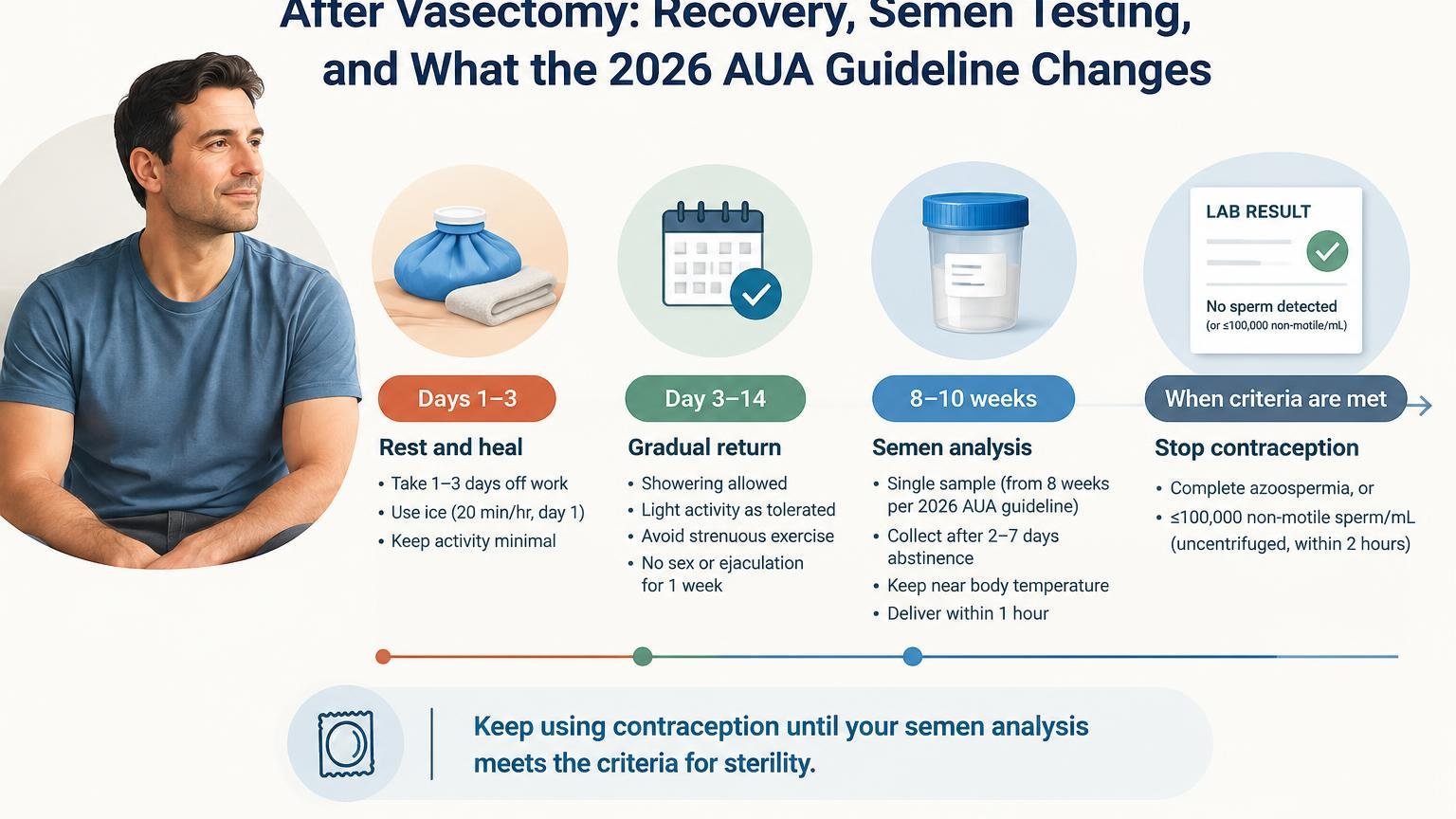
The practical aftercare guidance in the point-of-care reference is conservative and mostly general. Patients are advised to take 1-3 days off work, to rest with ice on the scrotum for 20 minutes per hour on day one, and to keep activity minimal on day two while showering is permitted. From day three, activity as tolerated is allowed, with limited activity for two weeks and avoidance of strenuous exercise or anything that risks local trauma. Ejaculation or sex should be avoided for the first week.
The reference also names warning signs that should prompt a call to the clinic: pain not relieved by the prescribed analgesics, scrotal swelling beyond what was expected, persistent scrotal bruising beyond two weeks, stitches still present beyond two weeks, and signs of scrotal infection such as redness, swelling, tenderness, fever, or pustular discharge from the incision.
Three caveats matter. First, this aftercare schedule is reference guidance without cited underlying studies, not a guideline recommendation. Second, the timing is generic and individuals differ — a desk worker and a heavy-lifting labourer are not the same. Third, the guideline source emphasises recognising and managing bleeding, infection, epididymitis and chronic scrotal pain, which are the complications to watch for, but it does not supply a day-by-day activity protocol here.
Post-Vasectomy Semen Analysis: Timing and Handling
The first sample should be collected at 3 months (or at least 8 weeks) after the procedure and after at least 20 ejaculations. To protect test sensitivity, some recommend collecting after 2-7 days of abstinence, delivering the sample to the laboratory within 1 hour of ejaculation while keeping it close to body temperature, and examining a centrifuged sample within 2 hours of ejaculation. For reference, the same summary reports a median of 3 weeks to loss of sperm motility and a median of 10 weeks to azoospermia, with rare non-motile sperm sometimes still present after 12 weeks.
The 2026 guideline is more flexible on timing. It states that PVSA may be performed as early as 8 weeks after the procedure, and that many clinicians target approximately 8-10 weeks to balance accuracy against patient convenience. It also supports mail-in testing as an acceptable option that may improve adherence, while noting an important asymmetry: mail-in assays require complete azoospermia to confirm success, because any detected sperm is treated as a failed result owing to assay limitations.
Interpreting the Result: When Contraception Can Stop
Under the 2026 guideline, one sample is enough when it meets the criteria. Patients may discontinue contraception after complete azoospermia, or after no more than 100,000 rare non-motile sperm per mL in an uncentrifuged sample that was evaluated within 2 hours of collection. If the sample was evaluated more than 2 hours after collection, only complete azoospermia is sufficient to stop contraception. Where those criteria are met, the guideline indicates that repeat analyses are not required.
| Scenario | What the sources advise | Key condition |
|---|---|---|
| First sample timing | At 3 months (or at least 8 weeks) and after at least 20 ejaculations in the point-of-care reference; the 2026 guideline allows testing as early as 8 weeks, with many clinicians targeting about 8-10 weeks | Adequate ejaculations before testing |
| Sample handling | Deliver within 1 hour of ejaculation, keep near body temperature, examine centrifuged sample within 2 hours | Handling affects whether a non-azoospermic result can clear the patient |
| Stopping contraception | Complete azoospermia, or no more than 100,000 rare non-motile sperm per mL in an uncentrifuged sample evaluated within 2 hours | Beyond 2 hours, azoospermia alone qualifies |
| Persistent motile sperm at 6 months | Counsel about repeat vasectomy | Patient should have complied with the recommended ejaculation before sampling |
| Persistent non-motile sperm above 100,000/mL | Shared decision-making: repeat vasectomy, continued contraception, and/or repeat semen evaluations | Threshold persists rather than clears |
| Mail-in testing | Acceptable; may improve adherence, but requires complete azoospermia to confirm success | Any detected sperm counts as failed due to assay limits |
The reference summary and the guideline differ in emphasis on persistent non-motile sperm. The reference advises monthly repeat semen analyses until either no sperm is seen on at least one sample or fewer than 100,000/mL non-motile sperm is found on two consecutive samples at 7 or more months after vasectomy. The guideline, by contrast, recommends shared decision-making when non-motile sperm persistently exceed 100,000/mL, weighing repeat vasectomy, continued contraception, and/or further semen evaluations. Neither framing is a guarantee of sterility, and the discrepancy illustrates how thresholds and interpretive rules continue to evolve.
Failure Risk and What the Guideline Says About Technique
The guideline strongly recommends combining mucosal cautery with fascial interposition as the occlusion technique. It discourages ligation and excision of a short vas segment alone because of higher failure rates. In the source's phrasing, a surgeon able to perform both mucosal cautery and fascial interposition places the patient in the lowest category for risk of vasectomy failure. The guideline summary does not provide numerical failure rates, so patients should not read a precise percentage risk into these statements.
Persistent motile sperm is the failure signal to take seriously. The point-of-care reference treats motile sperm on the initial 3-month sample as suspected failed vasectomy, advising confirmation on repeat analysis in one month and repeat vasectomy if motile sperm is confirmed on the second sample. The guideline extends the counselling window: when motile sperm persist at 6 months — of any quantity, rare or not — clinicians should counsel the patient about repeat vasectomy, because that patient is not sterile and the unintended pregnancy risk is not insignificant.
Fertility Restoration: Possible, Not Guaranteed
The guideline's Part II scope is fertility restoration, and its central counselling point is that restoration is possible but not guaranteed. Options include vasectomy reversal and sperm retrieval with intracytoplasmic sperm injection. Surgeons offering reversal should have microsurgical expertise to perform vasoepididymostomy as well as vasovasostomy. The best pre-operative predictors of reversal success named by the guideline are the duration of the obstructive interval, patient age, and female partner age — though the summary does not quantify how strongly each predicts outcome.
Two practical implications follow. Reversal involves additional cost, time and complexity, which is why vasectomy should still be framed as permanent. And because time since the obstruction matters, a man who is uncertain about future fertility should raise that before the procedure rather than after — the counselling described in the guideline is meant to be individualised to reproductive goals for exactly this reason.
Interpretation and Limitations
This article is an educational synthesis, not a systematic review, and it does not report new data. Its two sources are unequal. The point-of-care summary provides granular aftercare and laboratory handling detail but cites no underlying studies, sample sizes, or denominators, and its sperm thresholds differ from the newer guideline. The guideline material arrives through a news FAQ that summarises two guideline papers; the primary guideline text and its evidence tables are not reproduced here, so strength-of-evidence grading and numerical failure rates cannot be verified from this packet.
Several statements are guidance rather than observed outcomes: the 1-3 day work restriction, the ice schedule, the ejaculation avoidance period, and the 20-ejaculation target are recommendations, not measured findings. The median times to loss of motility (3 weeks) and azoospermia (10 weeks) are reported values without visible sampling context, and 'rare' non-motile sperm is not a defined quantity. The claim that mail-in testing may improve adherence is explicitly unquantified in the source.
Readers should also resist over-reading the reassurance about systemic disease. The guideline states that no causal association has been established between vasectomy and prostate cancer, high-grade prostate cancer, prostate cancer mortality, cardiovascular disease, or nephrolithiasis. That is a statement about causal inference from the epidemiological literature as summarised, not proof that individual risk is zero; men with baseline risk factors may still develop these conditions for unrelated reasons.
Research Outlook
The most active practical questions concern adherence and assay design rather than the operation itself. Up to 19% of patients fail to return a sample, and mail-in testing is being positioned as one response, with the trade-off that only complete azoospermia counts as success on those platforms. Whether home collection genuinely raises completion rates, and how much interpretive strictness that costs, are questions the guideline summary raises but does not answer with quantitative data.
A second question is how the single-sample approach performs over time compared with older repeat-testing schedules, particularly in men whose first sample shows low numbers of non-motile sperm. The reference's two-consecutive-sample rule and the guideline's shared-decision framing are not equivalent, and reconciling them will require outcome data on subsequent pregnancy and redo-vasectomy rates. The 2026 guideline is a decade-overhaul of prior recommendations, which makes the shift in PVSA practice one of its most consequential changes for patients.
Key Takeaways
- Keep using reliable contraception until a semen analysis confirms sterility; the procedure itself is not immediate sterilisation.
- The 2026 AUA guideline allows one PVSA, may be done as early as 8 weeks with many clinicians targeting about 8-10 weeks, and is sufficient when it shows complete azoospermia or no more than 100,000 rare non-motile sperm per mL in an uncentrifuged sample read within 2 hours.
- Persistent motile sperm at 6 months warrants counselling about repeat vasectomy; persistent non-motile sperm above 100,000/mL calls for shared decision-making.
- Fertility restoration after vasectomy is possible but not guaranteed, and reversal success predictors include the obstructive interval, patient age, and female partner age.
- Recovery advice such as 1-3 days off work, scrotal ice, and avoiding ejaculation for the first week comes from a point-of-care summary without cited studies; treat it as general guidance and follow your own surgeon's instructions.
Questions and Answers
Why must a man keep using contraception after a vasectomy until semen testing confirms sterility?
Sperm already stored beyond the blocked vas deferens remain in the ejaculate for weeks after surgery, so pregnancy is still possible. The point-of-care reference advises continuing reliable contraception until semen analysis confirms sterility, and notes that up to 19% of patients fail to return a sample, leaving their status unconfirmed. Testing, not the operation date, defines when risk drops.
When should post-vasectomy semen analysis be done, and how should the sample be handled?
The reference advises a first sample at 3 months (or at least 8 weeks) after at least 20 ejaculations, delivered to the lab within 1 hour of ejaculation and kept near body temperature, with a centrifuged sample examined within 2 hours. The 2026 guideline allows testing as early as 8 weeks, with many clinicians targeting about 8-10 weeks.
What sperm criteria allow a couple to stop contraception after vasectomy under the 2026 AUA guideline?
Contraception may stop after complete azoospermia, or after no more than 100,000 rare non-motile sperm per mL in an uncentrifuged sample evaluated within 2 hours of collection. If the sample was evaluated more than 2 hours after collection, only complete azoospermia is sufficient. When these criteria are met, the guideline indicates repeat analyses are unnecessary.
What happens if motile sperm are still found months after a vasectomy?
Persistent motile sperm suggests the vasectomy has not occluded successfully. The guideline advises counselling about repeat vasectomy when motile sperm persist at 6 months, of any quantity, because the patient is not sterile and pregnancy risk is not insignificant. The older reference describes confirming motile sperm on a repeat sample about a month later before considering redo surgery.
Can a vasectomy be reversed, and what affects the chance of fertility restoration?
The 2026 guideline counsels that fertility restoration is possible but not guaranteed. Options include vasectomy reversal and sperm retrieval with intracytoplasmic sperm injection. The best pre-operative predictors of reversal success are the duration of the obstructive interval, patient age, and female partner age; the summary does not quantify how strongly each factor predicts outcome.
Does a vasectomy increase the risk of prostate cancer or heart disease?
The 2026 guideline states that no causal association has been established between vasectomy and prostate cancer, high-grade prostate cancer, prostate cancer mortality, cardiovascular disease, or nephrolithiasis. This reflects causal inference from the summarised epidemiological literature rather than proof of zero individual risk; men with baseline risk factors may still develop these conditions for unrelated reasons.
Sources and References
- Vasectomy Postoperative Counseling.
- 2026 AUA Vasectomy Guideline: Key updates and clinical FAQs | Urology Times. Urology Times. 2026
SANYUN Science Center explains published research on men's reproductive and sexual health, connecting scientific evidence with everyday questions while making sources and limitations clear.
Disclaimer: This article is for scientific education and research communication only. It does not provide medical advice, diagnosis, or individualized treatment recommendations, and does not endorse any medication, supplement, device, penile enlargement procedure, or other intervention. Decisions about sexual and reproductive health should be made in consultation with a qualified healthcare professional. Do not delay seeking professional care because of information in this article.
Original Content & Copyright Notice
- This article is prepared for SANYUN Science Center, drawing on published research and publicly available academic literature on men’s sexual and reproductive health. Its editorial explanations and presentation are developed for this platform.
- Copyright in the original editorial content, selection, and arrangement is reserved by SANYUN Science Center to the extent protected by applicable law. Referenced research, quotations, and third-party materials remain subject to the rights of their respective owners. This notice does not claim ownership of scientific facts or third-party research.
- Except where permitted by applicable law or an applicable license, prior written permission is required to reproduce, republish, translate, adapt, redistribute, or commercially reuse protected content. Attribution alone does not grant permission for such reuse.
- For permitted quotation or authorized reuse, clearly identify the source and retain a link to the original article.
- Source: SANYUN Science Center
- Original URL: Retain the original article URL on science.san-yun.com.
- Copyright Holder: SANYUN Science Center, for its own protected editorial content.
- Quotation, excerpts, or authorized reuse must not distort the scientific meaning, omit material limitations or disclaimers, or imply unverified medical claims, product efficacy, or endorsement by SANYUN Science Center.



