




Category: Reproductive Care
Core Research Direction: Post-vasectomy semen analysis (PVSA) under the 2026 AUA Vasectomy Guideline: what counts as a successful result, when to test, and how persistent sperm should be managed
Search Intent: After a vasectomy, when should semen be tested, what result clears a man to stop other contraception, and what happens if sperm are still present?
Platform: SANYUN Science Center
Evidence reviewed through: 2026-11-21
Executive Summary
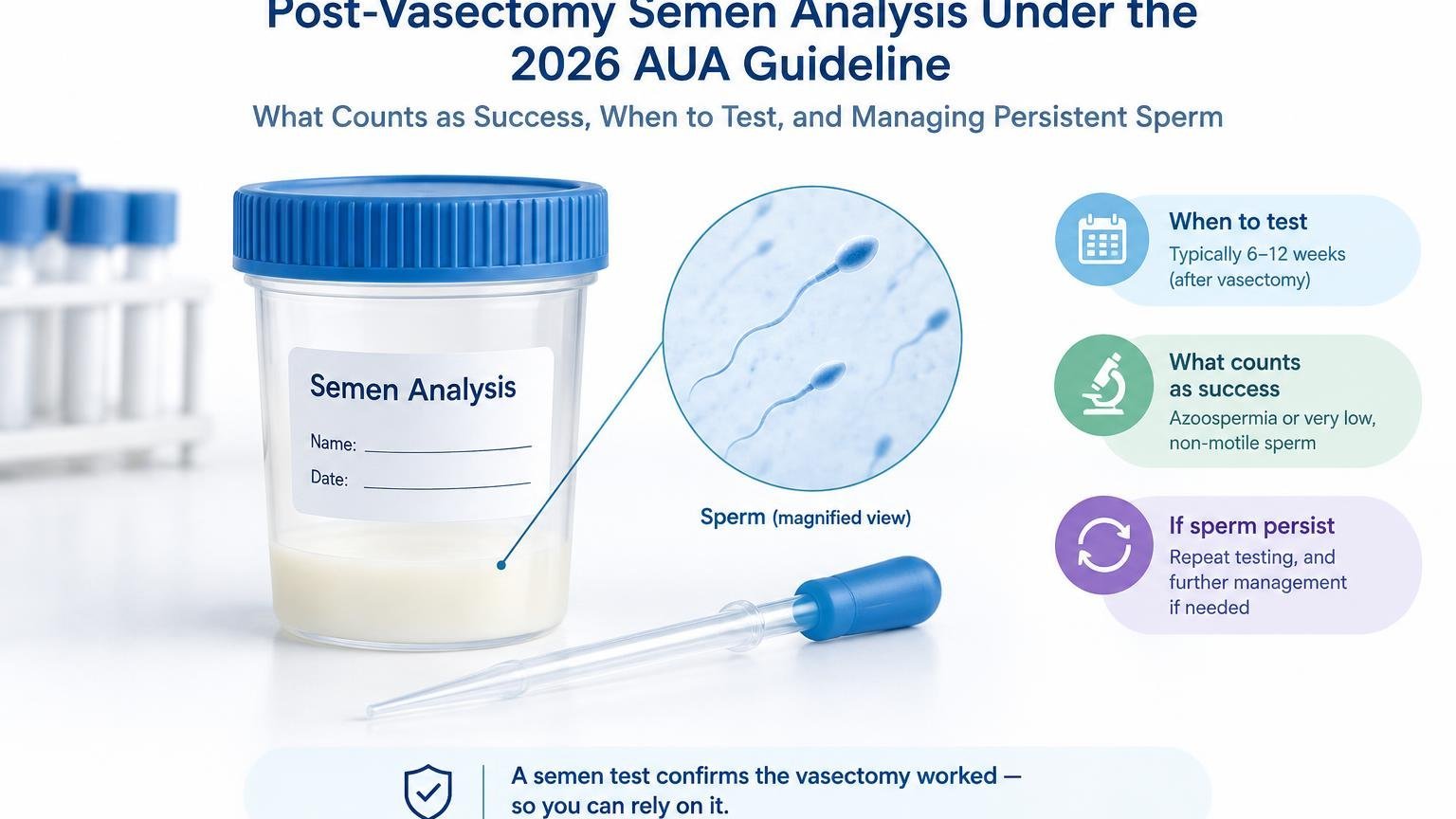
A vasectomy is not considered immediately effective. The 2026 American Urological Association (AUA) Vasectomy Guideline, as summarized in expert commentary and a clinical FAQ, recommends that men provide at least one semen sample after the procedure to confirm occlusive success. For standard laboratory-based post-vasectomy semen analysis (PVSA) using a fresh, uncentrifuged specimen examined in real time, a man may stop other contraception if the sample shows complete azoospermia or no more than 100,000 rare non-motile sperm per milliliter, provided the sample is evaluated within 2 hours of collection. If the sample is evaluated more than 2 hours after collection, only complete azoospermia allows contraception to be stopped. Any motile sperm, even a single one, is a failed or positive result and requires repeat testing. Mail-in tests are acceptable but require azoospermia to confirm success; any sperm detected is considered a failure because of assay limitations. The guideline does not mandate an exact testing window; expert commentary describes 8 to 10 weeks after vasectomy as a practical target within a broader 6- to 12-week range. Persistent motile sperm at 6 months, in a patient who has complied with ejaculation recommendations, should prompt counseling about repeat vasectomy. Persistent non-motile sperm greater than 100,000 per milliliter warrants shared decision-making among repeat vasectomy, continued contraception, and/or repeat semen evaluations.[1][2]
Why This Matters
Vasectomy is intended as permanent contraception. The summarized guideline reinforces that it is a safe and effective method, with no established causal association with prostate cancer, high-grade prostate cancer, prostate cancer mortality, cardiovascular disease, or nephrolithiasis. However, effectiveness depends on confirming that the vas deferens has been occluded and that sperm are no longer present in the ejaculate in sufficient numbers to cause pregnancy. Until PVSA confirms success, another contraceptive method is needed. The updated guideline places substantial emphasis on PVSA protocols, reflecting evolving evidence and the rapid expansion of home-based and mail-in testing options. Clear criteria matter because they determine when a couple can safely rely on vasectomy alone, and because misinterpretation of a “successful” result could lead to unintended pregnancy.
What Post-Vasectomy Semen Analysis Measures and Why Timing Matters
PVSA examines semen for the presence of sperm after vasectomy. The goal is to confirm that the procedure has achieved occlusion—that sperm are no longer reaching the ejaculate in numbers that could cause pregnancy. The summarized guideline distinguishes standard laboratory-based PVSA from mail-in testing because the two settings have different success criteria. For standard laboratory-based PVSA using a fresh, uncentrifuged specimen examined in real time, patients are considered cleared if they are azoospermic or have only rare nonmotile sperm. In these cases, only one semen analysis is needed and repeat testing is not required. However, any motile sperm, even a single one, constitutes a failed or positive test result and warrants repeat analysis until azoospermia or rare nonmotile sperm is achieved.
Timing involves a trade-off. Earlier testing is more likely to show residual sperm, while later testing prolongs the use of alternative contraception. The guideline does not mandate a precise testing window. Expert commentary describes 8 to 10 weeks after vasectomy as a practical “sweet spot” within a broader 6- to 12-week range. The summarized guideline allows PVSA as early as 8 weeks post-procedure, with many clinicians targeting approximately 8 to 10 weeks to balance accuracy and patient convenience. For samples evaluated more than 2 hours after collection, confirmation of complete azoospermia is needed to stop contraception; the rare nonmotile sperm threshold does not apply outside the 2-hour window.
What Counts as a Successful Result?
For standard laboratory-based PVSA using a fresh, uncentrifuged specimen evaluated within 2 hours of collection, contraception may be discontinued after confirmation of complete azoospermia or no more than 100,000 rare non-motile sperm per milliliter. When these criteria are met, only one semen analysis is needed and repeat testing is not required. The presence of any motile sperm, even a single sperm, is a failed or positive result and requires repeat analysis until azoospermia or rare nonmotile sperm is achieved. For samples evaluated more than 2 hours after collection, the standard is stricter: complete azoospermia is required to stop contraception.
Standard Laboratory Testing Versus Mail-In Testing
Mail-in PVSA tests are an acceptable option and may improve patient adherence. However, the standard for mail-in tests is stricter than for standard laboratory PVSA: the result must demonstrate azoospermia, and any sperm detected—motile or nonmotile—is considered a failed test. This difference reflects assay limitations of mail-in testing, according to the expert commentary. The summarized guideline accepts mail-in testing as an option, but the stricter criterion means that some men who might be cleared by standard laboratory PVSA would not be cleared by a mail-in test. The adherence benefit is stated qualitatively and without supporting data in the source.
| Testing Context | Clearing Criterion | Action if Not Met | Key Limitation |
|---|---|---|---|
| Standard laboratory PVSA, uncentrifuged sample evaluated within 2 hours of collection | Complete azoospermia or ≤100,000 rare non-motile sperm per mL | Repeat analysis until azoospermia or rare nonmotile sperm achieved | Any motile sperm, even one, is a failed result |
| Standard laboratory PVSA, sample evaluated more than 2 hours after collection | Complete azoospermia | Repeat analysis | Rare non-motile sperm threshold does not apply |
| Mail-in PVSA | Complete azoospermia | Failed test; repeat or discuss with clinician | Any sperm detected, motile or nonmotile, is a failure due to assay limitations |
| Persistent motile sperm at 6 months after vasectomy, with compliance to ejaculation recommendations | Not cleared | Counsel regarding repeat vasectomy | Patient is technically not sterile; unintended pregnancy risk is not insignificant |
| Persistent non-motile sperm >100,000/mL | Not cleared | Shared decision-making: repeat vasectomy, continue contraception, and/or repeat semen evaluations | Options presented without ranking or outcome data |
How Persistent Sperm Should Be Managed
Not all men clear after the first PVSA. If motile sperm persist, repeat testing is required. For persistent motile sperm at 6 months, clinicians should counsel patients regarding repeat vasectomy. The expert commentary adds an important condition: this counseling applies if the patient has complied with recommendations for ejaculation before submitting the sample. If motile sperm of any quantity persist at 6 months in a compliant patient, the expert states that discussion about a redo vasectomy is probably warranted because the patient is technically not sterile and the risk of unintended pregnancy is not insignificant. For persistent non-motile sperm greater than 100,000 per milliliter, shared decision-making should guide next steps, which may include repeat vasectomy, continued contraception, and/or repeat semen evaluations. The source does not rank these options or provide outcome data.
Interpretation and Limitations
The 2026 AUA Vasectomy Guideline is a clinical practice guideline, not a new experimental study. The evidence summarized here comes from secondary sources: an expert video commentary and a clinical FAQ that report guideline recommendations. These sources do not present the underlying systematic review, effect estimates, or primary data that informed the recommendations. The clearing criteria are presented as recommendations, and the threshold of no more than 100,000 rare non-motile sperm per milliliter in an uncentrifuged sample evaluated within 2 hours is a specific operational definition that may not be familiar to all readers. The expert-described timing window of 8 to 10 weeks is a practical target, not a guideline-mandated window. The statement that mail-in testing may improve adherence is qualitative and not supported by comparative data in the source. Persistent motile sperm at 6 months is a trigger for counseling about repeat vasectomy, but the source does not quantify pregnancy risk or redo success rates. The guidance on shared decision-making for persistent non-motile sperm above 100,000 per milliliter leaves room for clinical judgment without ranking the options.[3]
The source also reminds clinicians that vasectomy is intended as permanent contraception and that fertility restoration, while possible, is not guaranteed. This context matters for PVSA: the test confirms success for a procedure that should be considered irreversible. The summarized guideline states that no causal association has been established between vasectomy and prostate cancer, high-grade prostate cancer, prostate cancer mortality, cardiovascular disease, or nephrolithiasis. This information is relevant to counseling but does not change PVSA protocols.
Research and Clinical Outlook
The 2026 guideline reflects approximately a decade of new evidence and evolving practice. One key change is the expanded discussion of PVSA protocols, including the growing use of home-based and mail-in testing. The guideline panel sought to clarify what constitutes a successful result when these alternative methods are used. The source does not provide data on the comparative accuracy of mail-in versus laboratory testing, nor does it quantify how often persistent sperm leads to repeat vasectomy. Future research could address adherence to PVSA, the performance characteristics of mail-in assays, and the outcomes of shared decision-making for persistent non-motile sperm. The source also notes that questions around how many semen analyses are necessary, the ideal timing of testing, and how to improve patient adherence were key areas of focus for the guideline panel, suggesting these remain active areas of clinical uncertainty.
Key Takeaways
- After vasectomy, at least one semen sample is recommended to confirm occlusive success before stopping other contraception.
- For standard laboratory PVSA, contraception may be stopped if an uncentrifuged sample evaluated within 2 hours shows complete azoospermia or no more than 100,000 rare non-motile sperm per milliliter; if the sample is evaluated later than 2 hours, only complete azoospermia allows stopping contraception.
- Any motile sperm on standard laboratory PVSA is a failed result and requires repeat testing; mail-in testing is stricter and requires azoospermia for success.
- The guideline does not mandate a precise testing window; expert commentary describes 8 to 10 weeks after vasectomy as a practical target within a broader 6- to 12-week range.
- Persistent motile sperm at 6 months in a patient who complied with ejaculation recommendations should prompt counseling about repeat vasectomy; persistent non-motile sperm above 100,000 per milliliter warrants shared decision-making.
Questions and Answers
What is post-vasectomy semen analysis (PVSA) and why is it needed after a vasectomy?
PVSA is a semen test performed after vasectomy to confirm that sperm are no longer present in the ejaculate in numbers that could cause pregnancy. Because vasectomy is not immediately effective, another contraceptive method is needed until PVSA confirms success. The 2026 AUA guideline recommends at least one semen sample to confirm occlusive success before stopping other contraception.
What sperm count is considered a successful post-vasectomy semen analysis result?
For standard laboratory PVSA using a fresh, uncentrifuged specimen evaluated within 2 hours of collection, success means complete azoospermia or no more than 100,000 rare non-motile sperm per milliliter. If the sample is evaluated more than 2 hours after collection, only complete azoospermia allows contraception to be stopped. Any motile sperm, even a single one, is a failed result and requires repeat testing.
When should post-vasectomy semen analysis be performed after a vasectomy?
The 2026 AUA guideline does not mandate a precise testing window. Expert commentary describes 8 to 10 weeks after vasectomy as a practical “sweet spot” within a broader 6- to 12-week range. The guideline allows PVSA as early as 8 weeks post-procedure. Earlier testing may be more likely to show residual sperm, while later testing prolongs the use of alternative contraception.
How do mail-in post-vasectomy semen tests differ from laboratory tests in what counts as success?
Mail-in PVSA tests are acceptable but have a stricter success criterion than standard laboratory testing: the result must show complete azoospermia, and any sperm detected—motile or nonmotile—is considered a failed test due to assay limitations. Standard laboratory testing allows a small number of rare non-motile sperm (up to 100,000 per milliliter) when the sample is uncentrifuged and evaluated within 2 hours of collection.
What happens if motile or non-motile sperm persist after a vasectomy?
Persistent motile sperm requires repeat testing. If motile sperm persist at 6 months in a patient who complied with ejaculation recommendations, clinicians should counsel about repeat vasectomy because the patient is technically not sterile. For persistent non-motile sperm greater than 100,000 per milliliter, shared decision-making should guide next steps, such as repeat vasectomy, continued contraception, and/or repeat semen evaluations.
How strong is the evidence behind the 2026 AUA post-vasectomy semen analysis recommendations?
The recommendations come from a clinical practice guideline, not a new experimental study. The evidence summarized here is from secondary sources—an expert video commentary and a clinical FAQ—that report guideline recommendations without presenting the underlying systematic review, effect estimates, or primary data. The timing window of 8 to 10 weeks is described as a practical target, not a mandated window. The adherence benefit of mail-in testing is stated qualitatively.
Sources and References
- Akanksha Mehta. 2026 AUA Vasectomy Guideline: Key updates and clinical FAQs | Urology Times. Urology Times. 2026
- Akanksha Mehta. When should post-vasectomy semen analysis be performed? | Urology Times. Urology Times. 2026
- Akanksha Mehta. When should post-vasectomy semen analysis be performed? | Urology Times. 2026
SANYUN Science Center explains published research on men's reproductive and sexual health, connecting scientific evidence with everyday questions while making sources and limitations clear.
Disclaimer: This article is for scientific education and research communication only. It does not provide medical advice, diagnosis, or individualized treatment recommendations, and does not endorse any medication, supplement, device, penile enlargement procedure, or other intervention. Decisions about sexual and reproductive health should be made in consultation with a qualified healthcare professional. Do not delay seeking professional care because of information in this article.
Original Content & Copyright Notice
- This article is prepared for SANYUN Science Center, drawing on published research and publicly available academic literature on men’s sexual and reproductive health. Its editorial explanations and presentation are developed for this platform.
- Copyright in the original editorial content, selection, and arrangement is reserved by SANYUN Science Center to the extent protected by applicable law. Referenced research, quotations, and third-party materials remain subject to the rights of their respective owners. This notice does not claim ownership of scientific facts or third-party research.
- Except where permitted by applicable law or an applicable license, prior written permission is required to reproduce, republish, translate, adapt, redistribute, or commercially reuse protected content. Attribution alone does not grant permission for such reuse.
- For permitted quotation or authorized reuse, clearly identify the source and retain a link to the original article.
- Source: SANYUN Science Center
- Original URL: Retain the original article URL on science.san-yun.com.
- Copyright Holder: SANYUN Science Center, for its own protected editorial content.
- Quotation, excerpts, or authorized reuse must not distort the scientific meaning, omit material limitations or disclaimers, or imply unverified medical claims, product efficacy, or endorsement by SANYUN Science Center.



