




Category: Penile Size
Core Research Direction: Whether measuring and informing patients of pre-operative stretched penile length affects satisfaction after inflatable penile prosthesis implantation for erectile dysfunction
Search Intent: In men undergoing inflatable penile prosthesis implantation, does telling them their pre-operative stretched penile length improve their satisfaction with overall treatment and penile length six months later?
Platform: SANYUN Science Center
Evidence reviewed through: 2026-11-10
Executive Summary
Men who undergo penile prosthesis implantation for erectile dysfunction frequently report penile shortening afterwards, and this concern is thought to shape how satisfied they are with treatment. A prospective single-centre study tested whether measuring stretched penile length before surgery and sharing that information with patients changed satisfaction six months later. Of 149 enrolled patients, 102 were eligible for final analysis, with 49 in the measurement group and 53 controls who were not measured pre-operatively.[1]
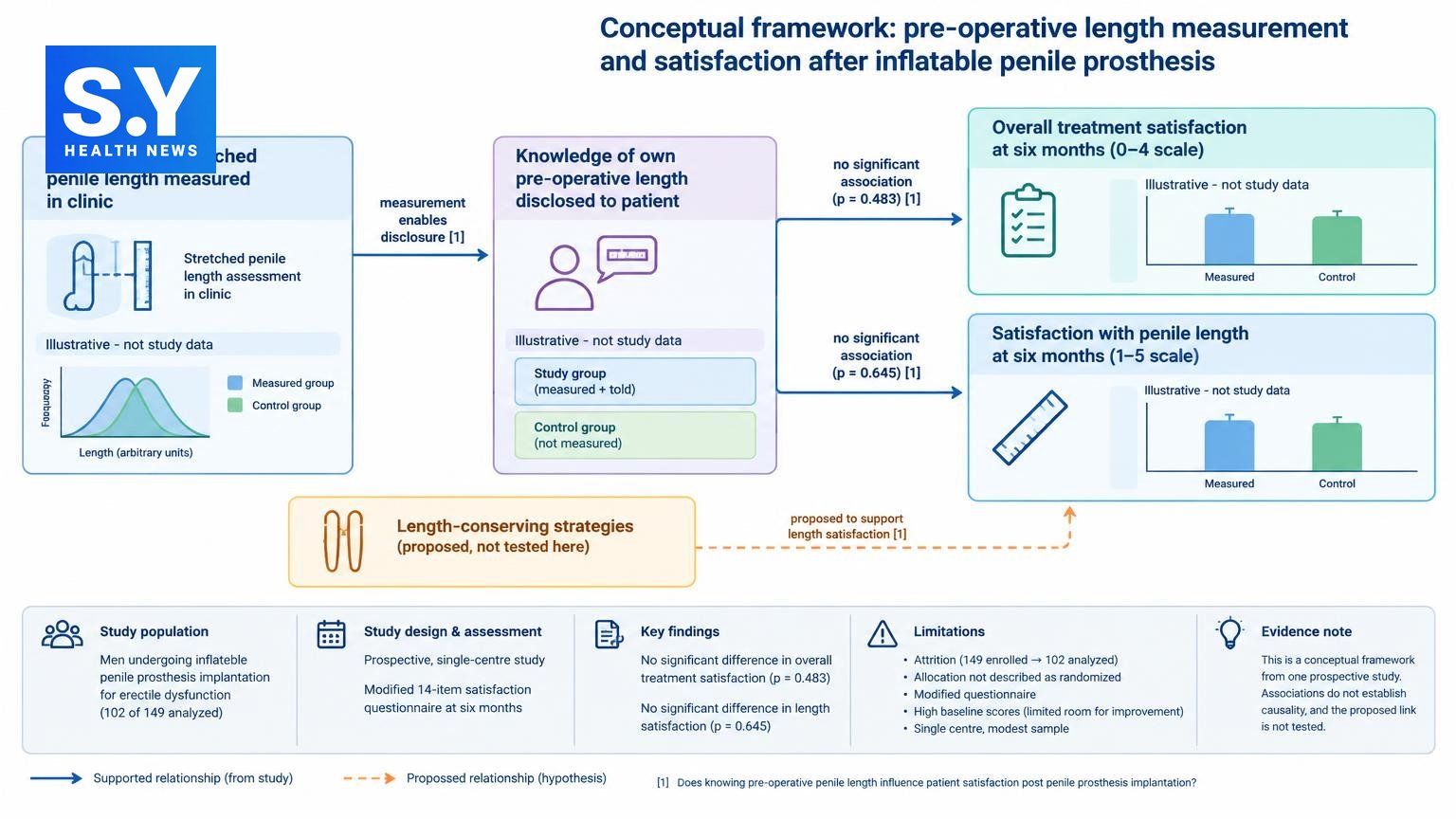
Overall treatment satisfaction averaged 3.57 in the study group and 3.53 in controls on a 0–4 scale (p = 0.483). Satisfaction with penile length averaged 4.08 versus 4.11 on a 1–5 scale (p = 0.645). Neither comparison was statistically significant. The authors concluded that knowledge of pre-operative stretched penile length did not influence post-operative satisfaction in this cohort and suggested that measuring length solely to inform the patient may be unnecessary.
- The intervention was disclosure of a pre-operative stretched penile length measurement, not a length-preservation procedure or a structured counselling programme.
- Scores were high in both arms, which leaves limited room to detect an improvement and means the result is best read as no clear benefit rather than proof of no effect.
- The authors proposed that interventions aimed at conserving penile length may help maintain satisfaction with length, but this was not tested in the reported data.
Why This Matters
Penile prosthesis surgery is a well-established treatment for erectile dysfunction that has not responded to other options, but the length question lingers after surgery for many men. The authors note that patients commonly complain of penile shortening after implantation, which makes the preoperative conversation a practical clinical problem rather than a purely technical one. If a simple measurement and explanation could protect satisfaction, it would be an inexpensive and low-risk step. If it does not, clinicians can reconsider whether routine measurement for disclosure alone adds value.
The question also touches a broader issue in men's sexual health: whether giving patients more numerical information reliably improves how they feel about their bodies and their treatment. That assumption is intuitively appealing but not automatically true. Satisfaction is shaped by expectations, baseline anatomy, surgical factors, relationship context and the meaning a man attaches to length. A single measurement delivered without an interpretive framework may not reach any of those levers.
Biological and Clinical Mechanism
The rationale for measuring pre-operative stretched penile length is partly anatomical and partly psychological. Stretched flaccid length is used in clinical practice as an accessible estimate of erectile length and as a baseline against which post-operative change might be judged. If a man knows his starting measurement, he may be better prepared for realistic outcomes and less likely to interpret normal post-surgical variation as major loss. The study hypothesis followed this logic: knowledge of the pre-operative measurement was expected to influence satisfaction.
The authors also point to length-conserving interventions as a possible route to maintaining satisfaction, which implies that the physical outcome itself, not only the information given about it, matters to patients. That is a hypothesis rather than an established mechanism, and the study did not test surgical or traction-based strategies. The reported design therefore isolates the informational component, not the anatomical one.
What the Evidence Shows
| Measure | Study group | Control group | Scale and timing | Reported comparison |
|---|---|---|---|---|
| Mean overall treatment satisfaction | 3.57 | 3.53 | 0–4 scale, six months after surgery | p = 0.483 |
| Mean satisfaction with penile length | 4.08 | 4.11 | 1–5 scale, six months after surgery | p = 0.645 |
| Patients eligible for final analysis | 49 | 53 | Enrolled cohort of 149 | Descriptive counts |
The study was prospective, with the measurement group receiving pre-operative stretched penile length assessment in clinic and controls not receiving it. Satisfaction was captured six months after surgery using a modified 14-item version of the Erectile Dysfunction Inventory of Treatment Satisfaction questionnaire, which addressed overall treatment satisfaction and satisfaction with penile length. The two groups produced nearly identical mean scores on both outcomes, and neither difference approached conventional statistical significance.
Statistically, the findings indicate that the observed differences are compatible with chance variation under the tested hypothesis. Clinically, the scores sit near the top of both scales, meaning most men in both arms were broadly satisfied. That combination matters: the study did not find that measured patients were dissatisfied, nor that unmeasured patients were more satisfied in any meaningful way. It found no signal that disclosure of the measurement shifted the outcome.
Interpretation and Limitations
The authors' conclusion is appropriately narrow: in this cohort, knowledge of pre-operative stretched penile length did not influence post-operative satisfaction, so measuring length in clinic solely to inform the patient may be unnecessary. That is a reasonable reading of the data, but it should not be generalized into a claim that communication about length is irrelevant. The intervention tested was a measurement, not a structured educational or expectation-setting conversation, and the two are not interchangeable.
Several design features limit certainty. The analysis included 102 of 149 enrolled patients, so attrition may have introduced differences between those who completed follow-up and those who did not. Allocation was by study group rather than described as randomized in the available text, which raises the possibility of confounding by surgeon, era or patient selection. The questionnaire was a modified 14-item version of a validated instrument, and satisfaction with length was captured on a different scale from overall satisfaction. A non-significant result in a modest sample is not proof of no effect; it may reflect insufficient power to detect a small difference.
There is also a ceiling consideration. With mean scores already high, a small but genuine benefit of measurement could be difficult to detect. Conversely, the result argues against a large effect of simple disclosure on satisfaction. The study cannot address whether measurement helps specific subgroups, such as men with pronounced pre-operative anxiety about length or those with unrealistic expectations, because subgroup findings were not reported in the available material.
Research Outlook
The natural next question is not whether to measure, but how to use the measurement. Trials comparing an unadorned measurement with a structured pre-operative conversation, including explicit discussion of realistic post-operative length and the distinction between flaccid and erect dimensions, would test a more plausible intervention. Longer follow-up could capture changes in satisfaction as the novelty of surgery fades, and validated, unmodified satisfaction instruments would improve comparability across studies.
The authors' suggestion that length-conserving interventions may maintain satisfaction with length is a separate hypothesis that deserves direct study rather than inference from an informational trial. Future work could also examine whether satisfaction with length tracks objective post-operative change or is driven mainly by preoperative expectations and baseline body image. Until such data exist, the practical message is modest: measuring and telling alone did not move satisfaction in this cohort, but the broader conversation about expectations remains clinically relevant.
Key Takeaways
- In a prospective study of 102 analyzed men, pre-operative stretched penile length measurement was not associated with better overall treatment satisfaction or length satisfaction six months after inflatable penile prosthesis implantation.
- Mean overall satisfaction was 3.57 versus 3.53 on a 0–4 scale, and mean length satisfaction was 4.08 versus 4.11 on a 1–5 scale, with p values of 0.483 and 0.645 respectively.
- The authors suggest that measuring length only to inform the patient may be unnecessary, while noting that length-conserving interventions could plausibly support satisfaction with length.
- Single-centre design, attrition from 149 enrolled to 102 analyzed, a modified questionnaire and high baseline scores limit how firmly the null result can be interpreted.
Questions and Answers
What is stretched penile length and why is it measured before penile prosthesis surgery?
Stretched penile length is a clinic measurement used as an accessible estimate of erectile length and as a baseline before inflatable penile prosthesis implantation. The idea tested in this study was that knowing this pre-operative value might help men form realistic expectations and therefore feel more satisfied after surgery, since penile shortening is a common post-operative complaint. The study found no significant satisfaction benefit from measurement alone.
Did measuring pre-operative penile length improve satisfaction after inflatable penile prosthesis implantation?
No clear improvement was seen. Among 102 analyzed patients, mean overall treatment satisfaction was 3.57 in the measured group versus 3.53 in controls on a 0–4 scale (p = 0.483), and mean satisfaction with penile length was 4.08 versus 4.11 on a 1–5 scale (p = 0.645). The authors concluded that knowledge of pre-operative stretched penile length did not influence satisfaction in this cohort.
How strong is the evidence that pre-operative penile length disclosure does not affect prosthesis satisfaction?
The evidence is limited to one prospective single-centre study with 102 patients eligible for final analysis, using a modified 14-item satisfaction questionnaire at six months. A non-significant result does not prove absence of any effect, especially with high baseline scores and a modest sample. The finding is best read as no detectable benefit of measurement alone, not as definitive evidence that communication about length is irrelevant.
Does the penile length satisfaction study apply to all men receiving a penile prosthesis?
It applies most directly to men similar to those enrolled: patients undergoing inflatable penile prosthesis implantation for erectile dysfunction at a single centre between August 2017 and December 2019. Men with severe pre-operative length anxiety, different prosthesis types or additional length-conserving procedures may respond differently, and the reported material does not include subgroup analyses. Generalization should therefore be cautious.
What are the limitations of the study on informing patients of penile length before prosthesis surgery?
Key limitations include attrition from 149 enrolled to 102 analyzed, a single-centre prospective design with group allocation not described as randomized, and a modified 14-item questionnaire. Both groups scored highly, leaving little room to show improvement, and the sample may be underpowered for small differences. The authors' recommendation about unnecessary measurement is an interpretation rather than a directly tested outcome.
If measurement alone did not help, what might support satisfaction with penile length after prosthesis surgery?
The authors suggest that interventions aimed at conserving penile length may help maintain satisfaction with length, although this was not directly tested in the reported study. A structured pre-operative conversation about realistic post-operative length and the difference between flaccid and erect dimensions is a separate strategy from simply disclosing a number. These possibilities require dedicated research before firm recommendations can be made.
Conceptual framework: Conceptual framework for a prospective single-centre study. Measurement enabled disclosure of pre-operative stretched penile length; neither overall treatment satisfaction nor length satisfaction differed significantly between measured and unmeasured groups. The link from length-conserving strategies to satisfaction is a proposed relationship, not a tested effect. The framework is conceptual and does not establish causation.
Academic References & Evidence
- Stephen Palasi; Skyler Howell; Travis P. Green; Christopher Kannady; Kristen B. Slaughter; Baibing Yang; Sravan Panuganti; Jose A. Saavedra-Belaunde; Jonathan Clavell-Hernandez; Run Wang. Does knowing pre-operative penile length influence patient satisfaction post penile prosthesis implantation?. International journal of impotence research. 2022 34(8):776-780 DOI: 10.1038/s41443-021-00472-1.
SANYUN Science Center explains published research on men's reproductive and sexual health, connecting scientific evidence with everyday questions while making sources and limitations clear.
Disclaimer: This article is for scientific education and research communication only. It does not provide medical advice, diagnosis, or individualized treatment recommendations, and does not endorse any medication, supplement, device, penile enlargement procedure, or other intervention. Decisions about sexual and reproductive health should be made in consultation with a qualified healthcare professional. Do not delay seeking professional care because of information in this article.
Original Content & Copyright Notice
- This article is prepared for SANYUN Science Center, drawing on published research and publicly available academic literature on men’s sexual and reproductive health. Its editorial explanations and presentation are developed for this platform.
- Copyright in the original editorial content, selection, and arrangement is reserved by SANYUN Science Center to the extent protected by applicable law. Referenced research, quotations, and third-party materials remain subject to the rights of their respective owners. This notice does not claim ownership of scientific facts or third-party research.
- Except where permitted by applicable law or an applicable license, prior written permission is required to reproduce, republish, translate, adapt, redistribute, or commercially reuse protected content. Attribution alone does not grant permission for such reuse.
- For permitted quotation or authorized reuse, clearly identify the source and retain a link to the original article.
- Source: SANYUN Science Center
- Original URL: Retain the original article URL on science.san-yun.com.
- Copyright Holder: SANYUN Science Center, for its own protected editorial content.
- Quotation, excerpts, or authorized reuse must not distort the scientific meaning, omit material limitations or disclaimers, or imply unverified medical claims, product efficacy, or endorsement by SANYUN Science Center.



