




Category: Premature Ejaculation
Core Research Direction: How the 2027 AUA/SMSNA guideline amendment and the 5th ICSM consensus reframe evidence-based evaluation and treatment of premature ejaculation, including what the updated evidence does and does not establish
Search Intent: What changed in the latest guideline and consensus on premature ejaculation, and which treatments are supported versus still uncertain?
Platform: SANYUN Science Center
Evidence reviewed through: 2026-11-22
Executive Summary
Two documents have refreshed the framing of premature ejaculation (PE) for clinicians. The AUA/SMSNA Disorders of Ejaculation Guideline has been amended, with the amendment indexed in the Journal of Urology in November 2026 and carrying a 2027 guideline label; it updates evidence-based guidance on evaluation, diagnosis and available treatments for PE and delayed ejaculation. Separately, the 5th International Consultation on Sexual Medicine (ICSM) has published consensus recommendations on definition, classification and treatment. The two are different kinds of product: one grades evidence within a formal guideline process, the other synthesises and recommends.[1][2][3]
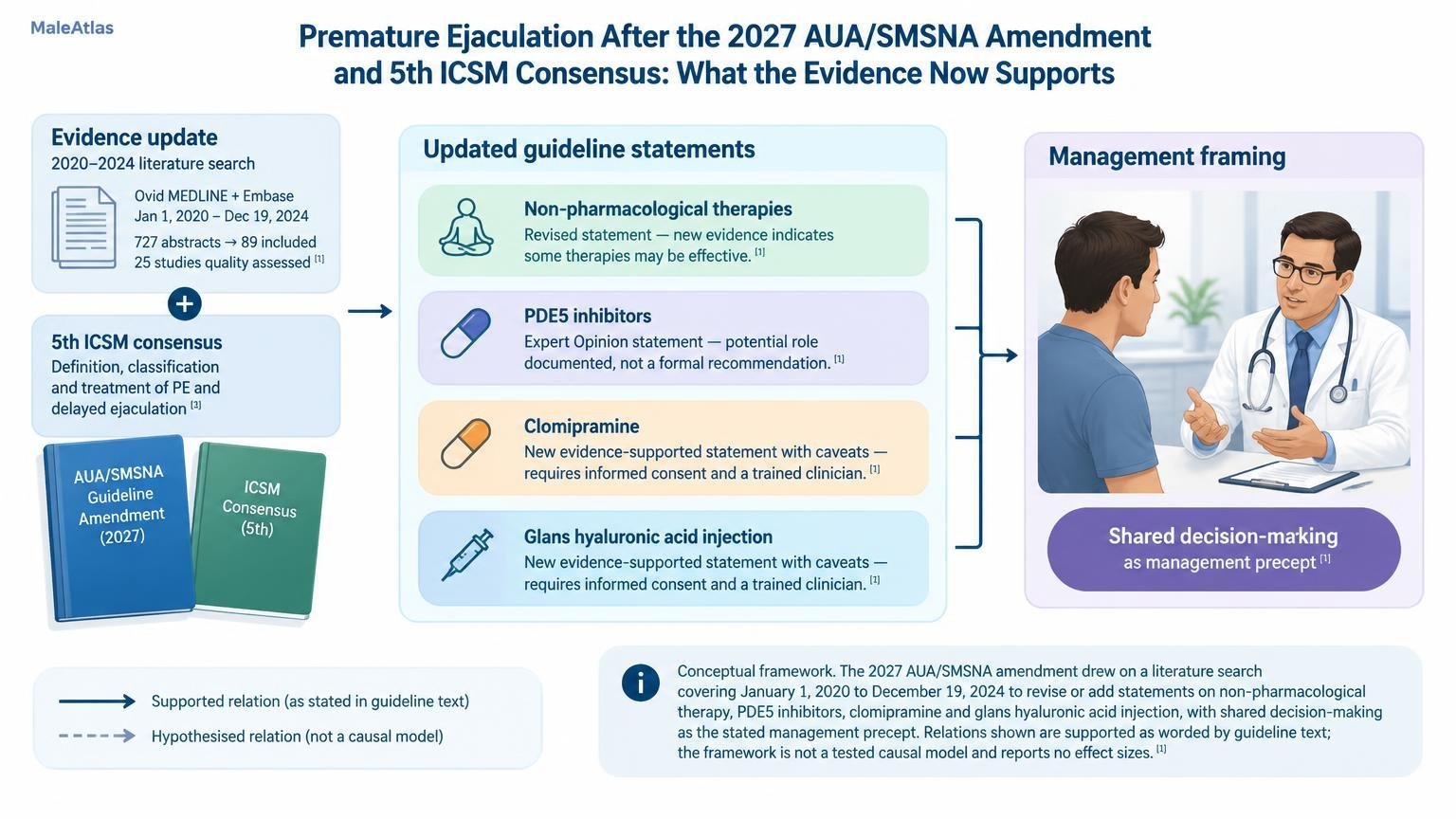
The amendment's evidence update was not a fresh freehand reading of the literature. A designated evidence-based practice centre searched Ovid MEDLINE and Embase for studies published between January 1, 2020 and December 19, 2024, identified 727 abstracts, of which 89 met inclusion criteria, and in 2025 assessed quality across 25 studies to inform statement updates. Those counts describe records and studies, not patients, and the available summary does not report effect sizes, confidence intervals or the number of participants behind any single recommendation.
The substantive changes are narrow but real. A statement on non-pharmacological therapies was revised to reflect new evidence that some of these therapies may be effective. A new Expert Opinion statement addresses potential use of PDE5 inhibitors. Evidence supported two new statements on daily or on-demand clomipramine and on glans hyaluronic acid injection, both explicitly conditioned on informed consent and use by a trained clinician. The Panel places shared decision-making as the fundamental principle regardless of which option is chosen.
Why This Matters
PE and delayed ejaculation are described as common conditions with a substantial impact on men's quality of life and their relationships. That framing matters because the clinical problem is rarely a single number. It involves distress, partner experience, expectations and the meaning a man attaches to control over ejaculation. A guideline that changes even a few statements can shift what clinicians offer, what patients ask for and what payers or regulators treat as legitimate care.
The risk in reading a guideline amendment is over-reading it. A new statement is not automatically a strong recommendation, and a recommendation is not proof of efficacy in every patient. The amendment itself distinguishes between revised evidence-based statements, a new Expert Opinion statement and two evidence-supported statements carrying important caveats. Those are different levels of warrant, and treating them as equivalent would misrepresent the document.
There is also a definitional layer. The ICSM consensus is intended to present evidence-based recommendations for the definition, classification and treatment of PE and delayed ejaculation. How a condition is defined determines who is counted, who is treated and what a trial can measure. The consensus topics include lifelong and acquired PE, intravaginal ejaculatory latency time (IELT), penile hypersensitivity, dapoxetine, selective serotonin reuptake inhibitors (SSRIs) and psychotherapy, which signals the conceptual breadth the consultation wanted to cover.
Biological and Clinical Mechanism
The packet does not supply a mechanistic account of PE, and this review will not manufacture one. What can be said is that the consensus scope explicitly names penile hypersensitivity and IELT, alongside the lifelong versus acquired distinction. Those terms are conceptual anchors rather than validated causal pathways: IELT is a latency measure, hypersensitivity is a proposed contributory construct, and the subtype distinction separates a lifelong pattern from one acquired after a period of typical function.
The treatment concepts mentioned in the consensus keywords point in several directions at once. Dapoxetine and SSRIs sit within serotonergic pharmacotherapy; psychotherapy sits within psychological and behavioural approaches; and the AUA/SMSNA amendment separately addresses PDE5 inhibitors, clomipramine and glans hyaluronic acid injection. The coexistence of these categories is itself informative: it suggests a condition managed through more than one mechanism of action rather than a single dominant target.
For readers who want the mechanistic and measurement background in more depth, the question of how PE is subtyped and measured is treated separately in an evidence review of PE subtypes and diagnostic frameworks. The present article stays with what the two 2026-era documents change, and what they leave open.
What the Updated Evidence Shows
The clearest structural finding is procedural. The amendment was informed by a defined search window, a defined set of databases, a documented screening yield and a formal quality assessment. That does not make the conclusions correct, but it makes the process auditable in a way that a narrative consensus cannot be. When the Panel says new data supported a statement, the reader can at least see how much literature was screened and how many studies were quality-assessed.
The revised non-pharmacological statement is the least specific and potentially the most consequential. The amendment states that new evidence indicates some non-pharmacological therapies may be effective, but the available summary does not name which therapies, in which subtype, against which comparator, or with what magnitude. A clinician cannot act on "some therapies may be effective" without the underlying statement text. This is a place where the summary is a signpost, not a prescription.
The PDE5 inhibitor statement is deliberately graded as Expert Opinion. That label tells the reader that the Panel saw a plausible role worth documenting but did not regard the evidence as sufficient for a higher-grade recommendation. PDE5 inhibitors are familiar from erectile dysfunction management, which may make the statement feel more established than it is; the guideline's own grading is the corrective.
Clomipramine and glans hyaluronic acid injection are the two genuinely new evidence-supported additions, and both arrive with explicit conditions. The Panel emphasises informed consent and use at the behest of a trained clinician. The amendment also states that these two recommendations come with important caveats, though the available summary does not enumerate them. The practical reading is that evidence exists, but it is not presented as a routine or first-line pathway.
| Guideline element | Status in the amendment | Evidence basis as described | Practical reading |
|---|---|---|---|
| Non-pharmacological therapies for PE | Statement revised | New evidence indicates some therapies may be effective; specific therapies and effect sizes not given in the summary | Direction of change is positive but not actionable without the full statement |
| PDE5 inhibitors | New Expert Opinion statement | Expert Opinion grade; not described as evidence-based recommendation | Potential role documented, not established efficacy |
| Clomipramine, daily or on-demand | New statement supported by evidence | Evidence supported the statement; informed consent and trained-clinician conditions apply | Legitimate option with caveats, not a routine default |
| Glans hyaluronic acid injection | New statement supported by evidence | Evidence supported the statement; informed consent and trained-clinician conditions apply | Legitimate option with caveats, not a routine default |
| Shared decision-making | Fundamental precept across all treatments | Panel recommendation, not a comparative trial result | Applies regardless of which option is chosen |
| Definition and classification | Addressed by the 5th ICSM consensus | Consensus recommendations aiming at evidence-based definition, classification and treatment | Framing document; not a graded guideline amendment |
The two documents should not be merged into a single verdict. The AUA/SMSNA amendment operates through graded statements tied to a defined evidence search. The 5th ICSM consensus aims to deliver recommendations on definition, classification and treatment, but the available text describes the aim and topic scope rather than listing the recommendations themselves. Where the two appear to converge on breadth of management options, that reflects shared subject matter, not a pooled analysis.
Interpretation and Limitations
Several limitations constrain how far this review can go. First, the sources available here are summaries and index records, not full guideline text. The amendment summary reports that evidence supported new statements but does not give effect sizes, confidence intervals, participant numbers or the specific studies behind each statement. Any statement about how well clomipramine or glans hyaluronic acid injection works would therefore be an inference beyond the available material.
Second, the search window is bounded. Studies published between January 1, 2020 and December 19, 2024 informed the update, with quality assessment conducted in 2025. Evidence published after that window is not represented in the amendment as described. A reader in late 2026 should treat the amendment as a snapshot anchored to that window rather than a continuously updated synthesis.
Third, the consensus product is a narrative synthesis with recommendations, not a primary study and not a systematic review with meta-analysis as described. Its stated aim is to present evidence-based recommendations for definition, classification and treatment, but the available record does not report how evidence was graded, how conflicts were resolved, or what the specific recommendations were. Citing it as proof that a treatment works would misdescribe what kind of document it is.
Fourth, the amendment concerns both PE and delayed ejaculation. Most of the new statements described here concern PE, but the guideline's scope is broader, and a statement summarised under the ejaculatory disorders heading may not apply identically to both conditions. This review has kept its focus on PE and should not be read as a full account of the delayed ejaculation provisions.
Fifth, the distinction between statistical and clinical meaning cannot be drawn from the available text at all. No effect sizes are reported, so there is no basis here for judging whether an observed difference would be noticeable to a patient or a couple. The absence of that information is a limitation of this review's source material, not evidence that the effects are small.
Finally, applicability is uncertain. The sources do not specify which populations, settings or subtypes the new statements were derived from, and the consensus keywords span lifelong and acquired PE without indicating whether recommendations differ between them. Clinicians should assume that the full documents contain those qualifications rather than that the recommendations are subtype-agnostic.
Research Outlook
The most useful near-term development would be transparency about what the new statements rest on. Reporting the specific trials behind the clomipramine and glans hyaluronic acid statements, with their comparators, durations and outcome measures, would let clinicians judge whether the caveats concern safety, durability, population specificity or limited replication. The amendment's summary confirms the statements exist but not what would change a reader's mind about them.
A second gap is definitional convergence. If the ICSM consensus and the AUA/SMSNA guideline settle on compatible definitions and classification, future trials can be compared more meaningfully, and future amendments can synthesise them without the subtype confusion that has historically complicated PE research. The consensus explicitly targets definition and classification alongside treatment, which makes convergence at least a stated aim rather than an incidental hope.
A third question is where non-pharmacological therapy now sits. The revised statement acknowledges that some non-pharmacological therapies may be effective, but the relationship between psychological or behavioural approaches and pharmacotherapy remains unspecified in the available text. Whether these are positioned as alternatives, adjuncts or sequencing options is exactly the kind of question the next amendment could answer more explicitly.
For readers following the treatment-evidence side of this topic, the comparative trial literature on psychological, pharmacological and combined approaches is examined in a separate review of psycho-behavioural versus pharmacological treatment of PE. The guideline amendment changes the status labels; it does not by itself resolve the underlying comparative question.
Key Takeaways
- The AUA/SMSNA amendment updates guidance on evaluation, diagnosis and treatment of PE and delayed ejaculation, and was indexed in the Journal of Urology in November 2026 under a 2027 guideline label.
- Its evidence update searched Ovid MEDLINE and Embase for studies published January 1, 2020 to December 19, 2024, identified 727 abstracts with 89 meeting inclusion, and quality-assessed 25 studies in 2025.
- A non-pharmacological statement was revised for possible effectiveness, a new Expert Opinion statement covers PDE5 inhibitors, and evidence supported new statements on clomipramine and glans hyaluronic acid injection with informed-consent and trained-clinician conditions.
- Shared decision-making is positioned as the fundamental principle across all treatment options for ejaculatory disorders.
- The 5th ICSM consensus aims to provide evidence-based recommendations on definition, classification and treatment, and covers lifelong and acquired PE, IELT, penile hypersensitivity, dapoxetine, SSRIs and psychotherapy; its detailed recommendations are not in the available record.
- Neither document, as summarised here, supplies effect sizes or participant-level results, so the magnitude and clinical importance of the new treatment statements remain unestablished in this review.
Questions and Answers
What is premature ejaculation and how is it classified in the 5th ICSM consensus?
Premature ejaculation is a common ejaculatory disorder that the 5th ICSM consensus addresses alongside delayed ejaculation, with stated aims of recommending definition, classification and treatment. The consensus scope names lifelong and acquired PE as distinct categories and lists intravaginal ejaculatory latency time and penile hypersensitivity among its topics. The available record describes the aim and topic scope rather than the final definitions themselves.
What did the 2027 AUA/SMSNA premature ejaculation guideline amendment change?
It revised a statement on non-pharmacological therapies to reflect evidence that some may be effective, added an Expert Opinion statement on PDE5 inhibitors, and supported two new statements on daily or on-demand clomipramine and glans hyaluronic acid injection for PE. The latter two carry informed-consent and trained-clinician conditions plus stated caveats. Shared decision-making is reaffirmed as the fundamental principle.
How strong is the evidence behind clomipramine and glans hyaluronic acid injection for premature ejaculation?
The amendment states that evidence supported both new statements, so they are not merely expert opinion. However, the Panel explicitly conditions them on informed consent and use by a trained clinician, and describes important caveats for both. The available summary does not report effect sizes, comparators, participant numbers or the specific caveats, so the strength of evidence cannot be graded further from these sources.
Are PDE5 inhibitors recommended for premature ejaculation?
Not in the sense of an established, evidence-graded recommendation. The amendment added a new Expert Opinion statement on their potential use for PE, which is a lower level of warrant than an evidence-based statement. The distinction matters: an Expert Opinion statement documents that the Panel considered a role plausible or worth noting, not that controlled evidence establishes benefit.
What are the main limitations of the updated premature ejaculation evidence?
The available sources are summaries and index records rather than full guideline text. No effect sizes, confidence intervals or participant numbers are reported for the new statements. The search covered studies published January 1, 2020 to December 19, 2024, so later evidence is not represented. The ICSM paper is a consensus synthesis, not a primary study, and its detailed recommendations are not in the record.
How do the AUA/SMSNA guideline and the ICSM consensus differ in what they provide?
They are different document types. The AUA/SMSNA amendment is a guideline update tied to a defined database search, screening yield and formal quality assessment, with statements graded by evidence type. The 5th ICSM paper is a consensus review aiming to recommend definition, classification and treatment. Agreement between them reflects shared subject matter, not a pooled or jointly analysed evidence base.
Conceptual framework: Conceptual framework. The 2027 AUA/SMSNA amendment drew on a literature search covering January 1, 2020 to December 19, 2024 to revise or add statements on non-pharmacological therapy, PDE5 inhibitors, clomipramine and glans hyaluronic acid injection, with shared decision-making as the stated management precept. Relations shown are supported as worded by guideline text; the framework is not a tested causal model and reports no effect sizes.
Academic References & Evidence
- Disorders of Ejaculation: AUA/SMSNA Guideline (2027) | Journal of Urology. DOI: 10.1097/JU.0000000000005378.
- Shindel AW; Rowland D; Bajic PJ. Unbound Prime. J Urol. 2026 :101097JU0000000000005378 DOI: 10.1097/JU.0000000000005378.
- Contemporary consensus and emerging directions in premature and delayed ejaculation: recommendations from the 5th International Consultation on Sexual Medicine.. Sexual medicine reviews PMID: 42855438.
SANYUN Science Center explains published research on men's reproductive and sexual health, connecting scientific evidence with everyday questions while making sources and limitations clear.
Disclaimer: This article is for scientific education and research communication only. It does not provide medical advice, diagnosis, or individualized treatment recommendations, and does not endorse any medication, supplement, device, penile enlargement procedure, or other intervention. Decisions about sexual and reproductive health should be made in consultation with a qualified healthcare professional. Do not delay seeking professional care because of information in this article.
Original Content & Copyright Notice
- This article is prepared for SANYUN Science Center, drawing on published research and publicly available academic literature on men’s sexual and reproductive health. Its editorial explanations and presentation are developed for this platform.
- Copyright in the original editorial content, selection, and arrangement is reserved by SANYUN Science Center to the extent protected by applicable law. Referenced research, quotations, and third-party materials remain subject to the rights of their respective owners. This notice does not claim ownership of scientific facts or third-party research.
- Except where permitted by applicable law or an applicable license, prior written permission is required to reproduce, republish, translate, adapt, redistribute, or commercially reuse protected content. Attribution alone does not grant permission for such reuse.
- For permitted quotation or authorized reuse, clearly identify the source and retain a link to the original article.
- Source: SANYUN Science Center
- Original URL: Retain the original article URL on science.san-yun.com.
- Copyright Holder: SANYUN Science Center, for its own protected editorial content.
- Quotation, excerpts, or authorized reuse must not distort the scientific meaning, omit material limitations or disclaimers, or imply unverified medical claims, product efficacy, or endorsement by SANYUN Science Center.



