




Category: Premature Ejaculation
Core Research Direction: Longitudinal and meta-analytic evidence on premature ejaculation: whether PE symptoms causally drive anxiety/depression/sexual distress over time, and how physiotherapy compares with dapoxetine for prolonging intravaginal ejaculatory latency time (IELT) in lifelong PE.
Search Intent: Do premature ejaculation symptoms cause later anxiety, depression and sexual distress, and how effective is physiotherapy compared with dapoxetine for prolonging IELT in men with lifelong PE?
Platform: SANYUN Science Center
Evidence reviewed through: 2026-11-23
Executive Summary
Two questions dominate current discussion of premature ejaculation (PE): whether the condition drives later psychological harm, and whether non-drug treatment can compete with medication for prolonging intravaginal ejaculatory latency time (IELT). The available evidence points in different directions for each.[1]
On the first question, a large population-based longitudinal study reports no evidence for long-term causal associations between PE symptoms and symptoms of anxiety, depression and sexual distress. That is a causal claim the design could not support, and the authors say so in the title rather than reporting a positive pathway.[2]
On the second, a 2026 systematic review and meta-analysis of six trials (416 participants) found a statistically significant pooled difference in IELT of −0.80 seconds (95% CI −1.53 to −0.06; P = .03) favoring dapoxetine 30 mg over physiotherapy in men with lifelong PE, with high heterogeneity (I2 = 83%). The authors conclude dapoxetine is significantly more effective, while describing physiotherapy as a safe option and a promising alternative for men intolerant to medication.[3]
The two datasets answer different questions with different designs, and neither settles the other. Read together, they suggest that the psychological burden of PE should not be assumed to be a simple downstream consequence, and that the IELT advantage of medication over physiotherapy is statistically robust but clinically small and imprecisely estimated.
Why This Matters
PE is described in consensus review as a common condition with a substantial impact on men's quality of life and their relationships. A frequently stated figure in the physiotherapy review is that approximately 75% of men will experience PE at some point in their lives, although the primary source and the definition behind that number are not given in the supplied text, so it should be treated as a narrative estimate rather than a precise prevalence.
If PE caused later anxiety and depression, early treatment would carry a mental health rationale as well as a sexual one. If it does not, clinicians should still take distress seriously but should not promise that treating latency will prevent psychiatric outcomes. Likewise, if physiotherapy matched dapoxetine for IELT, men who cannot tolerate medication would have a genuine first-line alternative; if the difference is real but small, the choice becomes a trade-off between magnitude of effect, side effects and personal preference.
Mechanism and Clinical Background
The Fifth International Consultation on Sexual Medicine review addresses lifelong and acquired PE, IELT, penile hypersensitivity, SSRIs, psychotherapy and dapoxetine among its topics, and aims to present evidence-based recommendations for definition, classification and treatment. The supplied text provides the scope and keywords but not the substance of those recommendations, so this article cannot report what the consensus actually concluded on any specific point.
The physiotherapy review describes dapoxetine as a short-acting SSRI approved in Europe but not the United States, the most used pharmacological treatment and the only oral compound developed for PE. It frames physiotherapy as pelvic floor muscle strengthening and biofeedback exercise, electrostimulation, acupuncture and yoga, targeting pelvic floor weakness or hypertonicity that may contribute to ejaculatory disorder. These are proposed mechanisms used to justify the interventions, not mechanisms demonstrated in the included trials.
A practical definitional point: lifelong PE is premature ejaculation from the first sexual experiences in nearly all penetrations, whereas acquired PE develops after a period of normal function and is often associated with physical, psychological or comorbid sexual disorders. The meta-analysis restricted inclusion to trials using IELT as the primary outcome in men with lifelong PE, which matters for how far its conclusions travel.
What the Longitudinal Evidence Shows About Anxiety and Distress
The population-based longitudinal study by Ventus, Gunst, Kärnä and Jern is a peer-reviewed original article published in a journal, and its stated finding is an absence of evidence for long-term causal associations between PE symptoms and symptoms of anxiety, depression and sexual distress in a large population-based sample.
That phrasing deserves care. A longitudinal design can test whether earlier PE symptoms predict later psychological symptoms after adjustment, and a null result of that kind argues against a strong causal pathway at population level. It does not prove that no individual man's distress is worsened by PE, and the supplied text does not report effect sizes, follow-up duration or the measures used, so the precision of the null finding cannot be assessed here.
This is also a reminder that cross-sectional correlations between PE and anxiety are compatible with several explanations: PE causing distress, distress or anxiety contributing to ejaculatory difficulty, shared risk factors, or reverse influence over time. The longitudinal result constrains the first explanation more than the others but does not adjudicate among them.
What the Meta-Analysis Shows About Physiotherapy and Dapoxetine
The 2026 systematic review and meta-analysis asked whether physiotherapeutic interventions increase IELT compared with pharmacological treatment in men diagnosed with PE. Six clinical trials with 416 participants met inclusion and were pooled, and the authors pooled IELT for physiotherapy versus dapoxetine 30 mg using a random-effects model.
| Variable | Definition as used in the review | Interpretation |
|---|---|---|
| IELT | Time from vaginal intromission to intravaginal ejaculation, used to diagnose and measure treatment response | The primary outcome; measured by stopwatch in most included trials and by self-report in one |
| Pooled mean difference | −0.80 s (95% CI −1.53 to −0.06) favoring dapoxetine 30 mg over physiotherapy | Statistically significant (P = .03); the interval excludes zero but the magnitude is under one second |
| Heterogeneity (I2) | 83% across included trials | High inconsistency; the authors state caution is required when interpreting the pooled result |
| Included trials and participants | Six clinical trials, 416 participants (text elsewhere describes a qualitative total of 466 men) | Small evidence base with heterogeneous designs, doses and physiotherapy modalities |
| Patient-reported satisfaction | No statistically significant difference reported between physiotherapy and pharmacological treatment | Suggests both approaches may be acceptable; tolerability was not systematically captured |
Individual trials illustrate the range. In one four-arm trial, IELT before treatment was similar across groups at around 44-45 seconds; after four weeks, the dapoxetine 60 mg group reached 127.52 seconds, the dapoxetine 30 mg group 103.21 seconds, the acupuncture group 87.21 seconds, and the placebo group did not exceed 63.43 seconds. In another trial, moderate physical activity raised IELT from 39.3 to 188.6 seconds, while the dapoxetine group rose from 36.8 to 181.7 seconds; minimal activity produced much smaller gains. These are single-trial observations of varying quality, not pooled effects.
One narrative detail is worth flagging because it complicates a simple drug-versus-exercise story: spontaneous IELT improvements appeared in a placebo group and in a dapoxetine group in different trials, leading the authors to suggest that measured effects may reflect specific treatment plus placebo and nonspecific effects. That is an interpretive hypothesis, not a tested mechanism, but it is a reasonable warning against attributing every second of gain to the active ingredient or the exercise protocol.
Interpretation: Statistical Versus Clinical Meaning
The most important interpretive task is separating the significance of the pooled estimate from its size. A mean difference of −0.80 seconds with a confidence interval from −1.53 to −0.06 is statistically significant because the interval excludes zero, and the review reports it as favoring dapoxetine. But the supplied abstract and results describe the effect in seconds while the discussion also describes a standardized mean difference of −0.80 framed as a large effect by Cohen's criteria.
Those two framings are not interchangeable. A standardized effect of 0.80 is large relative to the variability between participants; a raw difference of 0.80 seconds is trivial against IELTs that moved from tens of seconds into the low hundreds in individual trials. The supplied text does not resolve how the −0.80 second figure and the −0.80 standardized figure relate across the pooled studies, and the high heterogeneity (I2 = 83%) means the pooled value may not describe any particular trial well. Readers should therefore treat the direction of the finding as reasonably consistent with the authors' conclusion while treating the precise magnitude as uncertain.
The review's own conclusion is appropriately hedged: dapoxetine 30 mg appears significantly more effective than physiotherapy for prolonging IELT in lifelong PE, physiotherapy can be considered safe and beneficial, and a combined approach yielded the most significant improvements in the qualitative review. The combination signal is hypothesis-generating rather than established, because it rests on a small number of three-arm and four-arm trials.
Two features of the evidence base also narrow the clinical inference. Most included studies did not report adverse effects and did not mention treatment adherence, which the authors identify as limitations that could affect results. And blinding was a weak point: trials scored lowest on blinding of participants, therapists and assessors, which is difficult to avoid when comparing exercise with a tablet but still permits expectancy effects.
The longitudinal study and the meta-analysis also carry different kinds of uncertainty. The former reports a null causal finding whose effect estimates and follow-up are unavailable in the supplied material; the latter reports a positive but heterogeneous pooled difference from six small trials. Neither is strong enough to support confident claims about individual prognosis or about which treatment a given man should receive.
Research Outlook
The physiotherapy review's authors call for better-designed clinical trials using both subjective and objective measurement instruments. That recommendation targets the central weakness: IELT is a stopwatch or self-report number, and satisfaction, control and distress are the outcomes men actually care about. Future trials that prespecify both domains, report adverse events and adherence, and blind outcome assessors where possible would substantially strengthen the comparison.
On the psychological question, the appropriate next step is not another cross-sectional correlation but further longitudinal work with repeated measures and explicit modelling of bidirectional effects. The existing population-based study argues against a strong long-term causal pathway from PE symptoms to anxiety, depression and sexual distress; replication with reported effect sizes would clarify whether a smaller or time-limited association exists.
For clinical practice, the honest synthesis is that medication has the more consistent latency signal, physiotherapy has a plausible safety and tolerability rationale and comparable satisfaction in the pooled review, and combination therapy is promising but unproven. Men and clinicians should discuss goals beyond seconds, including control, distress and partner experience, rather than treating IELT as the sole endpoint.
Key Takeaways
- A large population-based longitudinal study reports no evidence for long-term causal associations between PE symptoms and symptoms of anxiety, depression and sexual distress; this constrains causal claims but does not rule out individual-level or short-term effects.
- A 2026 meta-analysis of six trials and 416 participants found a pooled IELT difference of −0.80 seconds (95% CI −1.53 to −0.06; P = .03) favoring dapoxetine 30 mg over physiotherapy in lifelong PE, with high heterogeneity (I2 = 83%).
- The review describes physiotherapy as safe and beneficial and a promising alternative for men intolerant to medication, and reports no statistically significant difference in satisfaction between the two approaches.
- Adverse effects and adherence were largely unreported in the included trials, and blinding was weak, so tolerability and real-world effectiveness comparisons remain uncertain.
- Narrative prevalence figures, including the widely repeated estimate that approximately 75% of men experience PE at some point, should be read cautiously because the underlying definition and source are not specified in the supplied text.
Questions and Answers
Do premature ejaculation symptoms cause later anxiety and depression?
A large population-based longitudinal study reports no evidence for long-term causal associations between PE symptoms and later symptoms of anxiety, depression and sexual distress. This argues against a strong causal pathway at population level, but the supplied text does not report effect sizes or follow-up length, and individual men may still experience distress that warrants clinical attention.
What did the 2026 meta-analysis of physiotherapy versus dapoxetine find for IELT in lifelong PE?
Pooling six trials with 416 participants, the review found a statistically significant mean IELT difference of −0.80 seconds (95% CI −1.53 to −0.06; P = .03) favoring dapoxetine 30 mg over physiotherapy, with high heterogeneity (I2 = 83%). The authors conclude dapoxetine is significantly more effective for prolonging IELT while calling for cautious interpretation.
Is physiotherapy a reasonable alternative to dapoxetine for premature ejaculation?
It may be for some men. The review describes physiotherapy as safe and beneficial and a promising alternative for patients intolerant to pharmacological treatment, and found no statistically significant difference in satisfaction between the two approaches. However, the evidence comes from a small, heterogeneous set of trials with weak blinding and limited reporting of adverse effects and adherence.
How strong is the evidence comparing physiotherapy with medication for premature ejaculation?
Moderate at best. The six included trials varied in design, physiotherapy modality and dapoxetine dose, heterogeneity was high at 83%, blinding of participants, therapists and assessors was weak, and most studies did not report adverse events or adherence. The authors themselves call for better-designed trials with both subjective and objective measures.
What is the difference between lifelong and acquired premature ejaculation?
Lifelong PE appears from the first sexual experiences in nearly all penetrations, whereas acquired PE develops after a period of normal ejaculatory function and is often associated with physical, psychological or comorbid sexual disorders. The meta-analysis comparing physiotherapy with dapoxetine restricted inclusion to men with lifelong PE, so its conclusions should not be automatically extended to acquired PE.
Does the pooled IELT difference mean dapoxetine is clinically far superior to physiotherapy?
Not necessarily. The pooled difference is statistically significant but reported as less than one second in raw terms, while individual trials showed much larger within-group gains for both approaches and a placebo group also improved. High heterogeneity means the pooled value may not describe any single trial, so the direction is more secure than the precise size of the advantage.
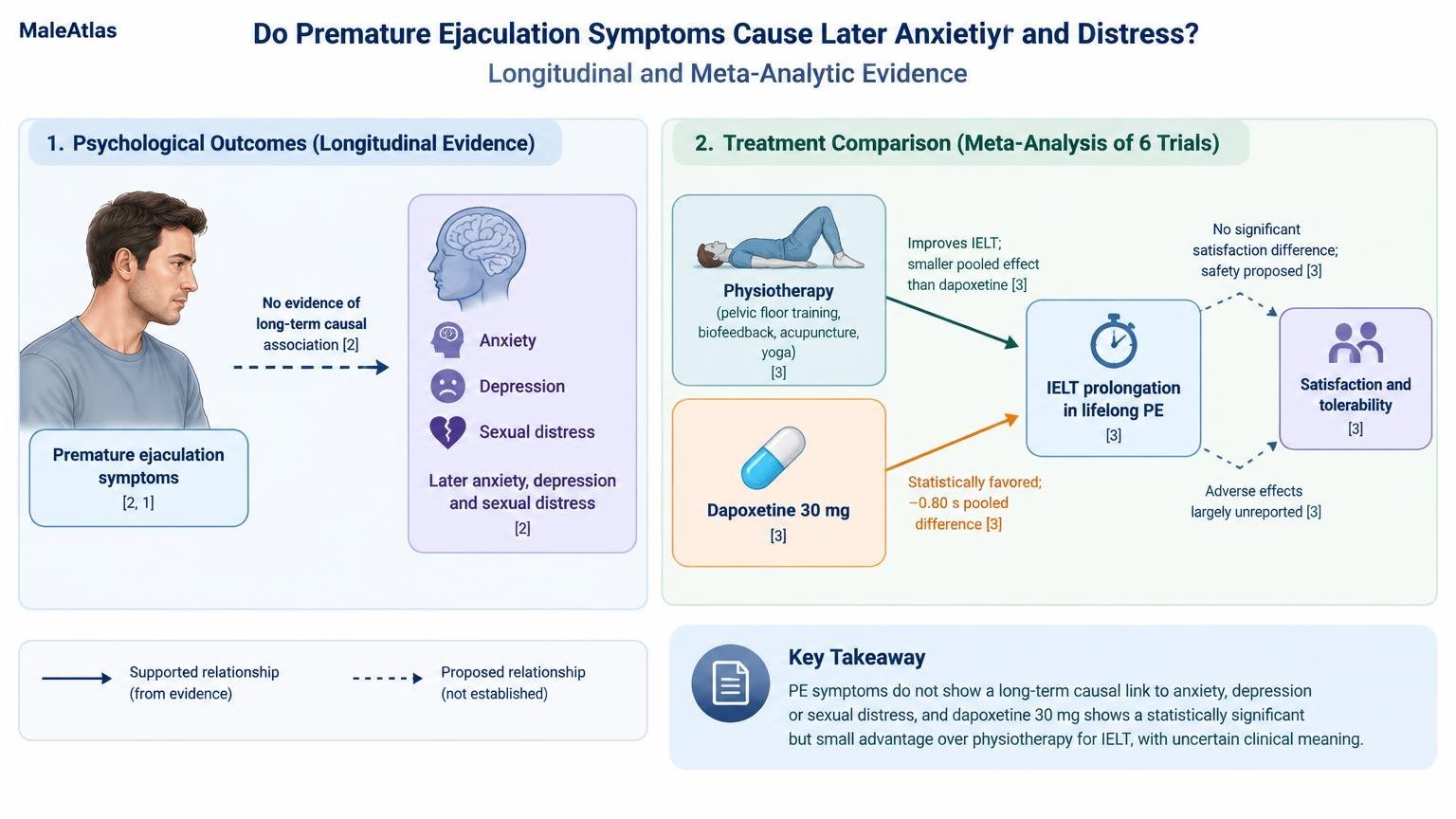
Conceptual framework: Conceptual framework. Left: population-based longitudinal evidence on whether PE symptoms predict later anxiety, depression and sexual distress (no evidence of long-term causal association). Right: pooled trial evidence comparing physiotherapy with dapoxetine 30 mg on IELT in lifelong PE, with satisfaction and tolerability as secondary dimensions. Supported versus proposed relations are distinguished; the framework is not a tested causal model.
Academic References & Evidence
- Contemporary consensus and emerging directions in premature and delayed ejaculation: recommendations from the 5th International Consultation on Sexual Medicine.. Sexual medicine reviews PMID: 42855438.
- Daniel Ventus; Annika Gunst; Antti Kärnä; Patrick Jern. undefined. 2017 54(2):264-272 DOI: 10.1080/00224499.2016.1255301.
- Esther M Medrano-Sánchez; Ana López-del-Castillo; Maud Boisseau; Juan C Fernández-Domínguez; Esther Díaz-Mohedo. Effectiveness of physiotherapy in male premature… : The Journal of Sexual Medicine. The Journal of Sexual Medicine. 2026 23(5) DOI: 10.1093/jsxmed/qdag096.
SANYUN Science Center explains published research on men's reproductive and sexual health, connecting scientific evidence with everyday questions while making sources and limitations clear.
Disclaimer: This article is for scientific education and research communication only. It does not provide medical advice, diagnosis, or individualized treatment recommendations, and does not endorse any medication, supplement, device, penile enlargement procedure, or other intervention. Decisions about sexual and reproductive health should be made in consultation with a qualified healthcare professional. Do not delay seeking professional care because of information in this article.
Original Content & Copyright Notice
- This article is prepared for SANYUN Science Center, drawing on published research and publicly available academic literature on men’s sexual and reproductive health. Its editorial explanations and presentation are developed for this platform.
- Copyright in the original editorial content, selection, and arrangement is reserved by SANYUN Science Center to the extent protected by applicable law. Referenced research, quotations, and third-party materials remain subject to the rights of their respective owners. This notice does not claim ownership of scientific facts or third-party research.
- Except where permitted by applicable law or an applicable license, prior written permission is required to reproduce, republish, translate, adapt, redistribute, or commercially reuse protected content. Attribution alone does not grant permission for such reuse.
- For permitted quotation or authorized reuse, clearly identify the source and retain a link to the original article.
- Source: SANYUN Science Center
- Original URL: Retain the original article URL on science.san-yun.com.
- Copyright Holder: SANYUN Science Center, for its own protected editorial content.
- Quotation, excerpts, or authorized reuse must not distort the scientific meaning, omit material limitations or disclaimers, or imply unverified medical claims, product efficacy, or endorsement by SANYUN Science Center.



