




Category: Premature Ejaculation
Core Research Direction: Whether psychological symptoms (anxiety, depression, sexual distress) causally drive premature ejaculation over time, and how treatment comparisons for PE should be interpreted given study-design limits
Search Intent: Do anxiety, depression, and sexual distress cause premature ejaculation over time, and what does current evidence actually establish about how PE should be defined and treated?
Platform: SANYUN Science Center
Evidence reviewed through: 2026-11-23
Executive Summary
Premature ejaculation (PE) is one of the most frequently reported male sexual complaints, yet its etiology remains contested. A long-standing clinical assumption holds that anxiety, depression and sexual distress are causal or maintaining factors. A population-based Finnish twin and sibling study tested this assumption directly by asking whether symptoms of these psychological problems predicted future PE, and whether PE predicted later psychological change.[1]
The study followed 985 male Finnish twins and brothers of twins who completed questionnaires in 2006 and 2012. Bivariate correlations between PE and the psychological variables were significant both within and across time. However, when structural equation models tested the hypothesized causal pathways, baseline anxiety and sexual distress did not predict future PE, and baseline PE did not predict later increments or decrements in anxiety, sexual distress or depression.
These null findings do not eliminate psychological factors from PE care. They constrain what can be claimed about long-term causal direction in a general population sample measured six years apart. Separately, a 2026 systematic review and meta-analysis comparing physiotherapy with dapoxetine for IELT illustrates a different interpretive problem: small trials, high heterogeneity and metric inconsistencies can make a statistically significant pooled result difficult to translate into clinical meaning. Together, the two bodies of evidence argue for careful language about causation and about comparative treatment effects.[2]
Why This Matters
How clinicians and patients explain PE shapes what treatment is offered. If anxiety is assumed to cause PE, psychological intervention becomes the logical first step. If the relationship is primarily cross-sectional or symptom-level rather than causal over years, then psychological support may still help distress and coping without being positioned as the root cause. The distinction matters because ejaculatory disorders are described as common conditions with a substantial impact on quality of life and relationships.[3]
The treatment-comparison question is equally practical. Men with PE and clinicians face choices among pharmacological, psychological and physical approaches, and the evidence base includes trials with different designs, outcome measurement methods and comparator arms. Reading a pooled effect without its heterogeneity and measurement caveats can overstate certainty. The 2026 physiotherapy review is a useful case study in those limits.
Biological and Clinical Mechanism
PE is clinically framed around ejaculation that occurs sooner than desired, with reduced perceived control and associated distress. The 2026 review describes intravaginal ejaculatory latency time (IELT) as the interval from vaginal intromission to intravaginal ejaculation, used both diagnostically and as a treatment-response measure. It distinguishes lifelong PE, present from early sexual experience, from acquired PE, which develops after a period of normal function and is often associated with physical, psychological or comorbid sexual disorders.
The proposed psychological mechanism is plausible at the level of acute sexual situations: anxiety may distract from erotic cues, encourage spectatoring, and reinforce rapid ejaculation through learned patterns. Sexual distress may maintain avoidance and reduced confidence. However, a mechanism that operates within sexual encounters does not necessarily produce detectable effects across a six-year interval in a general population sample. That gap between situational mechanism and long-term longitudinal signal is central to interpreting the Finnish twin study.
Pharmacological rationale in the treatment literature centers on serotonergic modulation of ejaculation. The 2026 review notes that dapoxetine, a short-acting selective serotonin reuptake inhibitor, is widely approved in Europe but not the United States and is described as the only oral compound developed specifically to treat PE and prolong IELT. Physiotherapy approaches instead target pelvic floor strength and control through strengthening, biofeedback, electrostimulation, acupuncture and yoga-based exercise.
What the Evidence Shows: Psychological Symptoms and PE Over Time
The Finnish study is a population-based longitudinal questionnaire study with structural equation modeling. Its sample of 985 male twins and brothers of twins completed measures in 2006 and 2012. The design allowed the authors to test whether baseline psychological symptoms predicted later PE symptoms, and whether baseline PE predicted later psychological symptoms, while modeling within-time and cross-time associations.
The bivariate results were consistent with prior cross-sectional literature: significant correlations were found between PE and anxiety, depression and sexual distress, both within and across the two measurement points. This is the pattern that has historically supported a psychological etiological model. But correlation across time is not the same as prediction of change, and the structural models were designed to test the stronger claim.
In those models, anxiety and sexual distress at the first measurement did not predict future PE. In the reverse direction, PE symptoms at baseline did not predict later increments or decrements in anxiety, sexual distress or depression. The authors describe these as null findings for the hypothesized associations. The study therefore did not support a long-term causal pathway in either direction within its modeling framework and measurement interval.
The authors offered two explanations for the null findings: the relatively long time between measurements, and the possibility that the instruments did not capture the aspects of anxiety most related to PE. These are interpretive hypotheses rather than tested mechanisms. They matter because a six-year interval could miss shorter-term or situation-specific effects, and broad anxiety measures may not reflect sexual-performance anxiety or acute distress during partnered sex.
What the Evidence Shows: Physiotherapy Versus Dapoxetine
The 2026 systematic review and meta-analysis set out to assess whether physiotherapeutic interventions increase IELT compared with pharmacological treatment in men diagnosed with PE. It pooled clinical trials published between 2014 and 2024. Six studies with a total of 416 participants met inclusion criteria for the meta-analysis. Interventions included pelvic floor muscle strengthening, biofeedback, electrostimulation, acupuncture, yoga and physical exercise; comparators included dapoxetine 30 mg and, in one study, fluoxetine.
The pooled effect was statistically significant (P = .03), with a mean difference in IELT of −0.80 seconds (95% confidence interval −1.53 to −0.06) favoring dapoxetine over physiotherapy, alongside high heterogeneity (I2 = 83%). The direction of the pooled estimate favored the pharmacological comparator for the primary outcome. The review's own discussion also reports a pooled standardized mean difference of −0.80, interpreted by the authors as a large effect according to Cohen's criteria, while cautioning that high heterogeneity limits certainty.
| Comparison feature | What the review reported | Interpretive caution |
|---|---|---|
| Pooled IELT difference, physiotherapy versus dapoxetine 30 mg | Mean difference −0.80 seconds (95% CI −1.53 to −0.06; P = .03), favoring dapoxetine | The absolute difference is small and heterogeneity is high; statistical significance does not establish clinical superiority across all contexts |
| Heterogeneity | I2 = 83% | Substantial variability across trials limits confidence in a single pooled estimate |
| Number of trials and participants | Six studies; 416 participants in the meta-analysis | Small evidence base with small individual samples |
| Methodological quality | Three high, one medium, two low on PEDro | Blinding of participants, therapists and assessors is difficult in physiotherapy trials |
| IELT measurement | Generally stopwatch-timed; one study used self-report | Measurement heterogeneity affects pooling and comparability |
The review's qualitative synthesis adds nuance that the pooled estimate alone does not convey. The authors conclude that dapoxetine 30 mg was significantly more effective than physiotherapy for prolonging IELT in men with lifelong PE, while also describing physiotherapy as a safe and beneficial option for patients intolerant of pharmacotherapy. They further suggest that combined approaches yielded the greatest IELT improvements in the qualitative review. Those conclusions are synthesis-level statements from a small and heterogeneous trial set.
A striking internal inconsistency is visible in the supplied review text: the same numerical value, −0.80, appears both as a mean difference in seconds and as a standardized mean difference. The authors acknowledge methodological and population differences among trials. Readers should treat the effect-size language with caution until the underlying metric is verified, and should not assume that a standardized effect can be converted directly into seconds of latency.
Interpretation and Limitations
The Finnish study has several strengths: a defined population-based sample, two measurement points, and formal tests of cross-lagged pathways rather than only cross-sectional correlation. Its limitations are equally important. It is observational and questionnaire-based, so causal inference depends on modeling assumptions. The six-year interval may be too long to detect shorter-term or reciprocal effects. The psychological measures may not have captured sexual-performance-specific anxiety. And the sample of twins and their brothers may not represent all men with PE, particularly those with clinically diagnosed lifelong PE.
The 2026 review has complementary limitations. The six included trials were small, with heterogeneous designs, interventions and comparators. Blinding is structurally difficult in physiotherapy research, and the review notes low scores on blinding items. IELT was mostly stopwatch-measured but self-reported in one trial. The authors themselves caution that scarcity and heterogeneity make definitive conclusions difficult. The pooled result should therefore be read as a signal within a limited evidence base, not as a definitive ranking of treatment modalities.
There is also a definitional issue that affects both literatures. The 2026 review notes that PE is clinically defined by very short IELT for lifelong PE, yet many trials enroll men with baseline IELT far above that threshold. Prevalence statements also vary. The review cites data that approximately 75% of men will experience PE at some point in their lives, but the underlying source of that figure is not specified in the supplied text. Such figures should not be treated as precise population estimates without verifying their derivation.
A consensus review from the Fifth International Consultation on Sexual Medicine is also relevant context, describing ejaculatory disorders as common conditions with substantial impact and presenting recommendations for definition, classification and treatment. The available abstract does not detail the specific recommendations or their evidence grading, so it is best used as a map of current expert framing rather than as proof of any particular causal or comparative claim.
Research Outlook
The psychological-causality question would benefit from designs with shorter follow-up intervals, repeated ecological momentary assessment around sexual activity, and measures specifically capturing sexual-performance anxiety and distress. Genetic designs that leverage twin and sibling data could help separate shared familial vulnerability from individually experienced psychological symptoms, although the Finnish study's modeling already used a genetically informative sample. Clinical samples with diagnosed lifelong and acquired PE would complement general population findings.
For treatment comparisons, the priority is larger randomized trials with consistent IELT measurement, prespecified comparators, and blinding where feasible. Trials should report both absolute latency values and validated patient-reported outcomes such as control and distress. Combined-treatment arms deserve particular attention, because the qualitative review suggests they may yield the largest improvements even though the pooled pharmacological comparison does not capture that. Until such trials exist, clinicians should present physiotherapy and pharmacotherapy as options with different evidence profiles and side-effect considerations rather than as a settled hierarchy.
Key Takeaways
- A population-based longitudinal study of 985 male Finnish twins and brothers found significant correlations between PE and anxiety, depression and sexual distress, but structural models did not support long-term causal pathways in either direction across a six-year interval.
- The study's null findings may reflect the long interval between measurements or instruments that did not capture sexual-performance anxiety; they do not show that psychological factors are irrelevant to PE.
- A 2026 meta-analysis of six small trials reported a statistically significant pooled IELT difference of −0.80 seconds favoring dapoxetine over physiotherapy, with high heterogeneity and a small evidence base.
- The same review described physiotherapy as a safe and beneficial option for patients intolerant of pharmacotherapy and suggested that combined approaches may yield the greatest improvements, while cautioning that definitive conclusions are difficult given scarce and heterogeneous trials.
Understanding the Evidence Base
Readers may encounter claims that anxiety causes PE, or that one treatment is proven superior to another. The evidence reviewed here supports a more measured stance. Associations exist, causal direction is uncertain over long time frames, and treatment comparisons rest on small, heterogeneous trials. That does not mean nothing is known; it means the known evidence has boundaries that should be stated clearly.
Questions and Answers
Do anxiety and depression cause premature ejaculation over time?
The longitudinal Finnish twin study found significant correlations between PE and anxiety, depression and sexual distress, but baseline anxiety and sexual distress did not predict future PE in structural models. The authors cautioned that the six-year interval or anxiety measures may have missed relevant effects. The evidence does not support a simple long-term causal claim in either direction.
What did the Finnish twin study find about premature ejaculation and psychological symptoms?
Among 985 male Finnish twins and brothers of twins measured in 2006 and 2012, PE was significantly correlated with anxiety, depression and sexual distress within and across time. However, anxiety and sexual distress at baseline did not predict later PE, and PE did not predict later changes in psychological symptoms.
How strong is the evidence that physiotherapy is as effective as dapoxetine for premature ejaculation?
A 2026 meta-analysis of six trials found dapoxetine 30 mg produced a statistically significant pooled IELT advantage of −0.80 seconds over physiotherapy, with high heterogeneity (I2 = 83%). However, trials were small, blinding was difficult, and the authors cautioned that scarcity and heterogeneity limit definitive conclusions. Physiotherapy was still described as a safe option for patients intolerant of medication.
Can sexual distress make premature ejaculation worse over the long term?
The longitudinal study tested this directly and did not find that baseline sexual distress predicted future PE. That does not rule out shorter-term or situational effects, which the study authors acknowledged as a possible explanation for their null findings. Sexual distress remains clinically relevant even if its long-term causal role is unproven.
What are the main limitations of current premature ejaculation treatment comparisons?
Treatment comparisons rely on few, small trials with heterogeneous designs, inconsistent IELT measurement and difficulty blinding physiotherapy interventions. The 2026 review included six studies with 416 participants, high heterogeneity and mixed methodological quality. These limits mean pooled results should inform rather than settle clinical decisions.
How should men understand the relationship between premature ejaculation and anxiety?
Anxiety and PE are commonly associated, but longitudinal evidence does not show that anxiety reliably causes PE over years. Anxiety may still affect sexual experience and distress. Men experiencing PE with anxiety should discuss both with a clinician, treating the association as a reason for comprehensive assessment rather than proof of a single cause or a guaranteed treatment path.
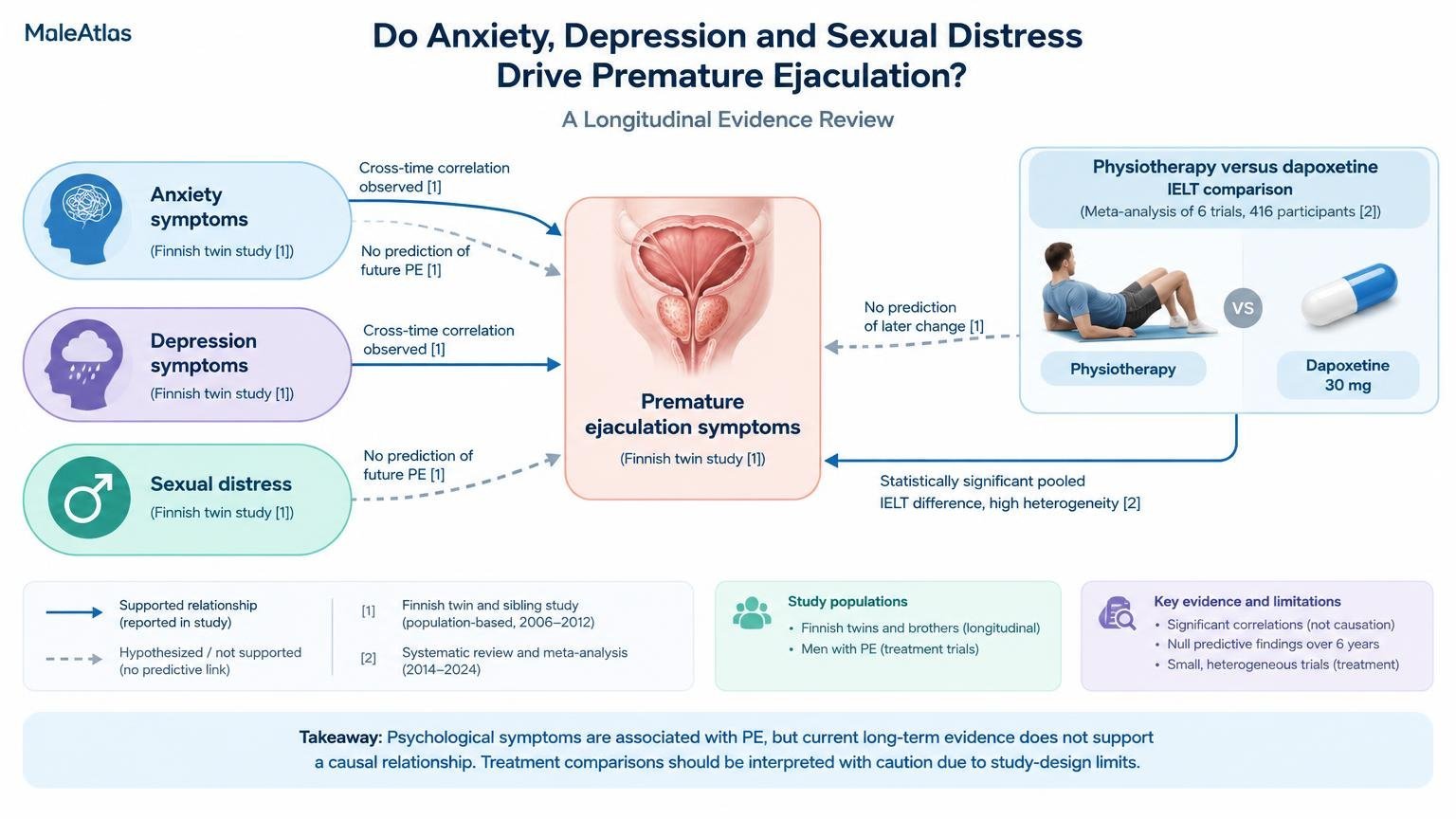
Conceptual framework: Conceptual framework summarizing the article's key variables: anxiety, depression and sexual distress in relation to premature ejaculation symptoms in a population-based longitudinal twin study, alongside a separate treatment-comparison construct. Solid relations reflect reported associations and null predictive findings; the treatment node summarizes a pooled meta-analytic comparison with high heterogeneity. The framework is an organizational aid, not a tested causal model.
Academic References & Evidence
- Daniel Ventus; Annika Gunst; Antti Kärnä; Patrick Jern. No Evidence for Long-Term Causal Associations Between Symptoms of Premature Ejaculation and Symptoms of Anxiety, Depression, and Sexual Distress in a Large, Population-Based Longitudinal Sample. Journal of Sex Research. 2017 54(2):272 DOI: 10.1080/00224499.2016.1255301.
- Esther M Medrano-Sánchez; Ana López-del-Castillo; Maud Boisseau; Juan C Fernández-Domínguez; Esther Díaz-Mohedo. Effectiveness of physiotherapy in male premature… : The Journal of Sexual Medicine. The Journal of Sexual Medicine. 2026 23(5) DOI: 10.1093/jsxmed/qdag096.
- Contemporary consensus and emerging directions in premature and delayed ejaculation: recommendations from the 5th International Consultation on Sexual Medicine.. Sexual medicine reviews PMID: 42855438.
SANYUN Science Center explains published research on men's reproductive and sexual health, connecting scientific evidence with everyday questions while making sources and limitations clear.
Disclaimer: This article is for scientific education and research communication only. It does not provide medical advice, diagnosis, or individualized treatment recommendations, and does not endorse any medication, supplement, device, penile enlargement procedure, or other intervention. Decisions about sexual and reproductive health should be made in consultation with a qualified healthcare professional. Do not delay seeking professional care because of information in this article.
Original Content & Copyright Notice
- This article is prepared for SANYUN Science Center, drawing on published research and publicly available academic literature on men’s sexual and reproductive health. Its editorial explanations and presentation are developed for this platform.
- Copyright in the original editorial content, selection, and arrangement is reserved by SANYUN Science Center to the extent protected by applicable law. Referenced research, quotations, and third-party materials remain subject to the rights of their respective owners. This notice does not claim ownership of scientific facts or third-party research.
- Except where permitted by applicable law or an applicable license, prior written permission is required to reproduce, republish, translate, adapt, redistribute, or commercially reuse protected content. Attribution alone does not grant permission for such reuse.
- For permitted quotation or authorized reuse, clearly identify the source and retain a link to the original article.
- Source: SANYUN Science Center
- Original URL: Retain the original article URL on science.san-yun.com.
- Copyright Holder: SANYUN Science Center, for its own protected editorial content.
- Quotation, excerpts, or authorized reuse must not distort the scientific meaning, omit material limitations or disclaimers, or imply unverified medical claims, product efficacy, or endorsement by SANYUN Science Center.



