




Category: Premature Ejaculation
Core Research Direction: Premature ejaculation: consensus-based definition, classification, etiology and management recommendations from the 5th International Consultation on Sexual Medicine, and what early-life adversity research adds
Search Intent: What does the 5th International Consultation on Sexual Medicine recommend for defining, classifying and treating premature ejaculation, and what does the available evidence say about its causes?
Platform: SANYUN Science Center
Evidence reviewed through: 2026-11-05
Executive Summary
Premature ejaculation (PE) is one of the ejaculatory disorders that a consensus review prepared for the 5th International Consultation on Sexual Medicine characterizes as common conditions with a substantial impact on men's quality of life and their relationships.[1]
That review reports synthesizing the latest findings on the etiology, epidemiology, evaluation and management of premature and delayed ejaculation, and states that its aim was to present evidence-based recommendations for definition, classification and treatment under the guidance of the 5th International Consultation on Sexual Medicine.
The indexed topics of that review include the lifelong versus acquired distinction in PE, intravaginal ejaculatory latency time (IELT), penile hypersensitivity, and treatments such as dapoxetine, selective serotonin reuptake inhibitors (SSRIs) and psychotherapy.
A separate 2024 conference abstract examined childhood maltreatment in relation to adult sexual response cycle disruptions. For women it reported significant associations with arousal, lubrication, orgasm and satisfaction problems; for men it described only a trend regarding premature ejaculation, not a significant result.[2]
The central point for readers is one of evidence strength. The consensus material frames the field and names its key constructs, but the supplied source text does not reproduce the specific recommendations, effect sizes or prevalence figures. The early-life adversity finding for men is preliminary. Nothing here supports a claim that childhood adversity has been shown to cause PE, or that any named treatment has a quantified benefit in this packet.
Why This Matters
Ejaculatory problems sit at the intersection of physical function, psychological experience and partnership. The consensus review's framing places them among common conditions with meaningful quality-of-life and relationship consequences, which matters because such concerns are often under-discussed in clinical settings.
A definition matters practically. Whether PE is lifelong or acquired, and how it is measured, changes what clinicians ask about, what they rule out and what they offer. The consensus review's scope explicitly covers definition, classification and treatment, indicating that these are treated as linked problems rather than separate ones.
There is also a public-understanding gap. Popular discussion often treats PE as a single entity with a single fix. The indexed literature points instead to subtypes, to a timing-based construct in IELT, to proposed sensitivity mechanisms, and to both pharmacological and psychological management options.
Definitions and Classification: What the Consensus Material Covers
The review prepared for the 5th International Consultation on Sexual Medicine was designed to address definition, classification and treatment together. Its aim was to present evidence-based recommendations for PE and delayed ejaculation, developed under the guidance of that consultation.
One classification axis appears directly in the indexed topics: the distinction between lifelong and acquired premature ejaculation. This is a clinically meaningful split because lifelong patterns suggest a constitutional or longstanding presentation, whereas acquired patterns invite attention to change over time. The packet does not supply the criteria used to separate them.
A second named construct is intravaginal ejulatory latency time, abbreviated IELT. In research and clinical communication it functions as a timing measure for ejaculation during vaginal intercourse. The packet lists IELT as a topic covered by the review but gives no cut-off values, distributions or measurement protocol.
A third topic is penile hypersensitivity, listed among the review's indexed themes. Its presence indicates that sensitivity has been discussed as a possible contributing mechanism. It does not, by itself, establish that hypersensitivity is present in most men with PE, that it is causal, or that reducing sensitivity is an effective strategy.
Biological and Clinical Mechanism: What Is Named and What Is Not Established
The packet supports a deliberately modest mechanistic account. Penile hypersensitivity is named as an indexed topic in the consensus review, which means it has been considered in the expert literature as a possible mechanism. That is a statement about the topics discussed, not a validated pathway.
The review's keyword list also names selective serotonin reuptake inhibitors and dapoxetine. The pharmacological rationale implied by this pairing is that serotonergic signalling is relevant to ejaculatory control, and that serotonergic agents are among the options considered. Again, the supplied text gives no effect estimates, dosing, or comparative data.
Psychotherapy appears alongside pharmacotherapy in the same topic list, which suggests that the consensus scope treats psychological management as part of the management landscape rather than as an alternative only for cases with an identified psychological cause. The packet does not describe which psychotherapeutic approaches were considered or how they compared with medication.
The packag also names etiology as a review domain, so causation was clearly within scope. However, no specific etiological model, percentage breakdown of causes, or evidence grading is available in the supplied material. Readers should therefore treat mechanistic statements attributed to this review as topic framing rather than as reported findings.
What the Evidence Shows: The 2024 Early-Life Adversity Abstract
The only empirical study in this packet is a 2024 conference abstract. It reports examining the link between childhood maltreatment and disruptions in the adult sexual response cycle, an observational design that relates a retrospectively reported childhood exposure to adult outcomes.
The reported results differ by sex. Among women, the abstract states significant associations between maltreatment and disruptions in arousal, lubrication, orgasm and satisfaction. Among men, the association with premature ejaculation was described as a trend.
That distinction is the most important detail in the abstract for a PE-focused reader. A trend is not a statistically significant finding. It may reflect a real but modest association that the study was underpowered to detect, or it may reflect noise. The abstract does not allow the reader to choose between these explanations.
The authors interpret their results as underscoring the enduring impact of early abuse on sexual health. That interpretation is a hypothesis-level statement generated by an observational study, and it should be read as such.
| Source type | Population or scope | What is reported | Key limitation |
|---|---|---|---|
| Consensus review prepared for the 5th International Consultation on Sexual Medicine | Men with premature and delayed ejaculation | Stated aim to give evidence-based recommendations on definition, classification and treatment; indexed topics include lifelong versus acquired PE, IELT, penile hypersensitivity, dapoxetine, SSRIs and psychotherapy | The supplied text does not reproduce the recommendations themselves, prevalence figures or effect sizes |
| 2024 conference abstract | Adults reporting childhood maltreatment, women and men | Significant associations with arousal, lubrication, orgasm and satisfaction disruption in women; only a trend for premature ejaculation in men | Abstract only; no sample size, instruments, effect sizes or confounder adjustment reported; trend is not a significant result |
Interpretation and Limitations
The first limitation concerns what the consensus source can support. The packet confirms that the review exists, that it addressed etiology, epidemiology, evaluation and management, and that it aimed to present recommendations on definition, classification and treatment. It does not contain the recommendations themselves. Any article, including this one, that describes the specific content of those recommendations would be going beyond the available text.
The second limitation concerns the empirical study. Conference abstracts are short reports; they typically omit sample characteristics, measurement validation, statistical models and effect sizes. In this packet, none of those details are available. The abstract also does not report whether the premature ejaculation trend survived adjustment for potential confounders such as age, relationship factors, anxiety or other mental health variables.
The third limitation concerns causality. The design links a retrospectively reported childhood exposure to adult outcomes. Recall bias, shared familial and social factors, and reverse-direction explanations cannot be excluded from an abstract-level report. The authors' own interpretation is framed as an enduring impact, which is a plausible hypothesis rather than a demonstrated causal pathway.
There is also a mismatch risk in how this evidence might be read. A trend-level male finding should not be translated into a claim that childhood maltreatment is an established cause of premature ejaculation, nor into a screening rule. What it does justify is attention to developmental and psychological history as one domain worth exploring with patients, alongside the biological and timing domains the consensus review indexes.
Clinical Relevance and Appropriate Conversations
For clinical readers, the consensus framing supports a structured approach that separates lifelong from acquired presentation, uses a timing construct such as IELT as part of assessment, and considers both pharmacological and psychological management options rather than assuming a single cause or single treatment.
Penile hypersensitivity is a reasonable topic to discuss as one hypothesis among several, not as an established explanation. Similarly, the mention of dapoxetine, SSRIs and psychotherapy reflects that these are within the scope of expert discussion; it is not evidence that any one of them outperforms the others, and treatment decisions require individual clinical assessment.
For the question of early-life adversity, an appropriate conversation acknowledges that adverse childhood experiences can shape adult sexual wellbeing in complex ways, while noting that the male PE evidence in this packet is preliminary. A clinician can hold both ideas without overstating either.
Research Outlook
Several gaps follow directly from the packet. First, the field would benefit from transparent reporting of how the consultation's recommendations were derived and graded, since the review's purpose was to present evidence-based recommendations but the packet provides no grading details.
Second, the early-life adversity line of work needs full peer-reviewed reports with adequate male samples, validated outcome measures and adjustment for confounders before any association with PE can be described as established. The current male signal is at trend level.
Third, the constructs named in the index, including IELT and penile hypersensitivity, invite work that clarifies how they relate to subjective distress. A timing measure and a proposed sensitivity mechanism are not the same as the patient's experience of control and satisfaction, and the packet gives no data connecting them.
Key Takeaways
- The consensus review prepared for the 5th International Consultation on Sexual Medicine aimed to provide evidence-based recommendations on the definition, classification and treatment of premature and delayed ejaculation; the packet does not reproduce the recommendations themselves.
- Indexed topics include the lifelong versus acquired distinction, intravaginal ejaculatory latency time, penile hypersensitivity, dapoxetine, SSRIs and psychotherapy, showing the breadth of the field rather than establishing superiority of any option.
- A 2024 conference abstract reported significant associations between childhood maltreatment and several sexual response disruptions in women, but only a trend for premature ejaculation in men.
- The authors' interpretation of an enduring impact of early abuse on sexual health is a hypothesis, not a causal finding, and the abstract lacks the detail to assess confounding or effect size.
- These findings should inform cautious, structured clinical discussion, not definitive statements about cause or guaranteed treatment response.
Questions and Answers
How does the 5th International Consultation on Sexual Medicine define premature ejaculation?
The supplied source material does not reproduce the full definition. It states that the review prepared for the consultation aimed to present evidence-based recommendations for the definition, classification and treatment of premature and delayed ejaculation. Its indexed topics include the lifelong versus acquired distinction and intravaginal ejaculatory latency time, but the specific wording and criteria are not available in this packet.
What does the newest evidence say about childhood maltreatment and premature ejaculation in men?
A 2024 conference abstract examined childhood maltreatment and adult sexual response disruptions. For women it reported significant associations with arousal, lubrication, orgasm and satisfaction problems. For men, the association with premature ejaculation was described only as a trend, not a significant result. The abstract gives no sample size, effect size or adjustment for confounders, so the male finding remains preliminary.
How strong is the evidence that penile hypersensitivity causes premature ejaculation?
The packet does not establish that link. Penile hypersensitivity appears among the indexed topics of the consensus review, meaning it has been discussed as a possible mechanism. That is topic-level framing, not a reported study result. No data in this packet quantify hypersensitivity in men with premature ejaculation or show that targeting it improves outcomes, so it should be treated as a hypothesis under discussion.
Which treatments for premature ejaculation are discussed in the consensus review?
Indexed topics include dapoxetine, selective serotonin reuptake inhibitors and psychotherapy, alongside the lifelong–acquired distinction, intravaginal ejaculatory latency time and penile hypersensitivity. The packet confirms these are within the review's scope. It does not provide comparative effectiveness, dosing, response rates or evidence grading, so it cannot support claims that one option is superior to another.
What are the main limitations of the premature ejaculation evidence described here?
The consensus review's specific recommendations, evidence grading and prevalence figures are not present in the supplied text. The only empirical study is a conference abstract lacking sample size, instruments, effect sizes and confounder adjustment, and its male finding was a trend. Neither source supports causal claims about childhood adversity causing premature ejaculation or guaranteed treatment effects.
Why does the lifelong versus acquired distinction matter in premature ejaculation?
It is one of the classification axes indexed in the consensus review and shapes how clinicians assess the problem. Lifelong patterns suggest a longstanding presentation, while acquired patterns invite attention to change over time. This distinction affects what questions are asked and what is ruled out. The packet does not supply the specific criteria used to separate the two categories.
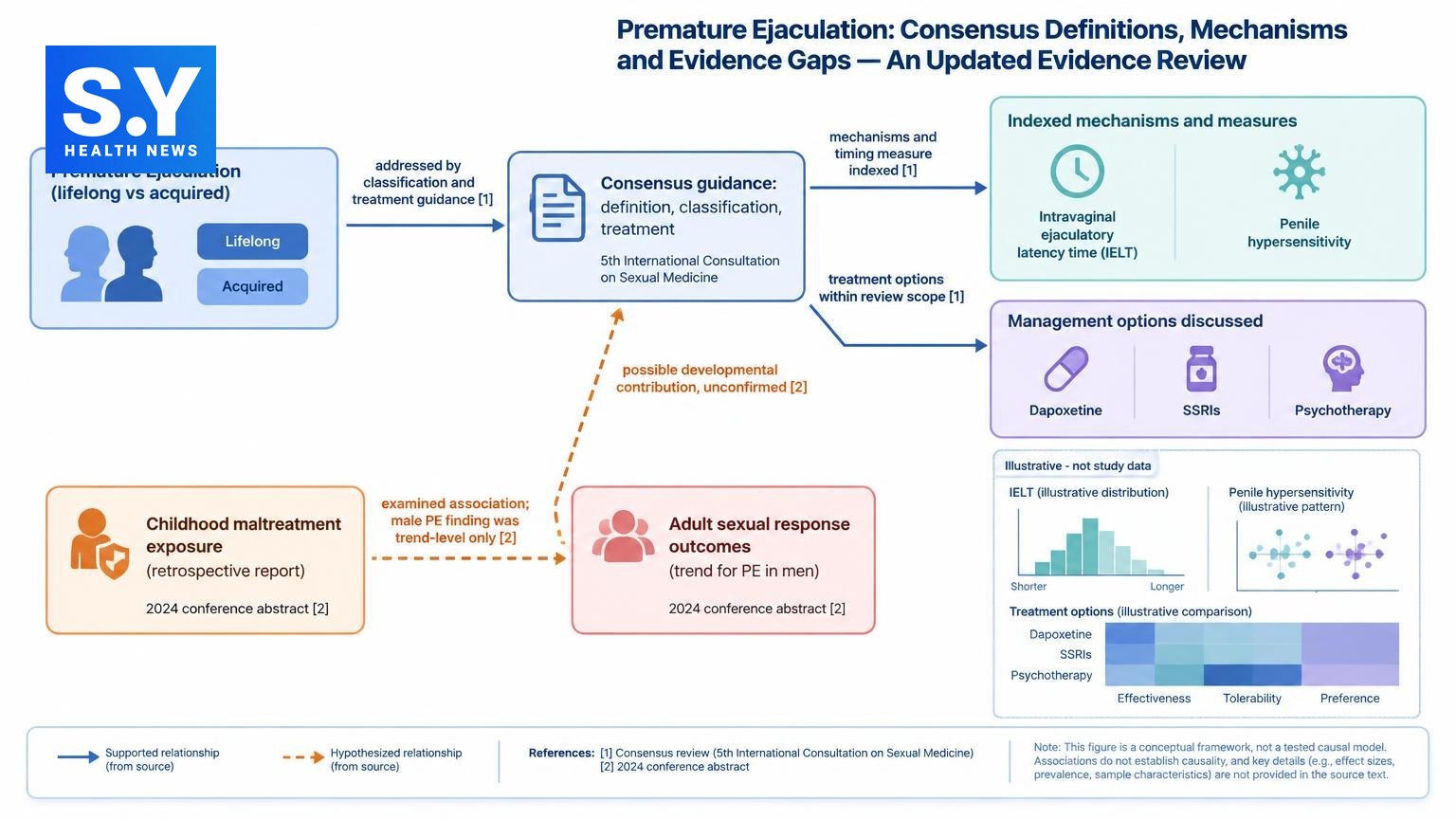
Conceptual framework: Conceptual framework, not a tested causal model. It maps the variables discussed in this review: premature ejaculation classified as lifelong or acquired, the scope of the 5th International Consultation on Sexual Medicine guidance, indexed mechanisms and measures, management options, and a separate 2024 conference abstract examining childhood maltreatment in relation to adult sexual response outcomes, where the male premature ejaculation finding was only a trend. Solid arrows indicate supported scope relationships; dashed relationships are proposed and unconfirmed.
Academic References & Evidence
- Contemporary consensus and emerging directions in premature and delayed ejaculation: recommendations from the 5th International Consultation on Sexual Medicine.. Sexual medicine reviews PMID: 42855438.
- Henrietta Egbunike; Kristine Jacquin. APS Journal Article. 2024
SANYUN Science Center explains published research on men's reproductive and sexual health, connecting scientific evidence with everyday questions while making sources and limitations clear.
Disclaimer: This article is for scientific education and research communication only. It does not provide medical advice, diagnosis, or individualized treatment recommendations, and does not endorse any medication, supplement, device, penile enlargement procedure, or other intervention. Decisions about sexual and reproductive health should be made in consultation with a qualified healthcare professional. Do not delay seeking professional care because of information in this article.
Original Content & Copyright Notice
- This article is prepared for SANYUN Science Center, drawing on published research and publicly available academic literature on men’s sexual and reproductive health. Its editorial explanations and presentation are developed for this platform.
- Copyright in the original editorial content, selection, and arrangement is reserved by SANYUN Science Center to the extent protected by applicable law. Referenced research, quotations, and third-party materials remain subject to the rights of their respective owners. This notice does not claim ownership of scientific facts or third-party research.
- Except where permitted by applicable law or an applicable license, prior written permission is required to reproduce, republish, translate, adapt, redistribute, or commercially reuse protected content. Attribution alone does not grant permission for such reuse.
- For permitted quotation or authorized reuse, clearly identify the source and retain a link to the original article.
- Source: SANYUN Science Center
- Original URL: Retain the original article URL on science.san-yun.com.
- Copyright Holder: SANYUN Science Center, for its own protected editorial content.
- Quotation, excerpts, or authorized reuse must not distort the scientific meaning, omit material limitations or disclaimers, or imply unverified medical claims, product efficacy, or endorsement by SANYUN Science Center.



