




Category: Premature Ejaculation
Core Research Direction: Contemporary consensus recommendations from the 5th International Consultation on Sexual Medicine on the definition, classification, evaluation and treatment of premature ejaculation (and delayed ejaculation), plus pharmacologic options (daily SSRIs, dapoxetine, tramadol) and screening guidance drawn from the ISSN guideline as summarized by Medscape.
Search Intent: What does the latest international consensus say about how premature ejaculation is defined, evaluated and treated, and what does guideline-based medication guidance (SSRIs, dapoxetine, tramadol) recommend?
Platform: SANYUN Science Center
Evidence reviewed through: 2026-10-30
Executive Summary
A review developed under the Fifth International Consultation on Sexual Medicine aims to present evidence-based recommendations for the definition, classification and treatment of premature ejaculation (PE) and delayed ejaculation (DE). It synthesizes recent findings on etiology, epidemiology, evaluation and management. The available abstract does not reproduce individual recommendation grades or effect sizes, so this article separates what the consensus review set out to deliver from what can be verified in the supplied summary material. PE and DE are described as common conditions with substantial impact on men's quality of life and relationships.[1]
Guideline-summary material adds practical texture. According to a secondary summary of the International Society of Sexual Medicine (ISSN) guideline, daily off-label doses of paroxetine, sertraline, citalopram, fluoxetine or clomipramine have been effective and tolerable for chronic acquired PE. Tramadol may be effective but is recommended only after other treatments fail because of addiction and side-effect risks, and must not be combined with an SSRI. Screening for PE is not recommended across the general population, but men with erectile dysfunction should be screened. Dapoxetine appears in the consensus review's keyword scope, indicating it was considered, but no specific recommendation for it is present in the supplied text.[2]
Why This Matters
Ejaculatory disorders are described as common conditions with a substantial impact on quality of life and relationships. That framing matters because PE is often discussed as a performance or confidence issue rather than as a recognized clinical condition with subtypes, diagnostic specifiers and treatment pathways. The consensus review's scope explicitly covers both lifelong and acquired PE, and its keyword set places intravaginal ejaculatory latency time (IELT), penile hypersensitivity, psychotherapy and selective serotonin reuptake inhibitors (SSRIs) within the evidence base it considered. Dapoxetine is also named among those keywords.
For clinicians and for men reading about their own symptoms, the practical value of a consensus document is that it separates what is well supported from what remains uncertain. The supplied materials show that this separation is not trivial: the same guideline source both endorses a set of daily medications for chronic acquired PE and declines to recommend population screening for PE, a combination that signals genuine uncertainty about who should be identified and when.
How Premature Ejaculation Is Classified
Contemporary classification places ejaculatory disorders within a broader grouping of sexual dysfunctions that also includes desire/excitation disorders, orgasmic disorders, erectile disorder and genito-pelvic pain/penetration disorder. Within this scheme, PE is an ejaculatory disorder rather than a stand-alone diagnosis. Educational summaries of the DSM-5-TR framework note that sexual dysfunctions are specified by pattern and context: lifelong versus acquired, generalized versus situational, and by level of distress. These specifiers are clinically useful because lifelong and acquired PE can differ in presentation and in how they respond to treatment.[3]
The consensus review's keyword scope confirms that it engaged with the lifelong/acquired distinction directly, and that IELT was treated as a central outcome construct. IELT is a measured interval, not a diagnosis in itself; guideline frameworks typically combine it with perceived control and distress. The supplied sources do not provide specific IELT thresholds or full diagnostic criteria, so readers should not infer numerical cut-offs from this article.
Biological and Clinical Framing
Sexual function reflects integrated neuroendocrine, vascular, musculoskeletal and psychosocial processes. Sexual dysfunction categories typically arise from combined influences rather than a single cause, including chronic disease, medication effects, trauma history, communication barriers and stress. This general framework helps explain why PE is rarely attributable to one cause and why assessment usually spans medical, psychological and relational domains.
Medication review is a routine part of that assessment because antihypertensives, neuropsychiatric drugs, hormonal agents, opioids and other substances can alter sexual function. The direction of effect varies by drug and by individual, so a medication history is a hypothesis-generating step rather than a verdict. In selected cases, treatment may target comorbid mood or anxiety conditions, sometimes with SSRIs or prescriber-led medication adjustments — a point that carries an inherent tension, since SSRIs are simultaneously used to treat PE and can themselves cause sexual side effects.
Evaluation and Screening Guidance
The guideline-summary material is notably restrained about case-finding. It states that the evidence was judged inadequate to recommend screening for or actively seeking PE in the general population or in any subpopulation. This is an important distinction: a condition can be common and burdensome while still lacking evidence that population-level screening improves outcomes. The absence of a screening recommendation is not a claim that PE is unimportant; it is a statement about the adequacy of evidence for a screening program.
One exception is carved out in the summary: men with erectile dysfunction should undergo screening for PE. The supplied text does not elaborate the rationale or the recommended instrument, so the basis for this targeted recommendation cannot be evaluated here. Separately, a physical examination is described as advisable, though not indispensable, in patients with chronic PE — language that leaves clinical judgment room rather than mandating a fixed workup.
What the Medication Evidence Shows
According to the guideline summary, daily doses of paroxetine, sertraline, citalopram, fluoxetine or clomipramine — used off-label — have been effective and tolerable in the treatment of chronic acquired PE. Several features of that statement deserve emphasis. It concerns chronic acquired rather than lifelong PE; it refers to daily dosing rather than on-demand use; and the agents listed include both SSRIs and the tricyclic clomipramine. Off-label status is explicit. The summary does not report effect sizes, trial counts, dosing schedules or comparator data, so it supports a general endorsement rather than a quantified claim of benefit.
Dapoxetine appears in the consensus review's keyword list, indicating that it was considered within the scope of the review. However, the supplied abstract does not provide any specific recommendation, dosing information or effect estimate for dapoxetine. Readers should therefore treat dapoxetine as a topic the consensus review engaged with, rather than as a specifically endorsed option in the available summary material.
Tramadol occupies a different position. The summary acknowledges that it may be an effective option for PE but states that the guideline recommends it only after other treatments have failed, citing risks of addiction and side effects. It further states that tramadol must not be combined with an SSRI because of the risk of serotonin syndrome. This is a safety-driven sequencing decision: a drug with plausible efficacy is deliberately placed behind better-tolerated options and paired with an explicit combination warning.
| Measure / finding | Population / follow-up | Limitations |
|---|---|---|
| Per the ISSN guideline (as summarized), daily doses of paroxetine, sertraline, citalopram, fluoxetine or clomipramine, used off-label, have been effective and tolerable in treating chronic acquired premature ejaculation. | men with chronic acquired premature ejaculation | Secondary summary of a guideline; no trial data, effect sizes or dosing supplied; off-label use. |
| Tramadol may be effective for premature ejaculation, but the ISSN recommends it only after other treatments fail, given risks of addiction and side effects. | men with premature ejaculation | Guideline recommendation summary; no trial data or dosing provided. |
| Tramadol should not be combined with an SSRI because of serotonin syndrome risk. | Safety statement; no incidence data supplied. | |
| The ISSN determined evidence was inadequate to recommend screening for premature ejaculation in the general population or any subpopulation. | general population or any subpopulation | Guideline judgment about evidence adequacy; no data shown. |
| Men with erectile dysfunction should nonetheless be screened for premature ejaculation, per the ISSN guideline summary. | men with erectile dysfunction | Guideline recommendation summary; rationale not detailed in supplied text. |
| A physical examination is advisable but not considered indispensable in patients with chronic premature ejaculation. | patients with chronic premature ejaculation | Guideline recommendation summary; no supporting data supplied. |
Interpretation and Limitations
The central limitation of this evidence base, as represented in the supplied materials, is indirectness. The consensus review is described as a synthesis of recent findings on etiology, epidemiology, evaluation and management, but the available record does not show its evidence-grading methods, the strength of individual recommendations, or the trials underpinning them. The medication and screening statements come from a secondary summary of a guideline rather than from the primary trials. Readers should therefore treat the endorsements as guideline-level positions, not as independently verified effect estimates.
A second limitation concerns scope mismatch. The endorsement of daily SSRIs and clomipramine is framed around chronic acquired PE, while the consensus review's keyword scope includes lifelong PE as well. The supplied sources do not resolve whether the same recommendations apply across subtypes with equal strength. Similarly, the statement that physical examination is advisable but not indispensable leaves the clinician without explicit criteria for when examination is required.
Third, some contextual claims come from educational rather than primary sources. The multifactorial framing of sexual dysfunction, the DSM-5-TR categorization and the medication-review rationale are drawn from a nursing education reference; they are reasonable orienting concepts but are not PE-specific trial evidence. They should inform how a clinician thinks about assessment, not be cited as proof of mechanism in PE.
Research Outlook
The consensus review's stated aim — evidence-based recommendations on definition, classification and treatment developed under international consultation — indicates that the field is consolidating rather than expanding its core framework. The unresolved questions visible in the supplied material are practical ones: how to identify men who would benefit from evaluation without endorsing broad screening, how to sequence pharmacologic and psychological options across lifelong and acquired subtypes, and how to clarify the place of dapoxetine, daily SSRIs and reserve tramadol within a stepped approach. Answering these will require transparent evidence grading and subtype-specific outcome data that the available summaries do not provide.
Key Takeaways
- PE is classified among ejaculatory disorders and specified as lifelong or acquired, generalized or situational, with distress severity noted.
- The Fifth International Consultation on Sexual Medicine review aimed to deliver evidence-based recommendations on definition, classification and treatment of PE and DE.
- Daily off-label paroxetine, sertraline, citalopram, fluoxetine or clomipramine have been described as effective and tolerable for chronic acquired PE in guideline summary material.
- Dapoxetine is named among the consensus review's keywords, indicating it was considered, but no specific recommendation is available in the supplied summary.
- Tramadol is reserved for after other treatments fail because of addiction and side-effect risks, and must not be combined with an SSRI.
- Population screening for PE is not recommended on current evidence, but men with erectile dysfunction should be screened.
- The available summaries lack effect sizes and recommendation grades, so the guidance should be read as consensus positioning rather than quantified proof.
Questions and Answers
What is premature ejaculation, and how is it classified?
PE is an ejaculatory disorder within broader sexual dysfunction categories that also include desire/excitation, orgasmic, erectile and genito-pelvic pain/penetration disorders. It is specified as lifelong or acquired, generalized or situational, and by distress severity. Sexual function reflects integrated neuroendocrine, vascular, musculoskeletal and psychosocial processes, so PE is usually multifactorial rather than attributable to one cause.
What did the consensus review set out to do, and what can be verified?
The review, developed under the Fifth International Consultation on Sexual Medicine, aimed to present evidence-based recommendations for the definition, classification and treatment of premature and delayed ejaculation, synthesizing recent findings on etiology, epidemiology, evaluation and management. The supplied abstract does not reproduce the individual recommendations or their grades, so the specific content of each recommendation cannot be verified from the available text alone.
How strong is the evidence for the medications described?
The medication statements come from a secondary summary of guideline recommendations, not from primary trials. Daily off-label paroxetine, sertraline, citalopram, fluoxetine or clomipramine are described as effective and tolerable for chronic acquired PE, but no effect sizes, trial numbers or dosing data are supplied. Dapoxetine appears only as a keyword topic. Tramadol is endorsed only after other treatments fail, with explicit warnings about addiction, side effects and serotonin syndrome risk when combined with an SSRI.
Who should be screened or evaluated for premature ejaculation?
The guideline summary states that evidence is inadequate to recommend screening for PE in the general population or any subpopulation, but that men with erectile dysfunction should be screened. A physical examination is advisable, though not indispensable, in chronic PE. These positions reflect judgments about evidence adequacy rather than claims that PE is unimportant or rare.
What limitations should readers keep in mind?
The available materials are indirect. The consensus review's evidence-grading methods and recommendation strengths are not shown, and the medication and screening statements come from a secondary guideline summary. The SSRI endorsement is framed around chronic acquired PE, leaving lifelong PE less clearly addressed. Some contextual framing comes from an educational nursing reference rather than PE-specific trials. These gaps limit how confidently the guidance can be quantified.
How should someone interpret this guidance in practice?
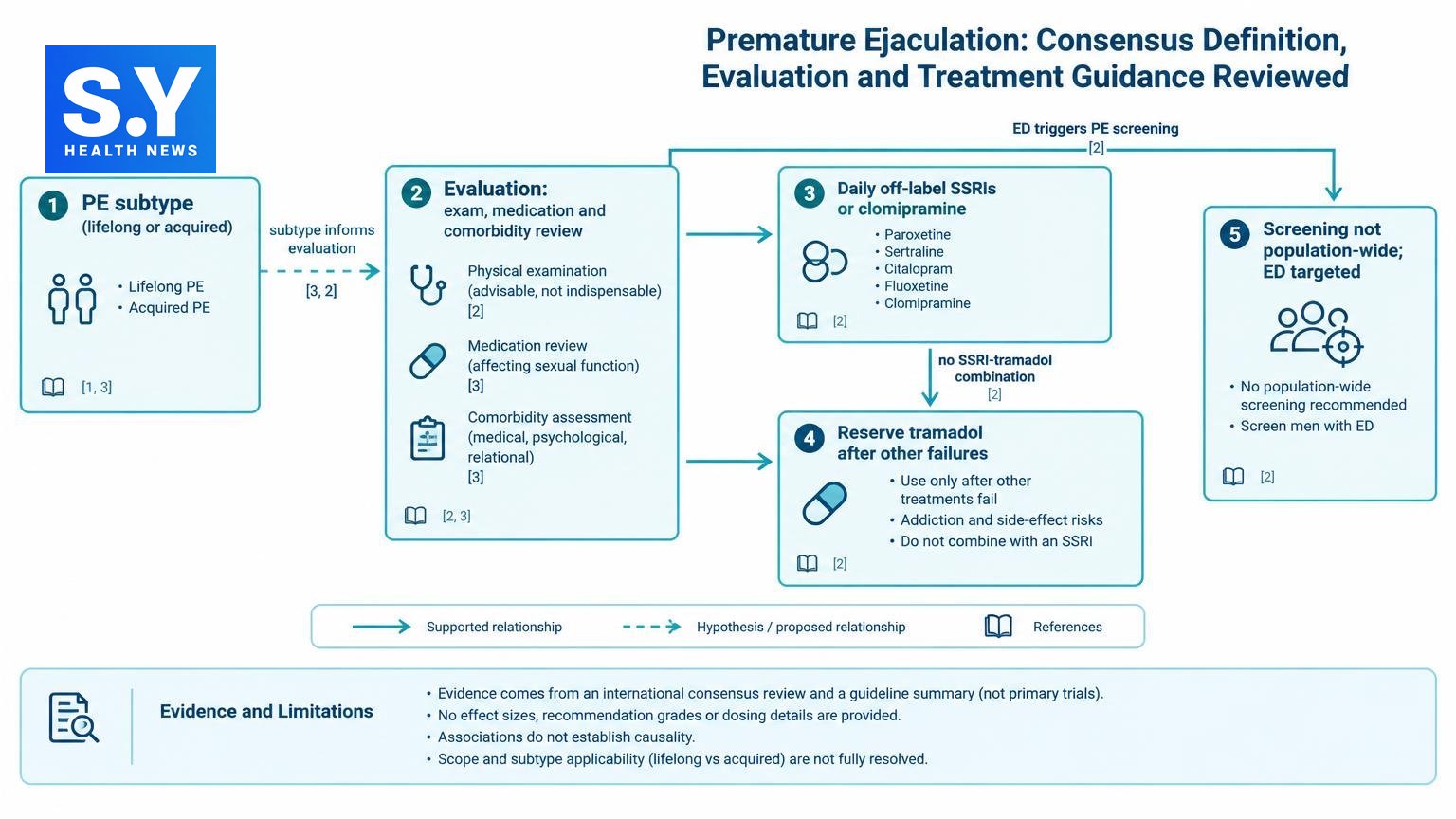
The guidance describes a clinical pathway: classify PE by subtype and distress, review medications and comorbid mood or anxiety conditions, consider daily off-label SSRIs or clomipramine for chronic acquired PE, and reserve tramadol for when other options fail without combining it with an SSRI. Dapoxetine was within the consensus review's scope but lacks a specific recommendation in the supplied summary. Because the recommendations are consensus-level rather than quantified, individual decisions belong in a conversation with a qualified clinician rather than self-directed use.
Conceptual framework: Conceptual framework summarizing how the reviewed sources connect premature ejaculation subtype, evaluation and guideline treatment pathways. Nodes reflect constructs discussed in the article; edges mark supported guideline relationships and one proposed subtype-to-evaluation link. This is an interpretive framework, not a tested causal model.
Academic References & Evidence
- Contemporary consensus and emerging directions in premature and delayed ejaculation: recommendations from the 5th International Consultation on Sexual Medicine.. Sexual medicine reviews PMID: 42855438.
- Mini Examen Clínico: Evalúe sus conocimientos sobre disfunción sexual – Page 4. 2019
- Categorias de disfuncion sexual | NClick.
SANYUN Science Center explains published research on men's reproductive and sexual health, connecting scientific evidence with everyday questions while making sources and limitations clear.
Disclaimer: This article is for scientific education and research communication only. It does not provide medical advice, diagnosis, or individualized treatment recommendations, and does not endorse any medication, supplement, device, penile enlargement procedure, or other intervention. Decisions about sexual and reproductive health should be made in consultation with a qualified healthcare professional. Do not delay seeking professional care because of information in this article.
Original Content & Copyright Notice
- This article is prepared for SANYUN Science Center, drawing on published research and publicly available academic literature on men’s sexual and reproductive health. Its editorial explanations and presentation are developed for this platform.
- Copyright in the original editorial content, selection, and arrangement is reserved by SANYUN Science Center to the extent protected by applicable law. Referenced research, quotations, and third-party materials remain subject to the rights of their respective owners. This notice does not claim ownership of scientific facts or third-party research.
- Except where permitted by applicable law or an applicable license, prior written permission is required to reproduce, republish, translate, adapt, redistribute, or commercially reuse protected content. Attribution alone does not grant permission for such reuse.
- For permitted quotation or authorized reuse, clearly identify the source and retain a link to the original article.
- Source: SANYUN Science Center
- Original URL: Retain the original article URL on science.san-yun.com.
- Copyright Holder: SANYUN Science Center, for its own protected editorial content.
- Quotation, excerpts, or authorized reuse must not distort the scientific meaning, omit material limitations or disclaimers, or imply unverified medical claims, product efficacy, or endorsement by SANYUN Science Center.



