




Category: Premature Ejaculation
Core Research Direction: Applicability and adequacy of current premature ejaculation diagnostic criteria (latency, control, bother/distress) across sexual orientations and non-penile–vaginal sexual activities, set against the framework of the 2026 ICSM consensus on definition, subtyping and management of PE
Search Intent: Do the standard premature ejaculation diagnostic criteria hold up for non-straight men and for sexual activities other than penile–vaginal intercourse, and how do contemporary consensus recommendations frame definition, subtyping and treatment?
Platform: SANYUN Science Center
Evidence reviewed through: 2026-11-16
Executive Summary
Premature ejaculation (PE) is among the most common male sexual complaints, and contemporary consensus work describes it as a condition with meaningful effects on quality of life and relationships. Yet the diagnostic scaffolding has a narrower origin than its clinical reach. As characterized in a 2022 perspective review, professional standards committees have generally applied PE criteria only to presumed heterosexual men during penile–vaginal intercourse. That scope assumption matters for any man whose partnered sex does not center on vaginal intercourse, and for clinicians who must decide whether a guideline definition fits the patient in front of them.[1][2][3]
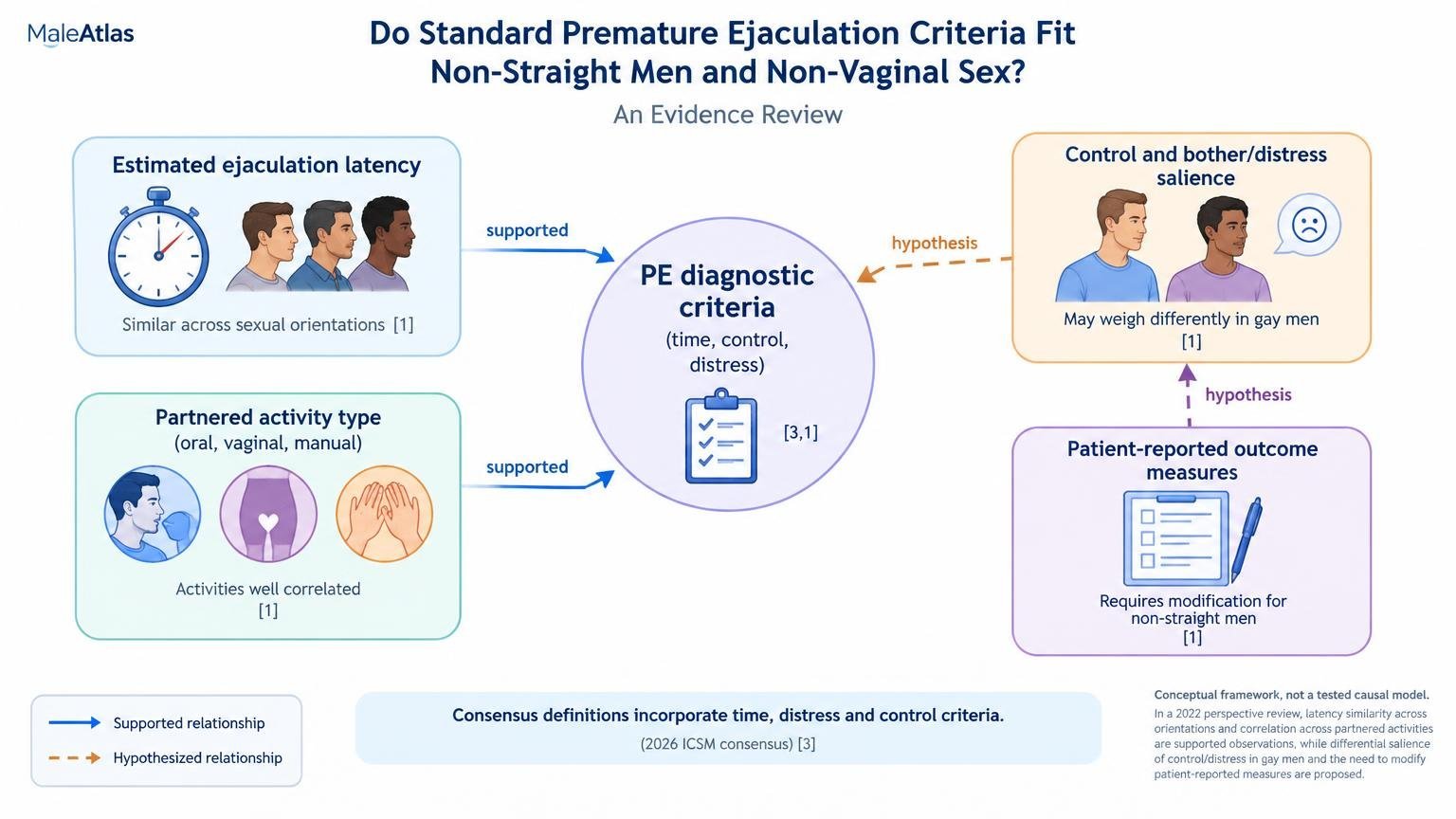
The perspective review argues that existing evidence supports expanding the criteria to non-straight men and to sexual activities not including vaginal intercourse. Its central observations are that estimated ejaculation latencies appear similar across men of different sexual orientations, and that partnered oral, vaginal and manual activities tend to be well correlated. At the same time, it flags plausible differences: masturbation latency patterns separate men with and without PE, and ejaculatory control and bother/distress may matter less to gay men than to straight men during partnered sex. Existing patient-reported outcome measures, the review concludes, require modification for non-straight men.
The 2026 Fifth International Consultation on Sexual Medicine (ICSM) consensus, as summarized in the available secondary sources, aims to provide evidence-based recommendations for the definition, classification and treatment of PE and delayed ejaculation (DE). It is reported to have used a modified Delphi process and the GRADE system, and its definitions are said to incorporate time, distress and control criteria. The summary describes lifelong, acquired, variable and subjective PE subtypes, with treatment including SSRIs, topical anesthetics and psychotherapy. These two strands—broadened applicability and updated consensus structure—are complementary rather than competing.
Why This Matters
Diagnostic criteria are not neutral descriptions. They decide who is counted in prevalence estimates, who is offered treatment, and what outcome measures a trial uses. If criteria were developed and validated around penile–vaginal intercourse in heterosexual men, then applying them unchanged to gay, bisexual or other non-straight men—or to sex that does not include vaginal penetration—risks misclassification in both directions. A man may be labeled as having PE when the latency and distress thresholds were calibrated on a different activity, or a genuine problem may go unrecognized because the standard script does not ask about it.
The stakes are practical. The consensus literature describes ejaculatory disorders as common and as substantially affecting quality of life and relationships, and PE as the most common male sexual complaint. A definition that travels poorly across sexual orientations and activities therefore has population-level consequences, not only semantic ones. It also affects how clinicians interpret patient-reported severity: a bother score built for vaginal intercourse may not capture the concerns of a man whose partnered sex is predominantly oral or anal.
How the Criteria Were Built—and Where They Were Tested
The perspective review frames the problem historically. Standards committees have generally applied PE criteria only to presumed heterosexual men having penile–vaginal intercourse; the word presumed is doing real work, because sexual orientation and actual sexual repertoire were rarely assessed directly in the studies underpinning those criteria. The review's stated purpose is to examine evidence supporting expansion to non-straight men engaging in sexual activities that do not include vaginal intercourse. It is a narrative perspective, not a new empirical study, and its claims are summaries of prior work rather than fresh measurements.
Contemporary consensus documents have attempted to systematize the definition. According to the Chinese-language summary of the 2026 ICSM work, definitions of PE and DE incorporate time, distress and control criteria, and PE is divided into lifelong, acquired, variable and subjective subtypes. The English-language abstract of the same consensus describes recommendations for definition, classification and treatment developed under the Fifth ICSM, synthesizing etiology, epidemiology, evaluation and management. The two summaries agree on structure but the available text does not report the specific numeric latency thresholds, so this review does not assert them.
What the Evidence Shows
The strongest signal in the perspective review concerns latency. Estimated ejaculation latencies appear similar across men identifying with different sexual orientations. This is a reassuring finding if it holds: it implies that the core timing construct is not systematically different in gay or bisexual men, so latency-based elements of the definition may transfer reasonably well. The qualification is that these are estimated, typically self-reported latencies rather than stopwatch-measured values, and the review presents them qualitatively without pooled numeric estimates.
A second signal concerns the correlation of activities. Partnered oral, vaginal and manual activities tend to be well correlated on the reviewed parameters. Clinically, this supports the idea that a man's ejaculatory pattern is not wholly activity-specific; a problem observed in one partnered context is likely to appear in others. The review does not provide specific correlation coefficients or describe the populations in which these correlations were computed, so the strength of the association should be read as directional rather than quantified.
The picture is less uniform for masturbation. Masturbation latency patterns are reported to differ between men with and without PE. That divergence is important because masturbation is a common solo activity and is sometimes used as a comparison or baseline. If latency during masturbation behaves differently in men with PE, then masturbation-based estimates cannot be substituted for partnered measures without caution, and the activity context becomes a substantive variable rather than an incidental detail.
The most consequential claim for measurement is tentative by design. The review suggests that ejaculatory control and bother/distress may be less critical to gay men than to straight men during partnered sex. This is stated as a possibility, not an established finding, and the source does not present primary data isolating this effect. If true, it would mean that two of the three pillars of the contemporary definition—the control and distress criteria that the 2026 consensus summary says are incorporated—may carry different weight across populations. That is a hypothesis to be tested, not a reason to discard the criteria.
| Construct | Source-grounded description | Implication for applicability |
|---|---|---|
| Estimated ejaculation latency | Reported to appear similar across men identifying with different sexual orientations | Supports transfer of latency-based criteria, with the caveat that values are estimated rather than measured |
| Partnered activity correlation | Oral, vaginal and manual partnered activities tend to be well correlated | Suggests ejaculatory patterns are not wholly activity-specific, though coefficients are not reported |
| Masturbation latency | Patterns differ between men with and without PE | Solo activity is not a straightforward proxy for partnered latency |
| Control and bother/distress | May be less critical to gay men than straight men during partnered sex (tentative) | Weighting of these criteria may need population-specific examination |
| Patient-reported outcome measures | Existing measures require modification for use with non-straight men | Measurement adaptation precedes valid comparison across orientations |
| Definition components | Consensus definitions are said to incorporate time, distress and control criteria | The three components may not be equally informative in every population or activity |
What the 2026 Consensus Adds
The Fifth ICSM consensus is best read as an attempt to stabilize definition and classification while the applicability questions remain open. Its stated aim is to present evidence-based recommendations for definition, classification and treatment of PE and DE. The Chinese-language summary reports that a modified Delphi method and GRADE system were used, that PE is the most common male sexual complaint, and that subtypes include lifelong, acquired, variable and subjective forms. Treatment options named in the summary are SSRIs, topical anesthetics and psychotherapy.
The consensus is also explicit about the limits of the evidence base. The summary notes that DE has less research and limited treatment options compared with PE, and it calls for stronger evidence-based treatment research, especially for DE. It further asserts that understanding pathophysiological mechanisms and individualizing treatment can improve prognosis. That last statement is a forward-looking recommendation rather than an observed comparative outcome, and it should be read as such.
Interpretation and Limitations
Several limitations constrain how far these conclusions can be pushed. The central applicability argument comes from a two-page perspective review published in 2022, not from a systematic review or a primary comparative study. Its claims about latency similarity, activity correlation and the lesser salience of control and distress in gay men are summaries of selected prior literature, presented without pooled estimates. The control-and-distress claim is explicitly hedged, and the recommendation that patient-reported outcomes be modified is a methodological proposal rather than a validated revision.
The consensus side of the evidence has its own constraints. The English-language abstract confirms the review's scope and indexed topics, including lifelong and acquired PE, intravaginal ejaculatory latency time, penile hypersensitivity, dapoxetine, SSRIs and psychotherapy, but it does not report effect sizes or the direction of individual recommendations. The more detailed methodology and subtype description come from a Chinese-language secondary summary, which this review cannot independently verify against the full consensus text. Numeric latency thresholds are therefore deliberately not stated here.
A further gap concerns the word presumed. Because the foundational studies rarely measured sexual orientation or activity directly, comparisons across orientations rest on secondary analyses and re-readings. The review's own framing acknowledges that patient-reported measures need modification before non-straight men can be studied on equal terms, which implies that some existing comparisons may be measuring the instrument's assumptions as much as the underlying phenomenon.
Research Outlook
The most useful next steps follow directly from the gaps. First, patient-reported outcome measures need adaptation and validation for non-straight men, so that control and bother can be compared on instruments designed to capture their concerns. Second, latency should be measured rather than estimated where feasible, and across activity types, to test whether the apparent similarity across orientations survives objective measurement. Third, the hypothesis that control and distress carry different weight in gay men deserves direct testing rather than inference from heterogeneous sources.
On the consensus side, the 2026 ICSM work sets a structure that future studies can populate. The call for stronger evidence-based treatment research, particularly for DE, is a reminder that definitional clarity is necessary but not sufficient. Individualizing treatment based on pathophysiological understanding is a reasonable clinical aspiration, but the summary presents it as a recommendation for the future rather than a demonstrated outcome.
Key Takeaways
- PE diagnostic criteria have generally been applied only to presumed heterosexual men during penile–vaginal intercourse, a scope limitation highlighted by a 2022 perspective review.
- Estimated ejaculation latencies appear similar across men of different sexual orientations, and partnered oral, vaginal and manual activities tend to be well correlated, supporting broader applicability of latency-based constructs.
- Masturbation latency patterns differ between men with and without PE, so solo activity is not a simple proxy for partnered latency.
- Control and bother/distress may matter less to gay men than straight men during partnered sex, and existing patient-reported measures require modification for non-straight men; both points are tentative or methodological.
- The 2026 Fifth ICSM consensus reportedly used a modified Delphi process and GRADE, incorporates time, distress and control criteria, and recognizes lifelong, acquired, variable and subjective PE subtypes.
Questions and Answers
Why might standard premature ejaculation diagnostic criteria not fit non-straight men?
Standards committees have generally applied PE criteria only to presumed heterosexual men during penile–vaginal intercourse, so orientation and non-vaginal activities were rarely assessed directly. A 2022 perspective review argues that latency estimates appear similar across orientations, but that control and bother/distress may matter less to gay men and that patient-reported measures need modification. The fit problem is therefore partly about measurement, not only about biology.
What does the evidence say about ejaculation latency in gay versus straight men?
According to the perspective review, estimated ejaculation latencies appear similar across men identifying with different sexual orientations. This is a qualitative summary of prior literature rather than a pooled analysis, and the values are typically self-reported estimates rather than stopwatch measurements. The similarity supports transferring latency-based criteria, but it does not establish equivalence across all activities or measurement methods.
Are ejaculatory control and distress equally important for all men with premature ejaculation?
Probably not, though the evidence is tentative. The review suggests that ejaculatory control and bother/distress may be less critical to gay men than to straight men during partnered sex, stated as a possibility rather than a measured effect. Contemporary consensus definitions reportedly incorporate time, distress and control criteria, so if the weighting differs across populations, the same definition may classify men differently.
What did the 2026 Fifth ICSM consensus say about premature ejaculation definition and subtypes?
As summarized in available sources, the Fifth ICSM consensus aimed to give evidence-based recommendations for definition, classification and treatment, reportedly using a modified Delphi method and GRADE. Definitions are said to incorporate time, distress and control criteria, and PE is divided into lifelong, acquired, variable and subjective subtypes. The available abstracts do not report numeric latency thresholds or comparative effect sizes, so those details cannot be asserted here.
What are the main limitations of the evidence on premature ejaculation criteria across sexual orientations?
The central applicability argument comes from a short 2022 perspective review, not a systematic review or primary comparative study. Its claims about latency similarity, activity correlation and the salience of control and distress are qualitative summaries without pooled estimates. The consensus evidence is also partly mediated by secondary-language summaries, and the foundational studies rarely measured orientation or activity directly.
How should clinicians interpret premature ejaculation symptoms in men whose sex does not include vaginal intercourse?
They should ask specifically about the activities that matter to the patient and avoid assuming that vaginal-intercourse norms apply unchanged. Partnered activities tend to be well correlated, which supports taking a broader history, but masturbation latency behaves differently in men with and without PE and existing patient-reported measures need modification for non-straight men. Assessment should therefore be activity-aware and cautious about applying a single threshold.
Conceptual framework: Conceptual framework, not a tested causal model. In a 2022 perspective review, latency similarity across orientations and correlation across partnered activities are supported observations, while differential salience of control/distress in gay men and the need to modify patient-reported measures are proposed. Consensus definitions incorporate time, distress and control criteria.
Academic References & Evidence
- David L. Rowland; Candace B. Roberson. Do the diagnostic criteria for premature ejaculation apply to non-straight men and to sexual activities other than penile–vaginal intercourse?. International Journal of Impotence Research. 2022 34:730-732 DOI: 10.1038/s41443-021-00467-y.
- Contemporary consensus and emerging directions in premature and delayed ejaculation: recommendations from the 5th International Consultation on Sexual Medicine.. Sexual Medicine Reviews PMID: 42855438.
- 2026 ICSM专家共识:早泄和延迟射精的当代共识与新兴方向. Sex Med Rev. 2026 14(4)
SANYUN Science Center explains published research on men's reproductive and sexual health, connecting scientific evidence with everyday questions while making sources and limitations clear.
Disclaimer: This article is for scientific education and research communication only. It does not provide medical advice, diagnosis, or individualized treatment recommendations, and does not endorse any medication, supplement, device, penile enlargement procedure, or other intervention. Decisions about sexual and reproductive health should be made in consultation with a qualified healthcare professional. Do not delay seeking professional care because of information in this article.
Original Content & Copyright Notice
- This article is prepared for SANYUN Science Center, drawing on published research and publicly available academic literature on men’s sexual and reproductive health. Its editorial explanations and presentation are developed for this platform.
- Copyright in the original editorial content, selection, and arrangement is reserved by SANYUN Science Center to the extent protected by applicable law. Referenced research, quotations, and third-party materials remain subject to the rights of their respective owners. This notice does not claim ownership of scientific facts or third-party research.
- Except where permitted by applicable law or an applicable license, prior written permission is required to reproduce, republish, translate, adapt, redistribute, or commercially reuse protected content. Attribution alone does not grant permission for such reuse.
- For permitted quotation or authorized reuse, clearly identify the source and retain a link to the original article.
- Source: SANYUN Science Center
- Original URL: Retain the original article URL on science.san-yun.com.
- Copyright Holder: SANYUN Science Center, for its own protected editorial content.
- Quotation, excerpts, or authorized reuse must not distort the scientific meaning, omit material limitations or disclaimers, or imply unverified medical claims, product efficacy, or endorsement by SANYUN Science Center.



