




Category: Premature Ejaculation
Core Research Direction: Premature ejaculation as a multidimensional, definition-dependent disorder: how classification, IELT measurement limits, uncertain pathophysiology, and support for pharmacologic versus psychosexual and pelvic-floor approaches are framed in EAU 2026 guidance and the 5th ICSM consensus, including evidence quality and durability gaps.
Search Intent: How is premature ejaculation defined, measured, and treated — and where does the evidence remain weak or uncertain?
Platform: SANYUN Science Center
Evidence reviewed through: 2026-11-13
Executive Summary
Premature ejaculation (PE) is best understood as a definition-dependent, multidimensional disorder rather than a single latency threshold. Contemporary diagnostic frameworks converge on three shared factors — time to ejaculation, perceived control and distress or interpersonal difficulty — and this combination, not intravaginal ejaculatory latency time (IELT) alone, carries the diagnosis. ICD-11 has renamed the condition early ejaculation and framed it around a very short latency to ejaculation, little perceived control, persistence over at least several months and clinically significant distress.[1]
Measurement reflects that nuance. IELT overlaps substantially between men with and without PE, and self-estimated IELT is treated as interchangeable with stopwatch measurement for routine classification, correctly assigning PE status with 80% sensitivity and 80% specificity in reported validation data. In trials, stopwatch measurement and geometric-mean reporting are preferred because IELT distributions are skewed.
Pathophysiology remains uncertain. Anxiety, penile hypersensitivity and serotonergic dysfunction are hypotheses with limited supporting data, while lifelong PE is conjectured to involve interacting central and peripheral serotonergic, dopaminergic, oxytocinergic, endocrinological, genetic and epigenetic factors. Treatment evidence is strongest for pharmacotherapy in lifelong PE and for treating underlying causes in acquired PE, but long-term outcomes are unknown, discontinuation of on-demand dapoxetine is high over time, and psychosexual and pelvic-floor evidence is weaker and less consistent.[2]
Why This Matters
PE is common and consequential. A narrative review of European and American guidance reports PE affecting 20–30% of men across various studies, with variability depending on methodology, cultural factors and the criteria used. That range is a warning as much as an estimate: when prevalence shifts with the definition applied, so do who gets diagnosed and who gets treated.[3]
The personal impact is substantial. Men with PE report lower satisfaction with their sexual relationship and with intercourse, difficulty relaxing, and less frequent intercourse, and the condition can affect self-confidence, partnerships and mental wellbeing. The 5th International Consultation on Sexual Medicine describes PE and delayed ejaculation as common conditions with substantial impact on quality of life and relationships. Despite this, few men seek treatment.[4]
The 2026 EAU guideline update is a limited revision of the 2025 publication, but it fully updated the supporting text and references throughout the Disorders of Ejaculation section and incorporated 116 updated studies across four guideline sections. Expert discussion accompanying the update emphasised limited high-quality evidence, particularly for treatment options for ejaculation disorders.[5][6]
Classification and the Definition Problem
Classification remains contested. The ICD-11 definition of early ejaculation requires ejaculation prior to or within a very short duration of vaginal penetration or other relevant sexual stimulation, with no or little perceived control, occurring episodically or persistently over at least several months and associated with clinically significant distress. DSM-5 and ISSM definitions for lifelong and acquired PE overlap with this on the same three factors, producing what the guideline calls a multidimensional diagnosis.
Beyond lifelong and acquired PE, two further syndromes have been proposed. Variable PE describes inconsistent, irregular early ejaculations regarded as a normal variation in sexual performance. Subjective PE describes a subjective perception of rapid ejaculation while measured latency is in the normal range or even longer, and should not be regarded as a manifestation of true medical pathology. These categories matter because they change what treatment is appropriate and what success means.
- Lifelong PE: present from the earliest sexual experiences, and the group in which pharmacotherapy is considered first-line.
- Acquired PE: develops after a period of normal ejaculatory function; the initial goal is treating the underlying cause, such as erectile dysfunction, prostatitis, lower urinary tract symptoms, anxiety or hyperthyroidism.
- Variable PE: inconsistent early ejaculations representing a normal variation of sexual function.
- Subjective PE: perceived rapid ejaculation despite normal or longer latency, not regarded as true medical pathology.
Measurement: What IELT Can and Cannot Tell Us
IELT has been proposed as an objective diagnostic criterion and treatment outcome, but the guideline is explicit that IELT alone is insufficient to define PE because distributions overlap significantly between men with and without the condition. It also fails for men whose PE occurs during non-coital sexual activity, and it cannot be applied in sex between men, where some studies report longer latency and others find no difference.
In everyday practice, self-estimated IELT is sufficient; self-estimated and stopwatch-measured IELT were reported as interchangeable, with 80% sensitivity and 80% specificity for assigning PE status. Clinical trials require calibrated stopwatch measurement, and because IELT data are skewed, geometric means should be reported instead of arithmetic means to avoid overestimating treatment-related delay.
Questionnaires complement rather than replace history. Only the Premature Ejaculation Diagnostic Tool (PEDT) and the Arabic Index of Premature Ejaculation discriminate between men with and without PE; on the five-item PEDT, a total score above 11 suggests a diagnosis, 9 or 10 a probable diagnosis, and below 8 a low likelihood. Other instruments, including the Premature Ejaculation Profile, have an optional role in routine practice.
| Measure | What it captures | Practical interpretation |
|---|---|---|
| Self-estimated IELT | Patient-reported time to ejaculation | Sufficient in routine practice; reported as interchangeable with stopwatch values and 80% sensitive and 80% specific for PE status |
| Stopwatch IELT | Timed latency under observation | Required in trials; geometric means preferred because distributions are skewed |
| PEDT (5 items) | Control, frequency, minimal stimulation, distress, interpersonal difficulty | Score above 11 suggests PE; 9–10 probable; below 8 low likelihood |
| Perceived control and distress | Patient-reported control and bother | Core diagnostic domains alongside latency; central to the multidimensional definition |
| AIPE (7 items) | Desire, erection, latency, control, satisfaction, anxiety/depression | Cut-off of 30 on a 7–35 scale best discriminates diagnosis; also grades severity |
Pathophysiology: Hypotheses Outrunning Data
Ejaculation itself is a complex process of emission and expulsion mediated by interacting neurological, hormonal and anatomical pathways, and interference anywhere in those pathways can produce ejaculatory disorders. The cause of PE, however, is described in the guideline as relatively unknown, with limited data supporting anxiety, penile hypersensitivity and serotonin receptor dysfunction as explanations.
For lifelong PE, the leading hypothesis is a complex interplay of central and peripheral serotonergic, dopaminergic, oxytocinergic, endocrinological, genetic and epigenetic factors. For acquired PE, psychological problems such as performance anxiety and relationship difficulties, plus comorbidities including erectile dysfunction, prostatitis, hyperthyroidism and poor sleep quality, are proposed contributors. These remain hypotheses and comorbidity associations, not established causal chains.
A separate and less mature line of evidence implicates the pelvic floor. A narrative review reports that pelvic floor muscle hypertonia is associated with PE, whereas hypotonia or incoordination is frequently seen in delayed ejaculation, and that strengthening and control exercises improve control and latency in PE. These are associational, narrative-level claims without effect sizes in the reviewed text, and should not be presented as proven mechanism.
What the Evidence Shows: Pharmacotherapy
For lifelong PE, pharmacotherapy is recommended as first-line; for acquired PE, the initial goal is treating the underlying cause. Dapoxetine, a short-acting SSRI, is approved on demand for lifelong and acquired PE in many countries but not the United States, and a lidocaine/prilocaine metered-dose spray is approved on demand for lifelong PE in the European Union. All other medications used in PE are off-label.
In randomized trials, dapoxetine 30 mg and 60 mg produced 2.5- and 3.0-fold increases in IELT overall, rising to 3.4- and 4.3-fold in patients with baseline average IELT under 30 seconds. Adverse events were dose-dependent and led to discontinuation in 4% of subjects on 30 mg and 10% on 60 mg. A low rate of vasovagal syncope (0.1%) was reported in phase III studies, and a post-marketing observational study that identified at-risk patients by history and orthostatic testing observed no syncope cases.
Durability is the weak point. Cumulative discontinuation rates rise over time, reaching 90% at two years after starting dapoxetine, with cost, disappointment that PE is not curable and the on-demand schedule among the reported reasons. Off-label daily SSRIs are effective, with meta-analyses suggesting geometric mean IELT increases of 2.6- to 13.2-fold, but tachyphylaxis may occur after six to 12 months, and men trying to conceive should avoid these drugs because of detrimental effects on sperm cells.
Topical anaesthetics are the oldest pharmacologic approach. In a meta-analysis, local anaesthetics had the best efficacy among treatment options including SSRIs, dapoxetine 30 and 60 mg, PDE5 inhibitors and tramadol for therapy durations under 8 weeks — a short-term comparison only. Lidocaine/prilocaine creams increased stopwatch-measured IELT from 1–2 minutes to 6–9 minutes in cited studies, though transfer to a partner can cause vaginal numbness and condom use or washing is advised.
| Approach | Reported effect | Key limitation |
|---|---|---|
| Dapoxetine 30 mg / 60 mg on demand | 2.5- and 3.0-fold IELT increase overall; 3.4- and 4.3-fold with baseline IELT under 30 seconds | Discontinuation due to adverse events in 4% and 10%; cumulative discontinuation reaching 90% at two years |
| Off-label daily SSRIs | Geometric mean IELT increases of 2.6- to 13.2-fold across meta-analyses | Tachyphylaxis may occur after six to 12 months; sperm effects relevant to couples trying to conceive |
| Lidocaine/prilocaine topical | Stopwatch IELT increased from 1–2 to 6–9 minutes; best efficacy in a meta-analysis limited to under 8 weeks | Short-term evidence; partner numbness; contraindicated with allergy |
| Duloxetine 30 mg daily | Two RCTs reported reduced PE severity and distress with acceptable tolerability | Long-term efficacy and safety unconfirmed before widespread recommendation |
Psychosexual, Behavioural and Pelvic-Floor Approaches
Psychosexual interventions — behavioural, cognitive or couple-focused — aim to teach ejaculatory control, build confidence, reduce anxiety and improve communication. The guideline is candid that psychosexual interventions alone lack empirical support, that evidence for their effectiveness is weak and inconsistent, and that long-term outcomes are unknown. Behavioural techniques may nonetheless be beneficial in variable and subjective PE, and psychotherapy can be considered for men uncomfortable with medication or as an adjunct.
Some specific components have more encouraging signals: start-stop exercises combined with psychoeducation and mindfulness have been reported to improve PE symptoms and associated distress, anxiety and depression, and smartphone-delivered psychological intervention has shown positive effects. The guideline grades combination of psychosexual approaches with pharmacotherapy as yielding superior outcomes than pharmacotherapy alone, but at a low level of evidence.
Pelvic-floor physiotherapy sits at the edge of this evidence base. A narrative review describes a notable role for pelvic floor muscle strengthening and control, including superficial and deep musculature, with biofeedback, electrostimulation and manual work among the described interventions, and positions these as complementary to pharmacologic and psychological treatment. The claims are plausible and clinically used but rest on narrative synthesis rather than large randomized comparisons.
Interpretation and Limitations
Several cautions should temper enthusiasm. First, much of the treatment evidence describes average latency change in trial populations; a statistically significant fold increase in IELT is not the same as restored control or resolved distress for an individual, and the guideline's own outcome framework treats control and bother as co-primary domains. Second, the strongest efficacy data are short-term, while the longest follow-up data describe discontinuation rather than benefit.
Third, the evidence base is heterogeneous. Prevalence estimates of 20–30% vary with methodology and culture, pathophysiology remains hypothetical, psychosexual evidence is graded weak and inconsistent, and pelvic-floor claims come from narrative review. The 2026 EAU update is a limited revision of the 2025 document, so its authority reflects cumulative appraisal rather than a single new trial, and expert commentary accompanying it explicitly flags limited high-quality evidence for ejaculation disorder treatments.
Fourth, diagnostic misassignment is a real hazard. Many men with erectile dysfunction also experience PE, and performance anxiety related to erectile difficulty may worsen PE, with a risk of misdiagnosing PE instead of the underlying erectile dysfunction. Some men are also unaware that loss of erection after ejaculation is normal and may misattribute the problem. Careful history, including partner impact, is therefore part of the intervention, not a preliminary formality.
Research Outlook
The 5th International Consultation on Sexual Medicine review aims to present evidence-based recommendations for the definition, classification and treatment of PE and delayed ejaculation; its full findings were not available in the reviewed abstract, so its conclusions should be treated as pending rather than confirmatory. Priorities implied by the current evidence include harmonising definitions across ICD-11 and DSM/ISSM frameworks, validating non-coital and non-heterosexual assessment approaches, and generating long-term comparative data.
Durability research is especially needed. The gap between short-term efficacy and two-year discontinuation, the uncertain long-term outcomes of psychosexual therapy, the unconfirmed long-term profile of duloxetine, and the tachyphylaxis seen with daily SSRIs all point to the same question: what sustains benefit over years rather than weeks? Pelvic-floor and combined biopsychosocial models are plausible candidates but require adequately powered, controlled evaluation before they can be recommended strongly.
Key Takeaways
- PE is diagnosed on a combination of latency, perceived control and distress; IELT alone is insufficient because values overlap between men with and without PE.
- Self-estimated IELT is adequate in routine practice, reported as interchangeable with stopwatch measurement at 80% sensitivity and 80% specificity; trials should use stopwatch measurement and geometric means.
- Pathophysiology is uncertain: anxiety, penile hypersensitivity and serotonergic dysfunction remain hypotheses with limited data, and lifelong PE is conjectured to involve multiple interacting central and peripheral systems.
- Pharmacotherapy is first-line for lifelong PE; in acquired PE the priority is treating the underlying cause. Dapoxetine produced 2.5- and 3.0-fold IELT increases at 30 mg and 60 mg, but cumulative discontinuation reached 90% at two years in reported data.
- Topical anaesthetics had the best short-term efficacy in one meta-analysis (under 8 weeks of therapy), but durability and partner-transfer issues limit interpretation.
- Psychosexual evidence is weak and inconsistent with unknown long-term outcomes; pelvic-floor physiotherapy is promising but rests on narrative-level evidence.
- The 2026 EAU update fully revised the Disorders of Ejaculation text, but experts continue to flag limited high-quality evidence for treatment options.
Questions and Answers
How is premature ejaculation defined and classified?
PE is defined by a combination of short time to ejaculation, limited perceived control and distress or interpersonal difficulty. ICD-11 calls it early ejaculation, requiring persistence over at least several months with clinically significant distress. Lifelong and acquired PE are distinguished, alongside proposed variable PE (normal variation) and subjective PE (perceived rapidity despite normal latency).
Why is intravaginal ejaculatory latency time alone not enough to diagnose premature ejaculation?
IELT distributions overlap substantially between men with and without PE, so a latency threshold cannot separate the groups. IELT also cannot capture PE during non-coital activity or sex between men. Diagnosis therefore combines latency with perceived control and distress. In routine practice self-estimated IELT is sufficient, reported as interchangeable with stopwatch values at 80% sensitivity and 80% specificity.
How much does dapoxetine increase IELT in premature ejaculation trials?
In randomized trial data, dapoxetine 30 mg and 60 mg produced 2.5- and 3.0-fold IELT increases overall, rising to 3.4- and 4.3-fold in men with baseline average IELT under 30 seconds. Adverse events caused discontinuation in 4% and 10% of subjects respectively. These are average trial effects, not guarantees of restored control, and long-term discontinuation rates are high.
Is psychotherapy or pelvic-floor physiotherapy effective for premature ejaculation?
Evidence is weaker here. The guideline describes psychosexual intervention evidence as weak and inconsistent, with long-term outcomes unknown, though behavioural techniques may help variable and subjective PE and combination with medication is weakly recommended. Pelvic-floor strengthening is reported in a narrative review to improve control and latency, but this rests on narrative rather than large randomized evidence.
What are the main limitations of current premature ejaculation research?
Definitions vary across frameworks, pathophysiology remains largely hypothetical, and prevalence estimates shift with methodology and culture. Treatment evidence is mostly short-term, while the longest follow-up describes high dapoxetine discontinuation, reaching 90% at two years. Experts accompanying the 2026 EAU update explicitly note limited high-quality evidence for ejaculation disorder treatments, and the update itself is a limited revision.
What should someone with premature ejaculation understand before seeking treatment?
PE is common and treatable but rarely curable in a single course, and the right approach depends on subtype. Lifelong PE is managed with pharmacotherapy first-line, while acquired PE calls for investigating causes such as erectile dysfunction, prostatitis, anxiety or thyroid disease. Many men also have erectile dysfunction that can mimic or worsen PE, so careful history matters. Guidelines inform but do not replace individualized clinical decisions.
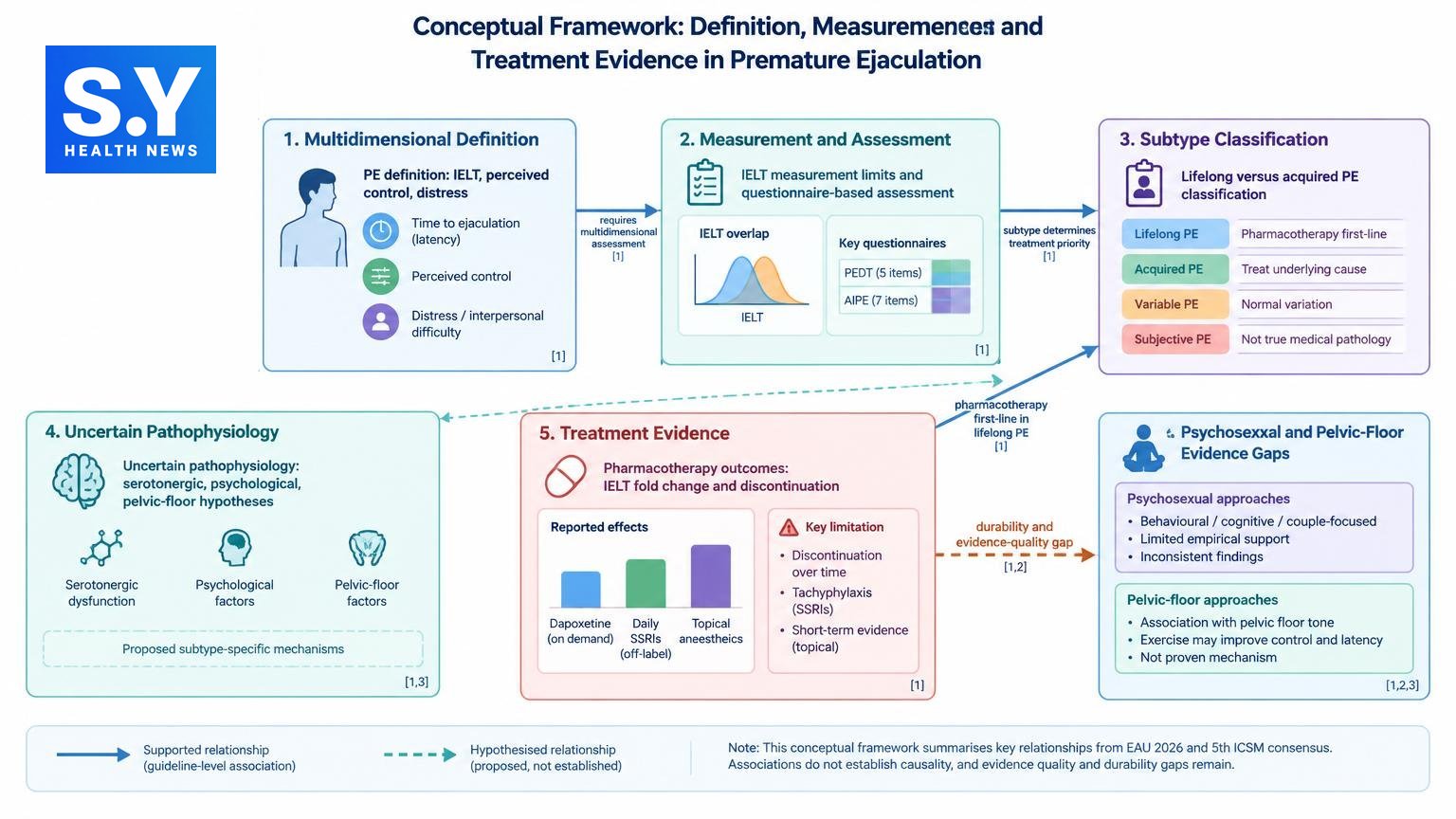
Conceptual framework: Conceptual framework. Premature ejaculation is defined multidimensionally (latency, control, distress); IELT alone is insufficient, so assessment combines self-estimated latency and validated questionnaires. Subtype classification guides treatment priority. Arrows marked as supported reflect guideline-level associations; mechanism and durability links are proposed hypotheses.
Academic References & Evidence
- Disorders of Ejaculation – EAU Guidelines on Sexual and Reproductive Health – Uroweb.
- 2026 update on EAU Guidelines for Sexual & Reproductive Health.
- Dra. Natalia Pérez Romero. Trastornos eyaculatorios: revisión basada en guías europeas y americanas. Urología Madrid 4(10)
- Contemporary consensus and emerging directions in premature and delayed ejaculation: recommendations from the 5th International Consultation on Sexual Medicine.. Sexual medicine reviews PMID: 42855438.
- EAU Guidelines on Sexual and Reproductive Health – Uroweb.
- Introduction – EAU Guidelines on Sexual and Reproductive Health – Uroweb.
SANYUN Science Center explains published research on men's reproductive and sexual health, connecting scientific evidence with everyday questions while making sources and limitations clear.
Disclaimer: This article is for scientific education and research communication only. It does not provide medical advice, diagnosis, or individualized treatment recommendations, and does not endorse any medication, supplement, device, penile enlargement procedure, or other intervention. Decisions about sexual and reproductive health should be made in consultation with a qualified healthcare professional. Do not delay seeking professional care because of information in this article.
Original Content & Copyright Notice
- This article is prepared for SANYUN Science Center, drawing on published research and publicly available academic literature on men’s sexual and reproductive health. Its editorial explanations and presentation are developed for this platform.
- Copyright in the original editorial content, selection, and arrangement is reserved by SANYUN Science Center to the extent protected by applicable law. Referenced research, quotations, and third-party materials remain subject to the rights of their respective owners. This notice does not claim ownership of scientific facts or third-party research.
- Except where permitted by applicable law or an applicable license, prior written permission is required to reproduce, republish, translate, adapt, redistribute, or commercially reuse protected content. Attribution alone does not grant permission for such reuse.
- For permitted quotation or authorized reuse, clearly identify the source and retain a link to the original article.
- Source: SANYUN Science Center
- Original URL: Retain the original article URL on science.san-yun.com.
- Copyright Holder: SANYUN Science Center, for its own protected editorial content.
- Quotation, excerpts, or authorized reuse must not distort the scientific meaning, omit material limitations or disclaimers, or imply unverified medical claims, product efficacy, or endorsement by SANYUN Science Center.



