




Category: Premature Ejaculation
Core Research Direction: Contemporary consensus on definition, subtypes, epidemiology, mechanisms, and treatment of premature ejaculation, with emphasis on the distinction between lifelong and acquired PE and on the limits of evidence for behavioral and pharmacological options (including a new smartphone-app intervention)
Search Intent: What does current expert consensus and available trial evidence establish about how premature ejaculation is defined, subtyped, and treated, and what remains uncertain?
Platform: SANYUN Science Center
Evidence reviewed through: 2026-11-13
Executive Summary
Premature ejaculation (PE) is described in the reviewed consensus material as the most common male sexual complaint and as an ejaculatory disorder that meaningfully affects quality of life and relationships. Contemporary definitions do not rest on a stopwatch alone: they combine an unwanted early ejaculation, a minimum duration of the problem, a sense of lost control and clinically relevant distress, with other explanations such as another physical condition excluded.[1][2][3][4]
The Fifth International Consultation on Sexual Medicine (ICSM) material reviewed here classifies PE into lifelong, acquired, variable and subjective subtypes and frames recommended management around selective serotonin reuptake inhibitors (SSRIs), local anesthetics and psychotherapy. This is a consensus framing, not a demonstration that each option has equally strong trial support.
The most conspicuous evidence gap concerns how many men actually have PE. Figures in the reviewed lay and educational sources range from about 4% of men meeting diagnostic criteria to about one third of all men, alongside a pooled estimate of about 14% from a 2025 meta-analysis described as covering 79 studies and more than 319,000 participants from 33 countries. These numbers are not interchangeable: they appear to measure different things in different populations.[5]
A smartphone-app intervention presented at a 2026 urology congress reported complete resolution of sexual dysfunction in nearly a quarter of participants in a twelve-week study of 80 previously untreated men. This is a noteworthy signal, but the available description does not specify a comparator or a peer-reviewed report, so it should not yet be read as proof of efficacy.
Why the Definition Matters More Than the Number
PE is easy to trivialize and easy to overdiagnose. A single fast ejaculation, a fast ejaculation after a long period of abstinence, or a duration that falls within the normal range but feels short to the man are not, in the reviewed educational material, equivalent to the diagnosis. The distinction matters because it separates a common and mostly transient experience from a persistent condition that warrants clinical attention.
The DSM-5 description cited in one reviewed article requires persistent or recurrent unwanted early ejaculation occurring within about one minute after vaginal penetration in at least 75% of cases over the preceding six months, together with clinically significant distress. A separate patient-education source lists four conditions that must hold simultaneously: timing, duration of more than six months, marked personal distress, and no other causative condition. The consensus summary likewise states that definitions incorporate time, distress and control criteria.
Two limitations deserve emphasis. First, the timing anchor is tied to vaginal penetration, which leaves non-penetrative sexual activity poorly captured by the threshold. Second, the reviewed sources describe these criteria second-hand; none of the excerpts reproduces the primary diagnostic text. The criteria are best understood as a structured clinical convention for identifying a distressing pattern, not as a biological cutoff validated against an objective biomarker.
The reviewed educational text also notes that average time to climax during intercourse is roughly 5 to 7 minutes, with wide variation between men, from less than a minute to more than half an hour. That range is a reminder that population averages say little about an individual, and that the diagnostic question is about a recurring unwanted pattern plus distress rather than deviation from an average.
Prevalence: Three Numbers, Three Different Questions
The prevalence figures in this packet are best read as an illustration of measurement heterogeneity rather than as a contradiction to be resolved by picking a winner. The lowest figure, about 4% of men, is presented specifically as the proportion meeting diagnostic criteria — that is, a narrow, criteria-based estimate. The highest, about one third of all men, comes from a lay urology article with no primary citation in the excerpt and most likely reflects a broader self-report or symptom-based framing. The intermediate pooled estimate of about 14% is attributed to a 2025 meta-analysis pooling 79 studies with more than 319,000 participants across 33 countries, but that meta-analysis is described second-hand in a health-insurance article without a bibliographic record in the excerpt.
| Prevalence figure | What it appears to measure | Source context | Key limitation |
|---|---|---|---|
| About 4% of men | Men meeting diagnostic criteria for PE | Patient-education article citing established guidance | Secondary figure; primary data not given in excerpt |
| About 14% of men on average | Pooled estimate across 79 studies, more than 319,000 participants, 33 countries | 2025 meta-analysis described in a health-insurance article | Second-hand description; no bibliographic record in excerpt |
| About one third of all men | Broad statement about men affected by PE | Lay-oriented urology article | No citation or primary data; inconsistent with criteria-based figures |
The practical implication is that a clinician should ask what a prevalence number is counting. Criteria-based estimates answer how many men have a diagnosable distressing condition. Broader estimates may include men with occasional fast ejaculation, men who are dissatisfied with duration but do not meet timing criteria, or men in selected settings. None of the reviewed sources provides the age-stratified or regional breakdowns needed to reconcile the figures, and the pooled estimate itself cannot be verified from the excerpt.
Lifelong, Acquired, Variable and Subjective Subtypes
The lifelong versus acquired distinction is the backbone of clinical subtyping. Lifelong PE is described as present from the first sexual experiences; acquired PE develops later in life after a period of satisfactory sexual function, with ejaculatory latency noticeably shorter than the man's earlier experience. This distinction is clinically consequential because it directs attention to different questions: a lifelong pattern invites exploration of constitutional and neurobiological factors, whereas an acquired pattern invites review of new stressors, relationship changes, pelvic or prostatic symptoms, thyroid disease and erectile difficulties.
The consensus summary adds two further categories, variable and subjective PE, alongside the lifelong and acquired forms, and frames PE overall as the most common male sexual complaint. Variable PE corresponds to an inconsistent, situational pattern rather than a persistent one; subjective PE describes distress about perceived shortness of latency that may not meet strict timing criteria. These categories are useful because they reduce the risk of treating every man who wishes he lasted longer as having the same disorder. The reviewed excerpts, however, do not provide diagnostic thresholds or reliability data specific to the variable and subjective categories.
Mechanisms: Multidimensional in Name, Partly Hypothetical in Detail
The reviewed sources converge on a multidimensional framing. One describes the European Association of Urology as defining PE as a multidimensional disorder, and the consensus review covers etiology, epidemiology, evaluation and management without endorsing a single pathway in the available excerpt. Beyond that broad agreement, the mechanistic detail is thinner than the confident tone of patient-facing material sometimes suggests.
The serotonin hypothesis is the most clinically influential. Serotonin is described as delaying ejaculation, so a relative serotonin deficiency is proposed as one contributing factor, and SSRIs are correspondingly central to pharmacological management. This is a plausible pharmacological rationale supported indirectly by drug response, but the reviewed excerpts do not include direct neurochemical measurements in men with PE, so the mechanism should be described as a working model rather than an established cause.
A second proposed mechanism links PE to erectile difficulties. One educational source proposes that men who fear losing their erection may unconsciously rush intercourse, making PE a consequence of the erectile problem rather than an independent disorder; the same source reports, citing an unidentified study, that up to 30% of men with erectile dysfunction also develop PE. The direction of effect is not established by the material reviewed: the association could reflect shared risk factors, anxiety-mediated reinforcement in either direction, or selection of men seeking care. The hypothesis is clinically useful because it prompts assessment of erection quality, but it should not be presented as a demonstrated causal chain.
Stress-related and pelvic-floor accounts are similarly plausible but under-specified. One source proposes that chronic stress raises cortisol and autonomic arousal, increasing excitability and speeding ejaculation. Another describes penile hypersensitivity, prostatitis, thyroid dysfunction, diabetes and other conditions as potential contributors. These are candidate mechanisms and clinical associations rather than validated causal pathways, and the reviewed excerpts do not quantify how much of the population burden each explains.
What the Treatment Evidence Shows
The consensus summary lists SSRIs, local anesthetics and psychotherapy as treatment components for PE, and the consensus review's keywords cover dapoxetine, SSRIs, psychotherapy, intravaginal ejaculatory latency time and penile hypersensitivity. One patient-education source states that dapoxetine is the only drug specifically approved in Europe for PE, while other SSRIs are used off-label. The reviewed material does not provide comparative effect sizes, and it explicitly separates regulatory approval from proven superiority.
Behavioral approaches include the stop-start technique, the squeeze technique, pelvic floor training, delaying condoms and topical anesthetics. The most important evidence caveat comes from a patient-education source that describes the evidence base for many self-help measures as consisting of few and small studies, with techniques such as stop-start and squeeze examined within sex therapy, leaving the effect size without accompanying therapy unclear. The same source recommends professional sexual or behavioral therapy when psychological factors, performance anxiety or relationship conflict are prominent.
Pelvic floor training is presented enthusiastically in one health-insurance article, which states that regular training significantly improves ejaculatory control and recommends several sessions daily over 12 weeks. That claim is not accompanied in the excerpt by a trial citation, effect size, or comparison group, and it should therefore be treated as a plausible, low-risk adjunct with uncertain magnitude of benefit rather than an established therapy.
The smartphone-app study is the newest signal in the packet and the one most in need of careful framing. In the CLIMACS study, a twelve-week program enrolling 80 previously untreated men not taking medication, sexual dysfunction reportedly resolved completely in nearly a quarter of participants. The presentation was made by Heidelberg researchers at the 2026 AUA congress. What is missing from the available description is decisive: whether there was a control or comparison group, how resolution was defined and measured, whether partners or clinicians corroborated improvement, and what happened to the remaining participants. Without these details, the result is hypothesis-generating.
Interpretation and Limitations
Several limitations apply across this review. The evidence base assembled here is secondary: a consensus abstract, a consensus summary, a lay urology article and two patient-education articles, not primary trials. No source in the packet reports a randomized comparison with effect sizes and confidence intervals for a specific PE treatment, so the article cannot rank options by efficacy. Statements about mechanisms and about the strength of behavioral evidence are best read as reasoned synthesis rather than as verified causal findings.
The prevalence figures, the erectile dysfunction link, the pelvic floor claim and the app result all share a common weakness: each is reported at second hand, and several lack a traceable primary citation in the excerpt. Statistical language also requires care. A reported resolution rate of nearly a quarter in a single-arm study is a descriptive proportion, not a demonstrated treatment effect; an association between erectile dysfunction and PE is not evidence that treating one cures the other; and a proposed serotonin deficit is not a measured deficiency.
A further limitation concerns applicability. Most of the reviewed material is aimed at a general adult male readership in high-income health systems, and the diagnostic thresholds are anchored to vaginal intercourse. Men in same-sex relationships, men whose sexual activity does not center on penetration, and men whose distress stems mainly from partner expectations are poorly represented in the criteria and in the evidence described. Cultural differences in willingness to report sexual distress may also affect prevalence estimates in ways the reviewed sources do not quantify.
Research Outlook
The consensus process itself signals where the field is heading. The Fifth International Consultation on Sexual Medicine is described as using a modified Delphi method and the GRADE system to generate recommendations on definition, classification and treatment, and the consensus summary calls for stronger evidence-based treatment research, especially for delayed ejaculation. That methodological shift matters because it makes the strength of evidence behind each recommendation explicit rather than implicit.
For PE specifically, three priorities emerge from the gaps described above. First, prevalence work needs to distinguish criteria-based diagnosis from broader symptom reporting so that the 4%, 14% and one-third figures can be interpreted rather than merely juxtaposed. Second, behavioral and digital interventions need controlled designs with pre-specified outcome definitions, because the current evidence is described as sparse and small and the app result lacks a described comparator. Third, mechanistic claims about serotonin, erectile function and stress need direct testing rather than inference from treatment response.
Key Takeaways
- PE is defined by a combination of unwanted early ejaculation, duration of the problem, loss of control and clinically significant distress, with other causes excluded; occasional fast ejaculation does not meet the diagnosis.
- Consensus classification distinguishes lifelong from acquired PE, and adds variable and subjective subtypes; lifelong onset from the first sexual experiences versus later deterioration after satisfactory function guides the clinical questions asked.
- Reported prevalence ranges from about 4% meeting diagnostic criteria to about one third of all men, with a pooled estimate of about 14% from a described 2025 meta-analysis; these figures measure different things and should not be treated as interchangeable.
- Proposed mechanisms include serotonin-mediated delay of ejaculation, anxiety-driven rushing in men with erectile difficulties, stress-related autonomic arousal and pelvic floor function; these are plausible models, not established causes in the reviewed material.
- Dapoxetine is described as the only drug specifically approved in Europe for PE, with other SSRIs used off-label; behavioral techniques are supported by few small studies conducted within sex therapy, so their standalone effect is unclear.
- A twelve-week smartphone-app study of 80 previously untreated men reported complete resolution in nearly a quarter at a 2026 congress, but the available description lacks a stated comparator and peer-reviewed detail, so it remains a preliminary signal.
Questions and Answers
What are the diagnostic criteria for premature ejaculation?
Contemporary definitions combine an unwanted early ejaculation, typically within about one minute of vaginal penetration in at least 75% of cases over six months, with loss of control and clinically significant distress, and they require that no other condition explains the symptoms. The reviewed consensus summary states that time, distress and control criteria are incorporated. Occasional fast ejaculation does not meet the diagnosis.
What is the difference between lifelong and acquired premature ejaculation?
Lifelong PE is present from the first sexual experiences, whereas acquired PE develops later in life after a period of satisfactory sexual function, with latency noticeably shorter than before. The consensus summary also lists variable and subjective PE subtypes. Acquired PE prompts assessment for new stressors, relationship changes, prostatic or thyroid conditions and erectile difficulties, because the onset pattern changes which contributing factors are plausible.
How common is premature ejaculation in men?
Estimates vary widely because they measure different things. About 4% of men are described as meeting diagnostic criteria, a pooled 2025 meta-analysis covering 79 studies and more than 319,000 participants from 33 countries is described as reporting about 14% on average, and one lay source states about one third of all men. These figures are not interchangeable, and several are reported second-hand.
How strong is the evidence for behavioral techniques and pelvic floor training for premature ejaculation?
The evidence is limited. One patient-education source describes the studies behind many self-help measures as few and small, with stop-start and squeeze techniques examined within sex therapy, leaving the effect without accompanying therapy unclear. Pelvic floor training is described as significantly improving control over 12 weeks, but that claim is not supported in the excerpt by a trial citation or effect size.
Does the smartphone app for premature ejaculation have proven effectiveness?
Not yet established. The twelve-week CLIMACS study of 80 previously untreated men, presented at a 2026 urology congress, reportedly found complete resolution in nearly a quarter of participants. However, the available description does not specify a control group, how resolution was measured, or whether results were peer reviewed, so the finding is preliminary and hypothesis-generating rather than proof of efficacy.
Is premature ejaculation caused by erectile dysfunction or by low serotonin?
Both are proposed mechanisms rather than established causes. One source proposes that men fearing loss of erection may rush intercourse, and reports that up to 30% of men with erectile dysfunction also develop PE, but the direction of the relationship is not established. Serotonin is described as delaying ejaculation and SSRIs are used clinically, but direct neurochemical evidence in men with PE is not provided.
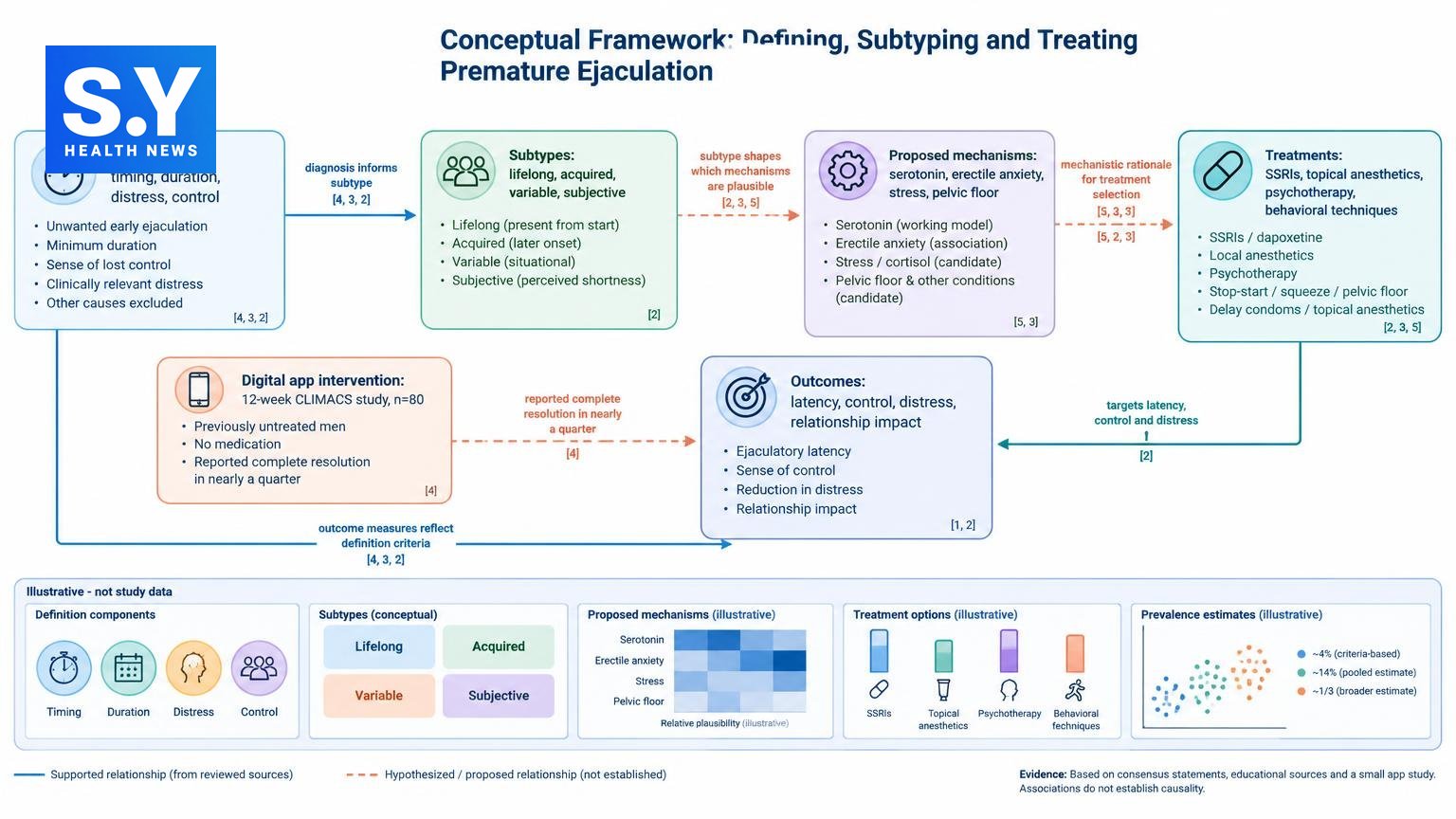
Conceptual framework: Conceptual framework, not a tested causal model. Premature ejaculation is defined by timing, duration, distress and control and classified into lifelong, acquired, variable and subjective subtypes. Proposed mechanisms are partly hypothetical. Treatments are grouped from consensus-level recommendations. The app study is a small 12-week single-description report without a stated comparator, so its link to outcomes is shown as proposed, not established.
Academic References & Evidence
- Contemporary consensus and emerging directions in premature and delayed ejaculation: recommendations from the 5th International Consultation on Sexual Medicine.. Sexual medicine reviews PMID: 42855438.
- 2026 ICSM专家共识:早泄和延迟射精的当代共识与新兴方向. Sex Med Rev. 2026 14(4)
- Sünje Nicolaysen. Vorzeitiger Samenerguss: Was tun & wann zum Arzt? | Doctolib. 2026
- Dr. Dagmar van Thiel. Vorzeitiger Samenerguss: Ursachen und Therapieoptionen.
- Vorzeitiger Samenerguss: Was hilft?.
SANYUN Science Center explains published research on men's reproductive and sexual health, connecting scientific evidence with everyday questions while making sources and limitations clear.
Disclaimer: This article is for scientific education and research communication only. It does not provide medical advice, diagnosis, or individualized treatment recommendations, and does not endorse any medication, supplement, device, penile enlargement procedure, or other intervention. Decisions about sexual and reproductive health should be made in consultation with a qualified healthcare professional. Do not delay seeking professional care because of information in this article.
Original Content & Copyright Notice
- This article is prepared for SANYUN Science Center, drawing on published research and publicly available academic literature on men’s sexual and reproductive health. Its editorial explanations and presentation are developed for this platform.
- Copyright in the original editorial content, selection, and arrangement is reserved by SANYUN Science Center to the extent protected by applicable law. Referenced research, quotations, and third-party materials remain subject to the rights of their respective owners. This notice does not claim ownership of scientific facts or third-party research.
- Except where permitted by applicable law or an applicable license, prior written permission is required to reproduce, republish, translate, adapt, redistribute, or commercially reuse protected content. Attribution alone does not grant permission for such reuse.
- For permitted quotation or authorized reuse, clearly identify the source and retain a link to the original article.
- Source: SANYUN Science Center
- Original URL: Retain the original article URL on science.san-yun.com.
- Copyright Holder: SANYUN Science Center, for its own protected editorial content.
- Quotation, excerpts, or authorized reuse must not distort the scientific meaning, omit material limitations or disclaimers, or imply unverified medical claims, product efficacy, or endorsement by SANYUN Science Center.



