




Category: Premature Ejaculation
Core Research Direction: Synthesizing current consensus guidance on the definition, classification, evaluation, and management of premature ejaculation (including dapoxetine, SSRIs, and psychotherapy), contrasted with popular claims about treatment course length and recovery timelines
Search Intent: How is premature ejaculation defined, classified, and treated according to contemporary consensus, and what can—and cannot—be said about how long treatment takes?
Platform: SANYUN Science Center
Evidence reviewed through: 2026-11-10
Executive Summary
Premature ejaculation (PE) is a common ejaculatory disorder associated with substantial impact on quality of life and relationships. Contemporary guidance from the Fifth International Consultation on Sexual Medicine aims to provide evidence-based recommendations for the definition, classification, evaluation, and treatment of PE and delayed ejaculation, synthesizing findings on etiology, epidemiology, and management.[1]
A central clinical distinction separates lifelong from acquired PE. In the definition attributed to the International Society for Sexual Medicine in a patient education source, lifelong PE involves ejaculation within about one minute of penetration from the first sexual experience, while acquired PE involves intravaginal ejaculatory latency time (IELT) typically under three minutes, together with perceived inability to delay ejaculation and negative personal consequences such as distress or avoidance.[2]
Management is consistently described across consumer sources as multimodal rather than a single fixed prescription. Options discussed include behavioral methods such as stop-start and squeeze techniques, psychotherapy, topical anesthetics, and oral agents including SSRIs and dapoxetine. However, the published consensus text available here is only an abstract; it does not provide the recommendation details or effect sizes needed to rank these options.[3]
Popular claims about a fixed treatment course—such as 'one to three months' or 'three to six months'—cannot be verified from the packet. They appear as uncited general statements in consumer health articles, not as consensus recommendations or trial findings. The evidence supports the principle that timelines vary by PE type, underlying causes, treatment response, and partner involvement, but it does not support a single predictable schedule.[4][5][6]
Why This Matters
Ejaculatory disorders are described as common conditions with substantial impact on men's quality of life and relationships, which makes clarity about definition and realistic treatment expectations clinically important. Men frequently ask how long treatment will take, but the packet does not contain the longitudinal comparative studies needed to answer that question with precision.
A further concern is that PE may coexist with other conditions. Organic contributors such as chronic prostatitis or endocrine disorders are described as requiring treatment of the underlying condition first, with the course potentially extending to three to six months, although that claim is uncited in the supplied text. Relying only on symptomatic drug treatment while missing a treatable contributor could delay meaningful improvement.
Definition and Classification: Lifelong Versus Acquired PE
The International Society for Sexual Medicine definition, as summarized in an education article, combines three elements: ejaculation that occurs very early (within about one minute of penetration for lifelong PE, or with IELT typically under three minutes for acquired PE), a sense that ejaculation cannot be delayed, and negative consequences such as distress, frustration, or avoidance of sexual activity. The three-part structure matters because it prevents labeling a man with a short but non-distressing latency as having a disorder.
The consensus review's scope explicitly includes lifelong and acquired premature ejaculation alongside intravaginal ejaculatory latency time, penile hypersensitivity, dapoxetine, SSRIs, and psychotherapy. The inclusion of these terms indicates that contemporary discussion treats PE as a heterogeneous condition rather than a single uniform entity.
One often overlooked contextual point is the distribution of IELT in the general male population. A consumer education article states that most IELTs fall between three and seven minutes, with a median of 5.4 minutes, and advises against chasing excessively long latency. That figure is presented without citation, so its population and study basis cannot be evaluated from the packet, but it serves as a caution against defining treatment success solely by duration.
Biological and Psychological Mechanisms Considered in the Literature
The packet supports a multifactorial framing. One consumer source states that PE is not caused by a single factor and may relate to higher nerve sensitivity, psychological tension, anxiety, partner relationship, hormone levels, and underlying diseases such as prostatitis. These are broad categories, not quantified causal contributions, and the review abstract does not list a ranked set of etiologies.
A proposed anxiety feedback loop is frequently described: anxiety may make ejaculation faster, and faster ejaculation may increase anxiety, so that without interrupting the cycle symptoms tend to recur regardless of medication duration. This is a plausible clinical hypothesis rather than an established quantitative mechanism from the packet; it should be treated as a rationale for including psychological care, not as proof of how much psychotherapy changes IELT.
Penile hypersensitivity appears among the consensus review's keyword topics, although the available abstract does not describe whether hypersensitivity is considered causal, a measurement, or a treatment target. Similarly, the role of serotonin is implicit in the inclusion of SSRIs and dapoxetine, but the abstract does not provide mechanistic detail or effect estimates.
What the Evidence Shows: Treatment Options and Their Reported Time Courses
The strongest anchor in the packet is the consensus article, but its value here is limited by the fact that only the abstract was available. It describes recommendations for definition, classification, and treatment, and covers dapoxetine, SSRIs, and psychotherapy as topics. It does not report specific effect sizes, head-to-head comparisons, or a recommended duration of treatment. Readers should treat any single numeric 'course length' as coming from consumer guidance, not from this consensus abstract.
Behavioral techniques are described in education-oriented sources as foundational for many men. The stop-start and squeeze methods are presented as requiring partner cooperation, with the squeeze technique specifically positioned as an alternative for those for whom stop-start has not worked. The same source states that after about two weeks of consistent squeeze practice most patients improve considerably, and that three to six months is generally needed for durable effect. These are uncited claims from a single education article, not findings from a controlled trial included in the packet.
For oral SSRIs such as sertraline and paroxetine, one source advises starting under medical supervision, notes that initial side effects often ease within a week, and states that effect appears in two to four weeks with longer-term continuation afterward. Another source describes dapoxetine-type SSRIs as reaching stable plasma levels after one to two weeks of regular dosing and suggests continuous use for one month before assessing efficacy, while also noting individual metabolic variation. These are practical clinical descriptions rather than trial reports, and the packet does not clarify how the on-demand use of dapoxetine compares with regular SSRI dosing.
Topical anesthetics are another described option. One source lists lidocaine ointment or tetracaine gel applied after erection, with two to four drops adjusted to effect and a condom used during intercourse. A second source states lidocaine gel is used on demand, typically taking fifteen to thirty minutes to act, and suggests better results when combined with behavioral training. Neither source provides comparative efficacy data, and the packet does not contain safety data on topical anesthetic use in this context.
A single consumer Q&A article offers an overall estimate that the treatment course is typically one to three months, varying by treatment method, severity, and individual differences. That article also states that about 60% of patients who adhere to standardized behavioral training achieve significant symptom relief within three months. The primary study behind that percentage is not included in the packet, and the definition of 'standardized training' is not provided, so the figure should be read as illustrative rather than confirmatory.
| Variable | Packet-grounded description | Interpretation and limitation |
|---|---|---|
| Lifelong PE threshold | Ejaculation within about 1 minute of penetration from first sexual intercourse | Used in the ISSM definition summarized by an education source; primary definition source not cited in the packet |
| Acquired PE threshold | IELT typically under 3 minutes | Accompanied by perceived inability to delay ejaculation and negative consequences; threshold values only |
| Median IELT in general population | 5.4 minutes (range commonly 3-7 minutes) | Uncited consumer article; population and study basis unavailable |
| SSRI onset to effect | 2-4 weeks | Uncited clinical guidance for sertraline and paroxetine; not a trial-derived estimate |
| Dapoxetine/SSRI steady state | 1-2 weeks to stable plasma levels; assess efficacy after 1 month | Consumer Q&A citing a specialist consensus not included in packet; standard on-demand use may differ from regular dosing |
| Topical anesthetic onset | 15-30 minutes | Guidance specific to lidocaine gel; no comparative efficacy or safety data in packet |
Interpretation and Limitations
The central limitation of this review is source quality. The consensus review is represented only by an abstract, so its recommendations cannot be verified in detail. The remaining packet items are consumer health news articles, a sexual health education article, and a Q&A page. None describes a randomized trial, systematic review, or guideline with transparent methodology in the supplied text. Numeric claims such as four to eight weeks of observation, three to six months of continuation, or one to three months total course are offered as general practice descriptions rather than as findings from the studies that generated them.
A second limitation concerns causality. The anxiety-PE loop and the influence of partner understanding, lifestyle factors, and pelvic floor exercise are described in consumer sources as clinically important, but the packet does not contain longitudinal or interventional data to quantify their effects. These should be framed as plausible contributors and treatment targets rather than as proven causal pathways or guaranteed modulators of recovery.
A third limitation is inconsistency across sources. Behavior therapy timelines range from a few weeks to several months; medication is described as both on-demand and regular; and overall course estimates vary from one to three months to three to six months depending on the cause. Some of this variation likely reflects genuine clinical heterogeneity, but without primary studies it is impossible to separate true differences from differences in author opinion or definition.
Research Outlook
The consensus review's stated scope covers definition, classification, and treatment across both PE and delayed ejaculation. For premature ejaculation specifically, the packet highlights unresolved questions: how best to measure treatment success beyond IELT, how to integrate behavioral and pharmacological approaches, and how to identify which men are likely to need longer or shorter treatment. None of these questions is answered with comparative data in the supplied sources.
A specific gap is the absence of head-to-head or placebo-controlled outcome data in the packet for dapoxetine, SSRIs, topical anesthetics, and psychotherapy. The keywords indicate these topics are within the consensus review's scope, but the abstract does not reveal its conclusions about relative efficacy, sequencing, or duration. Until those details are available, claims about fixed treatment courses should be treated as consumer guidance rather than as established evidence.
Key Takeaways
- Premature ejaculation is a common ejaculatory disorder with meaningful quality-of-life and relationship impact; contemporary consensus guidance addresses its definition, classification, evaluation, and treatment.
- The widely cited ISSM definition distinguishes lifelong PE (ejaculation within about one minute of penetration from the first sexual experience) from acquired PE (IELT typically under three minutes), with both requiring perceived inability to delay ejaculation and negative consequences.
- Treatment options discussed in the packet include behavioral techniques, psychotherapy, topical anesthetics, and oral SSRIs or dapoxetine; a consensus review lists these among its topics but the available abstract does not provide effect sizes or recommended durations.
- Specific time estimates—such as one to three months, four to eight weeks of observation, or three to six months of continuation—appear in consumer articles as general practice descriptions, not as findings from controlled trials included in the packet.
- Because the available evidence is limited and largely descriptive, treatment timelines should be presented as variable and individualized rather than as a predictable schedule, and no single option should be portrayed as a guaranteed or permanent cure.
Questions and Answers
What is premature ejaculation according to consensus definitions?
Premature ejaculation is defined by three elements: ejaculation that occurs very early, a perceived inability to delay ejaculation, and negative consequences such as distress or avoidance. According to the ISSM definition summarized in one education source, lifelong PE involves ejaculation within about one minute of penetration from the first sexual experience, while acquired PE involves an intravaginal ejaculatory latency time typically under three minutes.
What does the 5th International Consultation on Sexual Medicine say about premature ejaculation treatment?
The consensus review states that it presents evidence-based recommendations for the definition, classification, and treatment of premature and delayed ejaculation, synthesizing findings on etiology, epidemiology, evaluation, and management. Its listed topics include lifelong and acquired PE, intravaginal ejaculatory latency time, penile hypersensitivity, dapoxetine, SSRIs, and psychotherapy. However, only the abstract is available here, so specific recommendations, effect sizes, and recommended treatment durations are not verifiable from the packet.
How long does premature ejaculation treatment usually take, and is there strong evidence for a fixed course?
Consumer sources offer varying estimates, including one to three months overall, two to four weeks for oral SSRIs to take effect, and three to six months for the squeeze technique to produce durable effect. However, these are uncited general descriptions from consumer articles, not findings from the consensus review or from controlled trials included here. The evidence does not support a single fixed treatment course; timelines appear to vary by PE type, underlying cause, chosen treatment, and individual response.
Does dapoxetine or other SSRIs cure premature ejaculation permanently?
The packet does not support the idea of a permanent cure from a few doses. One consumer article states that oral or topical agents help prolong ejaculatory latency but do not produce a lasting cure from a few doses. Another source describes SSRIs and dapoxetine as options that may require regular use for weeks to months and medical supervision. The consensus abstract lists dapoxetine and SSRIs as topics but provides no efficacy or durability data in the available text.
Is behavioral therapy or psychotherapy effective for premature ejaculation, and how long does it take?
Behavioral techniques such as stop-start and squeeze methods, and psychotherapy, are described as important options in consumer and education sources. One article states most patients improve considerably after about two weeks of consistent squeeze practice, with three to six months generally needed for durable effect, while another suggests about 60% of patients adhering to standardized behavioral training achieve significant relief within three months. These figures are uncited or secondhand, and the consensus abstract does not provide behavioral or psychotherapy effect sizes.
What are the main limitations of the evidence on premature ejaculation treatment duration?
The key limitation is that the consensus review is represented only by an abstract, so its detailed recommendations and supporting data are unavailable. The remaining packet sources are consumer health articles and a Q&A page, none of which describes a randomized trial or systematic review in the supplied text. Numeric claims about treatment courses are therefore general practice descriptions or secondhand citations, and they vary widely. The evidence supports individualized care but not a fixed schedule or guaranteed timeline.
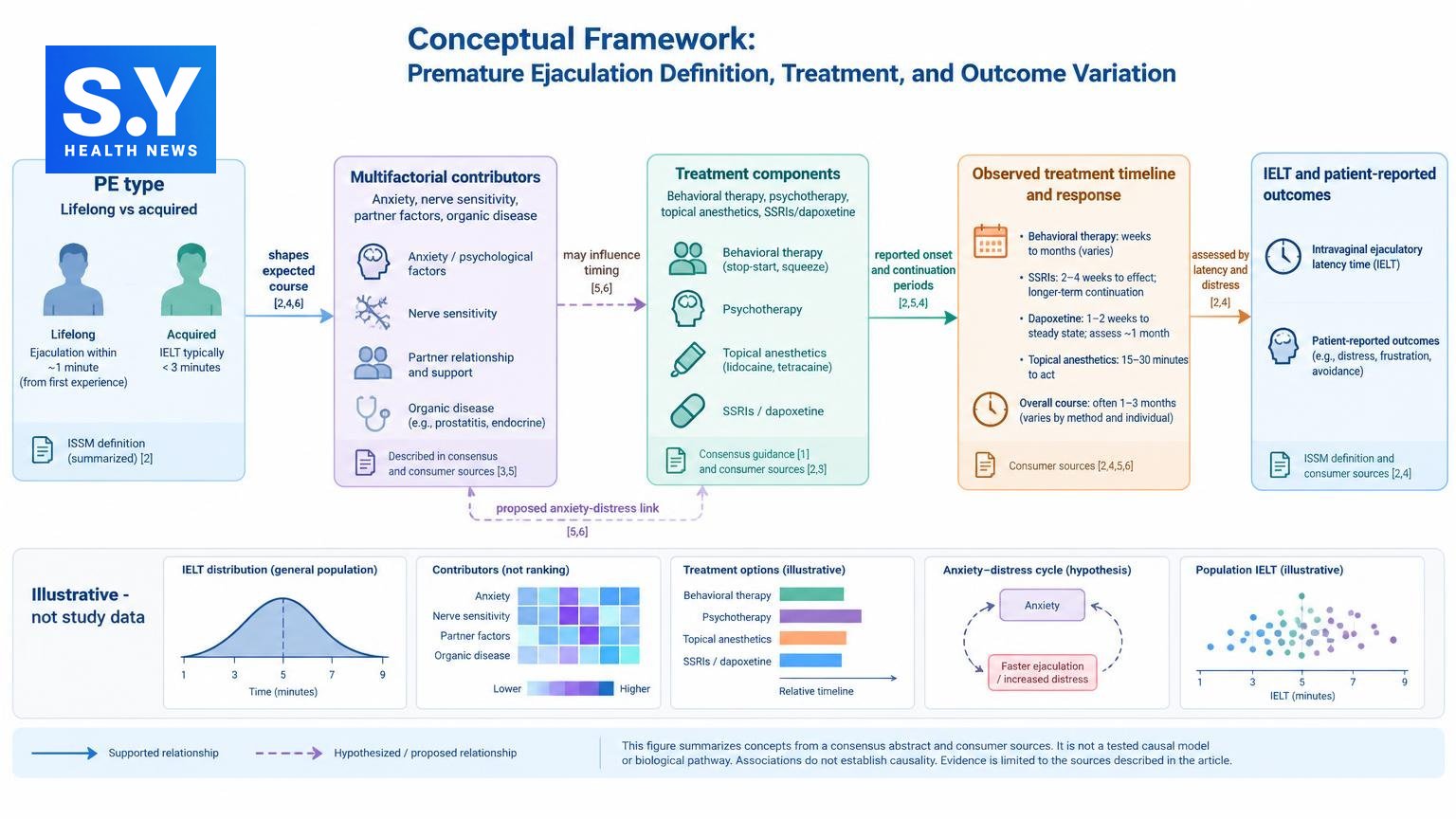
Conceptual framework: Conceptual framework: This figure organizes the article's main constructs—PE type, multifactorial contributors, treatment components, observed timelines, and outcomes. Solid relationships reflect supported associations as described in the packet; dashed relationships reflect proposed, unquantified links. It is not a tested causal model or a biological pathway. Study context is limited to a consensus abstract and consumer sources, so relationships should be read as conceptual aids rather than confirmed mechanisms.
Academic References & Evidence
- Contemporary consensus and emerging directions in premature and delayed ejaculation: recommendations from the 5th International Consultation on Sexual Medicine.. Sexual medicine reviews PMID: 42855438.
- 性感集中训练. 2026
- 治早泄药要吃多久?治疗早泄药需要长期吃吗得看病情和方案. 2026
- 治疗早泄一般需要多久? – 民福康. 2026
- 疗程到底多长?治疗早泄要吃药多久. 2026
- 早泄吃药能改善多长时间?恢复周期受这些因素影响. 2026
SANYUN Science Center explains published research on men's reproductive and sexual health, connecting scientific evidence with everyday questions while making sources and limitations clear.
Disclaimer: This article is for scientific education and research communication only. It does not provide medical advice, diagnosis, or individualized treatment recommendations, and does not endorse any medication, supplement, device, penile enlargement procedure, or other intervention. Decisions about sexual and reproductive health should be made in consultation with a qualified healthcare professional. Do not delay seeking professional care because of information in this article.
Original Content & Copyright Notice
- This article is prepared for SANYUN Science Center, drawing on published research and publicly available academic literature on men’s sexual and reproductive health. Its editorial explanations and presentation are developed for this platform.
- Copyright in the original editorial content, selection, and arrangement is reserved by SANYUN Science Center to the extent protected by applicable law. Referenced research, quotations, and third-party materials remain subject to the rights of their respective owners. This notice does not claim ownership of scientific facts or third-party research.
- Except where permitted by applicable law or an applicable license, prior written permission is required to reproduce, republish, translate, adapt, redistribute, or commercially reuse protected content. Attribution alone does not grant permission for such reuse.
- For permitted quotation or authorized reuse, clearly identify the source and retain a link to the original article.
- Source: SANYUN Science Center
- Original URL: Retain the original article URL on science.san-yun.com.
- Copyright Holder: SANYUN Science Center, for its own protected editorial content.
- Quotation, excerpts, or authorized reuse must not distort the scientific meaning, omit material limitations or disclaimers, or imply unverified medical claims, product efficacy, or endorsement by SANYUN Science Center.



