




Category: Premature Ejaculation
Core Research Direction: Contemporary evidence-based framework for defining, classifying, and treating premature ejaculation (lifelong vs acquired; IELT and distress criteria) and emerging digital therapeutic approaches
Search Intent: What does current consensus guidance and emerging evidence say about how premature ejaculation is defined, what causes it, and which treatments (behavioral, pharmacological, psychological, and digital) are supported?
Platform: SANYUN Science Center
Evidence reviewed through: 2026-11-03
Executive Summary
Premature ejaculation (PE) is described in clinical overview material as a common male sexual dysfunction with a substantial impact on quality of life, self-esteem and couple relationships. Contemporary consensus work under the Fifth International Consultation on Sexual Medicine states that ejaculatory disorders, including PE and delayed ejaculation, are common conditions with a considerable effect on men's quality of life and relationships. However, the sources available for this review are primarily narrative overviews and consensus-summary material rather than primary epidemiologic or randomized trial reports, so estimates of frequency and treatment effect must be read cautiously.[1]
Diagnostically, PE is defined by more than timing alone. DSM-5 requires a persistent or recurrent unwanted early ejaculation that, over the past six months, occurred within about one minute after vaginal penetration in at least 75% of cases, and both ICD-10 and DSM-5 additionally require significant distress for diagnosis. Clinical overviews also describe persistent or recurrent difficulty controlling ejaculation, occurring earlier than desired by the person or partner, and note that PE may be primary, present from the first sexual experiences, or secondary, developing over time. AUA guidance summarized in the German-language source similarly distinguishes lifelong from acquired patterns, with acquired PE defined by latency markedly shortened compared with earlier sexual experiences.[2][3]
Causes are described as multifactorial, typically combining biological, psychological and relational factors rather than a single origin. Treatment approaches in the reviewed sources include behavioral techniques such as stop-start and squeeze methods, psychological and couple therapy, pelvic floor training, and pharmacotherapy including SSRIs, dapoxetine, topical anesthetics and, in selected cases, PDE5 inhibitors or tramadol. A new digital development is a smartphone application studied in the twelve-week CLIMACS study, which enrolled 80 treatment-naive men not taking medication; results were presented at the 2026 AUA congress and, as reported, sexual dysfunction disappeared completely in nearly one quarter of participants. That finding comes from a conference presentation summarized in a news article, without a described comparator or randomization, and should be interpreted as preliminary rather than as proof of efficacy.
Why This Matters
PE is not a minor complaint. The consensus review states plainly that ejaculatory disorders, including PE and delayed ejaculation, are common and have a substantial impact on men's quality of life and their relationships. Clinical overview material goes further in describing effects on self-esteem and couple relationships, and notes that taboos around the problem can delay consultation with a specialist. Because the condition is defined partly by distress and interpersonal difficulty, not merely by a stopwatch, the burden is experienced by both the man and his partner.
Prevalence statements require care. One German-language overview states that PE is the most common ejaculatory disorder and affects roughly one third of all men, but that figure is presented without a described denominator, study design or cited epidemiologic survey. It is therefore best treated as a commonly repeated clinical impression rather than a verified population estimate. The discrepancy between widely quoted high prevalence and the narrower DSM-5 threshold, which requires both short latency and distress, helps explain why estimates vary: definitions that count occasional rapid ejaculation will always produce larger numbers than definitions requiring persistent, distressing symptoms.
How Premature Ejaculation Is Defined and Classified
The core definitional elements are latency, control and distress. DSM-5, as summarized in the German-language source, describes PE as a persistent or recurrent unwanted early ejaculation that in the past six months occurred within about one minute after vaginal penetration in at least 75% of cases. Both ICD-10 and DSM-5 additionally require significant distress for diagnosis. A separate clinical overview describes PE as persistent or recurrent difficulty controlling ejaculation during sexual activity, occurring earlier than desired by the person or partner, and adds that there is no universal standard time, with clinical relevance assigned when ejaculation systematically occurs within less than one minute after penetration or when there is significant inability to delay it that generates emotional or interpersonal distress.
These definitions are closely related but not identical, and the differences matter for research and clinical practice. The DSM-5 formulation is anchored to a specific time window (about one minute) and a frequency threshold (at least 75% of episodes) over a defined period (six months), whereas the clinical overview emphasizes the subjective experience of lost control and the presence of distress. The consensus review's indexed scope includes intravaginal ejaculatory latency time (IELT), lifelong and acquired PE, and penile hypersensitivity, indicating that latency measurement and subtype classification remain central to contemporary expert discussion. However, the available abstract does not provide the full recommendation text, effect estimates or threshold values, so the precise consensus positions cannot be independently assessed here.
The lifelong versus acquired distinction is a second organizing principle. AUA guidance summarized in the German source describes primary, lifelong PE as a lack of control over ejaculation present since the first sexual experience, and secondary, acquired PE as a persistent disturbance in which ejaculatory latency during penetrative intercourse is markedly shortened compared with the person's earlier sexual experiences. The Spanish-language clinical overview makes the same primary/secondary distinction, noting that primary PE can appear from the first sexual experiences while secondary PE develops over time. This classification is clinically useful because the two patterns may warrant different diagnostic attention, particularly for acquired PE, where a change from a prior baseline invites consideration of contributing medical, psychological or relational factors.
| Construct | How the sources define it | Why it matters clinically |
|---|---|---|
| DSM-5 latency and frequency criterion | Unwanted early ejaculation within about one minute after vaginal penetration in at least 75% of cases over the past six months | Provides a structured threshold for diagnosis, but is a definitional standard rather than an empirical study result |
| Distress requirement | ICD-10 and DSM-5 additionally require significant distress for diagnosis | Separates occasional rapid ejaculation from a disorder that warrants clinical attention |
| Control-based clinical description | Persistent or recurrent difficulty controlling ejaculation, earlier than desired by the person or partner; clinically relevant when systematic within less than one minute or when inability to delay causes emotional or interpersonal distress | Captures subjective experience and partner impact that a time threshold alone may miss |
| Lifelong (primary) PE | Lack of ejaculatory control present since the first sexual experience | Suggests a longstanding pattern potentially requiring different assessment than a new change |
| Acquired (secondary) PE | Persistent disturbance with ejaculatory latency markedly shortened compared with earlier sexual experiences | A change from baseline may prompt evaluation of contributing biopsychosocial factors |
| Prevalence claim | Roughly one third of all men, presented without described denominator, study design or citation | Should be treated as a clinical impression, not a verified epidemiologic estimate |
Biological, Psychological and Relational Contributors
The reviewed clinical overview states that causes of PE are multifactorial and that in most cases there is no single origin but a combination of biological, psychological and relational factors. Among biological contributors, it lists alterations in brain neurotransmitters, especially serotonin, which is described as playing a key role in controlling the ejaculatory reflex; glans hypersensitivity, which may increase excitatory response; prostatic inflammation or other urogenital alterations that may contribute to greater excitability; genetic factors, with a family predisposition in some cases; and hormonal dysfunctions, though described as less frequent. The consensus review's keyword list likewise includes penile hypersensitivity, suggesting that this construct remains part of contemporary expert discussion. These mechanistic statements come from narrative overview material and should be read as hypotheses or established background rather than as findings from the cited sources' own experiments.
Psychological and relational factors are described as especially relevant, particularly in acquired PE. The Spanish-language overview lists performance anxiety, chronic stress, negative early sexual experiences, low self-esteem or insecurity, and relationship or communication problems as common psychological contributors. Relational dynamics, including lack of communication, unrealistic expectations and pressure to perform sexually, are said to increase anxiety and worsen ejaculatory control. It also notes that PE and erectile dysfunction can reinforce each other in a cycle of anxiety and loss of control, and lists risk factors such as early sexual debut without adequate sexual education, prolonged abstinence, alcohol or recreational drug use, high work or emotional stress, and associated erectile dysfunction. These are clinical observations from an overview, not quantified associations from a controlled study.
The serotonin mechanism deserves a specific caution. The claim that serotonergic neurotransmission is central to ejaculatory control is biologically plausible and consistent with the use of serotonergic drugs in treatment, but the supplied sources do not present direct experimental data linking serotonin alterations to PE in patients. It is therefore best described as a mechanistic framework that informs treatment selection, not as a demonstrated cause in any individual. Similarly, penile hypersensitivity is listed as a keyword and mentioned as a possible contributor, but no sensory testing data or threshold values are provided in the available text.
What the Evidence Shows for Treatment
Behavioral techniques are described in the clinical overviews as established first-line or early approaches. The German-language source describes the stop-start method, in which the man masturbates and stops shortly before the point of inevitability, resuming stimulation when arousal has subsided, and the squeeze method, in which the ejaculatory reflex is interrupted by pressure with the thumb tip in the area of the frenulum. The Spanish-language overview similarly lists stop-start, squeeze and pelvic floor training, noting that these techniques require consistency and, in many cases, involvement of the partner. These descriptions explain the rationale of building awareness and control, but the supplied sources do not report controlled trial effect sizes, so the strength of evidence for each technique cannot be graded from this material alone.
Pharmacotherapy is summarized in the German-language source as follows: according to AUA guidance, first-line drug options include daily selective serotonin reuptake inhibitors, with clomipramine or dapoxetine cited, and topical penile anesthetics, while phosphodiesterase-5 inhibitors or tramadol may also be considered. The Spanish-language overview states that some patients may require SSRIs at low doses to delay ejaculation, dapoxetine as a rapid-acting drug specifically indicated for PE in many countries, and topical anesthetics such as lidocaine or prilocaine creams or sprays that reduce glans sensitivity. It also emphasizes that pharmacological treatment must always be prescribed and supervised by a specialist because it is not free of side effects. Two cautions apply: the classification of clomipramine and dapoxetine as SSRIs and the description of daily dosing are reported as stated by the source and were not independently verified here, and no comparative efficacy or adverse-event rates are provided.
Psychological and couple-based interventions are described as important when emotional or relational factors are prominent. The Spanish-language overview lists cognitive behavioral therapy to reduce performance anxiety, sexual education to improve understanding, and couple therapy to improve communication and reduce pressure during sex, usually combined with other strategies. The consensus review's indexed topics include psychotherapy alongside dapoxetine, SSRIs and IELT, indicating that psychological treatment remains within the scope of contemporary expert recommendations. However, the abstract does not provide comparative outcome data, so the relative contribution of psychotherapy versus pharmacotherapy, or of combined approaches, cannot be quantified from the available material. The German source notes that AUA guidance supports individualized combination of behavioral and pharmacological approaches.
Lifestyle measures are mentioned in the Spanish-language overview as supportive rather than primary treatment: reducing stress through exercise or relaxation, improving sleep quality, avoiding excessive alcohol, and maintaining a regular sex life without pressure. These are plausible general health measures, but the source presents them without outcome data, and they should not be framed as proven PE-specific interventions.
The Digital Therapy Signal: Early and Uncontrolled
The most novel material in the reviewed sources concerns a smartphone application. According to the German-language news report, the twelve-week CLIMACS study enrolled 80 treatment-naive men who were not taking medication, and results were presented by Heidelberg scientists at the 2026 AUA congress. The report states that sexual dysfunction disappeared completely in nearly one quarter of the affected men. The app is described as delivering training elements, tips and exercises, plus evidence-oriented information about PE designed by urology and psychology experts.
Several features of this report limit interpretation. It is a conference presentation summarized in a news article rather than a peer-reviewed publication with full methods. No comparator group, randomization procedure, blinding, or prespecified outcome definition is described in the available text. The outcome, complete disappearance of sexual dysfunction in nearly one quarter of participants, is a within-group proportion without a control condition, so regression to the mean, placebo or attention effects, and natural fluctuation cannot be excluded. The sample of 80 treatment-naive men not taking medication is a selected group, and applicability to men with acquired PE, comorbid erectile dysfunction, or prior treatment experience is unknown. The finding is therefore best described as a preliminary signal that warrants controlled investigation, not as evidence that a digital therapeutic is effective.
The digital approach is nevertheless conceptually consistent with the behavioral and educational components described elsewhere. Stop-start and squeeze techniques, psychoeducation, and anxiety reduction are all amenable in principle to app-based delivery, and the CLIMACS intervention reportedly combines training, tips and expert-designed information. Whether such delivery preserves the benefits of clinician-guided behavioral therapy, and for which patients, remains an open question that the available sources cannot answer.
Interpretation and Limitations
This review is constrained by the nature of its sources. The consensus document is represented only by an abstract and keyword list; its actual recommendations, evidence grading, threshold values and effect estimates are not available in the supplied text. The two clinical overviews are narrative summaries from a medical news site and a clinic website, without described systematic search methods, and one includes promotional framing toward a local clinic. The prevalence figure of roughly one third of all men lacks a described denominator or study design. The pharmacotherapy summary contains a classification and dosing description that were not independently verified. The digital therapy report is a conference presentation summary without a described comparator. Consequently, statements about mechanism, prevalence, comparative efficacy and digital treatment effects should be treated as provisional and as reflecting the sources' own level of evidence.
A second limitation concerns the distinction between definitional standards and empirical findings. The DSM-5 criterion and the distress requirement are definitional; they tell clinicians how to classify, not how common the condition is or how well treatments work. Similarly, the claim that serotonin plays a key role in ejaculatory control is a mechanistic framework that aligns with pharmacologic practice but is not demonstrated by the supplied data. Readers should resist translating definitional thresholds into population prevalence estimates or treatment response predictions.
A third limitation is geographic and regulatory. The sources reflect German, Spanish and international consensus perspectives, and the availability and approved indications of specific drugs, including dapoxetine, vary by country. The statement that dapoxetine is specifically indicated for PE in many countries is a general observation in one overview, not a regulatory determination for any particular jurisdiction. Treatment decisions should therefore be made with a qualified clinician familiar with local prescribing rules.
Research Outlook
The most clearly identified research gap is controlled evaluation of digital therapeutics for PE. The CLIMACS report describes a single-arm, twelve-week study of 80 treatment-naive men; randomized controlled trials with active comparators, blinded outcome assessment, and prespecified definitions of response would be needed to determine whether app-based training adds benefit beyond behavioral advice alone. Reporting of dropout, adherence and partner outcomes would also be important, since the clinical overviews emphasize relational impact and the need for consistency in behavioral techniques.
A second gap concerns the consensus recommendation itself. The Fifth International Consultation on Sexual Medicine review is described as synthesizing etiology, epidemiology, evaluation and management and as aiming to provide evidence-based recommendations for definition, classification and treatment of PE and delayed ejaculation. Once the full recommendations and their evidence grading are available, they should clarify how strongly each intervention is supported and how the lifelong versus acquired distinction should guide treatment selection. The indexed scope, which includes IELT, penile hypersensitivity, psychotherapy and SSRIs, suggests that the consensus addresses both measurement and multimodal treatment, but the supplied abstract does not allow those positions to be reported in detail.
A third gap concerns prevalence and natural history. The widely repeated figure of roughly one third of men is not supported in the supplied text by a described epidemiologic study, and the relationship between occasional rapid ejaculation and persistent distressing PE remains unclear. Population-based studies using consistent DSM-5 or ICD criteria, with distress and control measures, would help align public understanding with clinical definitions and reduce the risk of overdiagnosis or unnecessary treatment.
Key Takeaways
- PE is defined by latency, control and distress, not timing alone: DSM-5 specifies unwanted ejaculation within about one minute after vaginal penetration in at least 75% of cases over six months, and both ICD-10 and DSM-5 require significant distress.
- Lifelong (primary) PE is present from the first sexual experiences, whereas acquired (secondary) PE involves latency markedly shortened compared with earlier experiences; the distinction shapes assessment and treatment planning.
- Causes are described as multifactorial, combining biological factors such as serotonergic neurotransmission and glans hypersensitivity with psychological and relational contributors; these mechanistic claims come from narrative overviews rather than direct experiments.
- Behavioral techniques (stop-start, squeeze, pelvic floor training), psychological and couple therapy, and pharmacotherapy including SSRIs, dapoxetine and topical anesthetics are described as treatment options, with medication requiring specialist supervision because of side effects.
- A twelve-week smartphone-app study of 80 treatment-naive men reported complete resolution in nearly one quarter of participants, but this was a congress presentation without a described comparator or randomization and should be treated as preliminary.
- The prevalence figure of roughly one third of all men lacks a described study design or denominator and should not be treated as a verified epidemiologic estimate.
Questions and Answers
How is premature ejaculation defined using IELT and distress criteria?
DSM-5 describes PE as persistent or recurrent unwanted early ejaculation that, over the past six months, occurred within about one minute after vaginal penetration in at least 75% of cases, and both ICD-10 and DSM-5 require significant distress for diagnosis. Clinical overviews add that PE involves difficulty controlling ejaculation, occurring earlier than desired and causing emotional or interpersonal distress. These are definitional standards, not prevalence or treatment-response findings.
What is the difference between lifelong and acquired premature ejaculation?
AUA guidance summarized in the German-language source describes lifelong (primary) PE as loss of ejaculatory control present since the first sexual experience, and acquired (secondary) PE as a persistent disturbance in which ejaculatory latency during penetrative intercourse is markedly shortened compared with earlier sexual experiences. The Spanish-language overview makes the same distinction, noting that primary PE can appear from the first sexual experiences while secondary PE develops over time. The distinction guides assessment but does not by itself establish cause.
What does current evidence say about smartphone apps for premature ejaculation?
A German-language news report describes a twelve-week smartphone-app study, CLIMACS, enrolling 80 treatment-naive men not taking medication, with results presented at the 2026 AUA congress by Heidelberg scientists. Sexual dysfunction reportedly disappeared completely in nearly one quarter of participants. However, no comparator, randomization, blinding or prespecified outcome definition is described in the available text, so this is a preliminary, uncontrolled signal rather than evidence of efficacy.
Which treatments for premature ejaculation are described in clinical guidance?
Reviewed overviews describe behavioral techniques (stop-start, squeeze, pelvic floor training), psychological and couple therapy, and pharmacotherapy. AUA guidance summarized in the German source lists daily SSRIs, with clomipramine or dapoxetine cited, and topical penile anesthetics as first-line drug options, with PDE5 inhibitors or tramadol also to be considered. The Spanish-language overview adds low-dose SSRIs, rapid-acting dapoxetine and lidocaine or prilocaine topicals. Medication requires specialist supervision because of side effects; the sources provide no comparative effect sizes.
What are the main causes and risk factors for premature ejaculation?
Clinical overviews describe PE as multifactorial, usually combining biological, psychological and relational factors rather than a single origin. Listed biological contributors include serotonergic neurotransmission, glans hypersensitivity, prostatic inflammation or urogenital alterations, genetic predisposition and less frequent hormonal dysfunction. Psychological contributors include performance anxiety, chronic stress, negative early sexual experiences, low self-esteem and relationship or communication problems. Risk factors mentioned include early sexual debut without adequate education, prolonged abstinence, alcohol or drug use, high stress and associated erectile dysfunction. These are narrative claims without quantified associations.
How strong is the evidence behind premature ejaculation prevalence and treatment claims?
The available sources limit certainty. The claim that roughly one third of all men are affected is presented without a described denominator, study design or citation and should not be treated as a verified prevalence estimate. The consensus document is represented only by an abstract and keywords, so its recommendation strength and effect estimates are unavailable. Pharmacotherapy is described without comparative efficacy or adverse-event rates, and the digital therapy report lacks a comparator. Mechanistic claims such as serotonin's role come from narrative overviews rather than direct experiments.
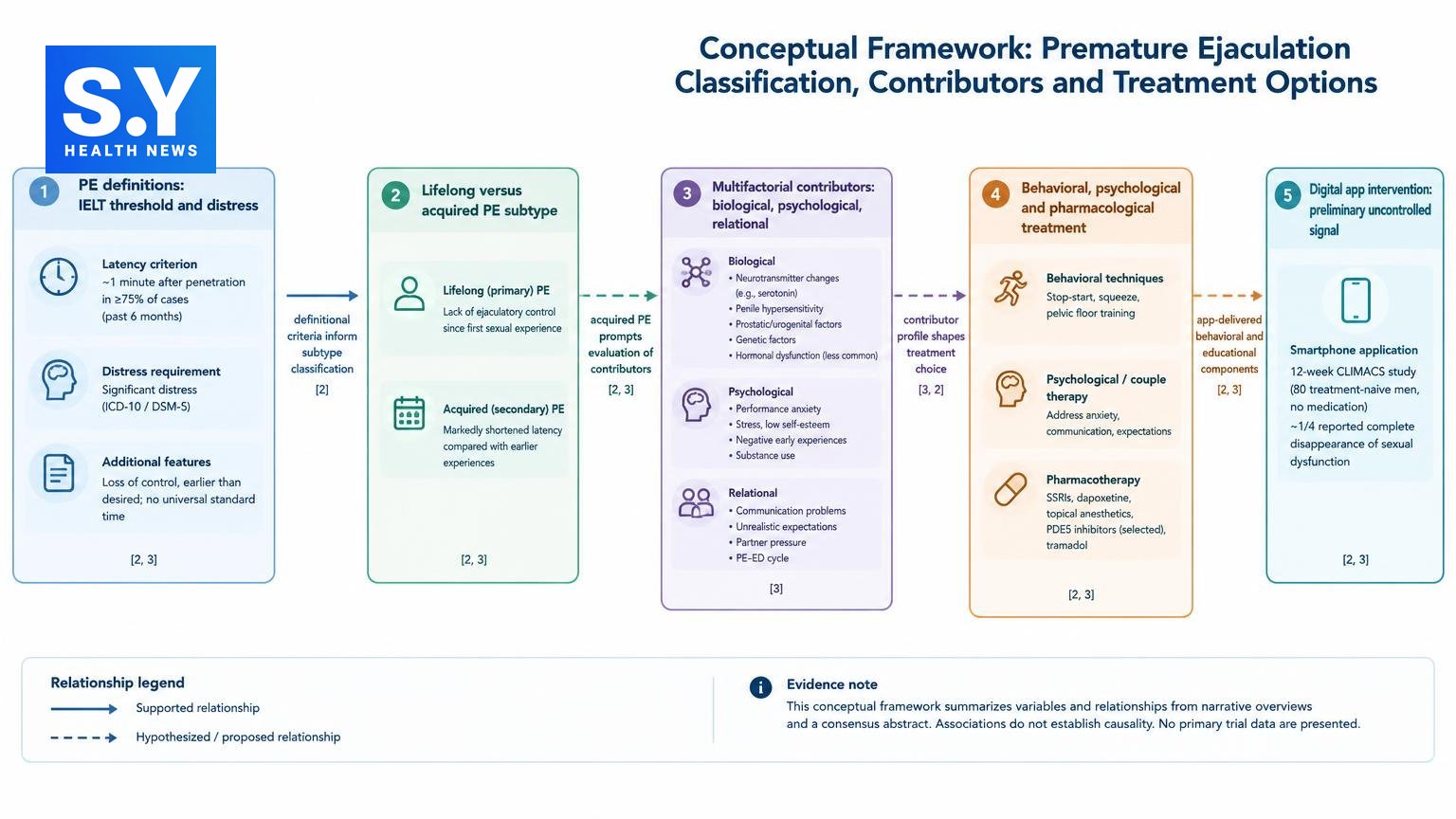
Conceptual framework: Conceptual framework of variables discussed in this evidence review: definitional criteria (latency threshold and distress), lifelong versus acquired PE classification, multifactorial biological-psychological-relational contributors, established behavioral and pharmacological treatments, and a preliminary uncontrolled smartphone-app signal. Relations are supported or proposed, not tested causal pathways. Source material is narrative overviews and a consensus abstract; no primary trial data are presented.
Academic References & Evidence
- Contemporary consensus and emerging directions in premature and delayed ejaculation: recommendations from the 5th International Consultation on Sexual Medicine.. Sexual medicine reviews PMID: 42855438.
- Dr. Dagmar van Thiel. Vorzeitiger Samenerguss: Ursachen und Therapieoptionen. arzt-wirtschaft.de
- Eyaculación precoz: causas y tratamientos disponibles – USC urólogos.
SANYUN Science Center explains published research on men's reproductive and sexual health, connecting scientific evidence with everyday questions while making sources and limitations clear.
Disclaimer: This article is for scientific education and research communication only. It does not provide medical advice, diagnosis, or individualized treatment recommendations, and does not endorse any medication, supplement, device, penile enlargement procedure, or other intervention. Decisions about sexual and reproductive health should be made in consultation with a qualified healthcare professional. Do not delay seeking professional care because of information in this article.
Original Content & Copyright Notice
- This article is prepared for SANYUN Science Center, drawing on published research and publicly available academic literature on men’s sexual and reproductive health. Its editorial explanations and presentation are developed for this platform.
- Copyright in the original editorial content, selection, and arrangement is reserved by SANYUN Science Center to the extent protected by applicable law. Referenced research, quotations, and third-party materials remain subject to the rights of their respective owners. This notice does not claim ownership of scientific facts or third-party research.
- Except where permitted by applicable law or an applicable license, prior written permission is required to reproduce, republish, translate, adapt, redistribute, or commercially reuse protected content. Attribution alone does not grant permission for such reuse.
- For permitted quotation or authorized reuse, clearly identify the source and retain a link to the original article.
- Source: SANYUN Science Center
- Original URL: Retain the original article URL on science.san-yun.com.
- Copyright Holder: SANYUN Science Center, for its own protected editorial content.
- Quotation, excerpts, or authorized reuse must not distort the scientific meaning, omit material limitations or disclaimers, or imply unverified medical claims, product efficacy, or endorsement by SANYUN Science Center.



