




Category: Premature Ejaculation
Core Research Direction: Distinguishing premature ejaculation (PE) subtypes—lifelong, acquired, variable, and subjective—using the Premature Ejaculation Diagnostic Tool (PEDT) in a population-based sample, and how contemporary consensus classifies and manages PE
Search Intent: How well does the Premature Ejaculation Diagnostic Tool (PEDT) distinguish the four PE subtypes, and what do current consensus recommendations say about PE classification and management?
Platform: SANYUN Science Center
Evidence reviewed through: 2026-11-03
Executive Summary
Premature ejaculation (PE) is not a single clinical picture. Contemporary frameworks separate lifelong, acquired, variable and subjective presentations, and the choice of label affects how a clinician interviews, examines and offers support. A brief screening questionnaire is therefore attractive: if one short instrument could assign subtype as well as flag probable PE, population research and routine consultation would both become simpler.[1][2]
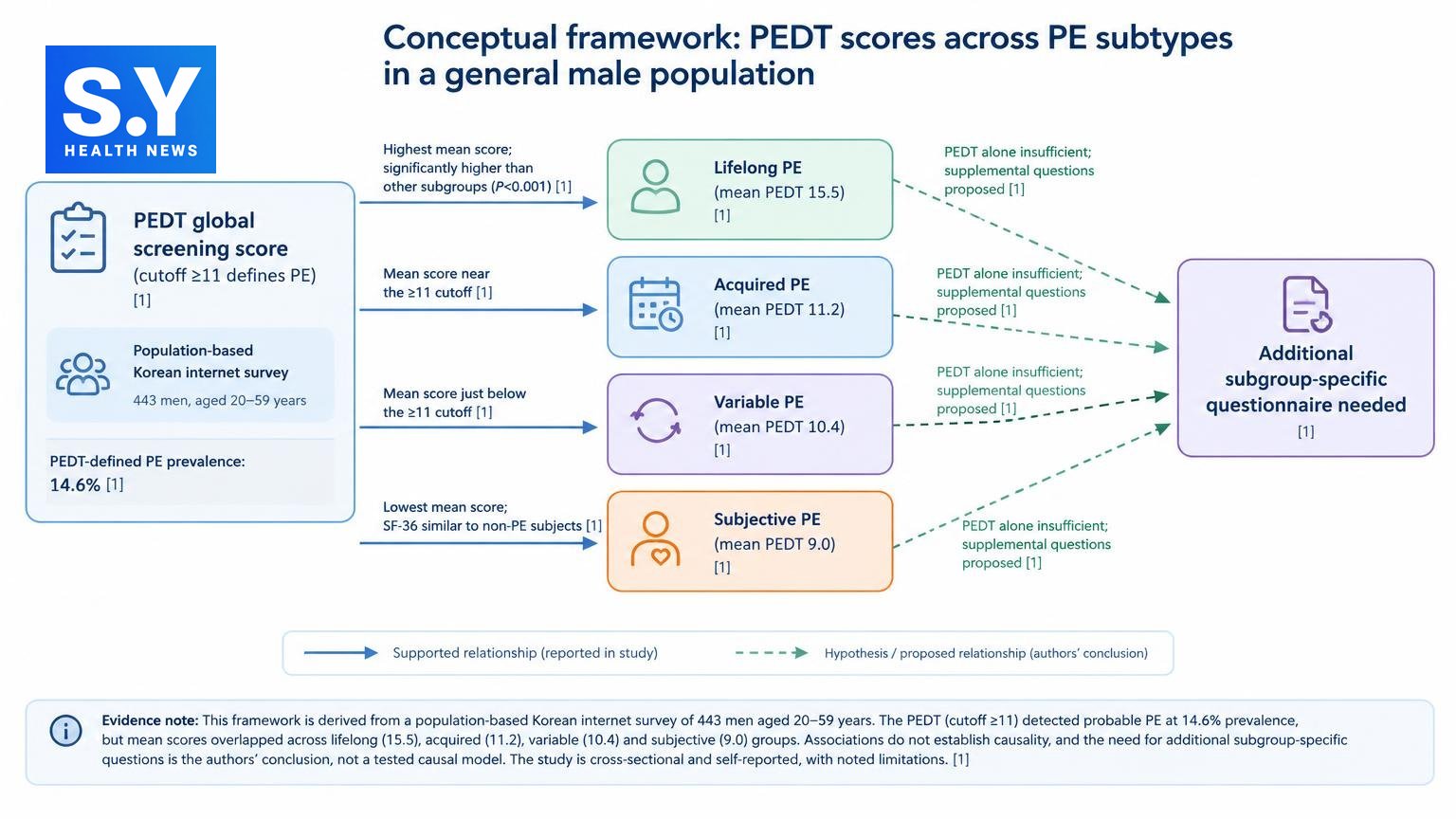
A population-based cross-sectional internet survey of Korean males aged 20-59 years tested that assumption directly. Using a PEDT cutoff of ≥11, PEDT-defined PE prevalence was 14.6% among 443 respondents (mean age 39.3±10.1 years). Lifetime PE accounted for 2.9% of the sample with a mean PEDT score of 15.5, acquired PE 7.0% with 11.2, variable PE 7.4% with 10.4, and subjective PE 3.2% with 9.0. PEDT scores were significantly higher in lifelong PE than in the other subgroups (P<0.001).
The authors' conclusion was deliberately narrow and important: in a general male population, the PEDT is not appropriate for research into the four PE subgroups unless it is combined with an additional questionnaire containing specific subgroup questions. In other words, a validated global screening score did not function as a subtype classifier. The subjective PE group, which had the lowest mean score, also had SF-36 physical and mental component scores similar to non-PE respondents, showing that a low symptom score does not necessarily mean an absence of distress or concern.
Why This Matters
The consensus literature describes ejaculatory disorders, including premature and delayed ejaculation, as common conditions with a substantial impact on men's quality of life and relationships. That framing matters because it moves the discussion beyond a single timing measure. Men may present with concerns about control, distress, partner experience or inconsistency across situations, and these are not interchangeable.
Classification also shapes how evidence is read. Lifelong PE, present from early sexual experience, is conceptually different from acquired PE, which develops after a period of typical function and may prompt investigation of contributing medical or psychological factors. Variable PE describes an inconsistent pattern, while subjective PE describes distress or perceived inadequacy despite ejaculatory latency that falls within typical ranges. If a tool collapses these categories, prevalence estimates and research samples may mix different populations.
For readers, the practical message is that a questionnaire score is a starting point, not a diagnosis. The Fifth International Consultation on Sexual Medicine review aimed to present evidence-based recommendations for definition, classification and treatment of premature and delayed ejaculation, but the supplied summary does not state the specific recommendation content. That gap is itself informative: a consensus label does not, on its own, resolve how individual men should be assessed.
Biological and Clinical Mechanism
The PEDT is described as a brief, multidimensional validated instrument devised for diagnosing PE. Multidimensional means the score aggregates several aspects of the ejaculatory experience rather than a single stopwatch measurement. This design is useful for detecting probable cases in surveys, but it does not automatically encode the timing, onset, consistency and distress features that define the four proposed subgroups.
The distinction between lifelong and acquired PE is often anchored in onset and course, while variable and subjective PE depend on situational consistency and the relationship between perceived performance and actual latency. A global screening score can be elevated in any of these presentations. The survey's pattern supports this: lifelong PE had the highest mean score, but acquired, variable and subjective groups also had mean scores at or above the cutoff used to define PE in the study.
The consensus review's keywords list intravaginal ejaculatory latency time (IELT), penile hypersensitivity, dapoxetine, selective serotonin reuptake inhibitors, and psychotherapy. These terms indicate the domains the review covers, not conclusions about efficacy. The word "hypersensitivity" signals that biological explanations are part of the discussion, but the supplied text provides no data on whether penile hypersensitivity is a cause, a correlate or a treatment target.
The subjective PE finding adds a clinical nuance. Men in that group reported SF-36 physical and mental component scores similar to non-PE subjects, yet they were classified within the PE spectrum by the study's definitions. This suggests that distress and functional health are separate dimensions from ejaculatory timing, and that a low PEDT score should not be used to dismiss a man's concern without further conversation.
What the Evidence Shows
| PE subgroup | Sample proportion | Mean PEDT score | Interpretation |
|---|---|---|---|
| Lifelong PE | 2.9% | 15.5 | Highest mean score; scores significantly higher than other subgroups (P<0.001) |
| Acquired PE | 7.0% | 11.2 | Mean score at the ≥11 cutoff used to define PE in the study |
| Variable PE | 7.4% | 10.4 | Largest subgroup proportion; mean score just below the ≥11 cutoff |
| Subjective PE | 3.2% | 9.0 | Lowest mean score; SF-36 component scores similar to non-PE subjects |
The overall PEDT-defined PE prevalence was 14.6% in a population-based sample of 443 men aged 20-59 years. That figure is a prevalence estimate produced by a screening threshold, not a clinical diagnosis rate. The sample was recruited online, and the study was cross-sectional, so it describes a moment in time rather than the natural history of symptoms.
Within that sample, subgroup proportions summed to a larger figure than the overall 14.6% prevalence, which indicates that men could meet more than one subgroup description or that subgroup assignment was not mutually exclusive. The source does not explain the overlap, and this should be treated as an unresolved feature of the data rather than a finding about how subtypes co-occur.
The statistical signal was strongest for lifelong PE: its mean score of 15.5 was significantly higher than the other subgroups (P<0.001). Statistical significance here means the difference is unlikely to be explained by chance within this sample. It does not mean the PEDT reliably classifies an individual man, and the authors' conclusion explicitly warned against using the instrument for subgroup research in a general population without additional specific questions.
Interpretation and Limitations
The central interpretive point is a distinction between discrimination at the group level and classification at the individual level. A questionnaire can show that lifelong PE tends to score higher while still performing poorly as a subtype test for any given respondent. The authors' recommendation to add a subgroup-specific questionnaire follows from that gap.
Several limitations constrain how far these results travel. The design was a cross-sectional internet survey of a population-based sample, so respondents self-selected into an online study and reported their own symptoms. Self-report can be affected by recall, interpretation of questions and willingness to disclose sexual concerns. The findings are described by the authors as applicable to a general male population, not to clinical samples seeking treatment.
The study used a single cutoff of ≥11 to define PE, which means the subgroup comparisons are conditional on that threshold. Men with variable PE had a mean score of 10.4, just below the cutoff, while acquired PE sat at 11.2. Small differences around a threshold can shift group membership, and mean scores do not show how many individuals were misclassified. The source does not provide sensitivity, specificity or reclassification data for the subgroups.
The consensus review is a narrative synthesis intended to produce recommendations under the Fifth International Consultation on Sexual Medicine. The supplied text does not report primary data, sample sizes or effect estimates, and it does not state the specific recommendations. It should therefore be read as a map of topics and professional framing, not as proof that any particular management strategy works.
A further caution concerns time. The survey was published in 2014, and the consensus review is a later synthesis, but the article does not establish that the PEDT's performance has changed. The evidence reviewed here is best understood as an argument about the limits of a brief global screener, not as a claim about current clinical practice standards.
Research Outlook
The most direct research implication is methodological. Studies that need to distinguish PE subtypes in general populations should pair a global screener such as the PEDT with questions that capture onset, consistency, latency and subjective distress. Without those items, prevalence estimates may blend distinct groups and obscure which men are most affected.
A second implication concerns validation. The survey shows that a tool can be valid for detecting probable PE while remaining insufficient for subclassification. Future work would need to report classification accuracy for each subtype, not only mean score differences, and to test performance in both community and clinical samples.
The consensus agenda also points toward a broader evidence base encompassing etiology, epidemiology, evaluation and management, with attention to both premature and delayed ejaculation. The supplied review keywords indicate that latency time, pharmacological options such as dapoxetine and SSRIs, psychotherapy and penile hypersensitivity are within scope, but the text does not provide outcome data. Readers should look for the full recommendations rather than inferring efficacy from topic lists.
Finally, the subjective PE group highlights a patient-centered research question: how should studies measure distress and relationship impact alongside timing? The finding that SF-36 scores in this group resembled those of non-PE subjects suggests that global health-related quality of life may not capture the specific concerns that lead men to identify as having PE.
Key Takeaways
- In a population-based Korean internet survey of 443 men aged 20-59 years, PEDT-defined PE prevalence was 14.6% using a cutoff of ≥11.
- Mean PEDT scores differed by subgroup: lifelong 15.5, acquired 11.2, variable 10.4 and subjective 9.0, with lifelong significantly higher than the others (P<0.001).
- The authors concluded that the PEDT is not suitable for researching the four PE subgroups in a general male population unless combined with additional subgroup-specific questions.
- The subjective PE group had the lowest PEDT score and SF-36 component scores similar to non-PE subjects, so low scores should not automatically be read as absence of concern.
- The Fifth International Consultation on Sexual Medicine review aims to provide evidence-based recommendations on definition, classification and treatment, but the supplied summary does not state the specific recommendations or efficacy findings.
Questions and Answers
What is the Premature Ejaculation Diagnostic Tool and what was it designed to do?
The PEDT is described as a brief, multidimensional validated instrument devised for diagnosing premature ejaculation. It aggregates several aspects of the ejaculatory experience into a score rather than relying on a single timing measurement. The Korean survey used a score of ≥11 to define PE, but the authors found the tool insufficient on its own for separating the four PE subgroups in a general male population.
Did the PEDT distinguish lifelong, acquired, variable and subjective premature ejaculation?
Only partly. Mean PEDT scores were highest for lifelong PE at 15.5 and significantly higher than the other subgroups (P<0.001), but acquired, variable and subjective groups also had mean scores near the ≥11 cutoff. The authors concluded the PEDT was not appropriate for subgroup research in a general population unless combined with additional subgroup-specific questions.
How strong is the evidence that the PEDT cannot classify PE subtypes?
The evidence comes from one cross-sectional, internet-based survey of 443 Korean men aged 20-59 years, published in 2014. It is a population-based self-report study, not a clinical validation against diagnostic interviews. The finding is consistent with the authors' stated concern about subgroup differentiation, but it should be replicated in other populations and clinical samples before being treated as definitive.
What were the reported PEDT scores and prevalence for each PE subgroup?
Among 443 men, PEDT-defined PE prevalence was 14.6%. Lifelong PE accounted for 2.9% with a mean score of 15.5, acquired PE 7.0% with 11.2, variable PE 7.4% with 10.4, and subjective PE 3.2% with 9.0. The subgroup proportions overlap with the overall prevalence, and the source does not explain this overlap.
Does a low PEDT score mean a man has no premature ejaculation concerns?
Not necessarily. The subjective PE group had the lowest mean PEDT score at 9.0, below the ≥11 cutoff, yet was classified within the PE spectrum. Its SF-36 physical and mental component scores were similar to those of non-PE subjects. This suggests that distress and perceived ejaculatory problems can occur alongside low questionnaire scores, and a score alone should not close the conversation.
What does the Fifth International Consultation on Sexual Medicine say about PE classification and management?
The review aims to present evidence-based recommendations for definition, classification and treatment of premature and delayed ejaculation. However, the supplied summary does not state the specific recommendations or report efficacy data. Its keywords indicate coverage of lifelong and acquired PE, intravaginal ejaculatory latency time, dapoxetine, SSRIs, psychotherapy and penile hypersensitivity, but topic coverage is not evidence of effectiveness.
Conceptual framework: Conceptual framework derived from a population-based Korean internet survey of 443 men aged 20-59 years. The PEDT (cutoff ≥11) detected probable PE at 14.6% prevalence, but mean scores overlapped across lifelong (15.5), acquired (11.2), variable (10.4) and subjective (9.0) groups. Supported lines reflect reported subgroup score differences; the proposed need for supplemental subgroup questions is the authors' conclusion, not a tested causal model.
Academic References & Evidence
- Sang Hoon Song; Woo Seok Choi; Hwancheol Son; Jae Seung Paick. Validity of the premature ejaculation diagnostic tool in four subgroups of premature ejaculation syndrome: Data from the korean internet sexuality survey-Part 1. Sexual Health. 2014 11(1):73-80 DOI: 10.1071/SH13171.
- Contemporary consensus and emerging directions in premature and delayed ejaculation: recommendations from the 5th International Consultation on Sexual Medicine.. Sexual medicine reviews PMID: 42855438.
SANYUN Science Center explains published research on men's reproductive and sexual health, connecting scientific evidence with everyday questions while making sources and limitations clear.
Disclaimer: This article is for scientific education and research communication only. It does not provide medical advice, diagnosis, or individualized treatment recommendations, and does not endorse any medication, supplement, device, penile enlargement procedure, or other intervention. Decisions about sexual and reproductive health should be made in consultation with a qualified healthcare professional. Do not delay seeking professional care because of information in this article.
Original Content & Copyright Notice
- This article is prepared for SANYUN Science Center, drawing on published research and publicly available academic literature on men’s sexual and reproductive health. Its editorial explanations and presentation are developed for this platform.
- Copyright in the original editorial content, selection, and arrangement is reserved by SANYUN Science Center to the extent protected by applicable law. Referenced research, quotations, and third-party materials remain subject to the rights of their respective owners. This notice does not claim ownership of scientific facts or third-party research.
- Except where permitted by applicable law or an applicable license, prior written permission is required to reproduce, republish, translate, adapt, redistribute, or commercially reuse protected content. Attribution alone does not grant permission for such reuse.
- For permitted quotation or authorized reuse, clearly identify the source and retain a link to the original article.
- Source: SANYUN Science Center
- Original URL: Retain the original article URL on science.san-yun.com.
- Copyright Holder: SANYUN Science Center, for its own protected editorial content.
- Quotation, excerpts, or authorized reuse must not distort the scientific meaning, omit material limitations or disclaimers, or imply unverified medical claims, product efficacy, or endorsement by SANYUN Science Center.



