




Category: Premature Ejaculation
Core Research Direction: Genetic and environmental contributions to premature ejaculation during first intercourse in young men, and how contemporary expert guidance reframes PE as a heterogeneous condition requiring shared decision-making
Search Intent: What does research actually show about why premature ejaculation occurs—especially at first intercourse—and what can clinical guidance reliably recommend?
Platform: SANYUN Science Center
Evidence reviewed through: 2026-11-20
Executive Summary
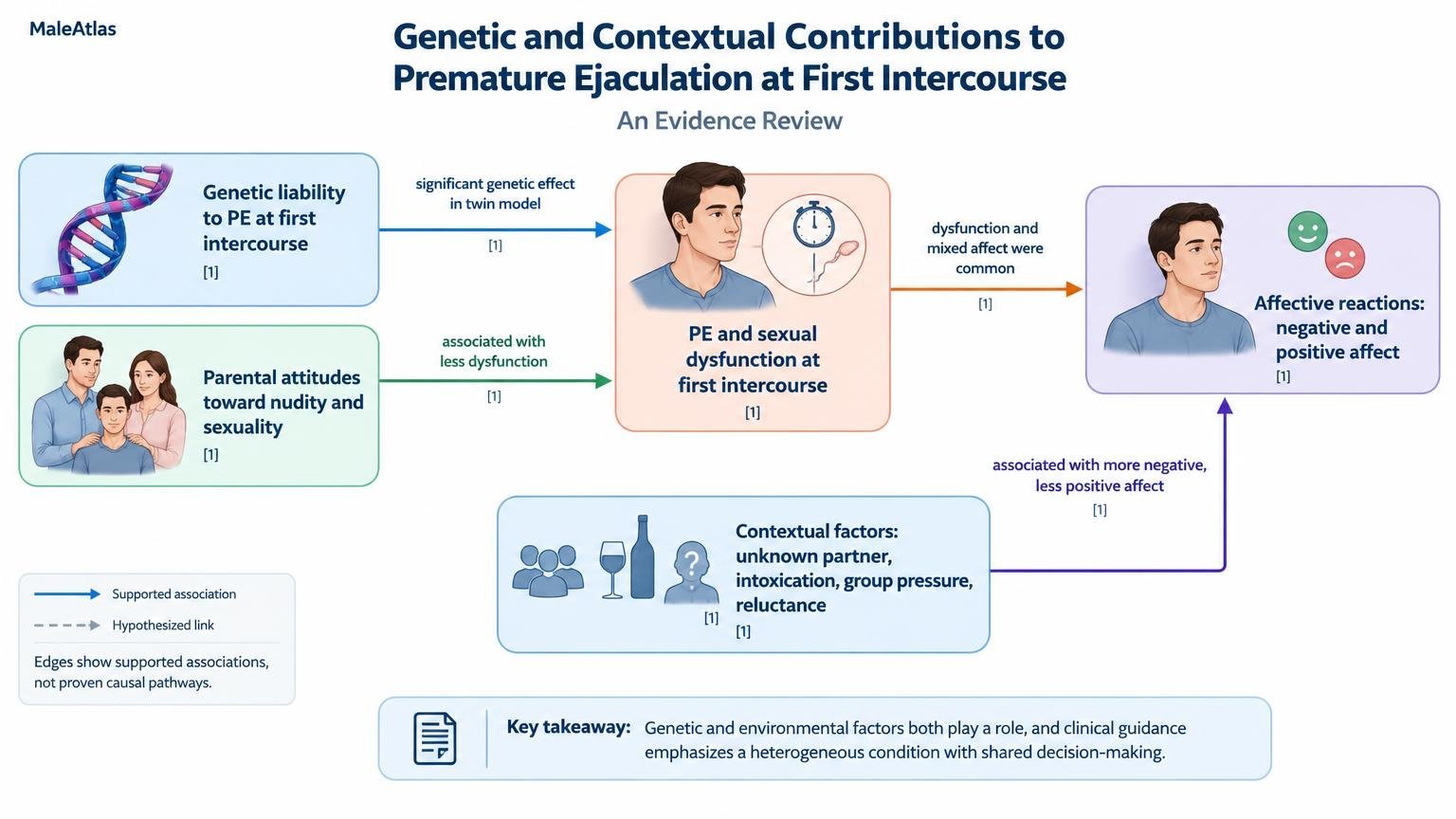
A study of 3,186 male twins and their siblings, with a mean age of 26.17 years (SD 4.77), examined sexual dysfunction recalled at first intercourse. Twin modeling found a significant genetic effect for premature ejaculation (PE) at first intercourse, but not for erectile dysfunction (ED). The authors also reported that sexual dysfunction and both negative and positive affect were common during first intercourse, and that more positive parental attitudes toward nudity and sexuality were associated with less dysfunction and more positive affect. Contextual factors—first intercourse with an unknown partner, strong intoxication, group pressure and reluctance to engage—were associated with more negative and less positive affect. These are retrospective, self-reported associations rather than causal findings.[1][2]
Contemporary expert guidance takes a broader clinical view. A consensus review under the Fifth International Consultation on Sexual Medicine characterizes ejaculatory disorders, including PE, as common conditions with substantial impact on quality of life and relationships, and aims to provide evidence-based recommendations for definition, classification and treatment. A separate guideline amendment, labelled AUA/SMSNA 2027 in the source title, searched two databases for studies published between January 1, 2020 and December 19, 2024, screened 727 abstracts, included 89, and assessed evidence quality for outcomes from 25 studies. It revised a statement on non-pharmacological PE therapies, added an Expert Opinion statement on PDE5 inhibitors, and supported new statements on daily or on-demand clomipramine and glans hyaluronic acid injection with explicit informed-consent caveats. Its central recommendation is shared decision-making regardless of treatment chosen.[3][4]
Why First-Intercourse PE Matters
First intercourse is a formative sexual experience, and the twin study was designed to estimate the relative contribution of genetic and environmental factors to sexual dysfunctions at that moment. The authors note that gender role conflict theory predicts young males should show high levels of such dysfunctions coupled with mixed affective reactions, making the first-intercourse setting a useful test of how biology and context interact. The clinical relevance is not that a single early experience defines a man's sexual future. Rather, the study separates two questions that are often conflated: whether a dysfunction occurred, and how the man felt about it. The authors report that both dysfunction and mixed affect were common, which reframes early PE as a frequent experience rather than an automatic sign of pathology.
Genetic and Environmental Contributions: What the Twin Model Showed
Twin modeling revealed a significant genetic effect for PE, but not for ED. This asymmetry is specific and important: in the same sample and the same recall window, liability to premature ejaculation showed a heritable component that erectile dysfunction did not. The finding does not mean that genes determine first-intercourse PE, nor that environment is irrelevant. It means that, within the assumptions of twin modeling, some of the variation in recalled PE is consistent with genetic influence. The estimate applies specifically to recalled first-intercourse PE, not to chronic or lifelong PE in adulthood.
The environmental side of the model is equally informative. More positive parental attitudes toward nudity and sexuality were associated with less sexual dysfunction and more positive affect during first intercourse, suggesting that family climate around sexuality may shape early sexual experience. Having first intercourse with an unknown partner and while strongly intoxicated, together with group pressure and reluctance to engage in intercourse, were related to more negative and less positive affect. These contextual factors were linked to emotional outcomes rather than to the genetic estimate itself, and the study design cannot establish causation. Erectile dysfunction during first intercourse was also associated with more negative and less positive affect.
| Variable | What the Study Measured | Interpretation |
|---|---|---|
| Premature ejaculation at first intercourse | Retrospective questionnaire item on PE during first intercourse | Showed a significant genetic effect in twin modeling; not a clinical diagnosis. |
| Erectile dysfunction at first intercourse | Retrospective questionnaire item on ED during first intercourse | No significant genetic effect; associated with more negative and less positive affect. |
| Parental attitudes | Reported parental attitudes toward nudity and sexuality | More positive attitudes associated with less dysfunction and more positive affect. |
| Contextual factors | Unknown partner, strong intoxication, group pressure, reluctance | Associated with more negative and less positive affect during first intercourse. |
| Affective reactions | Negative and positive affect during first intercourse | Both were common; affect is not a clinical outcome measure. |
How Contemporary Guidance Reframes PE
The 5th ICSM review situates PE within the broader category of ejaculatory disorders and emphasizes etiology, epidemiology, evaluation and management. Its stated aim is to present evidence-based recommendations for definition, classification and treatment. This framing matters because it moves the conversation away from a single number, such as latency time, toward a heterogeneous condition with subtypes, contributing factors and individualized care. The review is a consensus synthesis rather than an original dataset.
The AUA/SMSNA guideline amendment provides a concrete example of how evidence is being translated. The panel's evidence review searched Ovid MEDLINE and Embase for studies published between January 1, 2020 and December 19, 2024, identified 727 abstracts, and included 89. In 2025, evidence quality was assessed for outcomes from 25 studies to inform statement updates. A statement on non-pharmacological therapies was revised because new evidence indicates some of these therapies may be effective. A new Expert Opinion statement addressed the potential use of PDE5 inhibitors for PE, which is an expert-opinion designation rather than a demonstrated efficacy finding.
Two further statements were supported by evidence: daily or on-demand clomipramine, and glans hyaluronic acid injection for PE. The Panel explicitly emphasized that these treatments are to be used in the context of patient informed consent and at the behest of a trained clinician. The available summary does not report effect sizes, trial details or the risk profile of these interventions, so they should not be read as routine or universally preferred options.
The guideline's most transferable message is procedural rather than pharmacological: shared decision-making should be the fundamental precept in managing ejaculatory disorders regardless of the treatment option used. That recommendation aligns with the recognition that PE is heterogeneous and that patient values, preferences and circumstances vary. Shared decision-making means treatments should be discussed with informed consent and clinician involvement, rather than applied uniformly.
Interpretation and Limitations
The twin study has several limitations that constrain its interpretation. Participants were male twins and their siblings, a sample that may not represent the general population, and first intercourse was recalled retrospectively at a mean age of 26.17 years. The measures were questionnaire items rather than clinical diagnoses, and the genetic estimate applies specifically to recalled first-intercourse PE, not to chronic or lifelong PE in adulthood. Associations with parental attitudes and contextual factors are cross-sectional and cannot establish causation. The study also does not report prevalence figures for PE or effect sizes for the genetic analysis in the supplied text.
The guideline sources also have boundaries. The 5th ICSM document is a consensus review, not an original dataset, and its recommendations reflect expert synthesis. The AUA/SMSNA amendment searched two databases over a defined publication window, and the quality assessment covered 25 studies rather than all 89 included. The source title labels the guideline as 2027 even though the retrieval context falls within the evidence cutoff, so the date label should be treated with caution. The recommendation strength and certainty for shared decision-making are not provided in the available summary.
Taken together, the evidence supports a nuanced conclusion. Genetic factors appear to contribute to PE at first intercourse, but environmental and contextual factors shape how that experience is felt. Clinical guidance does not offer a single universal treatment; it offers a framework of heterogeneous presentation, evidence-graded options and shared decision-making. Statistical significance in a twin model is not the same as clinical inevitability, and an Expert Opinion statement is not the same as proven efficacy.
Research Outlook
Several questions remain open. The genetic finding for first-intercourse PE needs replication in independent samples and with measures that distinguish lifelong from acquired PE. The relationship between parental attitudes and early sexual experience deserves prospective study rather than retrospective recall. On the clinical side, the newly supported statements on clomipramine and glans hyaluronic acid injection require transparent reporting of effect sizes, harms and patient selection criteria so that shared decision-making can be genuinely informed rather than nominal.
Key Takeaways
- In a study of 3,186 male twins and siblings, twin modeling found a significant genetic effect for premature ejaculation at first intercourse but not for erectile dysfunction.
- Sexual dysfunction and mixed positive and negative affect at first intercourse were common, and more positive parental attitudes were associated with less dysfunction and more positive affect.
- First intercourse with an unknown partner, strong intoxication, group pressure and reluctance were associated with more negative and less positive affect, but these are observational associations.
- The 5th ICSM consensus characterizes PE as a common ejaculatory disorder and aims to provide evidence-based recommendations for definition, classification and treatment.
- The AUA/SMSNA guideline amendment revised a non-pharmacological statement, added an Expert Opinion statement on PDE5 inhibitors, and supported new statements on clomipramine and glans hyaluronic acid injection with informed-consent caveats.
- Shared decision-making is recommended as the fundamental precept in managing ejaculatory disorders regardless of treatment choice.
Questions and Answers
Is premature ejaculation at first intercourse influenced by genetics?
A twin study of 3,186 male twins and siblings found a significant genetic effect for premature ejaculation recalled at first intercourse, but not for erectile dysfunction. This suggests a heritable component, though the estimate is specific to retrospective first-intercourse reports and does not mean genes determine the outcome. Environmental and contextual factors also mattered.
What did the twin study find about parental attitudes and first-intercourse premature ejaculation?
More positive parental attitudes toward nudity and sexuality were associated with less sexual dysfunction and more positive affect during first intercourse. This was a cross-sectional association from retrospective self-report, so it cannot establish causation. The study also found that contextual factors such as an unknown partner and strong intoxication were associated with more negative affect.
How strong is the evidence behind current premature ejaculation guideline recommendations?
The 5th ICSM document is a consensus review synthesizing etiology, epidemiology, evaluation and management. The AUA/SMSNA amendment searched two databases for studies published between January 1, 2020 and December 19, 2024, screened 727 abstracts, included 89, and assessed evidence quality for outcomes from 25 studies. Some statements rest on new evidence; the PDE5 inhibitor statement is Expert Opinion. Recommendation strength and certainty are not provided in the available summary.
Does the premature ejaculation twin study apply to men in general or only to twins?
The genetic study enrolled male twins and their siblings, a sample that may not represent the general population, and asked them to recall first intercourse retrospectively at a mean age of 26.17 years. Its genetic estimate applies to that recalled experience and should not be generalized to chronic or lifelong PE in all men. The guideline sources address broader clinical populations but are consensus and evidence-review documents.
What were the main limitations of the twin study on first-intercourse premature ejaculation?
The twin study relied on retrospective self-report of first intercourse, used questionnaire items rather than clinical diagnoses, and cannot establish causation for the contextual associations. Participants were twins and siblings, which may limit generalizability. The genetic estimate applies to recalled first-intercourse PE, not to chronic or lifelong PE in adulthood. No prevalence figures or effect sizes are reported in the available summary.
What does shared decision-making mean for premature ejaculation treatment?
The AUA/SMSNA Panel recommends shared decision-making as the fundamental precept in managing ejaculatory disorders regardless of the treatment option used. This means treatments such as non-pharmacological therapies, clomipramine or glans hyaluronic acid injection should be discussed with informed consent and clinician involvement, rather than applied uniformly. It reflects the heterogeneous nature of PE and the need to weigh patient values and circumstances.
Conceptual framework: Conceptual framework of genetic and contextual influences on premature ejaculation at first intercourse, based on a retrospective twin study of 3,186 male twins and siblings. Edges show supported associations, not proven causal pathways; the framework is illustrative and not a tested causal model.
Academic References & Evidence
- Pekka Santtila; Kenneth Sandnabba; Patrik Jern. Prevalence and determinants of male sexual dysfunctions during first intercourse. Journal of Sex and Marital Therapy. 2009 35(2):86–105 DOI: 10.1080/00926230802712293.
- Santtila, P.; Sandnabba, N. K.; Jern, P.. Prevalence and determinants of male sexual dysfunctions during first intercourse. Journal of Sex and Marital Therapy. 2009 35(2):86-105 DOI: 10.1080/00926230802712293.
- Contemporary consensus and emerging directions in premature and delayed ejaculation: recommendations from the 5th International Consultation on Sexual Medicine.. Sexual medicine reviews PMID: 42855438.
- Disorders of Ejaculation: AUA/SMSNA Guideline (2027) | Journal of Urology. Journal of Urology DOI: 10.1097/JU.0000000000005378.
SANYUN Science Center explains published research on men's reproductive and sexual health, connecting scientific evidence with everyday questions while making sources and limitations clear.
Disclaimer: This article is for scientific education and research communication only. It does not provide medical advice, diagnosis, or individualized treatment recommendations, and does not endorse any medication, supplement, device, penile enlargement procedure, or other intervention. Decisions about sexual and reproductive health should be made in consultation with a qualified healthcare professional. Do not delay seeking professional care because of information in this article.
Original Content & Copyright Notice
- This article is prepared for SANYUN Science Center, drawing on published research and publicly available academic literature on men’s sexual and reproductive health. Its editorial explanations and presentation are developed for this platform.
- Copyright in the original editorial content, selection, and arrangement is reserved by SANYUN Science Center to the extent protected by applicable law. Referenced research, quotations, and third-party materials remain subject to the rights of their respective owners. This notice does not claim ownership of scientific facts or third-party research.
- Except where permitted by applicable law or an applicable license, prior written permission is required to reproduce, republish, translate, adapt, redistribute, or commercially reuse protected content. Attribution alone does not grant permission for such reuse.
- For permitted quotation or authorized reuse, clearly identify the source and retain a link to the original article.
- Source: SANYUN Science Center
- Original URL: Retain the original article URL on science.san-yun.com.
- Copyright Holder: SANYUN Science Center, for its own protected editorial content.
- Quotation, excerpts, or authorized reuse must not distort the scientific meaning, omit material limitations or disclaimers, or imply unverified medical claims, product efficacy, or endorsement by SANYUN Science Center.



